
Reconstructing Fatherhood After International Migration: A Narrative Inquiry into Masculinity, Emotional Expression, Parenting Practices, and Transnational Family Obligations
Keywords:
immigrant fathers, narrative inquiry, masculinity, emotional expression, parenting practices, transnational families, CanadaAbstract
Objective: This study aimed to explore how immigrant fathers residing in Canada reconstructed their understandings and practices of fatherhood after international migration, with particular attention to masculinity, emotional expression, parenting involvement, and transnational family obligations.
Methods and Materials: A qualitative narrative inquiry design was employed. Eighteen immigrant fathers residing in Ontario, British Columbia, Alberta, and Quebec were recruited through purposive and snowball sampling. Participants had migrated to Canada as adults, had lived in the country for at least two years, and had at least one child. Data were collected through demographic forms, in-depth semi-structured narrative interviews, field notes, and reflexive memos. Interviews lasted 70–110 minutes, were audio-recorded, transcribed verbatim, and, where necessary, translated into English with attention to conceptual equivalence. Data were analyzed using thematic narrative analysis. Each interview was first examined as a complete narrative case, followed by coding of significant episodes, cross-case comparison, identification of turning points, and development of overarching themes and narrative trajectories.
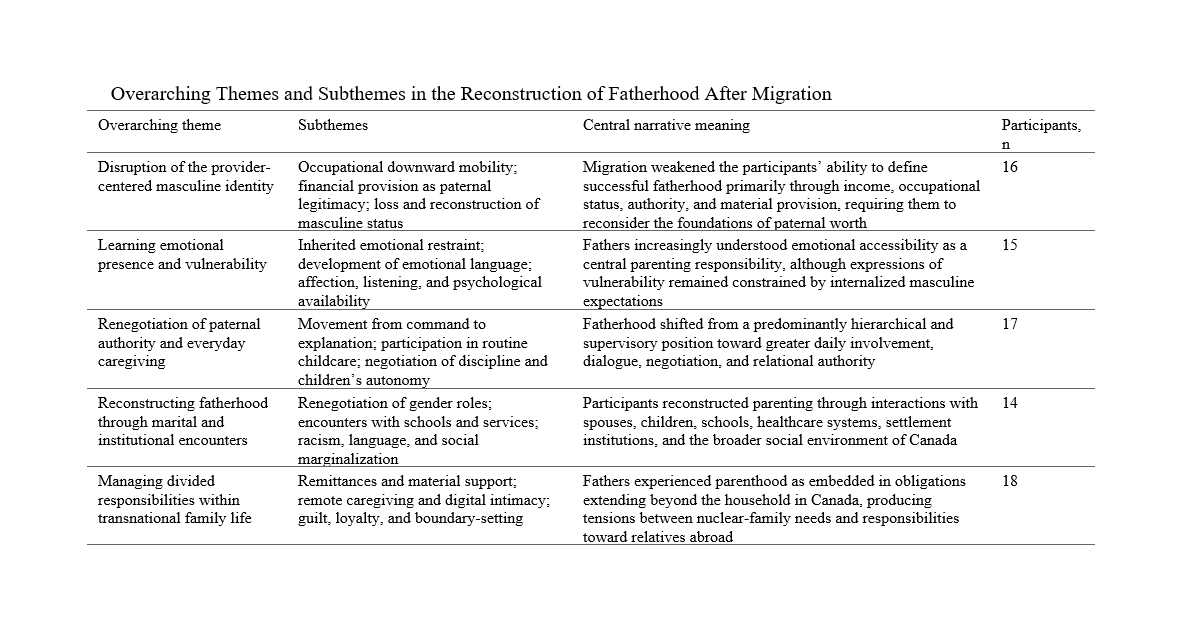
Findings: The analysis generated five interconnected themes: disruption of provider-centered masculine identity, learning emotional presence and vulnerability, renegotiation of paternal authority and everyday caregiving, reconstruction of fatherhood through marital and institutional encounters, and management of divided responsibilities within transnational family life. Three narrative trajectories were identified: transformative relational reconstruction, negotiated hybrid reconstruction, and defensive provider-centered reassertion. Migration weakened the stability of fatherhood models based primarily on income, occupational status, and unquestioned authority, while encouraging many participants to redefine paternal competence through emotional availability, shared caregiving, dialogue, and relational repair. However, adaptation remained uneven and was constrained by employment insecurity, racialization, intergenerational conflict, and continuing obligations toward relatives abroad.
Conclusion: International migration did not produce a simple transition from traditional to Western fatherhood; rather, it generated an ongoing process of negotiation through which fathers attempted to reconcile provision with presence, authority with dialogue, cultural continuity with children’s autonomy, and responsibilities in Canada with enduring transnational family commitments.
Downloads
References
Afifulloh, M. (2022). The Representation of Fatherhood Identity on Netflix Cinema. Pioneer Journal of Language and Literature, 14(1), 298. https://doi.org/10.36841/pioneer.v14i1.1713
Bonjour, S., & Diepenmaat, S. (2023). Doing Family Before the State. Does Recognition of De Facto Families Lead to More Inclusive Migration Law Practices? https://doi.org/10.31235/osf.io/gje58
Cai, C. (2023). The Influences of Father Involvement on Children’s Development in China. Journal of Education Humanities and Social Sciences, 8, 2068-2074. https://doi.org/10.54097/ehss.v8i.4647
Chatterjee, S., Saravanan, V., & Vaidyanathan, SR. (2026). Exploring the Emotional Experiences of First-Time Fathers During Infancy: A Qualitative Study. American Journal of Men S Health, 20(3). https://doi.org/10.1177/15579883261445266
Daniels, C. C. (2023). Evidence Informed Fatherhood Program: An Evaluation. Journal of Social Work, 23(2), 221-242. https://doi.org/10.1177/14680173221141668
Driant, B. L., & Hamon, E. (2024). Fatherhood in the Context of Preterm Birth: A Narrative Review of Contemporary Research Evidence. Journal of Family Theory & Review, 16(4), 885-906. https://doi.org/10.1111/jftr.12591
Feldman, R. (2023). Father Contribution to Human Resilience. Development and Psychopathology, 35(5), 2402-2419. https://doi.org/10.1017/s0954579423000354
Fitzgerald, H. E., Klitzing, K. v., Cabrera, N., Mendonça, J. S. d., & Skjøthaug, T. (2020). Handbook of Fathers and Child Development. https://doi.org/10.1007/978-3-030-51027-5
Haider, S. I. (2025). Between Distance and Duty: Emotional Labor in Transnational Fatherhood Among Pakistani Migrants in Italy. Frontiers in Sociology, 10. https://doi.org/10.3389/fsoc.2025.1643074
Han, Q. (2022). Negotiating the Meaning of Filial Piety in the Guasha Treatment. https://doi.org/10.31235/osf.io/2nx5h
Haugen, H. Ø. (2022). The Love Child and the State: Transnational Family Formation in Guangzhou. Nan Nü, 24(1), 134-160. https://doi.org/10.1163/15685268-02410039
Heshmati, R., Pour, N. S. Y., Abbasoghli, P. H., & Habibi, M. (2024). Adverse Childhood Experience, Parental Bonding, and Fatherhood as Parenting Vulnerabilities to Social Anxiety Severity. European Journal of Investigation in Health Psychology and Education, 14(7), 2057-2073. https://doi.org/10.3390/ejihpe14070137
Hoogar, PR. (2026). Father Involvement in Early Childhood Development: A Contextual Narrative Review for Early Childhood Education. https://doi.org/10.21203/rs.3.rs-9424018/v1
Jaji, R. (2022). Transnational Migration and Reconfiguration of the Family in Zimbabwe. Remhu Revista Interdisciplinar Da Mobilidade Humana, 30(66), 227-242. https://doi.org/10.1590/1980-85852503880006613
Jerves, E., Haene, L. D., Rober, P., & Enzlin, P. (2020). Adolescents’ Representations of Close Relationships in the Context of Parental Migration: An Exploratory Study From Ecuador. International Journal of Migration Health and Social Care, 16(3), 317-331. https://doi.org/10.1108/ijmhsc-05-2016-0020
Juozeliūnienė, I., Bielevičiūtė, I., & Budginaitė‐Mačkinė, I. (2020). Parenting and Migration in Academic Publications: What Is Seen to Be ‘Troubling’? Vilnius University Open Series(3), 78-97. https://doi.org/10.15388/os.2020.5
Lan, P. C. (2022). Navigating Childrearing, Fatherhood, and Mobilities: A Transnational Relational Analysis. The Sociological Review, 71(1), 3-26. https://doi.org/10.1177/00380261221143586
Larrinaga‐Bidegain, N., Gemignani, M., & Hernández‐Albújar, Y. (2024). Parents Who Migrate Without Their Children: Gendered and Psychosocial Reconfigurations of Parenting in Transnational Families. Journal of Family Theory & Review, 16(4), 857-884. https://doi.org/10.1111/jftr.12577
Lee, A. E., & Macías-Ayala, M. A. (2024). “To Separate Myself From Them, I Think I Will Feel Great Sadness”: Transnational Fatherhood and Border Regimes in Central Mexico. Latin American Research Review, 60(1), 98-114. https://doi.org/10.1017/lar.2024.37
Lee, BR. (2026). Parenting Adaptation Among Korean Immigrants in Western Countries: An Integrative Review. Asian American Journal of Psychology. https://doi.org/10.1037/aap0000429
Lesch, E. (2022). The Father Experiences and Challenges of Namibian and South African Offshore Working Men. Work a Journal of Prevention Assessment & Rehabilitation, 71(3), 585-599. https://doi.org/10.3233/wor-205124
Li, X., Hu, Y., Huang, C. Y., & Chuang, S. S. (2021). Beyond W.E.I.R.D. (Western, Educated, Industrial, Rich, Democratic)‐centric Theories and Perspectives: Masculinity and Fathering in Chinese Societies. Journal of Family Theory & Review, 13(3), 317-333. https://doi.org/10.1111/jftr.12403
Løfaldli, E. (2022). The Ideological Recontextualisation of Modern Fatherhood in Scandinavian and British Nordic Noir Crime Series. Modern Languages Open, 1. https://doi.org/10.3828/mlo.v0i0.369
Nayak, A. (2023). Decolonizing Care: Hegemonic Masculinity, Caring Masculinities, and the Material Configurations of Care. Men and Masculinities, 26(2), 167-187. https://doi.org/10.1177/1097184x231166900
Nayak, A. (2025). Social Geography II: Geographies of Care, Men and Masculinities. Progress in Human Geography, 50(1), 128-140. https://doi.org/10.1177/03091325251382945
Ngan, L. L., & Kit Wa Anita 陳潔華, C. (2023). The Quest for Lifestyle: Reverse Family Migration Among Hong Kong Returnee Parents. International Migration Review, 58(1), 94-116. https://doi.org/10.1177/01979183221149024
Novianti, R., Suarman, S., & Islami, N. (2023). Parenting in Cultural Perspective: A Systematic Review of Paternal Role Across Cultures. Journal of Ethnic and Cultural Studies, 10(1), 22-44. https://doi.org/10.29333/ejecs/1287
Raja, R., & Yang, M. (2025). Negotiating Everyday Transnationalism: A Qualitative Inquiry Into the Marital Lives of International Students in China and Their Chinese Partners. Global Networks, 25(4). https://doi.org/10.1111/glob.70030
Rokita-Jaśkow, J., & Panek, K. (2025). Proud and Fearful: Polish Mothers’ Emotions and Motivation to Maintain Polish as a HL in Transnational Exogamous and Endogamous Families. Frontiers in psychology, 16. https://doi.org/10.3389/fpsyg.2025.1558750
Roy, K., & Yumiseva, M. (2021). Family Separation and Transnational Fathering Practices for Immigrant Northern Triangle Families. Journal of Family Theory & Review, 13(3), 283-299. https://doi.org/10.1111/jftr.12404
Shu, B. (2020). Parental Migration, Parental Emotional Support, and Adolescent Children’s Life Satisfaction in Rural China: The Roles of Parent and Child Gender. Journal of Family Issues, 42(8), 1663-1705. https://doi.org/10.1177/0192513x20946345
Sümer, N., Beşpınar, F. U., Sieben, A., Beşpinar, Z., Gürdal, L., Uşaklılar, Ö., Kapısız, Z., & Üsten, ER. (2026). Effects of Paternal Unemployment on Family Dynamics and Well‐Being: A Systematic Review. Journal of Family Theory & Review, 18(2), 407-422. https://doi.org/10.1111/jftr.70069
Szyszka, M. (2020). Transnational Families in the Light of the Practice-Based Approach. Studia Demograficzne(2(176)), 113-129. https://doi.org/10.33119/sd.2019.2.6
Verdezoto, J., & Llanes, V. (2020). Transnational Narratives: Father-Child Separation From the Perspective of Migrant Men’s Children in Ecuador. Migration and Development, 9(3), 428-446. https://doi.org/10.1080/21632324.2020.1797459
Zarling, A., Berta, M., & White, A. (2025). Psychological Flexibility, Traditional Masculinity Ideology, and Parenting Among Fathers In IPV Intervention Programs. Family Process, 64(4). https://doi.org/10.1111/famp.70095
Zhong, Y. (2023). The Unique Role of Father Involvement in Child Socioemotional Development. Journal of Education Humanities and Social Sciences, 8, 1828-1834. https://doi.org/10.54097/ehss.v8i.4592
Downloads
Additional Files
Publication Timeline
- Submitted
- Revised
- Accepted



