
Silenced at Home, Visible Online: A Digital Narrative Study of How LGBTQ+ Young Adults Negotiate Family Belonging, Cultural Norms, Concealment, and Online Social Support
Keywords:
LGBTQ+ young adults, family belonging, identity concealment, digital narratives, online social support, cultural norms, disclosure, CanadaAbstract
Objective: This study aimed to explore how LGBTQ+ young adults in Canada narratively negotiate family belonging, cultural expectations, identity concealment, digital visibility, and online social support across interconnected offline and online environments.
Methods and Materials: A qualitative digital narrative design was employed with 24 LGBTQ+ young adults aged 18–29 years residing in six Canadian provinces. Participants were recruited through purposive maximum-variation sampling from LGBTQ+ organizations, educational institutions, community services, and online networks. Data were collected using a demographic and digital-use questionnaire, participant-generated digital narrative maps, and individual semi-structured online interviews lasting 75–110 minutes. Interviews examined family relationships, cultural and religious expectations, disclosure decisions, concealment strategies, online identity expression, digital safety, and experiences of social support. Data were analyzed through an integrated narrative and reflexive thematic approach involving case summaries, inductive coding, within-case interpretation, cross-case comparison, theme development, and analysis of divergent accounts.
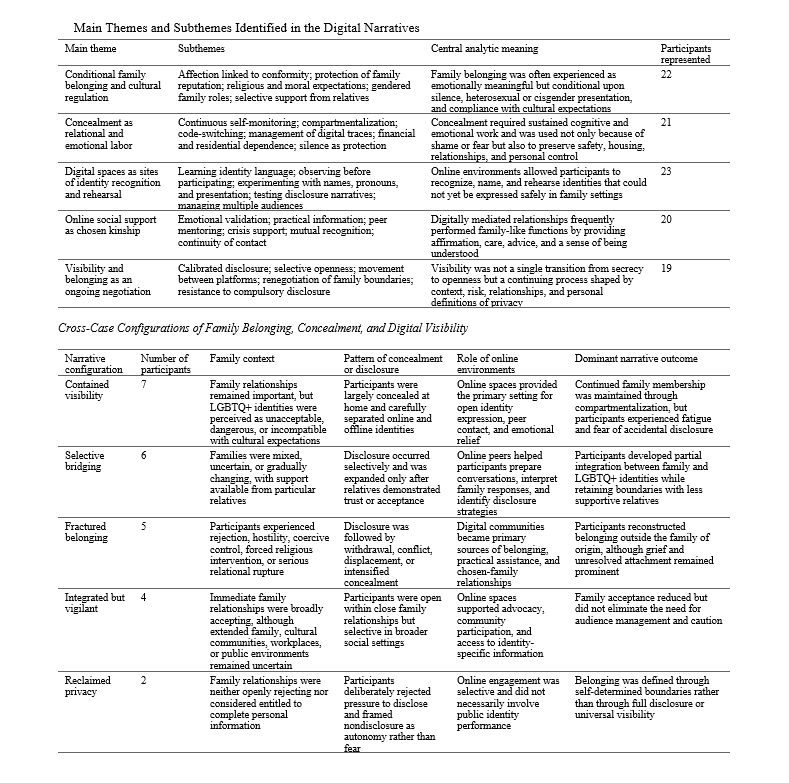
Findings: Five interrelated themes were identified: conditional family belonging and cultural regulation, concealment as relational and emotional labor, digital spaces as sites of identity recognition and rehearsal, online social support as chosen kinship, and visibility as an ongoing negotiation. Participants’ narratives clustered into five configurations: contained visibility, selective bridging, fractured belonging, integrated but vigilant identity, and reclaimed privacy. Family belonging was rarely described as wholly accepting or rejecting; instead, it was shaped by changing combinations of affection, dependence, silence, cultural obligation, and selective recognition. Online environments enabled identity exploration, emotional validation, practical assistance, and chosen-family relationships, but also introduced risks involving surveillance, involuntary disclosure, misinformation, harassment, and intersectional exclusion.
Conclusion: LGBTQ+ young adults negotiated belonging through context-dependent and strategically managed forms of visibility rather than through a linear progression from concealment to disclosure. Family and digital environments were mutually influential, and well-being depended largely on participants’ control over identity information, material safety, culturally responsive support, and access to affirming relationships.
Downloads
References
Abreu, R. L., Gattamorta, K. A., Laporte, R. R., Gonzalez, K. A., Toomey, R. B., & Rodríguez, M. M. D. (2025). Latinx Caregivers of LGBTQ People, Cultural Values, and Mental Health Outcomes. Journal of Family Psychology, 39(4), 407-417. https://doi.org/10.1037/fam0001320
Baerwolf, A. (2023). LGBTQ+ Youth Experiences of the COVID-19 Pandemic as Observed Through Gender-Sexuality Alliances. Transformative Social Work, 1(1). https://doi.org/10.55016/ojs/tsw.v1i1.77543
Bogdan, L. (2025). Undocumented and Queer Emerging Adults. Emerging Adulthood, 14(1), 5-21. https://doi.org/10.1177/21676968251383959
Critchlow, M., John, M. E., & Dunn, AR. (2026). Promoting a Sense of Belonging Among Care-Experienced Young People: Insights From a Scoping Review. Clinical Child Psychology and Psychiatry, 31(3), 1268-1301. https://doi.org/10.1177/13591045261432258
DeChants, J., Shelton, J., Anyon, Y., & Bender, K. (2022). “It Kinda Breaks My Heart”: LGBTQ Young Adults' Responses to Family Rejection. Family Relations, 71(3), 968-986. https://doi.org/10.1111/fare.12638
Eleuteri, S., Girardi, M., Spadola, R., & Todaro, E. (2024). Inclusion Goals: What Sex Education for LGBTQIA+ Adolescents? Children, 11(8), 966. https://doi.org/10.3390/children11080966
Flood, M., & Hochstenbach, C. (2024). Queer in a Housing Crisis: How Nonbinary Young Adults Navigate Housing Precarity. https://doi.org/10.31235/osf.io/crzpf
Ghosh, A. (2024). Solo Journeys: Understanding the Influence of Transnational Sexualities on LGBTQ+ Single Living Arrangements. Sociology Compass, 18(12). https://doi.org/10.1111/soc4.70025
Goldberg, A. E., Allen, K. R., & Sanner, C. (2023). Cherished Families, Unspoken Truths: Navigating Hidden and Challenging Family Experiences While Growing Up With LGBTQ Parents. Journal of marriage and family, 86(1), 219-244. https://doi.org/10.1111/jomf.12941
Hanna‐Walker, V., Lawrence, S. E., Clark, A. N., Walters, T. L., & Lefkowitz, E. S. (2023). “It’s Like an Elephant in the Room With My Family”: LGBTQ+ College Students’ Identity Expression During the COVID-19 Pandemic. Journal of Adolescent Research, 39(6), 1512-1538. https://doi.org/10.1177/07435584221149372
Ito, S., Jans, L., Rosenfeld, E. A., Shen, J., Vilkin, E., Gonzalez, A., & Vivian, D. (2025). Mental Healthcare Experiences and Preferences Among Lesbian, Gay, Bisexual, Transgender, and/or Queer/People of Color: A Scoping Review of Qualitative Research and Recommendations for Provider Training. Clinical Psychology Science and Practice, 32(2), 105-121. https://doi.org/10.1037/cps0000241
Jerome, C., & Ahmad Junaidi bin Ahmad, H. (2022). Coming Out Strategies on Social Media Among Young Gay Men in Malaysia. Youth, 2(1), 39-52. https://doi.org/10.3390/youth2010004
Jones, B. A., Wakefield, J. R. H., Szolin, K., Carter, T., & Bowe, M. (2024). “My Queer Identity and My Family Identity Are Two Very Separate Things”: A Mixed-Methods Study Investigating the Psychological Implications of Family Identity and Support for Trans and Gender Diverse Youth During the COVID-19 Pandemic. Psychology of Sexual Orientation and Gender Diversity. https://doi.org/10.1037/sgd0000757
Kaprinis, S., & Charalampakis, A. (2025). Social Exclusion and Psychopathology in LGBTQ+ Communities: A Neuropsychosocial Review. Frontiers in Sociology, 10. https://doi.org/10.3389/fsoc.2025.1638766
Kempapidis, T., Heinze, N., Green, A. K., & Gomes, R. S. M. (2023). Queer and Disabled: Exploring the Experiences of People Who Identify as LGBT and Live With Disabilities. Disabilities, 4(1), 41-63. https://doi.org/10.3390/disabilities4010004
Lam-Nguyen, H. (2025). Unfolding the Layers of LGBTQ+ Identity, Resilience, and Multicultural Perspectives in Vietnam. Frontiers in Sociology, 10. https://doi.org/10.3389/fsoc.2025.1536046
Mai, Y. (2023). Vietnamese LGBTQ Youth’s Transition to Adulthood: Expressions of Agency. Young, 32(1), 40-60. https://doi.org/10.1177/11033088231205155
Marquez, S. L. A., Mandap, G. M., & Deg-Aoan, N. P. (2024). Parental Acceptance and LGBT Community Connectedness as Predictors of Outness Among Filipino Queer Young Adults. Asr Chiang Mai University Journal of Social Sciences and Humanities, 11(1). https://doi.org/10.12982/cmujasr.2024.004
Matsick, J. L., Sullivan, J. T., Todd, E., Kruk, M., & Cook, J. (2024a). A Social Ecological Approach to Belonging in LGBTQ+ People. Nature Reviews Psychology, 3(3), 181-197. https://doi.org/10.1038/s44159-024-00280-6
Matsick, J. L., Sullivan, J. T., Todd, E., Kruk, M., & Cook, J. (2024b). Social Ecological Model of LGBTQ+ People's Belonging. https://doi.org/10.31219/osf.io/4utzr
Mousavi, M., Chong, N., Earnshaw, V. A., & Layland, E. K. (2024). LGBTQ+ Youth Identity Disclosure Processes: A Systematic Review. https://doi.org/10.21203/rs.3.rs-3892519/v1
Patel, S. (2025). Re‐theorizing the Sexual Minority Closet: Evidence From Queer South Asian Women. Canadian Review of Sociology/Revue Canadienne De Sociologie, 63(1). https://doi.org/10.1111/cars.70016
Pease, M., Kang, N., Oluwakemi, G., Jin, L., Bradshaw, B., & Le, T. P. (2024). “It’s Like Having a Superpower”: Reclaiming Creativity and the Intersectional Experiences of Trans Young Adults of Color. Journal of counseling psychology, 71(4), 215-228. https://doi.org/10.1037/cou0000737
Pensuksan, W. C., Aekwarangkoon, S., Saithanwanitkul, M., Montsma, C., & Ward, E. (2025). The Lived Experience of Thai LGBTQ+ Adolescents—Self-Discovery, Healing From Depression, and the Need for Support: A Phenomenological Study. International journal of environmental research and public health, 22(12), 1851. https://doi.org/10.3390/ijerph22121851
Postan‐Aizik, D., & Aboud‐Halabi, YR. (2026). Intersection of Multiple Minority Positions of Arab-Palestinian Gay Men in Israel: An Exploratory Study. American Journal of Orthopsychiatry, 96(3), 383-394. https://doi.org/10.1037/ort0000850
Reyes, M. E. S., Escote, A. M. D., Ferrer, A. V. C., Marpuri, J. K. O., Anna Clarissa, D. R. S., Torres, R. F. E., Cayubit, R. F. O., & Bacaoco, J. R. A. (2022). Suicidality Among Bisexual Youths: The Role of Parental Sexual Orientation Support and Concealment. Current Psychology, 42(28), 24425-24437. https://doi.org/10.1007/s12144-022-03474-4
Russell, S. T., & Dorri, A. A. (2023). Sexual and Gender Minority Youth. 375-390. https://doi.org/10.1037/0000298-023
Sahoo, S., Venkatesan, V., & Chakravarty, R. (2023). ‘Coming Out’/Self-Disclosure in LGBTQ+ Adolescents and Youth: International and Indian Scenario - A Narrative Review of Published Studies in the Last Decade (2012-2022). Indian Journal of Psychiatry, 65(10), 1012-1024. https://doi.org/10.4103/indianjpsychiatry.indianjpsychiatry_486_23
Shaheed, J., Cooper, S. M., McBride, M., & Burnett, M. (2022). Intersectional Activism Among Black Lesbian, Gay, Bisexual, Transgender, and Queer or Questioning Young Adults: The Roles of Intragroup Marginalization, Identity, and Community. Journal of Black Psychology, 48(3-4), 360-391. https://doi.org/10.1177/00957984211069058
Shrader, C. H., Salerno, J. P., Lee, J. Y., Johnson, A. L., & Algarin, A. B. (2024). Mental Health Impact of Multiple Sexually Minoritized and Gender Expansive Stressors Among LGBTQ+ Young Adults: A Latent Class analysis. Epidemiology and Psychiatric Sciences, 33. https://doi.org/10.1017/s2045796024000118
Toh, G. W., Koh, W. L., Ho, J., Chia, J., Maulod, A., Tirtajana, I., Yang, P., & Lee, M. (2023). Experiences of Conflict, Non-Acceptance and Discrimination Are Associated With Poor Mental Well-Being Amongst LGBTQ-identified Individuals in Singapore. Equality Diversity and Inclusion an International Journal, 42(5), 625-655. https://doi.org/10.1108/edi-10-2021-0270
Vázquez, I., Gato, J., Coimbrã, S., Tasker, F., Barrientos, J., Miscioscia, M., Cerqueira-Santos, E., Malmquist, A., Seabra, D., Leal, D., Houghton, M., Poli, M., Gubello, A., Ramos, M. d. M., Guzmán‐González, M., Urzúa, A., Osses, F. U., & Wurm, M. (2023). Psychological Adjustment Profiles of LGBTQ+ Young Adults Residing With Their Parents During the COVID-19 Pandemic: An International Study. International journal of environmental research and public health, 20(4), 3188. https://doi.org/10.3390/ijerph20043188
Wallace, E. R., O’Neill, S., & Lagdon, S. (2024). Risk and Protective Factors for Suicidality Among Lesbian, Gay, Bisexual, Transgender, and Queer (LGBTQ+) Young People, From Countries With a High Global Acceptance Index (GAI), Within the Context of the Socio‐ecological Model: A Scoping Review. Journal of adolescence, 96(5), 897-924. https://doi.org/10.1002/jad.12308
Wang, Y. Y., Ma, Z., Wang, Y., Liu, K., & Li, J. (2024). Modeling Perceived Parental Attitudes and Mental Well‐being in Chinese Young LGBTQ+ Individuals: Investigation of Weekly Diary Data Using Dynamic Network Analysis. Applied Psychology Health and Well-Being, 16(3), 1403-1421. https://doi.org/10.1111/aphw.12531
Xu, Y., Hall, W. J., Scott, M., Gao, Y., Chiang, P. C., Williams, D. Y., Srivastava, A., Ramon, M. E., & Englert, A. R. (2024). Strategies for Coping With Minority Stress Among Queer Young Adults: Usage Frequency, Associations With Demographics, and Mental Health. International journal of environmental research and public health, 21(8), 1052. https://doi.org/10.3390/ijerph21081052
Downloads
Additional Files
Publication Timeline
- Submitted
- Revised
- Accepted