
Cultural Values, Gender-Role Beliefs, and Marital Satisfaction Among Dual-Earner Couples: An Actor–Partner Interdependence Structural Equation Model of Work–Family Conflict and Perceived Partner Support
Keywords:
Cultural values, gender-role beliefs, marital satisfaction, dual-earner couples, work–family conflict, perceived partner support, Actor–Partner Interdependence ModelAbstract
Objective: This study aimed to examine the actor, partner, direct, and indirect associations of cultural values and gender-role beliefs with marital satisfaction through work-to-family conflict, family-to-work conflict, and perceived partner support among Canadian dual-earner couples.
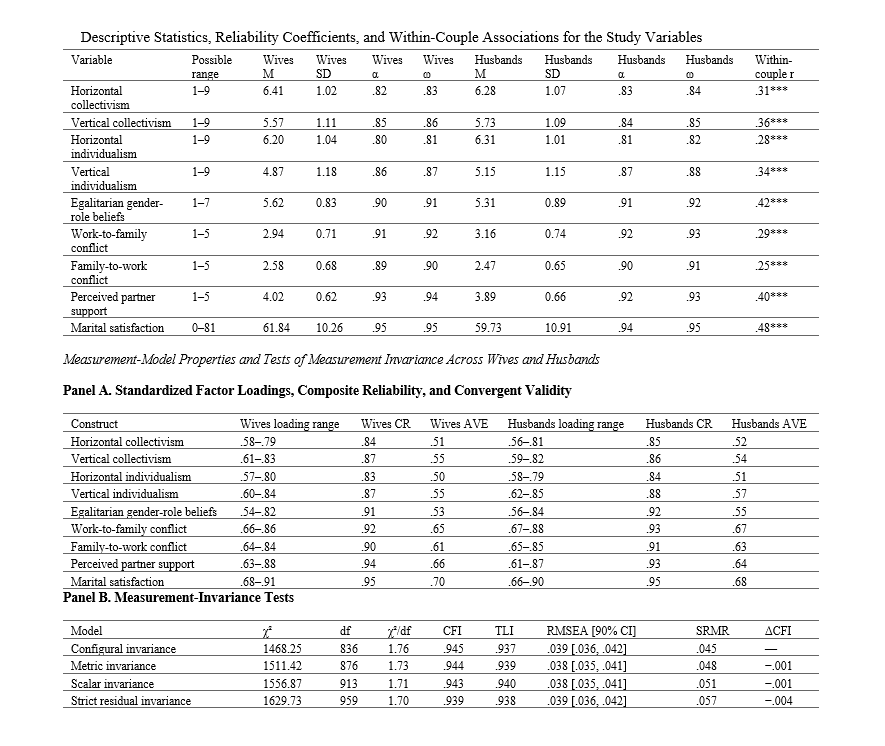
Methods and Materials: This cross-sectional correlational study included 250 different-gender dual-earner married couples, comprising 500 participants residing in Canada. Both spouses independently completed validated questionnaires assessing horizontal and vertical individualism and collectivism, gender-role beliefs, work-to-family conflict, family-to-work conflict, perceived partner support, and marital satisfaction. Data were analyzed using confirmatory factor analysis and Actor–Partner Interdependence Structural Equation Modeling. Measurement invariance across wives and husbands was examined, and indirect effects were tested using 5,000 bias-corrected bootstrap resamples.
Findings: The structural model demonstrated acceptable fit, χ²(872) = 1517.46, CFI = .943, TLI = .936, RMSEA = .038, and SRMR = .047. Horizontal collectivism significantly predicted greater perceived partner support through actor and partner effects. Vertical individualism predicted greater work-to-family conflict, lower perceived partner support, and lower marital satisfaction. Egalitarian gender-role beliefs predicted lower work-to-family conflict and greater perceived partner support for both spouses. Work-to-family conflict negatively predicted marital satisfaction through significant actor and partner pathways, whereas perceived partner support positively predicted marital satisfaction and produced the strongest direct effects. Significant bootstrapped indirect effects showed that work-to-family conflict and perceived partner support partially mediated the associations of cultural values and gender-role beliefs with marital satisfaction. The model explained 58.1% of the variance in wives’ marital satisfaction and 53.4% in husbands’ marital satisfaction.
Conclusion: Marital satisfaction among dual-earner couples is shaped by interdependent cultural, ideological, occupational, and relational processes. Egalitarian gender-role beliefs and horizontal collectivism appear to strengthen marital functioning by reducing work–family strain and increasing perceived partner support, whereas vertical individualism may undermine satisfaction through heightened conflict and reduced relational support.
Downloads
References
Ahmad, R., Majeed, D. S., Rabi, S. K., & Taseer, N. A. (2023). Work-Family Conflict and Work-Life Balance: A Study of Secondary School Teachers in Sargodha. Journal of Arts & Social Sciences (Jass), 10(1), 167-178. https://doi.org/10.46662/jass.v10i1.342
Ali, F., & Saleem, N. (2022). Relationship Between Conflict Resolution Styles and Marital Satisfaction Among Married Academicians. Gomal University Journal of Research, 38(03), 300-318. https://doi.org/10.51380/gujr-38-03-05
Andrade, A. L. D., Ferrão, L. F., Techio, G., & Ramos, F. P. (2023). The Work-Family Conflict: Dyadic View of Brazilian Couples. Interpersona an International Journal on Personal Relationships, 17(1), 69-87. https://doi.org/10.5964/ijpr.8533
Apura, E. L. (2022). The Impact of Seaweed Farming on Marital and Reproductive Role Satisfaction. International Journal of Science and Management Studies (Ijsms), 20-33. https://doi.org/10.51386/25815946/ijsms-v5i2p103
Bernhardt, J., & Bünning, M. (2021). The Long Arm of an Unsupportive Work-Family Culture in Work Organizations: Crossover to the Partner’s Work-Family Balance Satisfaction in Dual-Earner Couples. Applied Research in Quality of Life, 17(2), 723-750. https://doi.org/10.1007/s11482-021-09911-z
Bredemeier, C., Ndlovu, P. V., Vujić, S., & Winkler, R. (2024). Household Decisions and the Gender Gap in Job Satisfaction. Scottish Journal of Political Economy, 72(1). https://doi.org/10.1111/sjpe.12403
Chen, C., Huang, F., Wang, K., Jing, X., Zhou, M., & Zhang, J. (2021). Income and Life Satisfaction of Dual‐earner Couples: A Dyadic Study. Asian Journal of Social Psychology, 24(4), 553-564. https://doi.org/10.1111/ajsp.12460
Cheung, A. K., & Lui, L. (2023). Outsourcing Domestic Work: A Double‐edged Sword for Marital Relations Among Dual‐earner Couples. Family Relations, 73(2), 1139-1158. https://doi.org/10.1111/fare.12912
Çineli, B., & González, M. J. (2024). Married and Cohabiting Women's Financial Empowerment: A Study on Women's Bank Account Ownership in Spain. Family Relations, 74(1), 215-233. https://doi.org/10.1111/fare.13109
Czechowska‐Bieluga, M., & Lewicka-Zelent, A. (2021). Marital Satisfaction – A Literature Review. Family Upbringing, 25(2), 155-172. https://doi.org/10.61905/wwr/170384
Fikry, A., Abdul, A. J., Sibghatullah, A., Muhammad, N. S., & Harun, Z. F. (2024). From Click to Cuisine: Navigating the Landscape of Customer Satisfaction in Online Food Delivery Apps. Information Management and Business Review, 16(3(I)S), 579-588. https://doi.org/10.22610/imbr.v16i3(i)s.4085
Garg, V., & Saini, SR. (2026). Associations of Work Demands, Lifestyle Behaviors, and Sleep Quality With Relationship Satisfaction Among Working Couples in Urban India. https://doi.org/10.21203/rs.3.rs-9258547/v1
Honda, A., & Ono, M. (2025). Balancing and Conflict Between Work and Family Life of Sandwiched Caregivers: A Scoping Review. Safety and Health at Work, 16(2), 156-163. https://doi.org/10.1016/j.shaw.2025.04.004
Jidi, M. M., Zakaria, N. Z., Eshak, E. S., & Jamian, N. F. (2023). The Impacts of Dual Earner Income on Work-Life Balance. International Journal of Academic Research in Business and Social Sciences, 13(3). https://doi.org/10.6007/ijarbss/v13-i3/16346
Kim, D.-H., & Ban, J. (2025). Change Trajectories and Predictors of Work-Family Conflict for Dual-Earner Parents Raising Preteens. Journal of Family Issues, 47(2), 247-277. https://doi.org/10.1177/0192513x251370697
Kim, SR. (2026). Marriage as a Legal Gateway to Care: Legal Entitlement and Gender Inequality in the 2020 and 2025 Korean Time Use Survey. Family Court Review, 64(2), 335-362. https://doi.org/10.1111/fcre.70072
Lazuardi, C. M., & Puspitawati, H. (2022). Gender's Role in Financial Management and Purchasing Decisions on the Quality of Dual-Earner Family Marriage During the Covid-19 Pandemic. Journal of Child Family and Consumer Studies, 1(2), 96-107. https://doi.org/10.29244/jcfcs.1.2.96-107
Leong, M. S., & Juhari, R. (2021). Positive and Negative Interactions Between Mother-in-Law and Daughter-in-Law: What About Son-in-Law? Malaysian Journal of Social Sciences and Humanities (MJSSH), 6(5), 84-94. https://doi.org/10.47405/mjssh.v6i5.778
Leong, M. S., & Juhari, R. (2022). Work vs. Family and Marital Satisfaction Among Malaysian Chinese Dual-Earner Couples: An Actor-Partner Interdependence Model. Psychological Thought, 15(1), 53-80. https://doi.org/10.37708/psyct.v15i1.614
Li, M., Stas, L., Vanroelen, C., & Moortel, D. D. (2025). Linked Lives and Work-Family Dynamics: Gendered Workload, Family Support, and Mental Well-Being Among Urban Chinese Dual-Earner Households. International Journal for Equity in Health, 24(1). https://doi.org/10.1186/s12939-025-02687-w
Li, T., Li, L. M. W., Sun, Y. Y., Chan, L. Y., Law, W., Jiang, D., Stertz, A. M., & Wiese, B. S. (2024). Dual‐earner Couples' Sharing of Work‐related Experiences: Effects on Relational and Personal Well‐being. Applied Psychology Health and Well-Being, 16(4), 2006-2025. https://doi.org/10.1111/aphw.12574
Nugrahani, A., Maryana, M., & Rochma, I. (2024). Balancing Act: Examining the Relationship Between Role Conflict and Marital Satisfaction in Dual-Earner Families. Journal of Health Research and Technology, 2(2), 171-184. https://doi.org/10.58439/jhrt.v2i2.241
Reich-Stiebert, N., Froehlich, L., & Voltmer, J.-B. (2023). Gendered Mental Labor: A Systematic Literature Review on the Cognitive Dimension of Unpaid Work Within the Household and Childcare. Sex Roles, 88(11-12), 475-494. https://doi.org/10.1007/s11199-023-01362-0
Rumondor, P. C. B., Randall, A. K., Purwono, U., Muttaqin, D., & Ginanjar, A. S. (2022). Factor Structure and Validity of the Dyadic Coping Inventory–Bahasa Indonesia. Personal Relationships, 29(4), 751-777. https://doi.org/10.1111/pere.12459
San, L. M., & Juhari, R. (2021). Work-Family Conflict, Marital Satisfaction and Marital Stability Among Malaysian Chinese Dual-Earner Couples. International Journal of Academic Research in Business and Social Sciences, 11(12). https://doi.org/10.6007/ijarbss/v11-i12/11796
Schnettler, B., Grunert, K. G., Orellana, L., Miranda, H., Lobos, G., Miranda‐Zapata, E., Lapo, M., & Hueche, C. (2021). The Diverging Patterns of Life Satisfaction Between Families: A Latent Profile Analysis in Dual-Earner Parents With Adolescents. Current Psychology, 41(10), 7240-7257. https://doi.org/10.1007/s12144-020-01316-9
Schnettler, B., Miranda‐Zapata, E., Orellana, L., Poblete, H., Lobos, G., Lapo, M., & Adasme‐Berríos, C. (2020). Domain Satisfaction and Overall Life Satisfaction: Testing the Spillover-Crossover Model in Chilean Dual-Earner Couples. International journal of environmental research and public health, 17(20), 7554. https://doi.org/10.3390/ijerph17207554
Shah, R. (2023). Navigating Non‐normative Roles: Experiences of Female‐breadwinning Couples in Pakistan. European Journal of Social Psychology, 54(1), 251-264. https://doi.org/10.1002/ejsp.3013
Shimazu, A., Fujiwara, T., Iwata, N., Kato, Y., Kawakami, N., Maegawa, N., Nakao, M., Nomiyama, T., Takahashi, M., Tayama, J., Watai, I., Arima, M., Hasegawa, T., Matsudaira, K., Matsuyama, Y., Miyazawa, Y., Shimada, K., Takahashi, M., Watanabe, M., . . . Tokita, M. (2023). Effects of Work–family Life Support Program on the Work–family Interface and Mental Health Among Japanese Dual-Earner Couples With a Preschool Child: A Randomized Controlled Trial. Journal of Occupational Health, 65(1). https://doi.org/10.1002/1348-9585.12397
Shockley, K. M., Clark, M. A., Dodd, H., & King, E. B. (2021). Work-Family Strategies During COVID-19: Examining Gender Dynamics Among Dual-Earner Couples With Young Children. Journal of Applied Psychology, 106(1), 15-28. https://doi.org/10.1037/apl0000857
Steed, L. B., Dust, S. B., Rode, J. C., & Arthaud‐Day, M. L. (2023). Relative Income and Value Congruence in Dual‐income Couples. Journal of Organizational Behavior, 44(8), 1283-1300. https://doi.org/10.1002/job.2709
Stollberger, J., Heras, M. L., & Rofcanın, Y. (2022). Sharing Is Caring: The Role of Compassionate Love for Sharing Coworker Work–family Support at Home to Promote Partners’ Creativity at Work. Journal of Applied Psychology, 107(10), 1824-1842. https://doi.org/10.1037/apl0000985
Tam, D., & Grimes, A. (2022). Migration of Dual-Earner Couples: A Subjective Wellbeing Approach. Review of Economics of the Household, 21(1), 269-289. https://doi.org/10.1007/s11150-021-09598-z
Tement, S., Mihelič, K. K., & Kubicek, B. (2023). Time Pressure, Work‐related Spousal Support Seeking, and Relationship Satisfaction: Spillover and Crossover Effects Among Dual‐earner Couples. Stress and Health, 39(4), 871-883. https://doi.org/10.1002/smi.3232
Vithanage, V., & Arachchige, B. J. H. (2020). Gender Disparity in Work-Family Balance in Academia: A Study in the Sri Lankan University Context. Sri Lanka Journal of Social Sciences, 43(2), 61. https://doi.org/10.4038/sljss.v43i2.7623
Yoo, J. (2021). Gender Role Ideology, Work–Family Conflict, Family–Work Conflict, and Marital Satisfaction Among Korean Dual-Earner Couples. Journal of Family Issues, 43(6), 1520-1535. https://doi.org/10.1177/0192513x211026966
Yu, X., & Liu, S. (2021). Female Labor Force Status and Couple's Marital Satisfaction: A Chinese Analysis. Frontiers in psychology, 12. https://doi.org/10.3389/fpsyg.2021.691460
Downloads
Additional Files
Publication Timeline
- Submitted
- Revised
- Accepted



