
Parental Phubbing and Adolescent Loneliness: A Longitudinal Cross-Lagged Panel Model of Emotional Availability, Parent–Child Attachment, and Problematic Social Media Use
Keywords:
parental phubbing, adolescent loneliness, emotional availability, parent–child attachment, problematic social media use, cross-lagged panel modelAbstract
Objective: This study aimed to examine the reciprocal longitudinal relationship between parental phubbing and adolescent loneliness and to test parental emotional availability, parent–child attachment, and problematic social media use as mediating mechanisms.
Methods and Materials: A three-wave longitudinal study was conducted with 600 Canadian adolescents aged 12–17 years, recruited from public secondary schools in Ontario, British Columbia, Alberta, and Quebec. Data were collected at baseline, six months, and 12 months using standardized measures of parental phubbing, adolescent loneliness, parental emotional availability, parent–child attachment, and problematic social media use. A cross-lagged panel model was estimated using robust maximum-likelihood procedures and full-information maximum likelihood for missing data. Age, gender, family structure, socioeconomic status, daily social media use, and baseline mental health treatment were controlled.
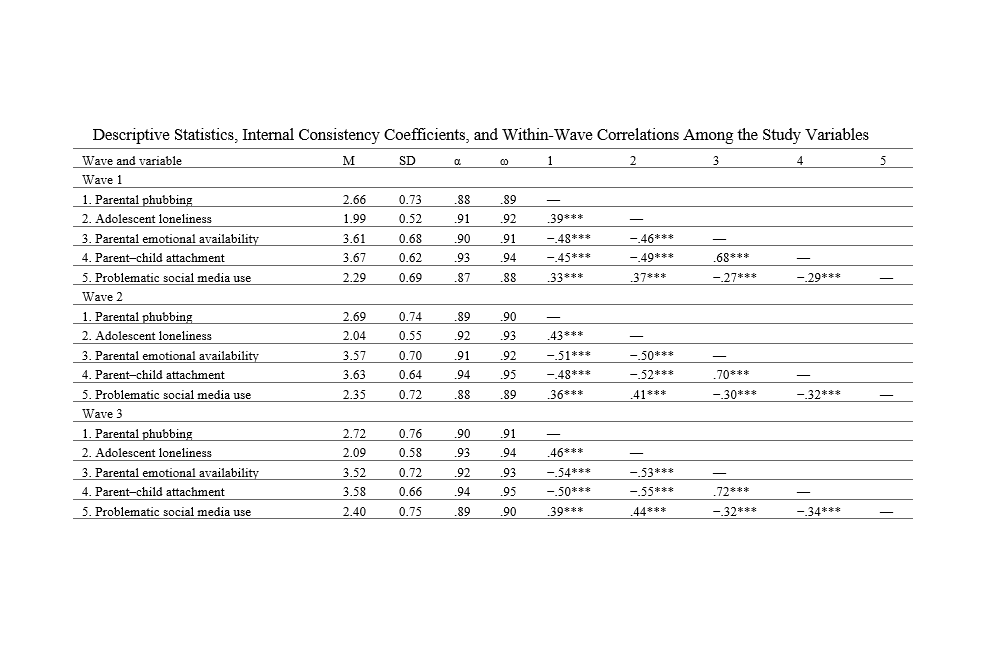
Findings: The final model demonstrated good fit, χ²(1249) = 2024.51, CFI = .951, TLI = .946, RMSEA = .032, and SRMR = .046. Parental phubbing significantly predicted subsequent loneliness, β = .17, p < .001, whereas loneliness predicted later parental phubbing more weakly, β = .06, p = .032. Parental phubbing predicted lower emotional availability, β = −.22, weaker attachment, β = −.19, and greater problematic social media use, β = .15, all p < .001. Emotional availability, attachment, and problematic social media use significantly predicted later loneliness. The total indirect effect of parental phubbing on loneliness was significant, β = .101, p < .001, with relational pathways stronger than the behavioral pathway.
Conclusion: Parental phubbing appears to contribute prospectively to adolescent loneliness primarily by reducing perceived emotional availability and attachment security and, secondarily, by increasing problematic social media use.
Downloads
References
Akbağ, M., AydoĞDu, F., & Rizzo, A. (2024). A New Measure of the Parental Phubbing-Mother and Father Form for Turkish Adolescents: Evaluation of Validity and Reliability. https://doi.org/10.21203/rs.3.rs-4378909/v1
Alemdar, D. K., & Çatıker, AR. (2026). Relationships Among Parental Phubbing and Children's Emotion Regulation Skills and Psychosocial Behavioral Symptoms. Journal of Psychosocial Nursing and Mental Health Services, 64(3), 39-49. https://doi.org/10.3928/02793695-20250821-02
Bottaro, R., & Faraci, P. (2022). The Use of Social Networking Sites and Its Impact on Adolescents’ Emotional Well-Being: A Scoping Review. Current Addiction Reports, 9(4), 518-539. https://doi.org/10.1007/s40429-022-00445-4
Büyükşakar, S., & Çeli̇k, E. (2024). Attachment Styles and Loneliness as Predictors of Phubbing Amongst University Students. Sakarya University Journal of Education, 14(1), 18-32. https://doi.org/10.19126/suje.1255291
Dixon, D., Sharp, C. A., Hughes, K., & Hughes, C. (2023). Parental Technoference and Adolescents’ Mental Health and Deviant Behaviour: A Scoping Review. https://doi.org/10.21203/rs.3.rs-2700352/v1
Duradoni, M., Severino, F. P., Bellotti, M., & Guazzini, A. (2024). How Mattering and Anti‐Mattering Experiences Across Offline and Online Environments Contribute to People's Digital Life Balance and Social Media Addiction. Journal of Community & Applied Social Psychology, 34(6). https://doi.org/10.1002/casp.70008
Fioravanti, G., Benucci, S. B., & Ghinassi, S. (2025). Psychological Risk Factors for Problematic Social Network Use: An Overview of Systematic Reviews and Meta-Analyses. Addictive Behaviors Reports, 21, 100600. https://doi.org/10.1016/j.abrep.2025.100600
Fu, Z., Ren, S., Duan, R., Tang, Y., & Lei, LR. (2026). Longitudinal Association Between Parental Phubbing and Digital Self‐harm in Chinese Adolescents: The Roles of Psychological Distress and Gender. Journal of Research on Adolescence, 36(2). https://doi.org/10.1111/jora.70173
Geng, Z., & Liu, R. (2025). The Impact of Smartphone Addiction and Negative Emotions on Parent–child Relationships Among Elementary School Students. Frontiers in Psychiatry, 16. https://doi.org/10.3389/fpsyt.2025.1582741
Harianti, W. S., & Kurniawan, I. N. (2022). Parental Phubbing and Mental Well-Being: Preliminary Study in Indonesia. Communications in Humanities and Social Sciences, 2(2), 53-59. https://doi.org/10.21924/chss.2.2.2022.34
He, D., Niu, G., Hu, Y., Song, K., Lan, P., Zhang, Y., & Zhou, Z. (2024). Parental Phubbing and Cyberloafing in Chinese Adolescent: The Mediating Roles of Rejection Sensitivity and Loneliness. Child & Family Social Work, 30(4), 860-870. https://doi.org/10.1111/cfs.13222
Komanchuk, J., Toews, A. J., Marshall, S., MacKay, L. J., Hayden, A., Cameron, J. L., Duffett‐Leger, L., & Letourneau, N. (2023). Impacts of Parental Technoference on Parent–Child Relationships and Child Health and Developmental Outcomes: A Scoping Review. Cyberpsychology Behavior and Social Networking, 26(8), 579-603. https://doi.org/10.1089/cyber.2022.0278
Kostić, J. O. (2022). Effects of Using Information and Communication Technologies on Relationships With Others and Personal Well-Being. Media Studies and Applied Ethics, 3(1), 147-162. https://doi.org/10.46630/msae.1.2022.10
Li, H., Peng, K., Wu, Y., Wang, L., & Luo, Z. (2025). Investigating Parental Factors That Lead to Adolescent Internet Gaming Addiction (IGA). PLoS One, 20(4), e0322117. https://doi.org/10.1371/journal.pone.0322117
Liu, X., Geng, S., Tong, L., Cheng, Y., & Yu, H. (2024). Connections Between Parental Phubbing and Electronic Media Use in Young Children: The Mediating Role of Parent–Child Conflict and Moderating Effect of Child Emotion Regulation. Behavioral Sciences, 14(2), 119. https://doi.org/10.3390/bs14020119
Liu, X., Liu, J., Flores, D. D., & McDonald, C. C. (2024). Family Factors Related to Adolescent Screen Media Use and Mental Health Outcomes: A Systematic Review and Recommendation for Practices. Journal of adolescence, 96(7), 1401-1427. https://doi.org/10.1002/jad.12367
Ma, S., Bi, X., Cui, H., & Ma, Y. (2024). Parental Phubbing and Mobile Phone Addiction Among Chinese Adolescents: A Moderated Mediation Model. Frontiers in psychology, 15. https://doi.org/10.3389/fpsyg.2024.1379388
Mu, H.-L., Jiang, Q., Xu, J., & Chen, S. (2022). Drivers and Consequences of Short-Form Video (SFV) Addiction Amongst Adolescents in China: Stress-Coping Theory Perspective. International journal of environmental research and public health, 19(21), 14173. https://doi.org/10.3390/ijerph192114173
Mulyaningrum, A., & Kusumaningrum, F. A. (2022). Parental Phubbing and Smartphone Addiction Among Adolescents. Inspira Indonesian Journal of Psychological Research, 3(1), 23-30. https://doi.org/10.32505/inspira.v3i1.4178
Nannatt, A., Tariang, N. M., Gowda, M., & Devassy, S. M. (2022). Family Factors Associated With Problematic Use of the Internet in Children: A Scoping Review. Indian Journal of Psychological Medicine, 44(4), 341-348. https://doi.org/10.1177/02537176221090862
Ni, N., Ahrari, S., Zaremohzzabieh, Z., Zarean, M., & Roslan, S. (2025). A Meta-Analytic Study of Partner Phubbing and Its Antecedents and Consequences. Frontiers in psychology, 16. https://doi.org/10.3389/fpsyg.2025.1561159
Nobakht, H. N., Wichstrøm, L., & Steinsbekk, SR. (2026). Social Media Use and the Quality of Family Relationships: A Six-Wave Longitudinal Study of Within-Family Effects From Age 10 to 20. Journal of youth and adolescence, 55(6), 1361-1373. https://doi.org/10.1007/s10964-026-02362-5
Özbek, M. M., Sevinçok, D., & Mısır, E. (2025). The Relationship Between Familial Functioning and Social Media Use Among Children With Depression and Attention Deficit Hyperactivity Disorder: A Comparative Study With Healthy Controls. Children, 12(7), 906. https://doi.org/10.3390/children12070906
Sun, J., & Miller, C. H. (2023). Insecure Attachment Styles and Phubbing: The Mediating Role of Problematic Smartphone Use. Human Behavior and Emerging Technologies, 2023, 1-11. https://doi.org/10.1155/2023/4331787
Symposium. (2023). International journal of psychology, 58(S1), 506-524. https://doi.org/10.1002/ijop.13020
Varkey, E., Micle, M., Ms, S., & Shiji, P. (2022). Maternal Phubbing and Mother - Child Relationship. Nji, CXIII, 173-176. https://doi.org/10.48029/nji.2022.cxiii403
Wang, H., & Lei, L. (2022). The Relationship Between Parental Phubbing and Short‐Form Videos Addiction Among Chinese Adolescents. Journal of Research on Adolescence, 32(4), 1580-1591. https://doi.org/10.1111/jora.12744
Wang, P., Zhao, M., Li, B., Wang, X., Xie, X., Geng, J., Nie, J., Zeng, P., & Mao, N. (2021). Mother Phubbing and Adolescent Loneliness: A Mediation Model of Mother–Adolescent Communication and Perceived Mother Acceptance. Social Science Computer Review, 40(6), 1562-1577. https://doi.org/10.1177/08944393211017263
Weinstein, A. (2023). Problematic Social Networking Site Use-Effects on Mental Health and the Brain. Frontiers in Psychiatry, 13. https://doi.org/10.3389/fpsyt.2022.1106004
Xie, Z., Xu, C., Feng, N., & Cui, L. (2025). Reciprocal Relationship Between Parental Technoference and Adolescent Problematic Mobile Phone Use: The Longitudinal Mediating Roles of Paternal and Maternal Attachment. Family Process, 64(3). https://doi.org/10.1111/famp.70058
Xiong, S., Chen, J., & Yao, N. (2024). A Multidimensional Framework for Understanding Problematic Use of Short Video Platforms: The Role of Individual, Social-Environmental, and Platform Factors. Frontiers in Psychiatry, 15. https://doi.org/10.3389/fpsyt.2024.1361497
Zhang, Y., Song, K., & Niu, G. (2025). Family Dynamics and Digital Distractions: A Survey-Based Study on How Co-Parenting and Parental Phubbing Shape Preschoolers’ Media Use. Behavioral Sciences, 15(6), 752. https://doi.org/10.3390/bs15060752
Zhu, Y., Deng, L., & Wan, K. (2022). The Association Between Parent-Child Relationship and Problematic Internet Use Among English- And Chinese-Language Studies: A Meta-Analysis. Frontiers in psychology, 13. https://doi.org/10.3389/fpsyg.2022.885819
Downloads
Additional Files
Publication Timeline
- Submitted
- Revised
- Accepted



