
Identifying Cultural Pathways of Parent–Child Attachment Development
Keywords:
Parent–child attachment, cultural pathways, cross-cultural parenting, migration, emotional bondingAbstract
Objective: This study aimed to explore and identify the cultural pathways that shape the development of parent–child attachment among families from diverse cultural backgrounds living in Canada.
Methods and Materials: The research adopted a qualitative, phenomenological design to capture parents’ lived experiences of attachment formation within multicultural contexts. Data were collected through semi-structured, in-depth interviews with 23 participants (13 mothers and 10 fathers) representing South Asian, East Asian, Middle Eastern, European, and Indigenous cultural groups. Participants were selected using purposive sampling, and interviews continued until theoretical saturation was reached. Each interview lasted between 60 and 90 minutes and focused on parental beliefs, emotional expression, cultural transmission, and adaptation to Canadian norms. All interviews were audio-recorded, transcribed verbatim, and analyzed thematically using NVivo 14 software following Braun and Clarke’s six-phase framework.
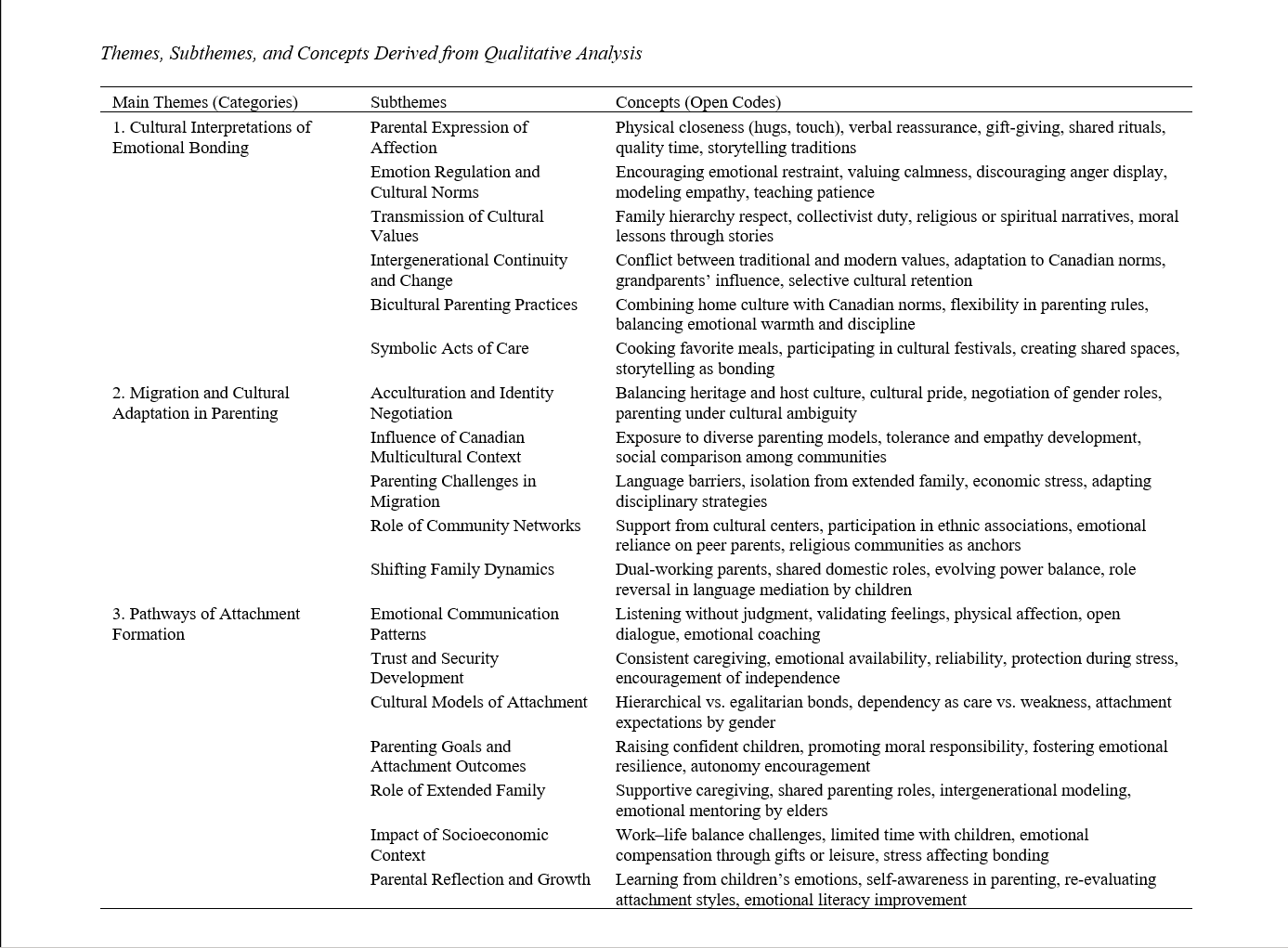
Findings: Analysis revealed three main themes—Cultural Interpretations of Emotional Bonding, Migration and Cultural Adaptation in Parenting, and Pathways of Attachment Formation. These themes encompassed 17 subthemes that described how cultural values, intergenerational beliefs, and migration experiences influence emotional expression and attachment behaviors. The findings showed that while traditional collectivist cultures emphasized caregiving through protection, respect, and shared rituals, integration into Canadian society encouraged more open emotional communication and autonomy-promoting parenting.
Conclusion: The study concludes that parent–child attachment development among Canadian families is a culturally dynamic process influenced by enculturation, migration, and social adaptation. Recognizing multiple cultural pathways of attachment can enhance culturally sensitive family interventions, parenting education, and cross-cultural counseling practices.
Downloads
References
Ailauova, Z. S. (2021). Pedagogical Conditions for the Formation of Cross-Cultural Competence of Future Primary School Teachers. Bulletin of Korkyt Ata Kyzylorda University, 59(4), 302-310. https://doi.org/10.52081/bkaku.2021.v59.i4.126
Bakaraki, M. P., Korovesis, T., & Kosiva, A. (2024). Attachment Theory Across Cultures: An Examination of Cross-Cultural Perspectives and Alloparenting Practices (Mini-Review). Brazilian Journal of Science, 3(8), 36-42. https://doi.org/10.14295/bjs.v3i8.616
Chen, X., Kemas, A. M., Mickols, E., Klein, K., Artursson, P., & Lauschke, V. M. (2024). The Choice of Ultra‐low Attachment Plates Impacts Primary Human and Primary Canine Hepatocyte Spheroid Formation, Phenotypes, and Function. Biotechnology Journal, 19(2). https://doi.org/10.1002/biot.202300587
Chen, X., Khir, A. M., Hamsan, H. H., & Burhan, N. A. S. (2025). From Attachment and Support to College Students' Well-Being: A Systematic Review Through the Lens of Self-Determination Theory. Multidisciplinary Reviews, 9(3), 2026103. https://doi.org/10.31893/multirev.2026103
Dybach, I. (2024). Features of the Formation of Cross-Cultural Communication Skills in IT Business. https://doi.org/10.55295/psl.2024.i24
Gerlach, J., Fößel, J. M., Vierhaus, M., Sann, A., Eickhorst, A., Zimmermann, P., & Spangler, G. (2022). Effects of Family Risk on Early Attachment Security: Gender-Specific Susceptibility and Mediation by Parenting Behavior. Developmental Child Welfare, 4(1), 20-40. https://doi.org/10.1177/25161032211065459
Hoenicka, M. A. K., López-de-la-Nieta, O., Rubio, J. L. M., Shinohara, K., Neoh, M. J. Y., Dimitriou, D., Esposito, G., & Iandolo, G. (2022). Parental Bonding in Retrospect and Adult Attachment Style: A Comparative Study Between Spanish, Italian and Japanese Cultures. PLoS One, 17(12), e0278185. https://doi.org/10.1371/journal.pone.0278185
Hollan, D., & Nutsubidze, T. (2023). Cross-Cultural Differences in the Self. https://doi.org/10.52340/jo.2022.05.01.04
Huang, K. H. (2025). Attachment Style Interactions and Their Influence on Adolescent Relationship Information. Interdisciplinary Humanities and Communication Studies, 1(5). https://doi.org/10.61173/1nvcc125
Inagawa, M., & Nakao, T. (2023). Associations Between Attachment-Related Variables in Fifth and Sixth Graders and Their Mothers in Japan. Humanities and Social Sciences Communications, 10(1). https://doi.org/10.1057/s41599-023-01685-z
Kafetsios, K. (2021). Collective Reactions to Epidemic Threat: Attachment and Cultural Orientations Predict Early COVID-19 Infection and Mortality Rates and Trajectories. Social Psychological and Personality Science, 13(7), 1126-1137. https://doi.org/10.1177/19485506211053461
Li, Y. (2022). Cross-Cultural Privacy Differences. 267-292. https://doi.org/10.1007/978-3-030-82786-1_12
Maftuhah, S., Aris, S., & Elfira, N. (2024). The Concept of Enculturation in Cross-Cultural Counseling. Marawa, 3(2), 158. https://doi.org/10.31958/marawa.v3i2.11042
Muhamedrahimov, R. J. (2022). Attachment in Young Children in Different Periods of Russian Society. Psikhologicheskii Zhurnal, 43(4), 27. https://doi.org/10.31857/s020595920021477-0
Neckoway, R., Brownlee, K., & Castellan, B. (2020). Is Attachment Theory Consistent With Aboriginal Parenting Realities? First Peoples Child & Family Review an Interdisciplinary Journal Honouring the Voices Perspectives and Knowledges of First Peoples, 3(2), 65-74. https://doi.org/10.7202/1069465ar
Patel, L., Gunion, S., Watt, A., & Booth, S. (2023). Re-Examining Attachment Theory in Educational Psychology: A Call for Culturally Responsive Practice. Educational Psychology in Scotland, 23(1), 52-58. https://doi.org/10.53841/bpsepis.2023.23.1.52
Rodríguez‐González, M., Bell, C. A., Pereyra, S. B., Díaz, M. P. M., Schweer‐Collins, M., & Bean, R. A. (2023). Differentiation of Self and Relationship Attachment, Quality, and Stability: A Path Analysis of Dyadic and Longitudinal Data From Spanish and U.S. Couples. PLoS One, 18(3), e0282482. https://doi.org/10.1371/journal.pone.0282482
Sakman, E., & Sümer, N. (2024). Cultural Correlates of Adult Attachment Dimensions: Comparing the US and Turkey. Cross-Cultural Research, 58(2-3), 208-237. https://doi.org/10.1177/10693971231220437
Seldikov, A. M., & Salykova, V. V. (2022). On the Cross-Cultural Formation of Conceptology. Litera(2), 45-51. https://doi.org/10.25136/2409-8698.2022.2.33620
Tan, A., Liu, Q., Septiadi, D., Chu, S., Liu, T., Richards, S. J., Rothen‐Rutishauser, B., Petri‐Fink, A., Gibson, M. I., & Boyd, B. J. (2021). Understanding Selectivity of Metabolic Labelling and Click-Targeting in Multicellular Environments as a Route to Tissue Selective Drug Delivery. Journal of Materials Chemistry B, 9(26), 5365-5373. https://doi.org/10.1039/d1tb00721a
Wang, C. D. C., Jin, L., Han, G., Zhu, W., & Bismar, D. (2022). Cross-Cultural Differences in Adult Attachment and Depression: A Culturally Congruent Approach. Journal of counseling psychology, 69(3), 298-310. https://doi.org/10.1037/cou0000589
Williams, A., Liu, C., Zhou, Q., Wu, J., Meng, L., Deng, X. F., & Chen, S. H. (2024). Parental Expressions of Love in Chinese American Immigrant Families: Implications for Children's Attachment Security. Developmental science, 27(6). https://doi.org/10.1111/desc.13549
Zayas, V., & Sakman, E. (2020). Human Attachment and Affiliation. https://doi.org/10.1093/acrefore/9780190236557.013.276
Zhu, W., Wang, C. D. C., Jin, L., & Lu, T. (2020). Adult Attachment, Sacrifice, and Emotional Wellbeing of Couples: A Cross-Cultural Comparison Between the U.S. And China. Journal of Social and Personal Relationships, 38(2), 482-503. https://doi.org/10.1177/0265407520963954
Downloads
Additional Files
Publication Timeline
- Submitted
- Revised
- Accepted



