
Predicting Suicidal Ideation Among Youth Using Family, Cultural, School, and Digital-Ecology Variables: A Stacked Ensemble Model with Calibration, Explainability, and Subgroup Fairness Assessment
Keywords:
Suicidal ideation, youth, machine learning, stacked ensemble, calibration, explainable artificial intelligence, digital ecology, subgroup fairnessAbstract
Objective: This study aimed to develop and independently evaluate a calibrated and explainable stacked ensemble model for predicting clinically significant suicidal ideation among youth in Taiwan using family, cultural, school, and digital-ecology variables.
Methods and Materials: A cross-sectional predictive modeling study was conducted with 4,812 Taiwanese students aged 15–24 years. Participants were recruited from secondary schools, vocational schools, junior colleges, and universities through multistage stratified cluster sampling. Suicidal ideation was assessed using the Suicidal Ideation Attributes Scale. Candidate predictors included family functioning, family support, family conflict, filial-piety orientations, loss-of-face concerns, mental-health stigma, school belonging, academic stress, bullying, social-media disorder symptoms, cyberbullying, nighttime digital use, exposure to self-harm content, and digital resilience. Data were divided into development, calibration, and independent holdout samples. Elastic-net regression, support vector machines, random forests, gradient boosting, and extreme gradient boosting were combined using a regularized logistic meta-learner. Model performance was examined through discrimination, calibration, explainability, decision-curve analysis, and subgroup fairness assessment.
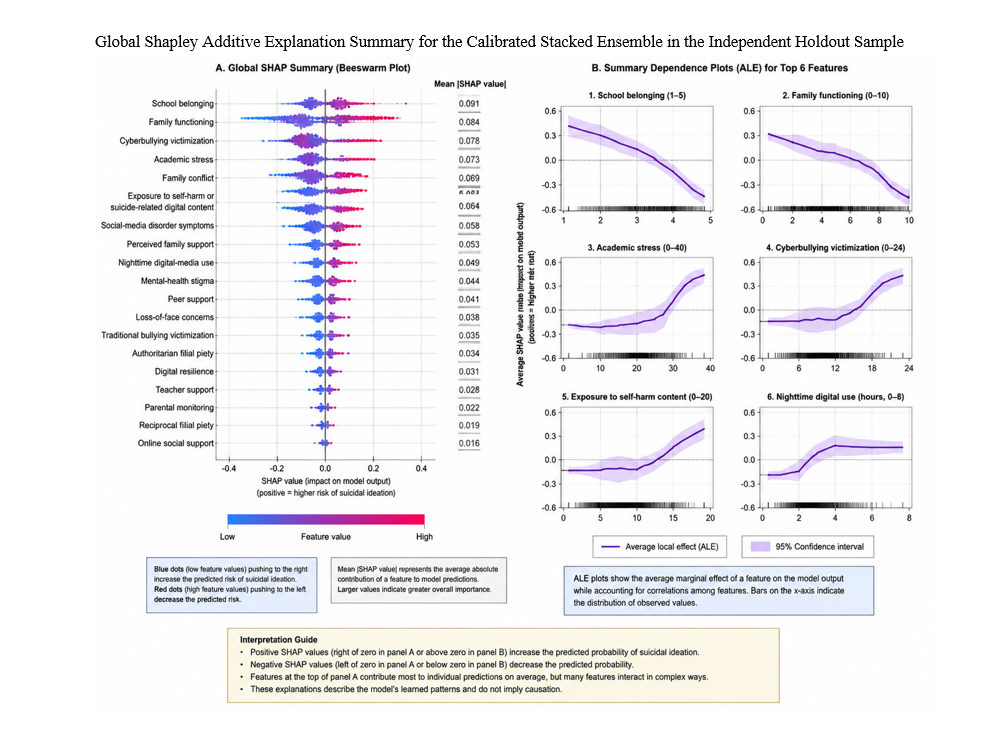
Findings: The calibrated stacked ensemble outperformed the conventional logistic-regression benchmark and all individual learners. In the independent holdout sample, the model achieved an area under the receiver operating characteristic curve of .889, an area under the precision–recall curve of .682, sensitivity of .861, specificity of .812, positive predictive value of .549, negative predictive value of .957, and Brier score of .115. Calibration was strong, with an intercept of 0.02 and slope of .98. School belonging, family functioning, cyberbullying, academic stress, family conflict, and exposure to self-harm-related digital content were the most influential predictors. Subgroup analyses showed generally comparable sensitivity, although specificity and calibration were weaker among several disadvantaged and smaller subgroups.
Conclusion: A calibrated stacked ensemble integrating multiple ecological domains can provide accurate and interpretable estimates of youth suicidal ideation, although its predictions should support rather than replace direct professional assessment and must be accompanied by ongoing fairness monitoring.
Downloads
References
Alves, M. I., Júnior, S. A. D., Thaís Nogueira de Oliveira, M., Felipe, A. O. B., Freitas, P. S., & Moreira, D. d. S. (2025). The Relationship Between Excessive Screen Time, Self‐Harm, and Suicidal Behavior in Adolescents During the COVID‐19 Pandemic: An Integrative Literature Review. Journal of Child and Adolescent Psychiatric Nursing, 38(2). https://doi.org/10.1111/jcap.70015
Ayasrah, F. T., Abu-Alnadi, H. J., Altawalbeh, M. A., Al-Mughrabi, A. M., Doughlas, A., & Al‐Said, K. (2024). Effect of Cyberbullying and Sexting on Adolescents in Jordan; Exploratory Research. Evolutionary Studies in Imaginative Culture, 1369-1372. https://doi.org/10.70082/esiculture.vi.1450
Chhabria, A., & Khar, P. (2023). Aggression, Suicide, and Self-Harm in Children and Adolescents. Journal of Indian Association for Child and Adolescent Mental Health, 19(1), 53-59. https://doi.org/10.1177/09731342231190715
Chock-Goldman, J. (2023). High-Achieving Asian American Adolescents and Suicide. Advances in Social Work, 22(3), 1084-1095. https://doi.org/10.18060/24604
Choi, J.-HR. (2026). Association Between Dietary Behavior and Mental Health in Adolescents From Multicultural and Non-Multicultural Families in Korea. Nutrients, 18(11), 1686. https://doi.org/10.3390/nu18111686
Du, W., & Luo, Y. (2025). A Cross-Sectional Study on the Association Between Secondhand Smoke Exposure and Suicide Among Adolescents in Multicultural Families: The Mediating Role of Perceived Stress. Tobacco Induced Diseases, 23(October), 1-17. https://doi.org/10.18332/tid/209551
Dwangu, A. M. (2023). Causes and Effects of Suicides Committed by Pupils in South African Schools. International Journal of Research in Education Humanities and Commerce, 04(03), 257-273. https://doi.org/10.37602/ijrehc.2023.4321
Fang, J., Lau, C. K. M., & Cheng, Y. (2024). Psychological Impact of COVID-19 on Individuals: Through Active Choices and Passive Adaption. https://doi.org/10.3389/978-2-8325-4481-5
Ferreira, D. B. B., Santos, R. M. S., Machado, M. C. L., Rezende, V. H. M., Romano‐Silva, M. A., & Miranda, D. M. d. (2025). Suicidality and Self-Harm in Adolescents Before and After the COVID-19 Pandemic: A Systematic Review. Frontiers in Psychiatry, 16. https://doi.org/10.3389/fpsyt.2025.1643145
Hilty, D. M., Stubbe, D., McKean, A. J., Hoffman, P., Zalpuri, I., Myint, M. T., Joshi, S. V., Pakyürek, M., & Li, S. T. T. (2023). A Scoping Review of Social Media in Child, Adolescents and Young Adults: Research Findings in Depression, Anxiety and Other Clinical Challenges. BJPsych Open, 9(5). https://doi.org/10.1192/bjo.2023.523
Jensen, L. C. X., Jones, M. S., Gibbs, B. G., & Jarvis, J. A. (2025). Adverse Childhood Experiences, Race/Ethnicity, and Suicidality Among Florida High School Students. Youth & Society, 57(2), 233-257. https://doi.org/10.1177/0044118x241312248
Macedo, D. M., McEvoy, M., Crowley, T., Loughhead, M., & Procter, N. (2024). Self‐harm and Suicidality Among Trans and Gender Diverse Youth From Culturally and Linguistically Diverse Backgrounds—A Scoping Review. International journal of mental health nursing, 33(4), 781-796. https://doi.org/10.1111/inm.13291
Martínez, A. D., Kloft, S., Escámez, P. S. F., Dezyani, P., & Cunningham, K. (2025). A Scoping Review of Suicide Prevention Interventions for Latinx Adults: Strategies, Gaps, and Future Directions. Frontiers in Public Health, 13. https://doi.org/10.3389/fpubh.2025.1481904
Meyer, S. R., Gillespie, A., Seff, I., Bennouna, C., Qushua, N., Tothezan, I., Boahen-Boaten, B. B., Allaf, C., & Stark, L. (2024). A Relational Approach to Understanding Psychosocial Wellbeing, Including Suicidal Ideation, Among MENA-Background Adolescents. Society and Mental Health, 15(2), 149-165. https://doi.org/10.1177/21568693231218264
Meza, J. I., Piña‐Watson, B., López, D., Bonilla, G. S., Sánchez, M. R., Manzo, G., & Garcia, A. (2024). Examining the Relationship Between Suicide Ideation Frequency and Intergenerational Acculturative Conflict Between Mexican Descent College Students and Their Caregivers Using the Interpersonal Theory of Suicide. Suicide and Life-Threatening Behavior, 55(1). https://doi.org/10.1111/sltb.13067
Molock, S. D., Boyd, R. C., Álvarez, K., Denton, E. g., Glenn, C. R., Katz, C. C., Mueller, A. S., Meca, A., Meza, J. I., Miranda, R., Ortin‐Peralta, A., Polanco‐Roman, L., Singer, J. B., Zullo, L., & Miller, A. B. (2023). Culturally Responsive Assessment of Suicidal Thoughts and Behaviors in Youth of Color. American psychologist, 78(7), 842-855. https://doi.org/10.1037/amp0001140
Nagata, J. M., Shim, J., Balasubramanian, P., Leong, A. W., Smith-Russack, Z., Shao, I. Y., Al-Shoaibi, A. A. A., Helmer, C. K., Ganson, K. T., Testa, A., Kiss, O., He, J., Groves, A. K., Baird, S., & Baker, F. C. (2025). Cyberbullying, Mental Health, and Substance Use Experimentation Among Early Adolescents: A Prospective Cohort Study. The Lancet Regional Health - Americas, 46, 101002. https://doi.org/10.1016/j.lana.2025.101002
Ostaszewski, K., Markiewicz, M., Klimanska, M., Haletska, I., Herasym, H., Klymanska, L., Mirchuk, I., Savka, V., & Зелена, О. (2025). Prevalence Of and Factors in Suicidal Thoughts in 14-15-Year-Olds. A Polish-Ukrainian Study. Postępy Psychiatrii I Neurologii. https://doi.org/10.5114/ppn.2025.151776
Platt, R., Álvarez, K., Vasquez, M. G., Acosta, J., Caicedo, M. R., Polk, S., & Wilcox, H. C. (2024). Suicide Prevention Programming Across Ecological Levels: Recommendations From Latinx Immigrant Origin Youth and Their Parents. Families Systems & Health, 42(1), 101-115. https://doi.org/10.1037/fsh0000835
Polanco‐Roman, L., Ebrahimi, C. T., Mafnas, K. S. W., Hausmann‐Stabile, C., Meca, A., Mazzula, S. L., Duarte, C. S., & Lewis‐Fernández, R. (2023). Acculturation and Suicide-Related Risk in Ethnoracially Minoritized Youth in the US: A Scoping Review and Content Analysis of the Empirical Evidence. Social Psychiatry and Psychiatric Epidemiology, 58(8), 1121-1137. https://doi.org/10.1007/s00127-023-02494-0
Prasad, S., Souabni, S. A., Anugwom, G., Aneni, K., Anand, A., Urhi, A., Obi-Azuike, C., Gibson, T., Khan, A., & Oladunjoye, A. F. (2023). Anxiety and Depression Amongst Youth as Adverse Effects of Using Social Media : A Review. Annals of medicine and surgery, 85(8), 3974-3981. https://doi.org/10.1097/ms9.0000000000001066
Sellars, S. E., & Kabra, RR. (2026). Risks and Benefits of Social Media on Adolescent Health. Pediatric Annals, 55(6). https://doi.org/10.3928/19382359-20260223-02
So, S., Coffey, D. M., & Javier, J. R. (2023). Parental Enculturation and Youth Mental Health Functioning Among Filipino American Families. Cultural diversity & ethnic minority psychology, 29(2), 279-288. https://doi.org/10.1037/cdp0000552
Witherspoon, D. P., Wei, W., Maereg, T., Chancy, D., & Boggs, S. (2023). African American and Black Adolescents and Young Adults in the United States: Development in Context. 343-357. https://doi.org/10.1037/0000298-021
Yu, T.-H., Yuen, C., & Yu, Z. (2025). Asian American Parenting and Youth Mental Health Outcomes: A Literature Review. Mental Health Science, 3(1). https://doi.org/10.1002/mhs2.101
Downloads
Additional Files
Publication Timeline
- Submitted
- Revised
- Accepted



