
Early Identification of Families at Risk of Child Maltreatment: A Fairness-Audited Machine-Learning Model Integrating Caregiver Stress, Social Isolation, Economic Hardship, Family History, and Neighborhood Disadvantage
Keywords:
Child maltreatment, machine learning, early identification, caregiver stress, economic hardship, social isolation, neighborhood disadvantage, algorithmic fairnessAbstract
Objective: This study aimed to develop and independently evaluate a fairness-audited machine-learning model for the early identification of Egyptian families at risk of child maltreatment.
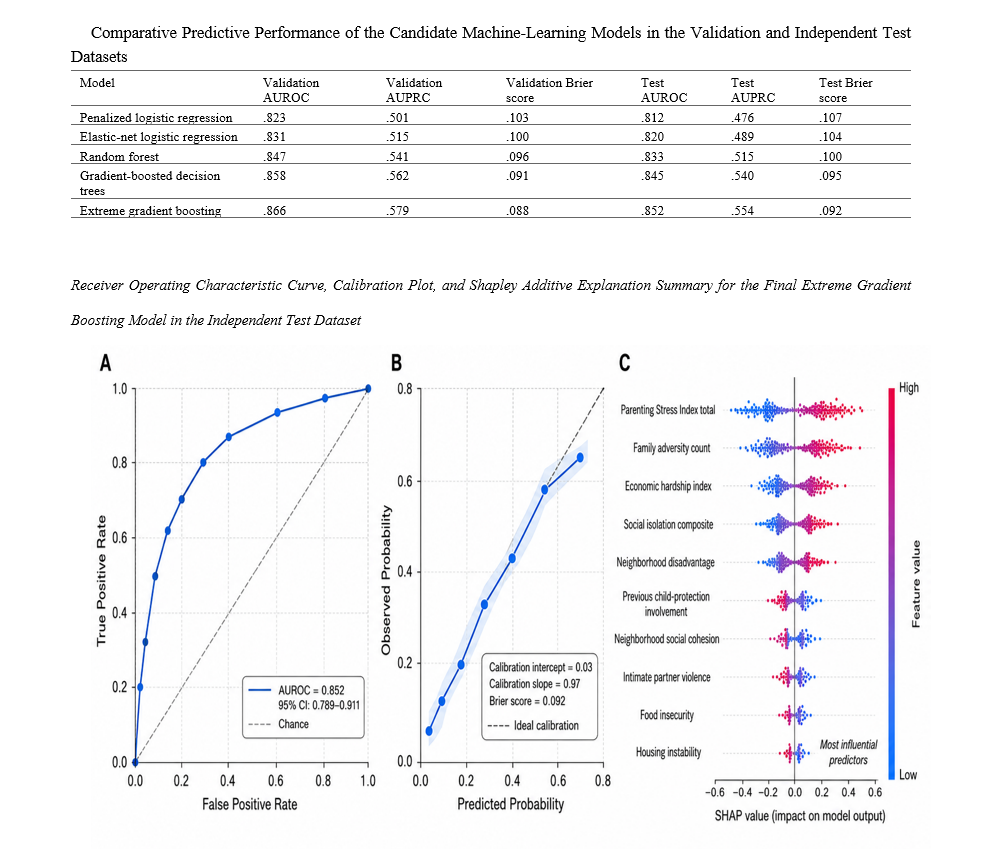
Methods and Materials: A prospective multicenter cohort study was conducted among 1,248 families recruited from healthcare, educational, and social-service settings across Cairo, Giza, Alexandria, Dakahlia, Minya, and Sohag. Baseline assessments measured caregiver stress, social isolation, economic hardship, family adversity, previous child-protection involvement, and neighborhood disadvantage. Families were followed for 12 months to identify newly substantiated or independently adjudicated child-maltreatment concerns. The sample was divided into development, validation, and independent test datasets. Penalized logistic regression, elastic-net regression, random forest, gradient-boosted decision trees, and extreme gradient boosting were compared using discrimination, calibration, classification, and fairness metrics.
Findings: Families with a subsequent maltreatment concern had significantly higher parenting stress, social isolation, economic hardship, family adversity, neighborhood disadvantage, food insecurity, housing instability, intimate partner violence, and previous child-protection involvement than families without a concern (all p < .001). Extreme gradient boosting demonstrated the strongest independent test performance, with an area under the receiver operating characteristic curve of .852, an area under the precision–recall curve of .554, and a Brier score of .092. At the selected threshold, sensitivity was 82.1%, specificity was 79.2%, positive predictive value was 41.1%, and negative predictive value was 96.2%. Calibration was satisfactory, with an intercept of .03 and slope of .97. Performance was broadly comparable across caregiver sex, child sex, residence, and region, although the false-positive rate was higher among low-income families.
Conclusion: A multilevel fairness-audited machine-learning model can identify families requiring further supportive assessment with good discrimination and calibration, but predictions should supplement professional judgment and must not be used as proof of maltreatment or as an independent basis for punitive intervention.
Downloads
References
Andom, F., Jonson-Reid, M., Henk, J., & Kemner, A. (2025). The Influence of Child Welfare Involvement on Parent Engagement Among Immigrant Families Who Receive Home Visiting Services. Child maltreatment, 31(3), 503-514. https://doi.org/10.1177/10775595251368358
Barboza-Salerno, G., Duhaney, S., Ramesh, B., & Stanek, C. (2025). Beyond Social Disadvantage: Advancing an Environmental Justice Framework to Address Child Maltreatment Risk. https://doi.org/10.21203/rs.3.rs-6521185/v1
Blumenthal, A. (2021). Neglect as Collective Failure to Provide for Children: Towards a New Theoretical Approach. https://doi.org/10.31235/osf.io/5afv2
Bullinger, L. R., Marcus, S., Reuben, K., Whitaker, D. J., & Self‐Brown, S. (2021). Evaluating Child Maltreatment and Family Violence Risk During the COVID‐19 Pandemic: Using a Telehealth Home Visiting Program as a Conduit to Families. Infant Mental Health Journal Infancy and Early Childhood, 43(1), 143-158. https://doi.org/10.1002/imhj.21968
Chiang, C.-J., Kim, H., Jonson‐Reid, M., Yang, M. Y., Moon, C. A., & Kohl, P. L. (2023). Risk Factors and Neglect Subtypes: Findings From a Nationally Representative Data Set. American Journal of Orthopsychiatry, 93(6), 532-542. https://doi.org/10.1037/ort0000698
Chiang, C. J., Rafieifar, M., Chen, J. H., & Yang, MR. (2026). Understanding Child Well‐being In CPS: Nativity and Immigration Status Diversity in Latino Families. Family Relations. https://doi.org/10.1111/fare.70142
Chung, Y., & Ahn, H. (2024). Understanding the Mediation Effect of Social Cohesion on the Relationship Between Material Hardship and Child Maltreatment by Poverty Spells. Child maltreatment, 30(3), 394-405. https://doi.org/10.1177/10775595241307896
Collin‐Vézina, D., Fallon, B., & Caldwell, J. (2023). Children and Youth Mental Health: Not All Equal in the Face of the COVID-19 Pandemic. 377-385. https://doi.org/10.1016/b978-0-323-91497-0.00072-2
Feely, M., & Bosk, E. A. (2021). That Which Is Essential Has Been Made Invisible: The Need to Bring a Structural Risk Perspective to Reduce Racial Disproportionality in Child Welfare. Race and Social Problems, 13(1), 49-62. https://doi.org/10.1007/s12552-021-09313-8
Herbers, J. E., Hayes, K. R., & Cutuli, J. J. (2021). Adaptive Systems for Student Resilience in the Context of COVID-19. School Psychology, 36(5), 422-426. https://doi.org/10.1037/spq0000471
Herbers, J. E., Wallace, L. E., & Tebepah, T. C. (2025). Risk and Resilience From Childhood Experiences of Stress and Poverty. 323-341. https://doi.org/10.1037/0000396-018
Hesselink, A. (2023). Adverse Childhood Experiences (ACEs) and the Link to Antisocial, Delinquent, and Criminal Behaviors. https://doi.org/10.5772/intechopen.1001823
Hoyle, M. E., Chamberlain, A. W., & Wallace, D. (2020). The Effect of Home Foreclosures on Child Maltreatment Rates: A Longitudinal Examination of Neighborhoods in Cleveland, Ohio. Journal of interpersonal violence, 37(5-6). https://doi.org/10.1177/0886260520943725
Hoyniak, C. P., Quiñones‐Camacho, L. E., Camacho, M. C., Chin, J., Williams, E. M., Wakschlag, L. S., & Perlman, S. B. (2021). Adversity Is Linked With Decreased Parent-Child Behavioral and Neural Synchrony. Developmental Cognitive Neuroscience, 48, 100937. https://doi.org/10.1016/j.dcn.2021.100937
Indriati, W., Yurista, S. R., Ardani, I. G. A. I., & Setiawati, Y. (2024). Childhood Maltreatment and Toxic Stress: What We Have Learned From the COVID-19 Pandemic Era. Journal of Korean Academy of Child and Adolescent Psychiatry, 35(3), 163-168. https://doi.org/10.5765/jkacap.240003
Kara, B., & Selçuk, B. (2020). Under Poverty and Conflict: Well-Being of Children Living in the East of Turkey. American Journal of Orthopsychiatry, 90(2), 246-258. https://doi.org/10.1037/ort0000426
Katz, C., Filho, S. R. P., Korbin, J. E., Bérubé, A., Fouché, A., Kaawa–Mafigiri, D., Maguire‐Jack, K., Muñoz, P., Spilsbury, J. C., Tarabulsy, G. M., Tiwari, A., Levine, D., Truter, E., & Varela, N. (2021). Child Maltreatment in the Time of the COVID-19 Pandemic: A Proposed Global Framework on Research, Policy and Practice. Child abuse & neglect, 116, 104824. https://doi.org/10.1016/j.chiabu.2020.104824
Klika, J. B., Maguire‐Jack, K., Feely, M., Schneider, W., Pace, G. T., Rostad, W. L., Murphy, C. A., & Merrick, M. T. (2022). Childcare Subsidy Enrollment Income Generosity and Child Maltreatment. Children, 10(1), 64. https://doi.org/10.3390/children10010064
Liu, Y., Snyder-Fickler, E., Evans, K. E., & Gifford, E. J. (2025). Child Maltreatment Re-Report, Substantiation, and Foster Care Placement: A Latent Class Analysis of Child, Caregiver, and Household Risk Factors Across Screened-in and Screened-Out Cases. Child maltreatment, 31(3), 552-567. https://doi.org/10.1177/10775595251361150
Maguire‐Jack, K., & Sattler, K. M. P. (2022). Neighborhood Poverty, Family Economic Well-Being, and Child Maltreatment. Journal of interpersonal violence, 38(5-6), 4814-4831. https://doi.org/10.1177/08862605221119522
Maguire‐Jack, K., Yoon, S., Chang, Y., & Hong, S. (2022). The Relative Influence of Family and Neighborhood Factors on Child Maltreatment at Critical Stages of Child Development. Children, 9(2), 163. https://doi.org/10.3390/children9020163
Maher, E. J., Ferraro, A. C., & Wang, D. (2025). Subgroups of Risk and Adversity for Families Investigated for Child Maltreatment by Poverty Status. Sociological Perspectives, 68(1-3), 61-81. https://doi.org/10.1177/07311214251321447
McDowell, H., Barriault, S., Afifi, T. O., Romano, E., & Racine, N. (2024). Child Maltreatment During the COVID-19 Pandemic: Implications for Child and Adolescent Mental Health. Frontiers in Child and Adolescent Psychiatry, 3. https://doi.org/10.3389/frcha.2024.1415497
Mucci, G., Collins, E., Pearce, E., Avina, M., Hao, S., Onungwa, C., Bunac, J., Hunte, Y., Coopersmith, L., & Yewell, N. (2024). The Lost Years: An Integrative Review of the Mental Health, Educational, and Social Impact of the Pandemic on Children and Adolescents From 2019 to 2022. Journal of Pediatric Neuropsychology, 10(1), 49-90. https://doi.org/10.1007/s40817-024-00160-0
Parenteau, A. M., Boyer, C., Campos, L., Carranza, A. F., Deer, L. K., Hartman, D. T., Bidwell, J. T., & Hostinar, C. E. (2022). A Review of Mental Health Disparities During COVID-19: Evidence, Mechanisms, and Policy Recommendations for Promoting Societal Resilience. Development and Psychopathology, 35(4), 1821-1842. https://doi.org/10.1017/s0954579422000499
Rokach, A., & Chan, S. (2021). The Effect of COVID on Child Maltreatment: A Review. Journal of Clinical Research and Reports, 9(3), 01-13. https://doi.org/10.31579/2690-1919/201
Rosenthal, A., Dimitrieva, J., & DePrince, A. P. (2022). Development of the Checklist of Service Needs and Barriers (C-Snab) Measure for Caregivers Involved in Child Maltreatment Investigations. Journal of Child and Family Studies, 31(12), 3405-3424. https://doi.org/10.1007/s10826-022-02462-3
Tener, D., Marmor, A., Katz, C., Newman, A., Silovsky, J. F., Shields, J. D., & Taylor, E. (2021). How Does COVID-19 Impact Intrafamilial Child Sexual Abuse? Comparison Analysis of Reports by Practitioners in Israel and the US. Child abuse & neglect, 116, 104779. https://doi.org/10.1016/j.chiabu.2020.104779
Thor, P., Yang, S., & Park, Y. (2022). Child Maltreatment in Asian American and Pacific Islander Families: The Roles of Economic Hardship and Parental Aggravation. International Journal on Child Maltreatment Research Policy and Practice, 5(2), 295-310. https://doi.org/10.1007/s42448-021-00111-8
Willoughby, K. A., Arbeau, K., Ketelaars, T., & Pierre, J. S. (2024). An Examination of Underlying Domains in Childhood Adversity: A Scoping Review of Studies Conducting Factor Analyses on Adverse Childhood Experiences. International journal of environmental research and public health, 21(11), 1441. https://doi.org/10.3390/ijerph21111441
Wong, R. S., Tung, K. T. S., Rao, N., Chan, K. L., Fu, K. W., Yam, J. C., Tso, W. W. Y., Wong, W. H. S., Lum, T. Y. S., Wong, I. C. K., & Ip, P. (2022). Using Latent Class Analyses to Examine Health Disparities Among Young Children in Socially Disadvantaged Families During the COVID-19 Pandemic. International journal of environmental research and public health, 19(13), 7893. https://doi.org/10.3390/ijerph19137893
Xu, Y., Bright, C. L., Barth, R. P., & Ahn, H. (2020). Poverty and Economic Pressure, Financial Assistance, and Children’s Behavioral Health in Kinship Care. Child maltreatment, 26(1), 28-39. https://doi.org/10.1177/1077559520926568
Younas, F., & Gutman, L. M. (2022). Parental Risk and Protective Factors in Child Maltreatment: A Systematic Review of the Evidence. Trauma Violence & Abuse, 24(5), 3697-3714. https://doi.org/10.1177/15248380221134634
Zhang, L., Liu, Y., & Jonson‐Reid, M. (2024). Early Childhood Income Instability and Mental Health in Adolescence: Parenting Stress and Child Maltreatment as Mediators. Child maltreatment, 30(1), 55-67. https://doi.org/10.1177/10775595241236389
Downloads
Additional Files
Publication Timeline
- Submitted
- Revised
- Accepted



