
Predicting Fertility Intentions Among Young Adults Using Machine Learning: The Relative Importance of Family Expectations, Housing Insecurity, Gender Ideology, Career Uncertainty, Relationship Quality, and Cultural Values
Keywords:
fertility intentions, machine learning, relationship quality, housing insecurity, gender ideology, career uncertainty, cultural values, GermanyAbstract
Objective: This study aimed to predict positive fertility intentions among young adults in Germany and determine the relative importance of family expectations, housing insecurity, gender ideology, career uncertainty, relationship quality, and cultural values.
Methods and Materials: A cross-sectional predictive study was conducted with 1,284 adults aged 18–35 years residing in Germany. Participants completed measures of fertility intentions, family expectations, housing insecurity, gender ideology, career uncertainty, relationship quality, and cultural values. The dataset was divided into an 80% training set and a 20% independent test set. Logistic regression, elastic-net regression, random forest, extreme gradient boosting, support vector machine, and multilayer perceptron models were developed using nested stratified cross-validation. Model performance was evaluated through the area under the receiver operating characteristic curve, precision–recall area, balanced accuracy, sensitivity, specificity, F1 score, and Brier score. Predictor importance was assessed using permutation importance and Shapley additive explanation values.
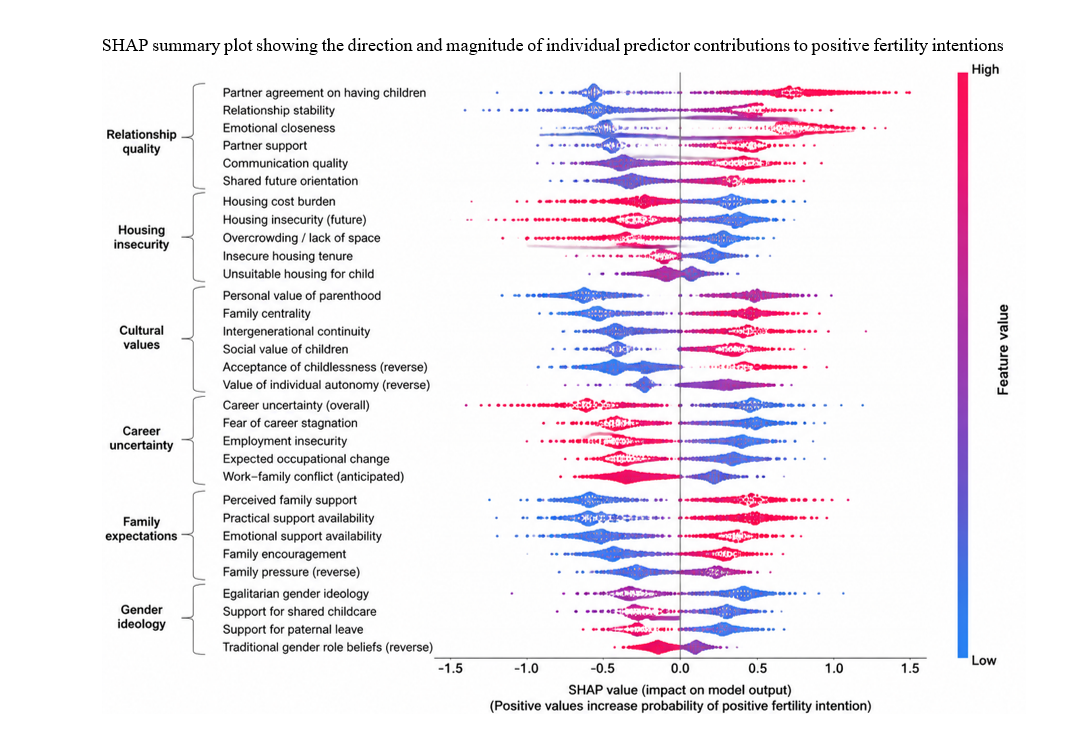
Findings: Extreme gradient boosting produced the strongest predictive performance, with an area under the receiver operating characteristic curve of .846, precision–recall area of .799, balanced accuracy of .784, sensitivity of .764, specificity of .803, F1 score of .753, and Brier score of .159. Its discrimination was significantly greater than that of standard logistic regression and elastic-net regression. Relationship quality was the most influential predictor domain, accounting for 24.8% of total SHAP importance, followed by housing insecurity at 21.6%, cultural values at 18.9%, career uncertainty at 15.7%, family expectations at 11.6%, and gender ideology at 7.4%. Severe housing and career uncertainty reduced the probability of positive fertility intentions, whereas high relationship quality and family-centered cultural values increased it. Family expectations showed a nonlinear pattern, and gender ideology was more influential when combined with supportive relationships and expectations of shared caregiving.
Conclusion: Fertility intentions among young adults in Germany are best predicted through an integrated assessment of relational, residential, cultural, and occupational conditions, with relationship quality and housing security representing the most influential domains.
Downloads
References
Akaliyski, P., Bowen, C. E., Gehrig, S., & Skirbekk, VR. (2026). Demographic Processes Constrain Global Growth in Gender Egalitarianism. Pnas Nexus, 5(5). https://doi.org/10.1093/pnasnexus/pgag133
Arıcı, AR. (2026). Fears and Desires: A Quantitative Analysis of Psychological, Relational, and Sociocultural Factors in Women’s Desire to Have Children. BMC public health, 26(1). https://doi.org/10.1186/s12889-026-27476-0
Arpino, B., & Mogi, R. (2024). Individuals’ Left-Right Self-Placement and Their Fertility Intentions: Evidence From the European Social Survey. https://doi.org/10.31235/osf.io/ahmuj
Begall, K., & Hiekel, N. (2024). Beyond the Continuum: A Micro-Level Analysis of the Gender Equality-Fertility Nexus in Three Nordic Countries. https://doi.org/10.4054/mpidr-wp-2024-004
Begall, K., & Hiekel, N. (2025). Examining the Gender Equality–Fertility Paradox in Three Nordic Countries. Population and Development Review, 51(2), 858-888. https://doi.org/10.1111/padr.12721
Erát, DR. (2026). National Identity and Fertility Intentions: Evidence From Hungary. Population and Development Review, 52(1), 135-166. https://doi.org/10.1111/padr.70051
Erát, D., & Bognár, A. (2024). Tomorrow’s Parents? Exploring the Fertility Intentions of Young Adults in Hungary. Szociológiai Szemle, 34(2), 24-54. https://doi.org/10.51624/szocszemle.12099
Fu, Y., Guo, F., Xie, C., & Liang, ZR. (2026). Sex, Digital Media, and Fertility Intentions in China: A Chain Mediation Analysis of Media Use and Gender Role Attitudes. Chinese Journal of Sociology, 12(2), 228-261. https://doi.org/10.1177/2057150x261434703
Han, S. W., & Oh, E. (2024). Aligned, Competing, and Blurred: Gender and Family Attitudes in East Asia. Journal of marriage and family, 87(2), 676-700. https://doi.org/10.1111/jomf.13059
Kumo, K., & Perugini, C. (2023). Religion, Ideology and Fertility. SSRN Electronic Journal. https://doi.org/10.2139/ssrn.4457825
Lee, M. A., Song, R., & Park, J. (2025). Does Perceived Gender Conflict Shape Young Koreans' Attitudes Toward Marriage and Childbearing? Journal of marriage and family, 87(4), 1816-1832. https://doi.org/10.1111/jomf.13106
Li, W. (2025). Fertility Anxiety vs. Anti-Fertility Anxiety: Exploring Chinese Women’s Conflicting Attitudes Toward Childbearing Through Social Media. Frontiers in psychology, 16. https://doi.org/10.3389/fpsyg.2025.1636612
Miao, JR. (2026). Normative Fertility Attitudes in Urban China: Evidence From a Factorial Survey Experiment. https://doi.org/10.21203/rs.3.rs-9097806/v1
Ng, K. U. (2025). Gender Differences in Fertility Ideals Among Muslim and Non-Muslim Immigrants and Their Children in France. Socius Sociological Research for a Dynamic World, 11. https://doi.org/10.1177/23780231251351671
Oslawski‐Lopez, J., & Tabor, J. A. (2024). Who Can Refuse? Attitudes About the Fertility Decisions of Wives and Husbands. Journal of Family Issues, 46(4), 681-705. https://doi.org/10.1177/0192513x241299421
Peng, H., Zhang, Z., Ma, H., Aimaitijiang, Z., Li, X., Wang, L., & zi, q. (2025). Understanding Fertility Intention Through the Lens of Family Functioning, Fertility Anxiety and Marriage-Fertility Views: A TPB-Based SEM Approach. https://doi.org/10.1101/2025.09.01.673580
Perry, S. LR. (2026). The Right Kind of Children: Christian Nationalism, Religiosity, and Support for Selective Versus General Pronatalism. Journal for the Scientific Study of Religion, 65(2), 399-413. https://doi.org/10.1111/jssr.70034
Rackin, H., & Gibson‐Davis, C. (2024). Youth's Political Identity and Fertility Desires. Journal of marriage and family, 86(4), 1132-1148. https://doi.org/10.1111/jomf.13000
Su, J. H., & Musick, K. (2024). How Sexism in Institutions and Everyday Interactions Shapes Early Childbearing. American Sociological Review, 89(6), 1141-1180. https://doi.org/10.1177/00031224241291602
Vestel, J. D., & Gadeyne, SR. (2026). Evolving Gender Attitudes and Fertility Preferences: A Study of Young Women in Five Sub‐Saharan African Countries. Studies in Family Planning, 57(2), 151-169. https://doi.org/10.1111/sifp.70047
Voicu, M., & Papuc, R. M. (2023). Fertility in Romania: The Delay of the Second Gender Revolution. Transylvanian Review of Administrative Sciences(69 E), 133-149. https://doi.org/10.24193/tras.69e.8
Wu, Y., Zhang, Y., Zhu, Z., Jiang, W., & Zha, Y. (2025). The Effects of Housing Expenditure Pressure and Gender Preference on the Reproduction Willingness for Young Female Migrants: Evidence From China. https://doi.org/10.21203/rs.3.rs-7441721/v1
Yang, X., Yue, Y., & Ma, J. (2025). Gender Attitudes, Women's Intra‐household Decision‐making Power, and Fertility Intentions. Family Relations. https://doi.org/10.1111/fare.70081
Zhou, J. (2025). A Comparative Analysis of Indian and Chinese Women’s Attitudes Toward Family, Childbearing, and Gender Norms. Journal of Asian and African Studies, 61(2), 1206-1220. https://doi.org/10.1177/00219096251313552
Zhou, Y. (2024). How Gendered Lived Experiences Shape Sex Preference Attitudes in Contemporary Urban China. Journal of marriage and family, 87(1), 365-391. https://doi.org/10.1111/jomf.13025
Downloads
Additional Files
Publication Timeline
- Submitted
- Revised
- Accepted



