
Explainable Machine Learning Prediction of Adolescent Depression From Family Functioning, Parenting Practices, Peer Relationships, Cultural Values, and Digital Media Behaviors
Keywords:
adolescent depression, explainable artificial intelligence, machine learning, SHAP, family functioning, parenting practices, peer relationships, cultural values, digital mediaAbstract
Objective: This study aimed to develop, validate, and explain a machine-learning model for predicting elevated depressive symptoms among adolescents using family functioning, parenting practices, peer relationships, cultural values, and digital-media behaviors.
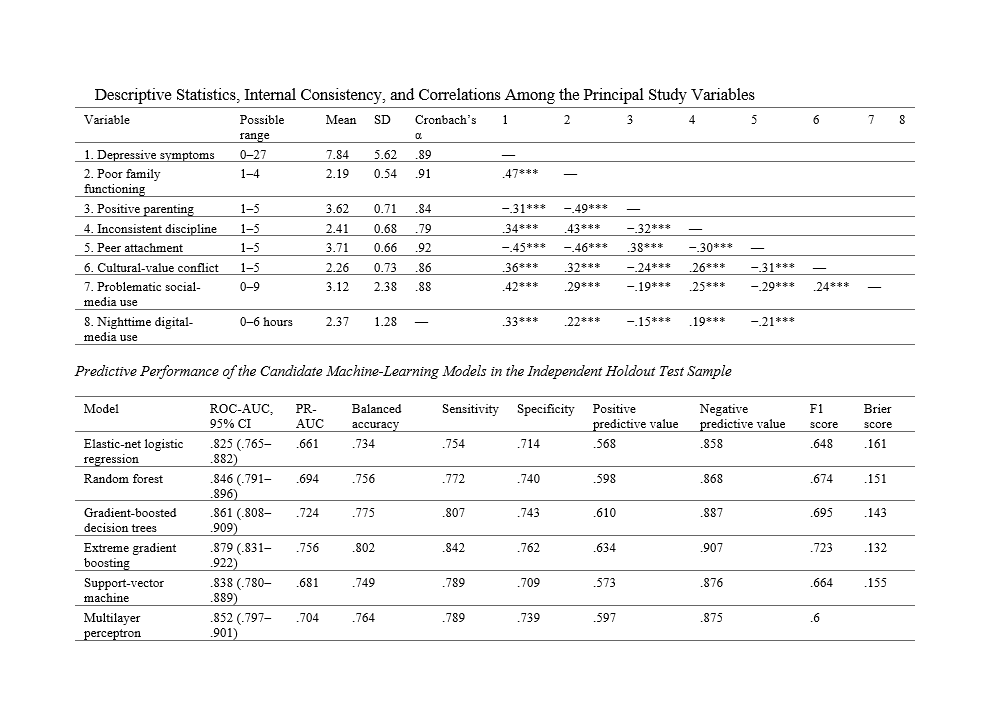
Methods and Materials: A cross-sectional predictive study was conducted with 1,000 Canadian adolescents aged 13–18 years who were recruited through stratified multistage cluster sampling. Depression was assessed using the Patient Health Questionnaire for Adolescents, while validated instruments measured family functioning, parenting practices, peer attachment, cultural-value conflict, problematic social-media use, and related behavioral factors. The dataset was divided into development and independent holdout samples. Elastic-net logistic regression, random forest, gradient-boosted decision trees, extreme gradient boosting, support-vector machines, and multilayer perceptron models were compared. Model performance was evaluated using ROC-AUC, precision-recall AUC, sensitivity, specificity, balanced accuracy, F1 score, and Brier score. SHapley Additive exPlanations were used to determine global feature importance, directional effects, nonlinear thresholds, and predictor interactions.
Findings: Extreme gradient boosting demonstrated the strongest predictive performance, achieving a ROC-AUC of .879, precision-recall AUC of .756, sensitivity of .842, specificity of .762, balanced accuracy of .802, F1 score of .723, and Brier score of .132. It outperformed elastic-net logistic regression and all other candidate algorithms. Poor family functioning was the most influential predictor, followed by peer alienation, problematic social-media use, nighttime device use, cybervictimization, inconsistent discipline, and cultural-value conflict. Positive parenting, longer sleep duration, trusted-friend availability, and supportive online-community engagement reduced predicted risk. Important interactions were observed between family dysfunction and peer alienation, problematic social-media use and nighttime device use, and cybervictimization and trusted-friend availability. Model performance remained stable across alternative depression cutoffs and major demographic subgroups.
Conclusion: Explainable machine learning can identify adolescent depression risk with good discrimination and calibration by integrating relational, cultural, and digital-behavioral factors, while SHAP analysis provides clinically meaningful explanations of individual and global predictions.
Downloads
References
Abdoli, M., Khoshgoftar, M., Jadidi, H., Daniali, S. S., & Kelishadi, R. (2024). Screen Time and Child Behavioral Disorders During COVID-19 Pandemic: A Systematic Review. International journal of preventive medicine, 15. https://doi.org/10.4103/ijpvm.ijpvm_78_23
Al-Shoaibi, A. A. A., Shao, I. Y., Ganson, K. T., Lavender, J. M., Testa, A., Kiss, O., He, J., Glidden, D. V., Baker, F. C., & Nagata, J. M. (2024). Prospective Association of Screen Time With Binge‐eating Disorder Among Adolescents in the United States: The Mediating Role of Depression. International Journal of Eating Disorders, 57(5), 1192-1201. https://doi.org/10.1002/eat.24169
Barbieri, V., Piccoliori, G., Engl, A., & Wiedermann, C. J. (2024). Parental Mental Health, Gender, and Lifestyle Effects on Post-Pandemic Child and Adolescent Psychosocial Problems: A Cross-Sectional Survey in Northern Italy. https://doi.org/10.20944/preprints202405.1743.v1
Bulut, G. Ç., & Gökçe, S. (2023). Problematic Social Media Use, Digital Gaming Addiction and Excessive Screen Time Among Turkish Adolescents During Remote Schooling: Implications on Mental and Academic Well-Being. Marmara Medical Journal, 36(1), 24-33. https://doi.org/10.5472/marumj.1244628
Chen, S., Long, C., Cai, Y., Du, S., Yang, Y. T., Li, Y., Lu, J., Liu, G., Louw, Q., & Ni, M. Y. (2025). Identifying High-Risk Adolescents for Mental Health Difficulties: A Machine Learning Analysis of the Health Behaviour in School-Aged Children Study Across 46 Countries. https://doi.org/10.1101/2025.09.10.25335503
Deng, Q., Sha, L., Hou, J., Zhao, X., Qu, Y., Yu, T., Song, X., Zheng, S., Fan, M., & Jiang, XR. (2026). Leisure Screen Time, Internet Gaming Disorder, and Mental Health Among Chinese Adolescents: Large-Scale Cross-Sectional Study. Journal of medical Internet research, 28, e80737. https://doi.org/10.2196/80737
Ding, K., & Li, H. (2023). Digital Addiction Intervention for Children and Adolescents: A Scoping Review. International journal of environmental research and public health, 20(6), 4777. https://doi.org/10.3390/ijerph20064777
Frei, E., Frei, O., Jahołkowski, P., Parker, N., Parekh, P., Shadrin, A., Hagen, E., Bakken, N. R., Birkenæs, V., Ask, H., Andreassen, O. A., & Smeland, O. B. (2023). The Phenotypic and Genetic Relationship Between Adolescent Mental Health and Time Spent on Social Media, Gaming, and TV. https://doi.org/10.1101/2023.09.14.23295537
Islam, M. A. (2023). Exploring the Impact of Covid-19 on Children's Social Media Usage: A Pragmatic Analysis of Excessive Screen Time and Its Effects on Child Development. Journal of Community Positive Practices, 23(2), 69-84. https://doi.org/10.35782/jcpp.2023.2.05
Kilic, Z., Maheux, A. J., Nesi, J., Silk, J. S., & Choukas‐Bradley, SR. (2026). Intimate Disclosure in Online‐only Friendships Predicts Adolescents' Depressive Symptoms. Journal of Research on Adolescence, 36(1). https://doi.org/10.1111/jora.70144
Kim, G., Jeong, H., & Yim, H. W. (2023). Associations Between Digital Media Use and Lack of Physical Exercise Among Middle-School Adolescents in Korea. Epidemiology and Health, 45, e2023012. https://doi.org/10.4178/epih.e2023012
Li, J., Costigan, C. L., & Lou, N. MR. (2026). A Profile Analysis of Triadic Acculturation Gaps in Chinese Canadian Immigrant Families. Journal of Family Psychology. https://doi.org/10.1037/fam0001502
Li, S., Batterham, P. J., Whitton, A. E., Maston, K., Khan, A., Christensen, H., & Werner‐Seidler, A. (2025). Cross‐sectional and Longitudinal Associations of Screen Time With Adolescent Depression and Anxiety. British Journal of Clinical Psychology, 64(4), 873-887. https://doi.org/10.1111/bjc.12547
Liebherr, M., Heyder, A., Brailovskaia, J., Burkardt, T. M., Latrouite, C., Montag, C., & Antons, S. (2025). The Digital Media-Use Effects (D-MUsE) Model: A comprehensive Framework for Exploring/Studying Functional and Dysfunctional Effects On adolescent Wellbeing. Journal of Behavioral Addictions, 14(1), 100-113. https://doi.org/10.1556/2006.2025.00007
Lim, Y. (2023). School and Bicultural Factors as Mediators Between Immigrant Mothers’ Acculturative Stress and Adolescents’ Depression in Korea. Children, 10(6), 1010. https://doi.org/10.3390/children10061010
Mao, L., He, R., Zhang, S., Ge, Y., Xu, E., Chen, Y., Cong, G., Miao, H., Jiang, Y., & Zhu, HR. (2026). Impact of the Interaction Between Screen Time and Activity Interests on Adolescent Depression Risk: Construction of a Predictive Model Based on Machine Learning. Actas espanolas de psiquiatria, 54(2), 500-515. https://doi.org/10.62641/aep.v54i2.2068
Moreno, M. A., & Jolliff, A. (2022). Depression and Anxiety in the Context of Digital Media. 217-241. https://doi.org/10.1017/9781108976237.013
Nakshine, V. S., Thute, P. P., Khatib, M. N., & Sarkar, B. (2022). Increased Screen Time as a Cause of Declining Physical, Psychological Health, and Sleep Patterns: A Literary Review. Cureus. https://doi.org/10.7759/cureus.30051
Nathiya, D. P., & Meenakshi, S. (2024). A Study on a Psychological Perspective of the Relationship Between Screen Time and Adolescent Emotional Regulation. International Research Journal on Advanced Engineering and Management (IRJAEM), 2(11), 3341-3350. https://doi.org/10.47392/irjaem.2024.0493
Ranjit, K., Ntlantsana, V., Tomita, A., & Paruk, S. (2022). Screen Time and Mental Health Among Adolescents. The Journal of Nervous and Mental Disease, 210(6), 454-461. https://doi.org/10.1097/nmd.0000000000001509
Rizzo, R., Fusto, G., Castagnola, I., Parano, C., Pappalardo, X. G., & Parano, E. (2025). Molecular and Neurobiological Imbalance From the Use of Technological Devices During Early Child Development Stages. Children, 12(7), 909. https://doi.org/10.3390/children12070909
Santos, R. M. S., Mendes, C. G., Bressani, G. Y. S., Ventura, S. d. A., Yago Jean de Almeida, N., Miranda, D. M. d., & Romano‐Silva, M. A. (2023). The Associations Between Screen Time and Mental Health in Adolescents: A Systematic Review. BMC psychology, 11(1). https://doi.org/10.1186/s40359-023-01166-7
Uddin, H., & Hasan, M. K. (2023). Family Resilience and Neighborhood Factors Affect the Association Between Digital Media Use and Mental Health Among Children: Does Sleep Mediate the Association? European Journal of Pediatrics, 182(6), 2521-2534. https://doi.org/10.1007/s00431-023-04898-1
Xiao, B., Hein‐Salvi, C., Zhao, H., Parent, N., & Shapka, J. DR. (2026). Fear of Missing Out, Depression, and Problematic Smartphone Use in Canadian Adolescents: A Developmental Cascade Model. Journal of adolescence, 98(4), 1108-1119. https://doi.org/10.1002/jad.70123
Zeng, X., Chen, Y., Zhang, Q., Jin, Y., Song, Y., Xue, K., Lou, H., Li, R., Lou, X., & Wang, X. (2022). Multidimensional Self-Rating Biological Rhythm Disorder and Its Association With Depression and Anxiety Symptoms Among Adolescents Aged 11–23 years: A School-Based Cross-Sectional Study From China. BMC psychiatry, 22(1). https://doi.org/10.1186/s12888-022-04354-8
Downloads
Additional Files
Publication Timeline
- Submitted
- Revised
- Accepted



