
Ranking Spiritual and Religious Practices Strengthening Family Bonds
Keywords:
family spirituality, religious practices, family cohesion, moral alignmentAbstract
Objective: This study aimed to identify, categorize, and rank the most significant spiritual and religious practices that strengthen family bonds, integrating qualitative content analysis and quantitative prioritization to develop a multidimensional framework of family spirituality.
Methods and Materials: The study adopted a sequential exploratory mixed-methods design. In the first phase, a qualitative content analysis was conducted through an extensive literature review until theoretical saturation was reached. Extracted data were coded and analyzed using NVivo 14, producing six overarching themes of family spirituality. In the second phase, these categories were incorporated into a structured questionnaire and administered to 200 adult participants from Italy. Respondents rated the perceived importance of each spiritual and religious practice on a five-point Likert scale. The quantitative data were analyzed using SPSS version 26, applying descriptive statistics and Friedman’s test to rank the practices by mean scores and determine relative importance.
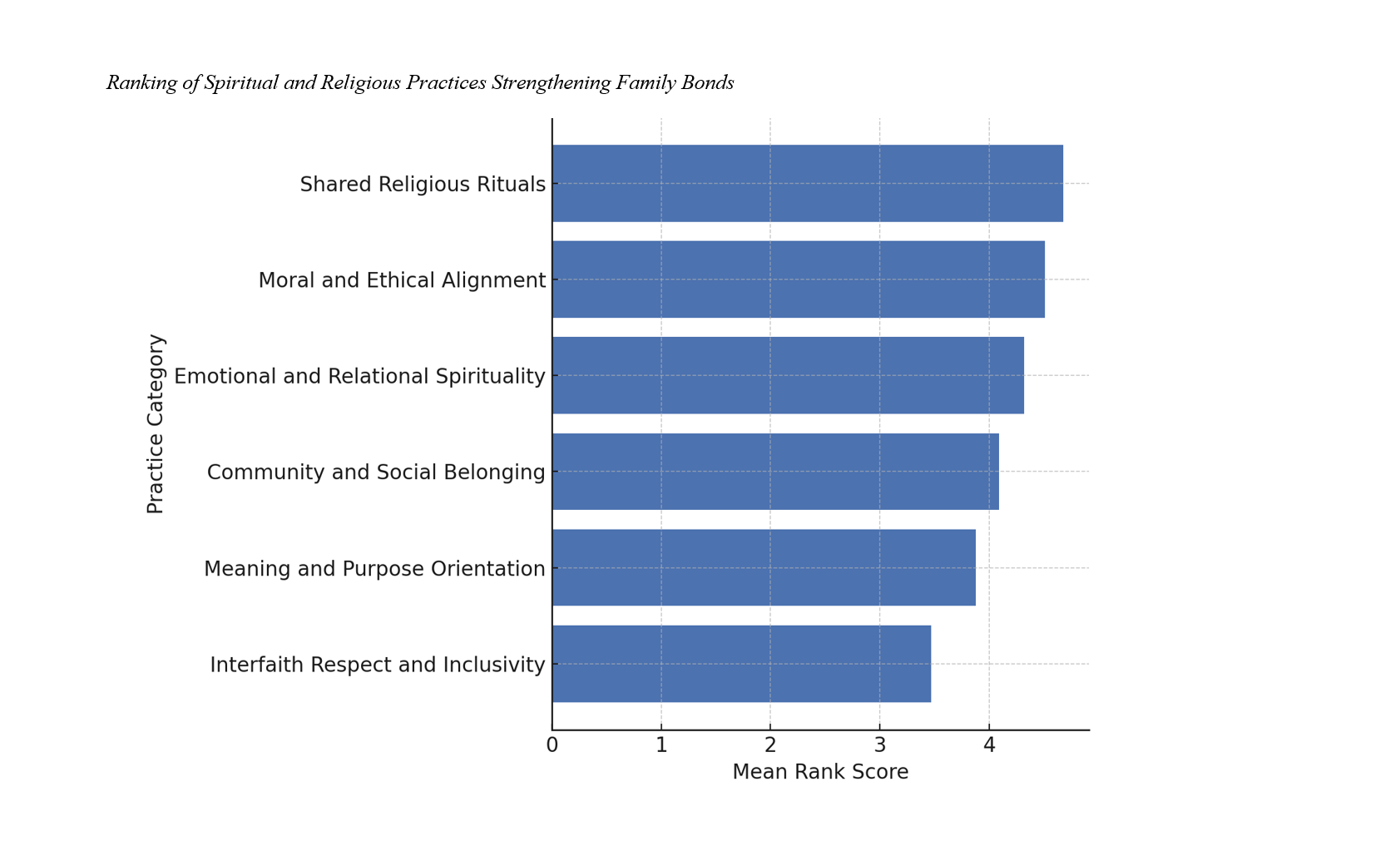
Findings: The results revealed six primary categories of family spirituality ranked as follows: shared religious rituals (M = 4.68), moral and ethical alignment (M = 4.51), emotional and relational spirituality (M = 4.32), community and social belonging (M = 4.09), meaning and purpose orientation (M = 3.88), and interfaith respect and inclusivity (M = 3.47). The Friedman test confirmed significant differences in perceived importance across categories (p < 0.001). The highest-ranked themes emphasized ritual participation and moral coherence as foundational mechanisms of family unity, while emotional, communal, and inclusive practices played complementary but secondary roles.
Conclusion: Spirituality strengthens family bonds through an integrated system of shared rituals, moral alignment, emotional connection, and social belonging.
Keywords: family spirituality; religious practices; family cohesion; moral alignment
Downloads
References
Agudelo, H. n., Andrade, R., & Botero, V. l. (2023). PACES: A Primary Care Tool to Detect Mental Health Disorders in Indigenous Colombians. Rural and Remote Health. https://doi.org/10.22605/rrh7851
Akbar, M., Putra, R., Iriani, A., & Abduh, M. (2025). Formulasi Kebijakan Dalam Pelayanan Pembayaran Pajak Waris Bea Perolehan Hak Atas Tanah Dan Bangunan Di Badan Pendapatan Kota Palembang. Economic Reviews Journal, 4(2). https://doi.org/10.56709/mrj.v4i2.736
Andriningsih, N. M. Y., & Sokarina, A. (2025). Revealing the Meaning of Cost in the Metatah Ceremony of the Balinese Hindu Community on Lombok Island. Formosa Journal of Multidisciplinary Research, 4(2), 771-788. https://doi.org/10.55927/fjmr.v4i2.74
Arief, M., Afnanda, M., & Rohmatika, R. V. (2024). Designing Family Education Through the Rules of the Quran and Hadith. Jatp, 3(2). https://doi.org/10.30631/v8gsjv68
Arifin, T. N., & Futriani, E. S. (2024). The Relationship Between Education Factors, Parents' Occupation and Economic Status on the Incidence of Early Marriage in Young Women in Sigedong Village, Bumijawa District, Tegal Regency. International Journal of Health and Pharmaceutical (Ijhp), 4(2), 242-247. https://doi.org/10.51601/ijhp.v4i2.241
Asadzandi, M., & A, S. K. (2023). Spiritual Pathology Theory of the Sound Heart Model: Socio-Cultural Factors of Spiritual Distress. World Journal of Social Science Research, 10(4), p17. https://doi.org/10.22158/wjssr.v10n4p17
Barbarin, O. A. (2025). Preparation for Racism and Adversity. 203-215. https://doi.org/10.1093/oso/9780197747490.003.0015
Berry, S. N., & Lazcano, S. (2024). Holistic Nursing Care for Perinatal Loss Based on Swanson's Theory of Caring. MCN the American Journal of Maternal/Child Nursing, 50(1), 24-29. https://doi.org/10.1097/nmc.0000000000001060
Firdous, R., Maryam, A., & Kasi, M. A. K. (2023). Experiential Religiosity Between Pir (Patron) and Murid (Client): Access of Patron-Client Relationship to Public Organization. 4(4), 101-117. https://doi.org/10.61503/cissmp.v2i4.86
Gadingan, B. G. (2025). Web of Struggles Among Junior High School Students Belonging to Challenged Families: Input to a Soul Rejuvenation Program. Cognizance Journal of Multidisciplinary Studies, 5(4), 134-404. https://doi.org/10.47760/cognizance.2025.v05i04.009
Goudarzi, S. M., Azmoudeh, M., & Hosseininasab, S. D. (2025). A Comprehensive Review of the Impact of Family Cohesion, Religious Values, and Spiritual Intelligence on Youth Susceptibility to Addiction. Aftj, 6(1), 70-79. https://doi.org/10.61838/kman.aftj.6.1.8
Hartanto, R., Priyanto, C., & Mustamik, K. (2025). Tradisi Mudik Dan Halal Bihalal Dalam Pandangan Islam. Tsaqofah, 5(2), 1565-1576. https://doi.org/10.58578/tsaqofah.v5i2.4875
Irawan, M. H., Saiban, K., & Junianto, J. (2024). Parenting Patterns of Substitute Parents for Children of Indonesian Migrant Workers. International Journal of Research in Social Science and Humanities, 05(04), 08-30. https://doi.org/10.47505/ijrss.2024.4.2
Ismail, S., Usman, A. H., Majid, M. A., Ali, A. W. M., Rasit, R. M., Aini, Z., & Siti Khaulah Mohd Hamzah, M. (2024). Muslim Parents’ Communication Approach to Adolescents According to Al-Tarbiyyah Al-Rashīdah by ‘Abd Al-Karīm Bakkār. Journal of Islamic Thought and Civilization, 14(1), 283-302. https://doi.org/10.32350/jitc.141.17
Job, M. K., Schumacher, P. B., Müller, G., & Kreyer, C. (2022). The Social and Spiritual Dimensions of Parental Experiences on End-of-Life Care of Their Child With Cancer: A Narrative Review. Palliative & Supportive Care, 21(2), 308-319. https://doi.org/10.1017/s1478951521001991
Kaur, L., Charan, G. S., Kaur, M., Kaur, R., & Narang, G. S. (2025). Stress and Coping Strategies Among Parents of Neonates in Neonatal Intensive Care Unit: A Cross-Sectional Study. Annals of African Medicine. https://doi.org/10.4103/aam.aam_16_25
Manungo, R. D., & Rukuni, T. (2021). Impact of Coronavirus Lockdown Among the Seventh - Day Adventist Community Members in Masvingo Urban, Zimbabwe. East African Journal of Education and Social Sciences(Issue 2 (April to June 2021)). https://doi.org/10.46606/eajess2021v02i02.0081
Miftahurrahmat, M., Jannah, M., & Syauky, A. (2025). Perkembangan Agama Pada Usia Sekolah (6-18 Tahun) Dalam Perspektif Islam. Indo-Mathedu Intellectuals Journal, 6(4), 5397-5412. https://doi.org/10.54373/imeij.v6i4.3480
Munif, M. (2023). Learning Strategies for Islamic Religious Education in the Family to Increase Children's Spiritual Awareness. Nasir Jurnal Pendidikan Islam, 1(2), 64-70. https://doi.org/10.59698/nasir.v1i2.80
Norwood, T., & Boulton, J. (2021). Reconciling the Uniquely Embodied Grief of Perinatal Death: A Narrative Approach. Religions, 12(11), 976. https://doi.org/10.3390/rel12110976
Novitasari, N. (2025). Implementation of an Integrated Pre-Tahfiz Model for Developing Religious Values in Early Childhood Education: A Case Study at Tadika Ceria Az-Zahra Malaysia. Al-Hikmah Indonesian Journal of Early Childhood Islamic Education, 9(1), 168-174. https://doi.org/10.35896/ijecie.v9i1.1009
Nurwiyani. (2023). Hubungan Pengetahuan, Motivasi, Serta Dukungan Orang Tua Dengan Kejadian Pernikahan Usia Dini Pada Remaja Putri Di Desa Simpang Rimba. Indonesian Scholar Journal of Nursing and Midwifery Science (Isjnms), 3(05), 1211-1220. https://doi.org/10.54402/isjnms.v3i05.428
Odilova, N. (2024). The Significance of Family Group Synergy in the Shaping of Self Concept in Adolescent. S Reports, 1(1). https://doi.org/10.69848/sreports.v1i1.4606
Pieja, W. (2022). Culture-Forming Character of the Heritage Passed on by the Family Based on the Exhortations Familiaris Consortio and Amoris Laetitia. Teologia I Moralność, 17(1(31)), 189-203. https://doi.org/10.14746/tim.2022.31.1.12
Rahmatullah, A. S., & Syafi’i, M. (2025). Perkembangan Kelekatan Pada Anak: Perspektif Psikologi Dan Islam Dalam Menciptakan Gaya Pengasuhan Terbaik Di Masyarakat. Al-Dyas, 4(2), 912-929. https://doi.org/10.58578/aldyas.v4i2.5220
Sitepu, A. G., Sipangkar, E., & Simbolon, E. (2024). Implementation of a Life of Prayer in a Catholic Family Based on the Familiaris Consortio Document 59-62. Jetish Journal of Education Technology Information Social Sciences and Health, 3(2), 955-965. https://doi.org/10.57235/jetish.v3i2.3105
Smoljo-Dobrovoljski, S. (2025). The Impact of Family Dynamics on the Image of God and Maturation in Faith. Religions, 16(4), 474. https://doi.org/10.3390/rel16040474
Wasosa, H. (2025). Sacred Vows and Broken Bonds: The Effects of Divorce on Catholic Families in Mutare Diocese. International Journal of Research and Scientific Innovation, XII(XV), 119-132. https://doi.org/10.51244/ijrsi.2025.121500011p
Zulfikar, T., & Fathinuddin, M. (2023). Hak Dan Kewajiban Orang Tua Terhadap Anak Berdasarkan Pasal 45 Undang Undang Nomor 1 Tahun 1974 Tentang Perkawinan. Journal Evidence of Law, 2(1), 31-39. https://doi.org/10.59066/jel.v2i1.230
Downloads
Additional Files
Publication Timeline
- Submitted
- Revised
- Accepted



