Design and Effectiveness of a Transdiagnostic Protocol for Misophonia: Effects on Symptoms and Quality of Life Among University Students
Keywords:
Misophonia, Transdiagnostic Intervention, Quality of Life, University Students, Emotion Regulation, Cognitive-Behavioral TherapyAbstract
Objective: This study aimed to design and evaluate the effectiveness of a transdiagnostic intervention protocol for reducing misophonia symptoms and improving quality of life among university students.
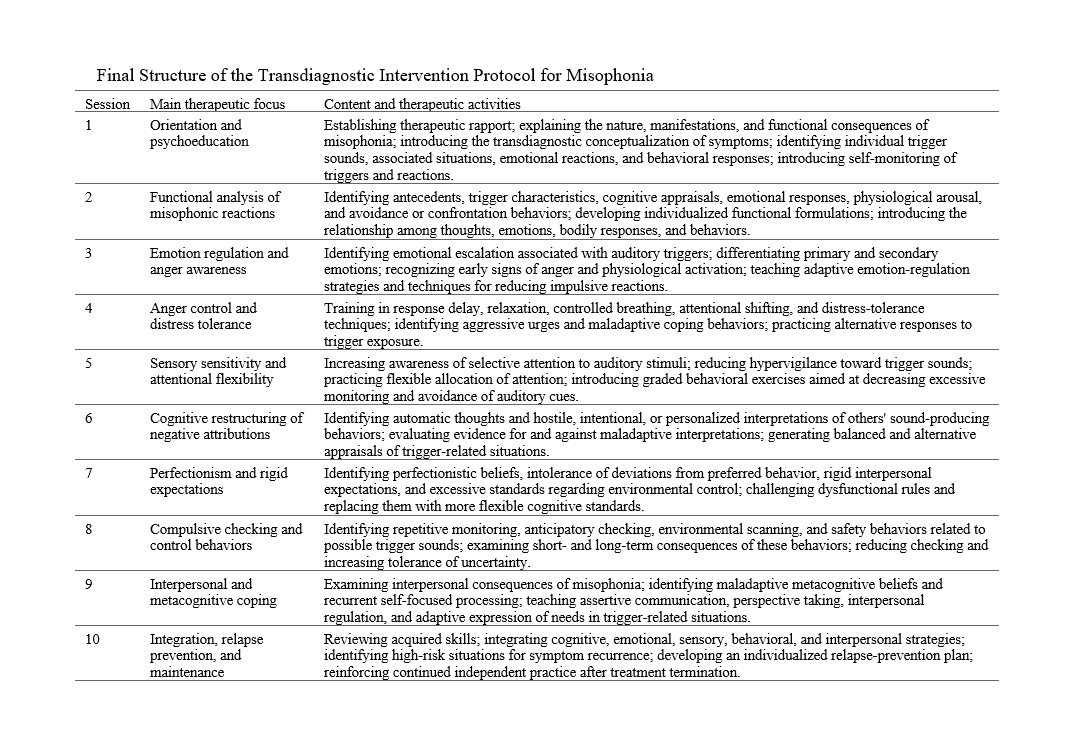
Methods and Materials: This applied quasi-experimental study used a pretest–posttest control-group design with a 3-month follow-up. The transdiagnostic protocol was developed from a prior grounded theory study and integrated emotion regulation, anger control, sensory sensitivity, cognitive restructuring, perfectionism, compulsive checking management, and interpersonal-metacognitive components. Content validity was evaluated by 11 experts using CVR and CVI indices. Sixty undergraduate psychology students with misophonia from Islamic Azad University, Zanjan Branch, and the University of Zanjan were recruited purposively and randomly allocated to experimental and control groups (30 each). The experimental group received ten weekly 90-minute sessions, whereas the control group received no intervention. Outcomes were assessed using the Misophonia Questionnaire and WHOQOL-BREF at pretest, posttest, and follow-up. Data were analyzed using mixed repeated-measures ANOVA with Greenhouse–Geisser correction where required and Bonferroni-adjusted pairwise comparisons.
Findings: Significant time × group interactions were found for misophonia symptoms, F(1.331, 77.195) = 19.87, p < .001, η²p = .255; emotions and behaviors, F(1.232, 71.468) = 10.65, p < .001, η²p = .155; and total misophonia score, F(1.160, 67.271) = 18.28, p < .001, η²p = .240. Significant interactions were also observed for physical health, F(1.158, 67.154) = 10.42, p = .001, η²p = .152; psychological health, F(1.192, 69.158) = 9.01, p = .002, η²p = .134; social relationships, F(2, 116) = 10.63, p < .001, η²p = .155; environmental health, F(1.136, 65.895) = 15.07, p < .001, η²p = .206; and overall general health, F(1.472, 85.369) = 10.65, p < .001, η²p = .155. Most treatment gains remained significant at follow-up.
Conclusion: The transdiagnostic protocol was effective in reducing misophonia symptoms and improving multiple dimensions of quality of life, with substantial maintenance of benefits over 3 months.
Downloads
References
Aazh, H. (2025). Cognitive Behavioural Therapy (CBT) for Managing Tinnitus, Hyperacusis, and Misophonia: The 2025 Tonndorf Lecture. Brain Sciences, 15(5), 526. https://doi.org/10.3390/brainsci15050526
Abbasi, H., Mohammadi, S., & Hassani, F. (2026). Phenomenology of Misophonia in the Iranian Population: A Grounded Theory Study. KMAN Counseling & Psychology Nexus, 4, 1-17. https://doi.org/10.61838/kman.ooc.psynexus.6477
Andermane, N., Bauer, M., Simner, J., & Ward, J. (2023). A symptom network model of misophonia: From heightened sensory sensitivity to clinical comorbidity. Journal of Clinical Psychology, 79, 2364-2387. https://doi.org/10.1002/jclp.23552
Ay, E., Huviyetli, M., & Çakmak, E. (2024). The mediating role of anxiety in the relationship between misophonia and quality of life: Findings from the validated Turkish version of MisoQuest. Frontiers in psychology, 15, 1361645. https://doi.org/10.3389/fpsyg.2024.1361645
Dibb, B., & Golding, S. E. (2022). A longitudinal investigation of quality of life and negative emotions in misophonia. Frontiers in Neuroscience, 16, 900474. https://doi.org/10.3389/fnins.2022.900474
Erfanian, M., Kartsonaki, C., & Keshavarz, A. (2019). Misophonia and comorbid psychiatric symptoms: A preliminary study of clinical findings. Nordic journal of psychiatry, 73, 219-228. https://doi.org/10.1080/08039488.2019.1609086
Ferrer-Torres, A., & Giménez-Llort, L. (2022). Misophonia: A systematic review of current and future trends in this emerging clinical field. International journal of environmental research and public health, 19(11), 6790. https://doi.org/10.3390/ijerph19116790
Ghorbani, S., Ashouri, A., Gharraee, B., & Farahani, H. (2022). Effectiveness of online group-mindfulness and acceptance-based therapy and cognitive-behavioral therapy on misophonia. Iranian journal of psychiatry and behavioral sciences, 16, e120159. https://doi.org/10.5812/ijpbs-120159
Guzick, A. G., Cervin, M., Smith, E. E., Clinger, J., Draper, I., Goodman, W. K., & Storch, E. A. (2023). Clinical characteristics, impairment, and psychiatric morbidity in 102 youth with misophonia. Journal of affective disorders, 324, 395-402. https://doi.org/10.1016/j.jad.2022.12.083
Jager, I. J., Vulink, N. C. C., Bergfeld, I. O., van Loon, A. J. J. M., & Denys, D. A. J. P. (2020). Cognitive behavioral therapy for misophonia: A randomized clinical trial. Depression and Anxiety, 38, 708-718. https://doi.org/10.1002/da.23127
Jastreboff, P. J., & Jastreboff, M. M. (2023). The neurophysiological approach to misophonia: Theory and treatment. Frontiers in Neuroscience, 17, 895574. https://doi.org/10.3389/fnins.2023.895574
Lewin, A. B., Milgram, L., Cepeda, S. L., Karlovich, A., Dickinson, S., Bolen, M., & Ehrenreich-May, J. (2025). Treatment of youth misophonia: A randomized controlled trial comparing transdiagnostic cognitive-behavioral therapy to psychoeducation and relaxation training. Behavior therapy. https://doi.org/10.1016/j.beth.2025.04.006
Mattson, S. A., D'Souza, J., Wojcik, K. D., Guzick, A. G., Goodman, W. K., & Storch, E. A. (2023). A systematic review of treatments for misophonia. Personalized Medicine in Psychiatry, 39-40. https://doi.org/10.1016/j.pmip.2023.100104
McMahon, K., Cassiello-Robbins, C., Greenleaf, A., Guetta, R., Frazer-Abel, E., Kelley, L., & Rosenthal, M. Z. (2024). The unified protocol for transdiagnostic treatment of emotional disorders for misophonia: A pilot trial exploring acceptability and efficacy. Frontiers in psychology, 14, 1294571. https://doi.org/10.3389/fpsyg.2023.1294571
Mehrabizadeh Honarmand, M., & Roushani, K. (2019). Investigation of psychometric properties of Misophonia Questionnaire. The Neuroscience Journal of Shefaye Khatam, 7(2), 13-22. https://doi.org/10.29252/shefa.7.2.13
Möllmann, A., Heinrichs, N., Illies, L., Potthast, N., & Kley, H. (2023). The central role of symptom severity and associated characteristics for functional impairment in misophonia. Frontiers in Psychiatry, 14, 1112472. https://doi.org/10.3389/fpsyt.2023.1112472
Natalini, E., Fioretti, A., Eibenstein, R., & Eibenstein, A. (2024). Metacognitive Interpersonal Therapy for Misophonia: A Single-Case Study. Brain Sciences, 14(7), 717. https://doi.org/10.3390/brainsci14070717
Pfeiffer, E., Allroggen, M., & Sachser, C. (2025). The prevalence of misophonia in a representative population-based survey in Germany. Social Psychiatry and Psychiatric Epidemiology, 60(1), 257-264. https://doi.org/10.1007/s00127-024-02707-0
Potgieter, I., Macdonald, C., Partridge, L., Cima, R., Sheldrake, J., & Hoare, D. J. (2019). Misophonia: A scoping review of research. Journal of Clinical Psychology, 75(7), 1203-1218. https://doi.org/10.1002/jclp.22771
Savard, M. A., Sares, A. G., Coffey, E. B., & Deroche, M. L. (2022). Specificity of affective responses in misophonia depends on trigger identification. Frontiers in Neuroscience, 16, 879583. https://doi.org/10.3389/fnins.2022.879583
Swedo, S. E., Baguley, D. M., Denys, D., Dixon, L. J., Erfanian, M., Fioretti, A., & Raver, S. M. (2022). Consensus definition of misophonia: A Delphi study. Frontiers in Neuroscience, 16, 841816. https://doi.org/10.3389/fnins.2022.841816
Vitoratou, S., Hayes, C., Uglik-Marucha, N., Pearson, O., Graham, T., & Gregory, J. (2023). Misophonia in the UK: Prevalence and norms from the S-Five in a UK representative sample. PLoS One, 18(3), e0282777. https://doi.org/10.1371/journal.pone.0282777
Downloads
Additional Files
Publication Timeline
- Submitted
- Revised
- Accepted