Cross-Lagged Structural Equation Modeling of Loneliness, Problematic Social Media Use, Self-Esteem, and Depressive Symptoms Among Adolescents
Keywords:
Adolescents, Loneliness, Problematic Social Media Use, Self-Esteem, Depressive SymptomsAbstract
Objective: This study aimed to examine the reciprocal longitudinal relationships among loneliness, problematic social media use, self-esteem, and depressive symptoms across three measurement waves among adolescents in Slovenia.
Methods and Materials: A three-wave longitudinal correlational design was conducted with 612 Slovenian adolescents aged 13–18 years (M = 15.47, SD = 1.36). Participants completed assessments at baseline, six months, and twelve months. Loneliness was measured using the UCLA Loneliness Scale, problematic social media use using the Social Media Disorder Scale, self-esteem using the Rosenberg Self-Esteem Scale, and depressive symptoms using the Patient Health Questionnaire-9. Data were analyzed using descriptive statistics, Pearson correlations, confirmatory factor analysis, longitudinal measurement invariance testing, and cross-lagged structural equation modeling. Missing data were handled using full information maximum likelihood estimation, and age and gender were included as covariates.
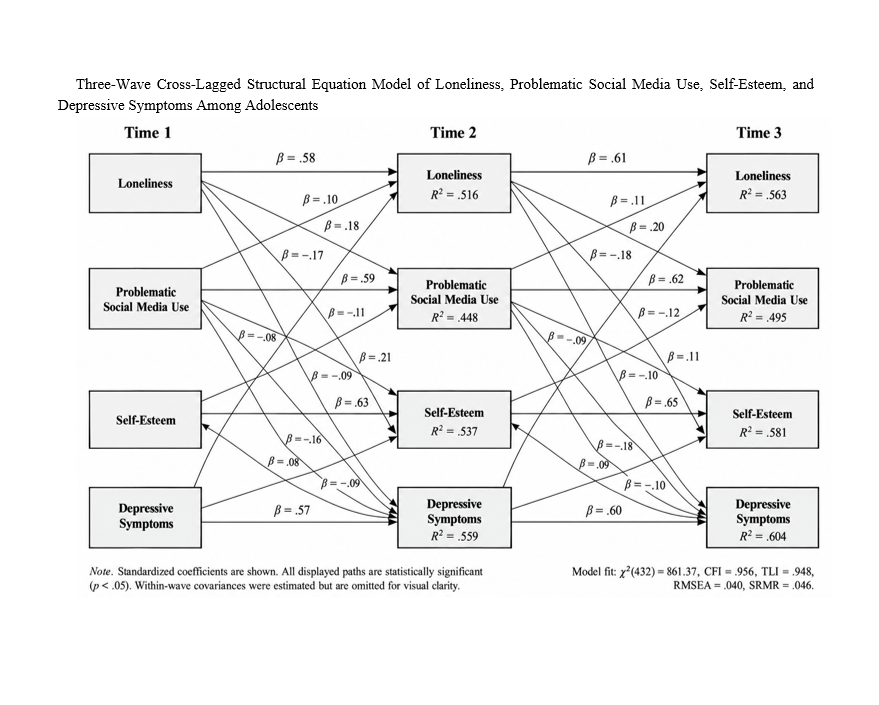
Findings: The final structural model showed good fit, χ²(432) = 861.37, CFI = .956, TLI = .948, RMSEA = .040, and SRMR = .046. All four constructs demonstrated significant temporal stability across both intervals. Loneliness predicted greater subsequent problematic social media use (β = .18 and .20), lower self-esteem (β = −.17 and −.18), and higher depressive symptoms (β = .21 and .22; all p < .001). Reverse effects were also significant, with problematic social media use, lower self-esteem, and depressive symptoms predicting later loneliness. Problematic social media use predicted lower subsequent self-esteem and higher depressive symptoms, while self-esteem and depressive symptoms showed significant reciprocal effects across both intervals. Equality-constrained analyses indicated that the principal cross-lagged effects were stable across time.
Conclusion: The findings indicate that loneliness, problematic social media use, self-esteem, and depressive symptoms form a reciprocal and relatively stable longitudinal network during adolescence, with loneliness emerging as a particularly important prospective predictor of later psychosocial difficulties.
Downloads
References
Adili, A., Dilihumaer, A., Zhu, H., & Tang, H. (2024). Research Progress on Phosphodiesterase 4 Inhibitors in Central Nervous System Diseases. Journal of Zhejiang University (Medical Sciences). https://doi.org/10.3724/zdxbyxb-2024-0023
Che, Q., Sun, Y., Jin, J., Zhu, C., Wang, K., Ye, R., & Yu, F. (2024). The Application of Neurofeedback for Positive Emotion Enhancement in Depression Treatment. Advances in Psychological Science, 32(2), 342. https://doi.org/10.3724/sp.j.1042.2024.00342
Chen, Q., & Feng, J. (2024). Progress of Research on Information and Communication Technology (ICT) in Children’s Geography and Implications. 地理科学进展, 43(1), 147-162. https://doi.org/10.18306/dlkxjz.2024.01.011
Chen, Y., Ma, Y., Fan, X., Lyu, J., & Yang, R. (2024). Facial Expression Recognition Ability and Its Neuropsychological Mechanisms in Children With Attention Deficit and Hyperactive Disorder. Journal of Zhejiang University (Medical Sciences), 53(2), 254-260. https://doi.org/10.3724/zdxbyxb-2023-0390
Chmiel, M., Cieśluk, M., & Znajdek, J. (2026). Loneliness and Problematic Social Media Use Among Adolescents: The Mediating Role of Fear of Missing Out. Brain Sciences, 16(7), 724. https://doi.org/10.3390/brainsci16070724
Gao, Q., Chen, M. F., Sun, J., Li, Y., Wang, W., Xiang, S., Xie, M., & Lin, D. (2026). Family Environmental Unpredictability and Adolescent Physiological and Psychological Health: The Buffering Role of Positive School Climate. Acta Psychologica Sinica, 58(9), 1720. https://doi.org/10.3724/sp.j.1041.2026.1720
Haidabieke, A., Zhou, T., Yu, J., Wang, J., Chen, F., & Ding, X. (2024). Understanding the Adjustment Functions of Solitude From a Lifespan Development Perspective: A Five-Round Comparison of Benefits and Costs. Advances in Psychological Science, 32(2), 330. https://doi.org/10.3724/sp.j.1042.2024.00330
Huang, S., Lai, X., Zhang, C., Xinmei, Z., Xinran, D. A. I., Mengdi, Q. I., Wenrong, W., & Wang, Y. (2024). Relationship Between Adolescents’ Smartphone Stress and Mental Health: Based on the Multiverse-Style Analysis and Intensive Longitudinal Method. Acta Psychologica Sinica, 56(6), 745. https://doi.org/10.3724/sp.j.1041.2024.00745
Kong, X., & Mao, H. (2026). Diagnostic Transitions in Adolescent Inpatients With Mental Disorders: A Retrospective Cohort Study. Journal of Zhejiang University (Medical Sciences), 55(8), 714-722. https://doi.org/10.3724/zdxbyxb-2025-0680
Liu, D., Li, Y., Chen, P., & Guo, Y. (2026). Effects of Exercise Interventions on Anxiety and Depressive Symptoms in Patients With Fibromyalgia: A Traditional and Network Meta-Analysis. Journal of Zhejiang University (Medical Sciences). https://doi.org/10.3724/zdxbyxb-2025-0925
Meng, X., Chen, Y., Wang, X., Yuan, J., & Yu, D. (2024). The Relationship Between School Connectedness and Depression: A Three-Level Meta-Analytic Review. Advances in Psychological Science, 32(2), 246. https://doi.org/10.3724/sp.j.1042.2024.00246
Meng, X., Luo, Y., Han, C., Wu, G., Chang, J., Yuan, J., & Fu, X. (2024). Social Inclusion Regulates the Effect of Social Exclusion on Adaptation to Emotional Conflict. Acta Psychologica Sinica, 56(5), 577. https://doi.org/10.3724/sp.j.1041.2024.00577
Song, T., & Xu, L. (2024). Review and Prospect of Research on Residential Balcony Environment From the Perspective of Healing. Landscape Architecture, 31(2), 87-94. https://doi.org/10.3724/j.fjyl.202303010107
Sun, Y., Zhao, C., Peng, S., Zhang, T., Liang, Y., & Cui, Y. (2026). Associations Between Multimorbidity Patterns and Depressive Symptoms Among Middle-Aged and Older Adults: A Latent Class Analysis Based on CHARLS Data. Journal of Zhejiang University (Medical Sciences), 55(8), 774-782. https://doi.org/10.3724/zdxbyxb-2025-0615
Wang, M., Suo, T., & Jiang, Y. (2024). “A Continuous Process” and “Three Stages”: An Analysis of the Etiology of Emotional Dysregulation in Depressed Adolescents. Advances in Psychological Science, 32(6), 928. https://doi.org/10.3724/sp.j.1042.2024.00928
Wei, G.-X., Ge, L.-K., & Lin, X. (2024). A Decade of Progress in Sports and Exercise Neuroscience From 2012 to 2022: A Review and Perspectives. Chinese Science Bulletin (Chinese Version), 69(24), 3492-3514. https://doi.org/10.1360/tb-2024-0034
Wen, S., Yu, X., Gong, J., Zhang, X. D., Sun, J., Zhang, S., & Lyu, H. (2024). A Three-Level Meta-Analysis of the Relationship Between Family Dysfunction and Mental Health of Children and Adolescents. Advances in Psychological Science, 32(5), 771. https://doi.org/10.3724/sp.j.1042.2024.00771
Xianxin, M., Chen, Y. A. N., Delin, Y. U., Shuling, G. A. O., & Fu, X. (2024). The Association Between Childhood Maltreatment and Internet Addiction: A Three-Level Meta-Analysis. Advances in Psychological Science, 32(7), 1087. https://doi.org/10.3724/sp.j.1042.2024.01087
Yongmei, H., & Hongyu, Z. (2023). The Influences of Adult Attachment and Gender onMental Health Among Medical Undergraduates. Ha. https://doi.org/10.57237/j.ha.2022.02.002
Zeng, J., Lin, Z., Chen, Y., Jin, C., Xiao, Y., & Jiang, W. (2026). Evolution and Influencing Factors of Disease Burden of Depres-Sive Disorders and Depressive Levels Among Chinese Adolescents. Journal of Zhejiang University (Medical Sciences), 55(8), 691-702. https://doi.org/10.3724/zdxbyxb-2025-0757
Zhang, C., & Lin, P. (2026). Effect of Network Literacy on Depression Levels Among Young Adults: An Analysis Based on China Family Panel Studies. Journal of Zhejiang University (Medical Sciences), 55(8), 723-733. https://doi.org/10.3724/zdxbyxb-2025-0742
Zhou, X., Zhang, J., Xu, L., & Jin, A. (2024). Protective Environment Strategies for Hematopoietic Stem Cell Transplantation: Progress and Prospects. Journal of Zhejiang University (Medical Sciences), 53(6), 796-803. https://doi.org/10.3724/zdxbyxb-2024-0082
Downloads
Additional Files
Publication Timeline
- Submitted
- Revised
- Accepted