Structural Equation Modeling of Adolescent Psychological Well-Being Based on Family Cohesion, Peer Support, and Self-Esteem
Keywords:
Psychological well-being, family cohesion, peer support, self-esteem, adolescents, structural equation modelingAbstract
Objective: This study aimed to test a structural equation model of adolescent psychological well-being based on family cohesion, peer support, and self-esteem, with particular attention to the direct and indirect effects of family and peer variables through self-esteem.
Methods and Materials: This descriptive-correlational, cross-sectional study was conducted among 512 adolescents aged 13–18 years enrolled in secondary schools in Canada during the 2025–2026 academic year. Participants were selected through multistage cluster sampling. Data were collected using the 42-item Ryff Psychological Well-Being Scale, the Balanced Cohesion Scale of FACES IV, the Friends subscale of the Multidimensional Scale of Perceived Social Support, and the Rosenberg Self-Esteem Scale. Data were analyzed using IBM SPSS Statistics and AMOS. Pearson correlation analysis, confirmatory factor analysis, and structural equation modeling with maximum likelihood estimation were performed. Indirect effects were examined using bias-corrected bootstrapping with 5,000 resamples.
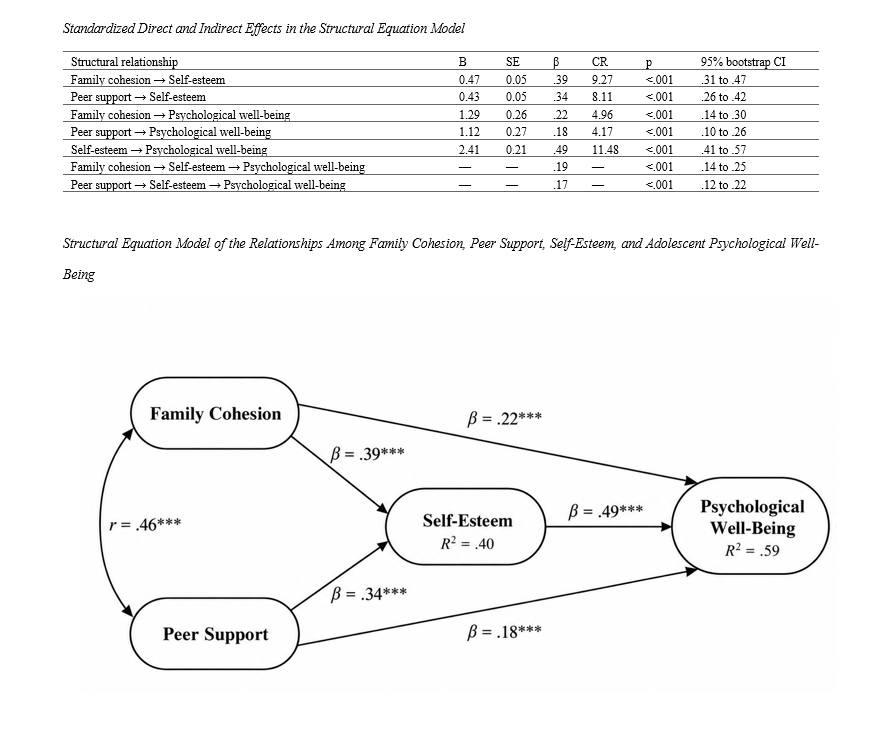
Findings: The structural model demonstrated acceptable fit, χ²/df = 2.36, CFI = .946, TLI = .940, RMSEA = .052, and SRMR = .045. Family cohesion significantly predicted self-esteem (β = .39, p < .001) and psychological well-being (β = .22, p < .001), while peer support significantly predicted self-esteem (β = .34, p < .001) and psychological well-being (β = .18, p < .001). Self-esteem had the strongest direct effect on psychological well-being (β = .49, p < .001). Significant indirect effects on psychological well-being through self-esteem were observed for family cohesion (β = .19, p < .001) and peer support (β = .17, p < .001). The model explained 39.8% of the variance in self-esteem and 58.7% of the variance in psychological well-being.
Conclusion: Adolescent psychological well-being is associated with both interpersonal resources and positive self-evaluation, with self-esteem partially mediating the effects of family cohesion and peer support.
Downloads
References
Armitage, J. M., Wang, A., Davis, O. S. P., Collard, P., & Haworth, C. M. A. (2021). Positive Wellbeing and Resilience Following Adolescent Victimisation: An Exploration Into Protective Factors Across Development. JCPP Advances, 1(2). https://doi.org/10.1002/jcv2.12024
Brown, B., & Browne, D. T. (2024). Youth Mental Health in a Canadian Community Sample During COVID‐19: Exploring the Role of Perceived Sense of Belonging. Journal of Community Psychology, 52(6), 720-738. https://doi.org/10.1002/jcop.23125
Chen, N., Jing, Y., & Pang, Y. (2022). Relation Between Parent and Child or Peer Alienation and Life Satisfaction: The Mediation Roles of Mental Resilience and Self-Concept Clarity. Frontiers in psychology, 13. https://doi.org/10.3389/fpsyg.2022.1023133
Chen, Y. W., Lu, F., Sun, D., Liao, C., & Na, M. (2025). Psychological Detachment in Chinese Higher Education: A Multitheoretical Model of Academic Stress, Cultural Pressure, and Coping Resources. Frontiers in psychology, 16. https://doi.org/10.3389/fpsyg.2025.1647184
Chiao, C., & Chyu, L. (2022). Perceived Peer Relationships in Adolescence and Loneliness in Emerging Adulthood and Workplace Contexts. Frontiers in psychology, 13. https://doi.org/10.3389/fpsyg.2022.794826
Çi̇çek, İ., Korkmaz, Z., Ünsal, F., Gómez‐Salgado, J., & Yıldırım, M. (2025). The Effect of Secure Attachment on Family Relationships and Peer Bullying in Adolescents: The Mediating Role of Positive Childhood Experiences. Frontiers in psychology, 16. https://doi.org/10.3389/fpsyg.2025.1700648
Dam, V. A. T., Ngoc, H., Vu, T. B. T., Vu, K. L., Minh, H. V., Nguyen, N. T. T., Nguyen, T. T., Vu, T. M. T., Nguyen, T. P. T., Auquier, P., Boyer, L., Fond, G. B., Latkin, C. A., Ho, C. S. H., & Ho, R. (2023). Associations Between Parent-Child Relationship, Self-Esteem, and Resilience With Life Satisfaction and Mental Wellbeing of Adolescents. Frontiers in Public Health, 11. https://doi.org/10.3389/fpubh.2023.1012337
Deniz, E., Noret, N., Chow, A. R. W., Baldwin, J. R., & Toseeb, U. (2026). Bullying Trajectories From Childhood to Adolescence: The Relationship With Mental Health Outcomes for Autistic and Neurotypical Youth. Autism Research, 19(5). https://doi.org/10.1002/aur.70227
Deniz, E., & Toseeb, U. (2023). A Longitudinal Study of Sibling Bullying and Mental Health in Autistic Adolescents: The Role of Self‐esteem. Autism Research, 16(8), 1533-1549. https://doi.org/10.1002/aur.2987
Enwere, C. A., & Iloakasia, A. J. (2024). The Role of Self-Esteem in Predicting Psychological Well-Being Among Senior Secondary School Adolescents in Anambra State: A Gender Perspective. Applied Psychology Research, 3(2), 1555. https://doi.org/10.59400/apr1555
Esnaola, I., Martínez‐Gregorio, S., Azpiazu, L., Antonio‐Agirre, I., & Oliver, A. (2025). Do Parent Trust and Trait Emotional Intelligence Predict Self‐Concept? A Longitudinal Study. Psychology in the Schools, 62(12), 5020-5037. https://doi.org/10.1002/pits.70057
Farmakopoulou, I., Lekka, M., & Gkintoni, E. (2024). Clinical Symptomatology of Anxiety and Family Function in Adolescents—The Self-Esteem Mediator. Children, 11(3), 338. https://doi.org/10.3390/children11030338
Fino, E., Kapllanaj, M., Crocetti, E., & Rubini, M. (2023). Who Matters the Most? The Role of Parents, Teachers, and Peers’ Support in Adolescents’ Well-Being. https://doi.org/10.20944/preprints202306.1229.v1
Ge, X. (2025). Bullying Victimization, Suicidal Behavior, and Help-Seeking in Chinese Adolescents: A Legal-Psychological Study of Resilience and Responsibility. Frontiers in psychology, 16. https://doi.org/10.3389/fpsyg.2025.1625188
Hirani, S., Ojukwu, E., & Bandara, N. A. (2022). Understanding the Role of Prosocial Behavior in Youth Mental Health: Findings From a Scoping Review. Adolescents, 2(3), 358-380. https://doi.org/10.3390/adolescents2030028
Hoferichter, F., Kulakow, S., & Hufenbach, M. C. (2021). Support From Parents, Teachers, and Peers Is Differently Associated With School Students’ Well-Being. https://doi.org/10.31234/osf.io/mp3hq
Huang, X., Hu, N., Yao, Z., & Peng, B. (2022). Family Functioning and Adolescent Depression: A Moderated Mediation Model of Self-Esteem and Peer Relationships. Frontiers in psychology, 13. https://doi.org/10.3389/fpsyg.2022.962147
Huang, Y., Lu, J., & Širůček, J. (2023). The Associations Between Social Environment and Adolescents’ Psychosomatic Health: An Ecological Perspective. Frontiers in psychology, 14. https://doi.org/10.3389/fpsyg.2023.1141206
Jiang, L. (2026). Behavioral and Computational Perspectives on Emotion Regulation and Subjective Wellbeing: An Integrative Review With a Focus on Adolescents. Frontiers in psychology, 17. https://doi.org/10.3389/fpsyg.2026.1778913
Kanth, D. B. (2022). Effects of Personal Relationships on Physical and Mental Health Among Young Adults- A Scoping Review. The Open Psychology Journal, 15(1). https://doi.org/10.2174/18743501-v15-e2208180
Kassis, W., Vasiou, A., Govaris, C., Rietz, C., & Graf, U. (2023). Individual and Social Predictors of Greek Early Adolescents’ Self-Determination: A Longitudinal Structural Equation Analysis. Psychology the Journal of the Hellenic Psychological Society, 28(2), 176-194. https://doi.org/10.12681/psy_hps.31471
Kim, T. (2026). Multilevel Socioecological Correlates of Physical Activity, Flourishing, and Depression in Children and Adolescents: A Structured Evidence Synthesis. Frontiers in Public Health, 14. https://doi.org/10.3389/fpubh.2026.1871867
Lin, J., & Guo, W. (2024). The Research on Risk Factors for Adolescents’ Mental Health. Behavioral Sciences, 14(4), 263. https://doi.org/10.3390/bs14040263
Monika, M., Majeed, J., & Sharma, N. (2023). Psychological Well-Being of Adolescents. JRTDD. https://doi.org/10.53555/jrtdd.v6i7s.2157
Mussina, Z., & Lawrence, K. C. (2026). Ethnic Identity Can Moderate the Relationship Between Self-Esteem, Peer Relationships, and Mental Well-Being of Adolescent and Youth. BMC psychology, 14(1). https://doi.org/10.1186/s40359-026-04046-y
Nedungadi, P., Menon, R., Gutjahr, G., & Raman, R. (2023). Adolescents as Ambassadors in Substance Abuse Awareness Programs: Interpersonal and Intrapersonal Effects. Sustainability, 15(4), 3491. https://doi.org/10.3390/su15043491
Németh, L., & Bernáth, L. (2022). The Mediating Role of Global and Contingent Self-Esteem in the Association Between Emerging Adults’ Perceptions of Family Cohesion and Test Anxiety. Journal of Adult Development, 29(3), 192-204. https://doi.org/10.1007/s10804-022-09396-6
Ruiz, Y. P., Pérez-Torres, V., Angulo-Brunet, A., García, J. E. N., & Gallardo‐Nieto, E. (2025). School, Family, and Peer Connectedness as Protective Factors for Depression and Suicide Risk in Spanish Adolescents. Frontiers in psychology, 16. https://doi.org/10.3389/fpsyg.2025.1547759
Runions, K., Sae-Koew, J. H., Pearce, N., Sarasjärvi, K. K., Attey, M., & Mitrou, F. (2024). Pathways of Socioeconomic Disadvantage and Peer Bullying in Children and Youth: A Scoping Review. Health Education & Behavior, 52(1), 122-134. https://doi.org/10.1177/10901981241275631
Saiding, A., Wang, H., Ma, J., Zhang, H., Guo, K., Wu, Y., Luo, X., & Chen, C. (2025). Belief in Others and Social Anxiety Symptoms Among Rural Chinese Adolescents: A Moderated Mediation Model of Self-Esteem and Gender. School Psychology International, 46(5), 475-498. https://doi.org/10.1177/01430343251377115
Sarwar, A., Islam, M. A., Mohiuddin, M., Tareq, M. A., & Siddika, A. (2022). Social Connections and Self-Perceived Depression: An Enhanced Model for Studying Teenagers’ Mental Wellbeing. International journal of environmental research and public health, 19(23), 15791. https://doi.org/10.3390/ijerph192315791
Sherwood, S. H. (2026). Life Outside the Closet: How Disclosure Reactions Shape Mental Health for Sexual and Gender Diverse Youth in European Schools. Psychology of Sexual Orientation and Gender Diversity. https://doi.org/10.1037/sgd0000953
Sitnik‐Warchulska, K., Izydorczyk, B., Markevych, I., Baumbach, C., Mysak, Y., Buczyłowska, D., Szwed, M., & Lipowska, M. (2025). Family Cohesion and Behavioural Problems in Young Adolescents: Mediating Effects of Neighbourhood Cohesion and Moderating Roles of Individual and Family Structure Factors. Journal of Community & Applied Social Psychology, 35(2). https://doi.org/10.1002/casp.70071
Tay‐Karapas, K., Guzmán‐González, M., Bahamondes, J., & Comino, P. (2025). Maternal and Paternal Attachment and Subjective Well‐being in Adolescents Who Experienced Parental Divorce. Family Relations, 74(4), 1946-1960. https://doi.org/10.1111/fare.13163
Toseeb, U., & Wolke, D. (2021). Sibling Bullying: A Prospective Longitudinal Study of Associations With Positive and Negative Mental Health During Adolescence. Journal of youth and adolescence, 51(5), 940-955. https://doi.org/10.1007/s10964-021-01495-z
Verdugo, L., & Sánchez‐Sandoval, Y. (2022). Psychological and Social Adjustment as Antecedents of High School Students’ Future Expectations. Journal of Psychologists and Counsellors in Schools, 32(1), 39-53. https://doi.org/10.1017/jgc.2020.1
Ying, L., Zhang, S., & Jia, X. (2022). Peer Attachment and Self‐esteem Mediate the Relationship Between Family Function and Social Anxiety in Migrant Children in China. Child Care Health and Development, 49(3), 563-571. https://doi.org/10.1111/cch.13072
Downloads
Additional Files
Publication Timeline
- Submitted
- Revised
- Accepted