Exploring the Dimensions and Components of Educational Governance Affecting Adolescent Identity Formation: A Qualitative Study Using Thematic Analysis
Keywords:
Educational Governance, Governance Dimensions, Adolescent Identity Formation, Thematic Analysis, Sustainable DevelopmentAbstract
Objective: This study aimed to explore the dimensions and components of educational governance that influence adolescent identity formation.
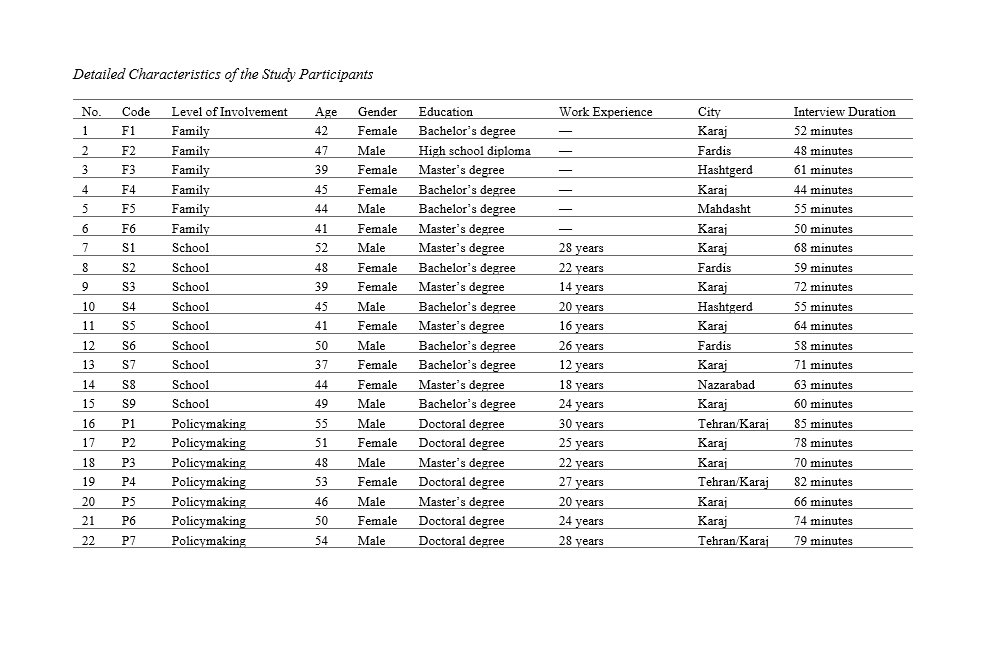
Methods and Materials: This qualitative study was conducted in Alborz Province using thematic analysis based on Braun and Clarke’s six-phase framework. Data were collected through semi-structured interviews with 22 participants representing three key levels of the educational governance system: family, school, and policymaking. Participants were selected to provide diverse perspectives on the mechanisms through which educational governance shapes adolescents’ identity development. The interview data were analyzed through six systematic phases: familiarization with the data, generation of initial codes, searching for themes, reviewing themes, defining and naming themes, and producing the final report. The analysis focused on identifying interconnected structural, procedural, and value-cultural mechanisms affecting adolescent identity formation.
Findings: The thematic analysis yielded three overarching dimensions that collectively constituted the central theme of the “educational governance network gap.” The structural dimension encompassed excessive centralization, implementation gaps, weaknesses in monitoring and evaluation, project-based and episodic approaches, ambiguity in institutional missions, and instability at middle-management levels. The procedural dimension included inter-institutional conflicts in education, poor coordination within the educational network, exclusion of adolescents from participatory processes, educational inconsistency, mutual blame and avoidance of responsibility, and ceremonial or slogan-based programs. The value-cultural dimension comprised an excessive emphasis on academic achievement and university entrance examinations, generational gaps and conflicts between traditional and modern values, globalization and the dominance of digital culture, declining social capital and institutional trust, structural vulnerabilities within families, and contextual diversity in Alborz Province. These dimensions were interrelated and jointly influenced adolescents’ opportunities for coherent identity formation.
Conclusion: Effective educational governance for adolescent identity formation requires simultaneous attention to structural, procedural, and value-cultural dimensions and a transition from centralized, fragmented, and directive governance toward a network-based, participatory, accountable, and identity-oriented model.
Downloads
References
Abdallah, A. K., Al Khanbooli, B., Al Kaabi, N. A. M., & Al Awadhi, M. A. (2024). Bridging Innovative Technologies with Progressive Educational Governance. In Cutting-Edge Innovations in Teaching, Leadership, Technology, and Assessment (pp. 84-99). IGI Global Scientific Publishing.
Alexsandy, F., Sapdi, R. M., & Mulyana, C. (2025). Neoliberal Control Mechanisms and Their Impact on Islamic Educational Governance. Journal of Educational Management Research, 4(6), 2832-2845.
Amani, Z., & Dehghan, S. (2023). The Role of Educational Governance in Achieving Educational Justice in Public Schools. Quarterly Journal of Educational Management, 14(1), 23-44.
Bagheri Movahed, M., Shahriari, G., Esfandiari, S., Shahabinejad, A., & Hosseini, S. A. (2025). A Comparative Study of Educational Governance Models and Their Role in Managing School Transformation in the Digital Age Second National Conference on Humanities with a New Approach and First International Research Conference of Modern Educators, Astara.
Castendi, S., Munawir, M., Raharjo, K., Djalil, M. A., Syahputra, H., Muslim, B., & Adam, M. (2022). Educational governance and the challenges of universities in the Persian Gulf region. Journal of Applied Research in Higher Education, 10(3), 60-72.
Chen, Y. (2025). Analyzing the Impact of Social Media Usage on the Formation of Self-Identity Among Chinese Adolescents. Lecture Notes in Education Psychology and Public Media, 85(1), 186-192. https://doi.org/10.54254/2753-7048/2025.21366
Gallagher, M., Evans, P., & Saqrpong-Duah, J. (2024). Radiating Out Rather than Scaling Up: Horizontalism and Digital Educational Governance in Ghana. International Journal of Educational Development.
Gurram, N. T., Narender, M., Bhardwaj, S., & Kalita, J. P. (2025). A Hybrid Framework for Smart Educational Governance Using AI, Blockchain, and Data-Driven Management Systems. Advances in consumer research, 2(5).
Heydari, A. (2024). Analysis of Iran's Teacher Education Policymaking System Based on the Educational Governance Model.
Ioannidou, A., & Zarifis, G. (2026). Educational Governance and the Construction of Learning Outcomes of Young Adults in Europe: Conceptual Aspects and Empirical Evidence. Studies in the Education of Adults, 58(1), 403-420.
Jahanshahi, R., Haghighatian, M., & Bahian, S. (2024). Sociologically Investigating the Impact of Cultural Factors on the National Identity Reproduction in Students. Sociology of Education, 10(1), 183-192. https://doi.org/10.22034/ijes.2023.2013621.1481
Jahanshahi, R., Haghighatian, M., & Behian, S. (2024). Examining Structural Threat Factors Affecting the Reproduction of National Identity in Adolescents (Case Study: Students of Kohgiluyeh and Boyer-Ahmad Province). Sociology of Education(33), 20-31. https://www.iase-jrn.ir/article_715967.html
Khalafi, S. (2024). Predicting Identity Formation in Adolescents based on Emotional Capital and Moral Disengagement Factors. Iranian Journal of Educational Research, 3(4), 451-462. https://ijer.hormozgan.ac.ir/article-1-180-en.html
Lathifah, H., & Prastiwi, Y. (2025). Adolescent Identity Formation Under Terminal Illness: A Psychosocial Education Approach. J. Found. Learn. Child Dev, 1(02), 35-41. https://doi.org/10.53905/childdev.v1i02.7
Maniei, R., Soleimani, N., Abbaszade, N., & Tabatabaee, S. M. (2019). Identification of effective factors on good educational governance in educational system using three-branch theory. medical journal of mashhad university of medical sciences, 61(suppl. 1), 223-230. https://doi.org/10.22038/mjms.2019.14344
Nichols, T. P., & Thrall, A. (2025). Platformed Privatization: Data, Technology, and the Changing Infrastructure of Educational Governance. In Research Handbook on Education Privatization and Marketization (pp. 108-121). Edward Elgar Publishing.
Rezaei, M., Ahmadi, A., & Karimi, S. (2022). Educational Governance and Stakeholder Participation in the Education System. Quarterly Journal of Educational Management, 15(3), 59-78.
Rodrigues, C., Neto-Mendes, A., Santos, M., & Gouveia, A. (2025). Mapping Problems and Approaches in Educational Governance: A Systematic Literature Review. Education Sciences, 15(8), 1048.
Sergiovanni, T. j., Kelleher, p., McCarthy, M., & Wirt, F. M. (2004). Educational Governance and Administration. pearson Eduation, Ins. https://books.google.com/books/about/Educational_Governance_and_Administratio.html?id=9pAeMAAACAAJ
Downloads
Additional Files
Publication Timeline
- Submitted
- Revised
- Accepted