Comparison of the Effects of Gamification and Traditional Educational Methods on Students' Basic Psychological Needs and Prosocial and Antisocial Behaviors in Physical Education Classes
Keywords:
gamification, physical education, prosocial behaviors, self-determination theoryAbstract
Objective: The aim of the present study was to compare the effects of gamification and traditional educational methods on students' basic psychological needs and prosocial and antisocial behaviors in physical education classes.
Methods and Materials: In this quasi-experimental study, the statistical population consisted of seventh-grade female students in Tabriz schools. Two classes were selected using convenience sampling from one of the schools and were then randomly assigned, with one class serving as the experimental group (n = 33) and the other as the control group (n = 25). The experimental group received basketball training through a gamification approach, whereas the control group received the same content using a traditional teaching approach. The intervention was implemented over eight sessions (one session per week, with each session lasting 90 minutes). Data were collected using the Basic Needs in the Game questionnaire developed by Ballou et al. (2024) and the Prosocial and Antisocial Behavior in Sport Scale developed by Kavussanu and Boardley (2009).
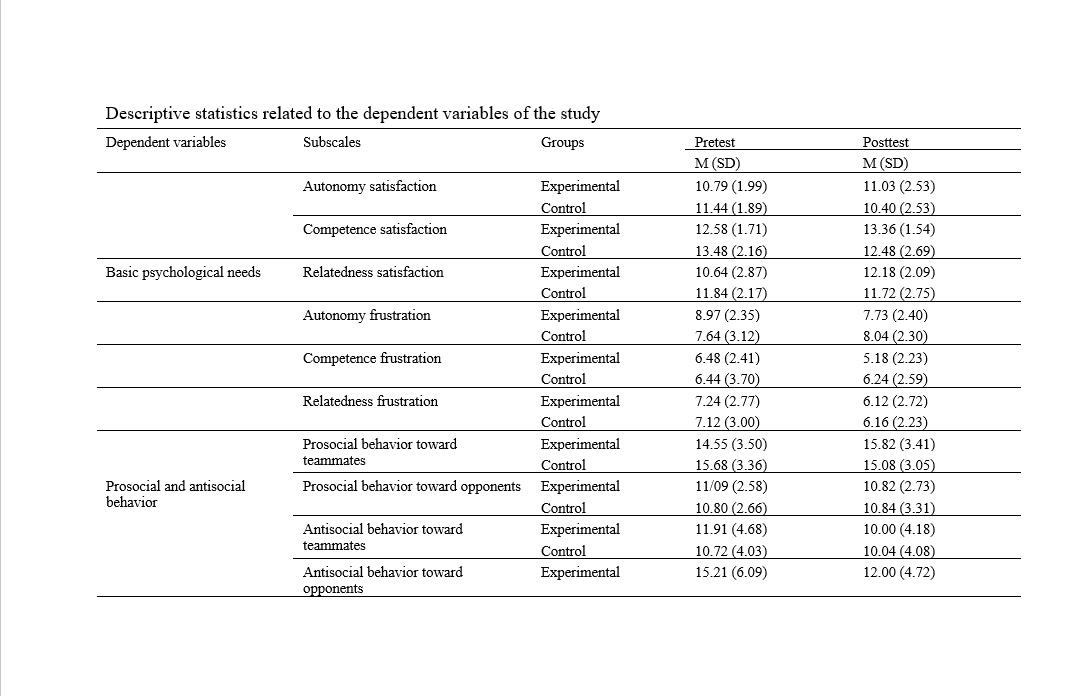
Findings: The findings showed that gamification, compared with the traditional method, increased satisfaction of competence and relatedness and reduced autonomy frustration among students. Gamification also increased prosocial behaviors and decreased antisocial behaviors.
Conclusion: Based on these findings, the use of gamification in girls' junior high school physical education classes can be considered an effective approach in the educational process by influencing students' basic psychological needs and prosocial and antisocial behaviors.
Downloads
References
Antonopoulos, N. (2024). Digital Gamification and Physical Activity of Students. Iosr Journal of Sports and Physical Education, 11(6), 46-59. https://doi.org/10.9790/6737-1106014659
Ballou, N., Denisova, A., Ryan, R., Rigby, C. S., & Deterding, C. S. (2024). The Basic Needs in Games Scale (BANGS): A New Tool for Investigating Positive and Negative Video Game Experiences. International Journal of Human-Computer Studies, 188, 103289. https://doi.org/10.1016/j.ijhcs.2024.103289
Banik, B. G., & Gullapelly, A. (2025). AI-Powered Gamification and Interactive Learning Tools for Enhancing Student Engagement. 283-310. https://doi.org/10.4018/979-8-3693-8292-9.ch013
Behzadnia, B. (2021). The Relations Between Students' Causality Orientations and Teachers' Interpersonal Behaviors with Students' Basic Need Satisfaction and Frustration, Intention to Physical Activity, and Well-Being. Physical Education and Sport Pedagogy, 26(6), 613-632. https://doi.org/10.1080/17408989.2020.1849085
Behzadnia, B., Mollaei Zangi, F., Rezaei, F., & Eskandarnejad, M. (2024). Predicting Students' Basic Psychological Needs, Motivation, and Well-Being in Online Physical Education: A Semester-Term Longitudinal Study. International Journal of Sport and Exercise Psychology, 22(7), 1588-1606. https://doi.org/10.1080/1612197X.2023.2237051
Behzadnia, B., Rezaei, F., & Salehi, M. (2022). A Need-Supportive Teaching Approach Among Students with Intellectual Disability in Physical Education. Psychology of Sport and Exercise, 60, 102156. https://doi.org/10.1016/j.psychsport.2022.102156
Cheon, S. H., Reeve, J., & Marsh, H. W. (2023). Autonomy-Supportive Teaching Enhances Prosocial and Reduces Antisocial Behavior via Classroom Climate and Psychological Needs: A Multilevel Randomized Control Intervention. Journal of Sport and Exercise Psychology, 45(1), 26-40. https://doi.org/10.1123/jsep.2021-0337
Davies, K. F., Clarke, S., Martins, R., Rudd, J., & Duncan, M. (2024). The Effect of a Home-Based, Gamified Stability Skills Intervention on 4-5-Year-Old Children's Physical and Cognitive Outcomes: A Pilot Study. Psychology of Sport and Exercise, 73, 102636. https://doi.org/10.1016/j.psychsport.2024.102636
Diana, R., Kassymova, G. K., Issaliyeva, S., Nursultan, M., & Orynbayeva, A. (2025). Assessing the Influence of Gamification on Student Motivation in English Language Acquisition. Muallim Journal of Social Sciences and Humanities, 1-11. https://doi.org/10.33306/mjssh/304
Dólera-Montoya, S., Valero-Valenzuela, A., Jiménez-Parra, J. F., & Manzano-Sánchez, D. (2021). Improvement of the Classroom Climate Through a Plan of Gamified Coexistence with Physical Activity: Study of Its Effectiveness in Primary Education. Espiral. Cuadernos del Profesorado, 14(28), 65-77. https://doi.org/10.25115/ecp.v14i28.4420
Fernandez-Rio, J., De Las Heras, E., González, T., Trillo, V., & Palomares, J. (2020). Gamification and Physical Education: Viability and Preliminary Views from Students and Teachers. Physical Education and Sport Pedagogy, 25(5), 509-524. https://doi.org/10.1080/17408989.2020.1743253
Fernandez-Rio, J., Zumajo-Flores, M., & Flores-Aguilar, G. (2022). Motivation, Basic Psychological Needs and Intention to Be Physically Active After a Gamified Intervention Programme. European Physical Education Review, 28(2), 432-445. https://doi.org/10.1177/1356336X211052883
Ferraz, R., Ribeiro, D., Alves, A. R., Teixeira, J. E., Forte, P., & Branquinho, L. (2024). Using Gamification in Teaching Physical Education: A Survey Review. Montenegrin Journal of Sports Science & Medicine, 13(1), 31-44. https://doi.org/10.26773/mjssm.240304
Ferriz-Valero, A., Østerlie, O., Martínez, S. G., & García-Jaén, M. (2020). Gamification in Physical Education: Evaluation of Impact on Motivation and Academic Performance Within Higher Education. International journal of environmental research and public health, 17(12), 4465. https://doi.org/10.3390/ijerph17124465
Ferriz Valero, A., Agulló-Pomares, G., & Tortosa-Martínez, J. (2023). Benefits of Gamified Learning in Physical Education Students: A Systematic Review. Apunts Educación Física y Deportes, 153, 39-51. https://doi.org/10.5672/apunts.2014-0983.es.(2023/3).153.04
Flores-Aguilar, G., Prat-Grau, M., Fernández-Gavira, J., & Muñoz-Llerena, A. (2023). 'I Learned More Because I Became More Involved': Teacher's and Students' Voice on Gamification in Physical Education Teacher Education. International journal of environmental research and public health, 20(4), 3038. https://doi.org/10.3390/ijerph20043038
Gil-Madrona, P., López, P. J. C., Martín, I. P., & Martínez, A. M. (2022). Gamification in Physical Education Through the Popular Games of Don Quijote de la Mancha to Improve Affective Domain and Social Interactions. In Handbook of Research on Using Motor Games in Teaching and Learning Strategy (pp. 20-44). IGI Global Scientific Publishing. https://doi.org/10.4018/978-1-7998-9621-0.ch002
Hossein Nejad, A., & Mohammadi, S. (2022). Psychometrics Persian Version of the Questionnaire of Social and Antisocial Behaviors in Sports. Iranian Journal of Motor Behavior and Sport Psychology, 1(3), 67-79.
Jang, H. R., Reeve, J., Cheon, S. H., & Song, Y. G. (2020). Dual Processes to Explain Longitudinal Gains in Physical Education Students' Prosocial and Antisocial Behavior: Need Satisfaction from Autonomy Support and Need Frustration from Interpersonal Control. Sport, Exercise, and Performance Psychology, 9(3), 471-487. https://doi.org/10.1037/spy0000168
Lapusniak, S. (2022). Physical Activity Promotion in Children Using a Novel Smartphone Game: A Pilot Randomized Controlled Trial University of British Columbia].
Martí-Parreño, J., Galbis-Córdova, A., & Currás-Pérez, R. (2021). Teachers' Beliefs About Gamification and Competencies Development: A Concept Mapping Approach. Innovations in Education and Teaching International, 58(1), 84-94. https://doi.org/10.1080/14703297.2019.1683464
Montesinos, C. H., Gil-Madrona, P., Bartolomé, J. G., & Molina, A. S. (2022). A Proposal of a Gamified Physical Education Lesson to Enhance Social and Emotional Skills in Primary Education. In Handbook of Research on Using Motor Games in Teaching and Learning Strategy (pp. 434-443). IGI Global Scientific Publishing. https://doi.org/10.4018/978-1-7998-9621-0.ch024
Otani, V., Uchida, R., & Vissoci, J. (2024). Gamification, Social Skills and Mental Health Promotion. Frontiers in Psychiatry, 15, 1441344. https://doi.org/10.3389/fpsyt.2024.1441344
Quintas, A., Bustamante, J. C., Pradas, F., & Castellar, C. (2020). Psychological Effects of Gamified Didactics with Exergames in Physical Education at Primary Schools: Results from a Natural Experiment. Computers & Education, 152, 103874. https://doi.org/10.1016/j.compedu.2020.103874
Real-Pérez, M., Sánchez Oliva, D., & Padilla Moledo, C. (2021). Africa Project 'La Leyenda de Faro': Effects of a Methodology Based on Gamification on Situational Motivation About the Content of Corporal Expression in Secondary Education. Retos, 42, 567-574. https://doi.org/10.47197/retos.v42i0.86124
Roure, C., & Pasco, D. (2022). Exploring the Effects of a Context Personalization Approach in Physical Education on Students' Interests and Perceived Competence. Journal of Teaching in Physical Education, 42(2), 331-340. https://doi.org/10.1123/jtpe.2021-0283
Sefidgar, A., Kheirollahi Meydani, H., & Moharramzadeh, M. (2024). The Impact of Physical Activities Integrated with Game and Gamification on the Quality of Students' Leisure Time (Case Study: Female Secondary School Students of Ardabil City). Journal of tourism and leisure, 9(17), 85-102.
Segura-Robles, A., Fuentes-Cabrera, A., Parra-González, M. E., & López-Belmonte, J. (2020). Effects on Personal Factors Through Flipped Learning and Gamification as Combined Methodologies in Secondary Education. Frontiers in psychology, 11, 1103. https://doi.org/10.3389/fpsyg.2020.01103
Shafiei Sarvestani, M., Mirani Sargazi, N., Hafezi, A., Jami, M., & Mirgol, A. (2025). Explaining the Role of Gamification in Developing Creative Thinking Skills and Research Tendencies in Virtual Education among Medical Sciences Students in Yazd during the Post-Corona Period. Jundishapur Education Development Journal, 16(1), 26-38.
Sotos-Martínez, V. J., Ferriz-Valero, A., García-Martínez, S., & Tortosa-Martínez, J. (2024). The Effects of Gamification on the Motivation and Basic Psychological Needs of Secondary School Physical Education Students. Physical Education and Sport Pedagogy, 29(2), 160-176. https://doi.org/10.1080/17408989.2022.2039611
Sotos-Martínez, V. J., Tortosa-Martínez, J., Baena-Morales, S., & Ferriz-Valero, A. (2024). It's Game Time: Improving Basic Psychological Needs and Promoting Positive Behaviours Through Gamification in Physical Education. European Physical Education Review, 30(3), 435-457. https://doi.org/10.1177/1356336X231217404
Trigueros, R., Alias, A., Gallardo, A. M., García-Tascón, M., & Aguilar-Parra, J. M. (2020). Validation and Adaptation of the Prosocial and Antisocial Behavior in Sport Scale to the Spanish Context of Physical Education. International journal of environmental research and public health, 17(2), 477. https://doi.org/10.3390/ijerph17020477
White, R. L., Bennie, A., Vasconcellos, D., Cinelli, R., Hilland, T., Owen, K. B., & Lonsdale, C. (2021). Self-Determination Theory in Physical Education: A Systematic Review of Qualitative Studies. Teaching and Teacher Education, 99, 103247. https://doi.org/10.1016/j.tate.2020.103247
Xi, N., & Hamari, J. (2019). Does Gamification Satisfy Needs? A Study on the Relationship Between Gamification Features and Intrinsic Need Satisfaction. International Journal of Information Management, 46, 210-221. https://doi.org/10.1016/j.ijinfomgt.2018.12.002
Downloads
Additional Files
Publication Timeline
- Submitted
- Revised
- Accepted