Classifying Nonsuicidal Self-Injury Risk Based on Childhood Trauma, Emotion Dysregulation, Peer Rejection, and Depressive Symptoms Using a Support Vector Machine
DOI:
https://doi.org/10.61838/Keywords:
nonsuicidal self-injury, childhood trauma, emotion dysregulation, peer rejection, depressive symptoms, support vector machine, adolescentsAbstract
Objective: This study aimed to classify past-year nonsuicidal self-injury risk among Canadian adolescents using childhood trauma, emotion dysregulation, peer rejection, and depressive symptoms within a support vector machine framework.
Methods and Materials: A cross-sectional predictive classification design was conducted with 684 adolescents aged 12–17 years recruited from secondary schools in Ontario, Quebec, British Columbia, and Alberta. Nonsuicidal self-injury was assessed using the Inventory of Statements About Self-Injury, while childhood trauma, emotion dysregulation, peer rejection, and depressive symptoms were measured using validated self-report instruments. The dataset was divided into an 80% development set and a 20% independent test set using stratified sampling. Linear and radial basis function support vector machines were compared with penalized logistic regression. Hyperparameters were optimized through stratified 10-fold cross-validation, and model performance was evaluated using sensitivity, specificity, balanced accuracy, F1 score, area under the receiver operating characteristic curve, and area under the precision–recall curve. Permutation importance was used to estimate predictor contributions.
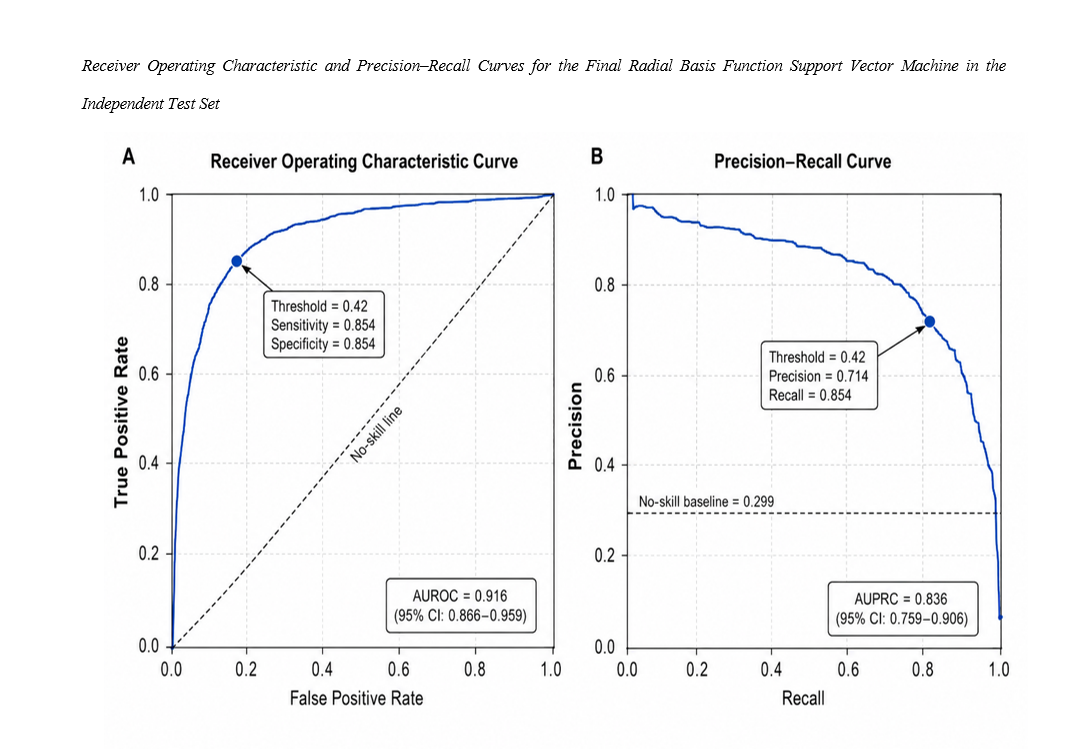
Findings: Adolescents with nonsuicidal self-injury scored significantly higher on all predictor variables than those without such behavior, with the largest effects observed for depressive symptoms, impulse-control difficulties, limited access to regulation strategies, peer rejection, and emotional abuse (all p < .001). The radial basis function support vector machine outperformed the linear model and penalized logistic regression, achieving an accuracy and balanced accuracy of .854, sensitivity of .854, specificity of .854, F1 score of .778, test AUROC of .916, and AUPRC of .836. Depressive symptoms were the strongest predictor, followed by impulse-control difficulties, limited regulation strategies, peer rejection, emotional abuse, and nonacceptance of emotional responses.
Conclusion: Nonsuicidal self-injury risk was classified with high accuracy using a nonlinear combination of depressive, emotional-regulatory, interpersonal, and trauma-related variables, supporting the use of support vector machines as adjunctive tools for adolescent risk screening.
Downloads
References
Apicella, M., Pontillo, M., Maglio, G., Vincenzo, C. D., Santa, G. D., Andracchio, E., & Vicari, S. (2025). Non-Suicidal Self-Injury in Adolescents: A Clinician’s Guide to Understanding the Phenomenon, Diagnostic Challenges, and Evidence-Based Treatments. Frontiers in Psychiatry, 16. https://doi.org/10.3389/fpsyt.2025.1605508
Byeon, H. (2025). Can Decoding the Complex Web of Non-Suicidal Self-Injury in Adolescents Pave the Way for Tailored Interventions? World journal of psychiatry, 15(3). https://doi.org/10.5498/wjp.v15.i3.103258
Cardona, N. D., Madigan, R. J., & Sauer‐Zavala, S. (2022). How Minority Stress Becomes Traumatic Invalidation: An Emotion-Focused Conceptualization of Minority Stress in Sexual and Gender Minority People. Clinical Psychology Science and Practice, 29(2), 185-195. https://doi.org/10.1037/cps0000054
Chu, J., Wang, Y., Zhang, X., Jiang, Z., Li, Y., Wang, K., Zhang, R., Wang, W., & Li, L. (2026). From Early Trauma to Self-Harm: A Sequential Mediation Model of Self-Efficacy, Psychological Resilience, and Depression in Adolescents. https://doi.org/10.21203/rs.3.rs-8697764/v1
Fini, G. D., Civilotti, C., Bolognino, A., Einaudi, G., Molo, M., Veglia, F., Gandino, G., & Finzi, S. (2025). The Burden of the Past: A Systematic Review of Childhood Trauma and Mental Health in Transgender and Gender Nonconforming Individuals. European Journal of Investigation in Health Psychology and Education, 15(9), 183. https://doi.org/10.3390/ejihpe15090183
Gagliano, A., Costanza, C., Modica, I. D., Carucci, S., Donno, F., Germanò, E., Abbate, C. S., Roccella, M., & Vetri, L. (2024). Neurodevelopmental Disorders and Suicide: A Narrative Review. Journal of clinical medicine, 13(6), 1627. https://doi.org/10.3390/jcm13061627
Galindo, D., Lopez, A., Osorno, D., Ruiz, L. G., & Osorno, I. (2026). The Effects of Social Networks and Digital Technology on Non-Suicidal Self-Injury in Children and Adolescents: A Systematic Review. Cureus. https://doi.org/10.7759/cureus.101014
Ge, Y., Xiao, Y., Li, M., Yang, L., Song, P., Li, X., & Yan, H. (2023). Maladaptive Cognitive Regulation Moderates the Mediating Role of Emotion Dysregulation on the Association Between Psychosocial Factors and Non-Suicidal Self-Injury in Depression. Frontiers in Psychiatry, 14. https://doi.org/10.3389/fpsyt.2023.1279108
Grove, J. L., Carlson, S. E., Parkhurst, K. A., O’Neill, J., & Smith, T. W. (2022). Nonsuicidal Self‐injury, Sleep Quality, and Shame Response to a Laboratory Stress Task. Journal of Clinical Psychology, 79(3), 871-885. https://doi.org/10.1002/jclp.23450
Jarvers, I., Heidingsfelder, E., Ecker, A., Kandsperger, S., Brunner, R., & Schleicher, D. (2025). Characteristics of Self-Injurious Behaviour and Early Traumatic Experiences: Associations With Emotional Reactivity, Depression and Aggression in University Students. BJPsych Open, 11(2). https://doi.org/10.1192/bjo.2024.862
Li, J. (2025). Longitudinal Pathways From Childhood Maltreatment to NSSI in Middle School Students With Depressive Symptoms: A Latent Change Score Analysis. Depression and Anxiety, 2025(1). https://doi.org/10.1155/da/6659147
Li, J., Wang, J., Tian, Y., Cui, D., Xu, X., Zhang, Q., Ni, X., & Yu, C. (2026). Parental Harsh Parenting and Non-Suicidal Self-Injury Among Chinese Adolescents: The Role of Emotional Uncontrollability, Deviant Peer Affiliation, School Disengagement, and Self-Control. Frontiers in Psychiatry, 16. https://doi.org/10.3389/fpsyt.2025.1732342
Li, M., Yang, X., Ge, Y., Yan, H., Li, X., Yue, W., & Yan, H. (2025). Functional Heterogeneity in Non-Suicidal Self-Injury Across Psychiatric Disorders: Neural and Psychosocial Correlates. https://doi.org/10.1101/2025.01.23.25320985
Luca, L. D., Giletta, M., Menesini, E., & Prinstein, M. J. (2022). Reciprocal Associations Between Peer Problems and Non‐suicidal Self‐injury Throughout Adolescence. Journal of Child Psychology and Psychiatry, 63(12), 1486-1495. https://doi.org/10.1111/jcpp.13601
Mehmood, A., Xu, S., Siddiqi, S. M., Zhang, L., Huang, G., Liang, Z., & Zhou, Y. (2025). Exploration of Nonsuicidal Self‐Injury as an Addiction‐Like Behaviour in Depressed Adolescents in the Light of the I‐PACE Model. Clinical Psychology & Psychotherapy, 32(5). https://doi.org/10.1002/cpp.70147
Oshin, L. A., Silamongkol, T., Pucker, H. E., Finkelstein, J. A., King, A. M., & Rizvi, S. L. (2024). … and We Could Do Better: Comparing the Efficacy of Dialectical Behavior Therapy Between LGBQ and Heterosexual Adults With Borderline Personality Disorder. Professional Psychology Research and Practice, 55(1), 58-67. https://doi.org/10.1037/pro0000529
Qian, H., Shu, C., Li, F., Xiang, J., Guo, Y., & Wang, G. (2022). Childhood Maltreatment, Stressful Life Events, Cognitive Emotion Regulation Strategies, and Non-Suicidal Self-Injury in Adolescents and Young Adults With First-Episode Depressive Disorder: Direct and Indirect Pathways. Frontiers in Psychiatry, 13. https://doi.org/10.3389/fpsyt.2022.838693
Quiroga-Garza, A., Ana Lucía de la Garza, C., Almaguer, P. A. I., Hernández, M. H., & Treviño, A. (2025). Risk of Self-Injurious Behavior Increases in Adolescence: New Findings. Frontiers in psychology, 16. https://doi.org/10.3389/fpsyg.2025.1563027
Rogante, E., Cifrodelli, M., Sarubbi, S., Costanza, A., Erbuto, D., Berardelli, I., & Pompili, M. (2024). The Role of Emotion Dysregulation in Understanding Suicide Risk: A Systematic Review of the Literature. Healthcare, 12(2), 169. https://doi.org/10.3390/healthcare12020169
Sun, C., Zhang, H., Zhou, R., Wu, B., Cai, Y., Cui, L., Zhang, M., & Peng, D. (2025). Association Between Childhood Maltreatment and Emotion Dysregulation in Patients With Major Depressive Disorder and Non-Suicidal Self-Injury. General Psychiatry, 38(3), e101875. https://doi.org/10.1136/gpsych-2024-101875
Taha, H., Alhaddad, O. M., Awamleh, S., Shatnawi, A., Belkhiria, H. Y., Jarosheh, Y., Alhawamdeh, T., Wahbeh, A., Al-Ani, A., & Jönsson, L. (2026). Exploring the Determinants of Non-Suicidal Self-Injury Among University Students in Jordan: A Cross-Sectional Study. Frontiers in Psychiatry, 16. https://doi.org/10.3389/fpsyt.2025.1751707
Tan, H., Zhang, F., Zong, X., Gui, G., Bai, H., Wang, H., Weng, S., & Liu, Z. (2025). Family Functioning and Dysfunctional Attitudes Mediate the Link Between Childhood Maltreatment and Nonsuicidal Self-Injury in Depressed College Students: A Moderated Mediation Model of Anhedonia. Frontiers in Psychiatry, 16. https://doi.org/10.3389/fpsyt.2025.1649915
Vafaei, T., Samavi, S. A., Whisenhunt, J., & Najarpourian, S. (2023). An Investigation of Self-Injury in Female Adolescents: A Qualitative Study. Quality & Quantity, 57(6), 5599-5622. https://doi.org/10.1007/s11135-023-01632-9
Weinreich, L., Moll, K., Sperl, M. F. J., Schulte‐Körne, G., & Timmermans, B. (2025). Experimental Investigations of Social Exclusion Among Adolescents With Psychiatric Disorders: A Systematic Review. European Child & Adolescent Psychiatry, 34(9), 2631-2648. https://doi.org/10.1007/s00787-025-02687-9
Wu, B., Zhang, H., Chen, J., Chen, J., Liu, Z., Cheng, Y., & Peng, D. (2023). Potential Mechanisms of Non‐suicidal Self‐injury (NSSI) in Major Depressive Disorder: A Systematic Review. General Psychiatry, 36(4). https://doi.org/10.1136/gpsych-2022-100946
Wu, O., Zhu, M., Yeo, K. J., Xu, W., Wu, Y. F., & Lu, X. (2025). Navigating Emotions: The Role of Self-Talk in Preventing Adolescent Self-Injury. Health Education & Behavior, 53(2), 201-214. https://doi.org/10.1177/10901981251363168
Xu, J., Na, J., Qin, Q., & Jiang, Q. (2022). The Relationship Between Negative Peer Relationship and Non-Suicidal Self-Injury in Chinese Adolescents: A Moderated-Mediation Model. Frontiers in psychology, 13. https://doi.org/10.3389/fpsyg.2022.913872
Yan, R., Ding, W., Wang, D., Lin, X., Lin, X., Li, W., & Xie, R. (2023). Longitudinal Relationship Between Child Maltreatment, Bullying Victimization, Depression, and Nonsuicidal Self‐injury Among Left‐behind Children in China: 2‐year Follow‐up. Journal of Clinical Psychology, 79(12), 2899-2917. https://doi.org/10.1002/jclp.23585
Yoon, S. H., Kim, J. S., Lee, H.-A., Lee, W. T., Song, Y. W., & Shim, S.-H. (2025). Electrophysiological Characteristics in Adolescents With Non-Suicidal Self-Injury: An Event-Related Potential Study and Source Analysis. Frontiers in Psychiatry, 16. https://doi.org/10.3389/fpsyt.2025.1596035
Yu, C., Cai, Y., & Pan, M. (2024). Correlation Analysis of Non-Suicidal Self-Injury Behavior With Childhood Abuse, Peer Victimization, and Psychological Resilience in Adolescents With Depression. Actas espanolas de psiquiatria, 52(3), 289-300. https://doi.org/10.62641/aep.v52i3.1650
Zetterqvist, M., Landberg, Å., Jönsson, L., & Svedin, C. G. (2023). The Psychosocial Consequences of Covid-19 in Adolescents With Nonsuicidal Self-Injury. Child and adolescent psychiatry and mental health, 17(1). https://doi.org/10.1186/s13034-023-00566-2
Zhang, J., Liu, Y. D., Zhang, H., Huang, Z. H., Wang, F., Yang, J., Wang, S., Jia, F. J., & Hou, C. L. (2022). Correlates of Non-Suicidal Self-Injury in Adolescent Psychiatric Patients in China. Frontiers in Psychiatry, 13. https://doi.org/10.3389/fpsyt.2022.864150
Zhou, R., Liu, Y. H., He, Y. Y., Liang, J. R., Chen, M., Chen, N., Jia, F., & Hou, C. L. (2026). Symptom Complexity Subtypes Show Distinct Individualism–Collectivism Orientations in Adolescents With Depressive Episodes, With Loneliness Mediating Their Relationship. Asia-Pacific Psychiatry, 18(1). https://doi.org/10.1111/appy.70011
Downloads
Additional Files
Publication Timeline
- Submitted
- Revised
- Accepted