Childhood Emotional Neglect and Substance Misuse among Emerging Adults: The Mediating Roles of Alexithymia, Experiential Avoidance, and Loneliness
DOI:
https://doi.org/10.61838/Keywords:
childhood emotional neglect, substance misuse, emerging adults, alexithymia, experiential avoidance, loneliness, mediation, NigeriaAbstract
Objective: This study aimed to examine the relationship between childhood emotional neglect and substance misuse among Nigerian emerging adults and to determine whether alexithymia, experiential avoidance, and loneliness mediated this relationship.
Methods and Materials: This cross-sectional correlational study was conducted with 412 emerging adults aged 18 to 29 years who were recruited from universities, vocational institutions, youth organizations, and community settings in Nigeria. Participants completed the Emotional Neglect subscale of the Childhood Trauma Questionnaire–Short Form, the 20-item Toronto Alexithymia Scale, the Acceptance and Action Questionnaire–II, the UCLA Loneliness Scale, and the Alcohol, Smoking and Substance Involvement Screening Test. Pearson correlation analysis was used to examine associations among the study variables. A parallel multiple-mediation analysis was conducted using PROCESS Model 4 with 5,000 bootstrap resamples. Age, sex, educational enrolment, and current psychological treatment were entered as covariates.
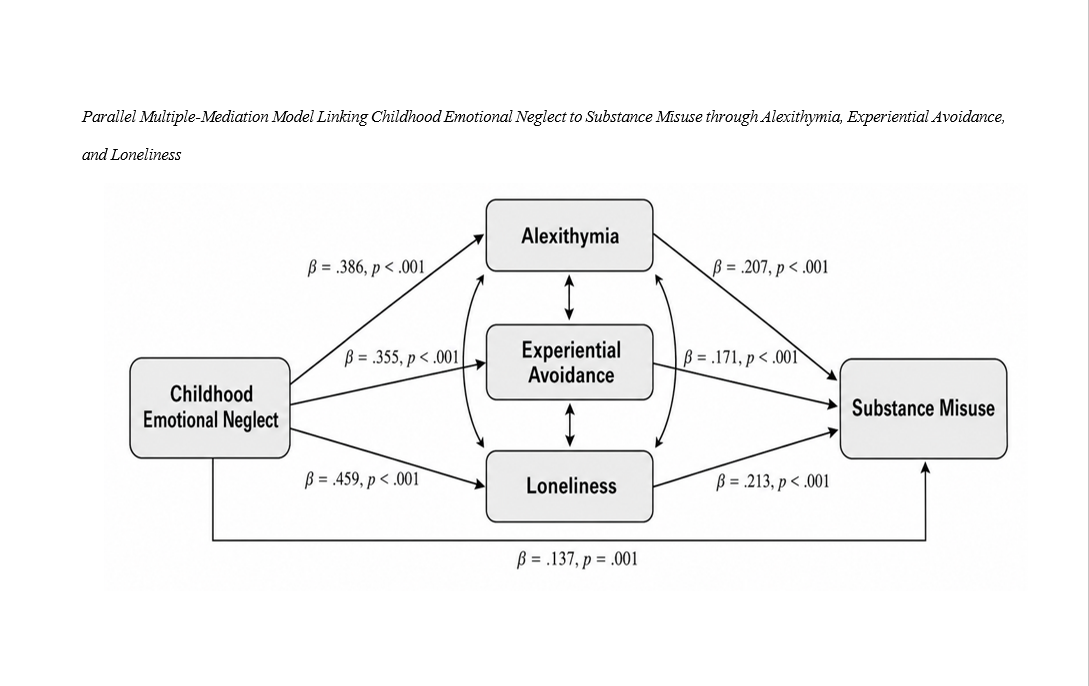
Findings: Childhood emotional neglect significantly predicted alexithymia (β = .386, p < .001), experiential avoidance (β = .355, p < .001), and loneliness (β = .459, p < .001). Alexithymia (β = .207, p < .001), experiential avoidance (β = .171, p < .001), and loneliness (β = .213, p < .001) each significantly predicted substance misuse. The total effect of childhood emotional neglect on substance misuse was significant (B = 0.767, 95% CI [0.590, 0.944]). The direct effect remained significant after inclusion of the mediators (B = 0.280, 95% CI [0.123, 0.437]), indicating partial mediation. The total indirect effect was significant (B = 0.487, 95% CI [0.347, 0.647]). Significant specific indirect effects were observed through alexithymia (B = 0.163, 95% CI [0.089, 0.251]), experiential avoidance (B = 0.124, 95% CI [0.061, 0.205]), and loneliness (B = 0.200, 95% CI [0.119, 0.298]).
Conclusion: Childhood emotional neglect was associated with greater substance misuse among Nigerian emerging adults both directly and indirectly through emotional-processing difficulties, avoidance-based coping, and loneliness. Interventions addressing emotional awareness, acceptance of distress, and social connectedness may help reduce substance-related risk in this population.
Downloads
References
Akpinar, B. (2024). Examining the Relationship Between Childhood Traumas, Alexithymia and Emotional Regulation Difficulties in University Students. https://doi.org/10.5772/intechopen.1005138
Bos, P., Voshaar, R. C. O., & Hanssen, D. (2022). Prevalence and Correlates of Alexithymia in Older Persons With Medically (Un)explained Physical Symptoms. International Journal of Geriatric Psychiatry, 37(6). https://doi.org/10.1002/gps.5736
Chang, R. S., Lee, M., Im, J. J., Choi, K. H., Kim, J., Chey, J., Shin, S.-H., & Ahn, W. Y. (2023). Biopsychosocial Factors of Gaming Disorder: A Systematic Review Employing Screening Tools With Well-Defined Psychometric Properties. Frontiers in Psychiatry, 14. https://doi.org/10.3389/fpsyt.2023.1200230
Chiappini, S., Sampogna, G., Ventriglio, A., Menculini, G., Ricci, V., Pettorruso, M., Volpe, U., & Martinotti, G. (2025). Exploring Emerging Psychopathological Characteristics and Challenges of Novel Depression Subtypes: Insights From the Literature. Frontiers in Psychiatry, 16. https://doi.org/10.3389/fpsyt.2025.1613251
Conti, C., Lanzara, R., Rosa, I., Müller, M., & Porcelli, P. (2022). Feeling Alone in Pandemic Lockdown. Psychological Correlates of Perceived Loneliness in College Students Before and During the COVID-19 Stay-at-Home Period: A Longitudinal Study. https://doi.org/10.21203/rs.3.rs-2166470/v1
Conti, C., Lanzara, R., Rosa, I., Müller, M., & Porcelli, P. (2023). Psychological Correlates of Perceived Loneliness in College Students Before and During the COVID-19 Stay-at-Home Period: A Longitudinal Study. BMC psychology, 11(1). https://doi.org/10.1186/s40359-023-01099-1
Fagnani, G. (2022). The Central Role of Schools in Promoting Death Education Interventions. Ethics in Progress, 13(2), 107-121. https://doi.org/10.14746/eip.2022.2.8
Farahani, H., Azadfallah, P., Watson, P., Qaderi, K., Pasha, A., Dirmina, F., Esrafilian, F., Koulaie, B., Fayazi, N., Sepehrnia, N., Esfandiary, A., Abbasi, F. N., & Rashidi, K. (2022). Predicting the Social-Emotional Competence Based on Childhood Trauma, Internalized Shame, Disability/Shame Scheme, Cognitive Flexibility, Distress Tolerance and Alexithymia in an Iranian Sample Using Bayesian Regression. Journal of Child & Adolescent Trauma, 16(2), 351-363. https://doi.org/10.1007/s40653-022-00501-1
Freeman, B., Salivar, E. G., & Thayer, K. K. (2024). The Impact of the Military Lifestyle on Adult Military Children Relationships. Couple and Family Psychology Research and Practice, 13(1), 1-14. https://doi.org/10.1037/cfp0000252
Furlanetto, M., & Dantas, R. T. (2023). Stakehold ZXSY: Disorder Deficit Familial Asynchrony and Syndrome Z. Journal of Medical Clinical Case Reports. https://doi.org/10.47485/2767-5416.1032
Furlanetto, M. L. (2023). Substances Pathological of Use and Syndrome Z: Medicine D. Jih, 2(1), 1-20. https://doi.org/10.51219/jih/furlanetto-m-l-jr/4
Gelvez-Gafaro, L.-M., & Medina-Duarte, D.-M. (2022). Psychosocial Risk Factors Associated With Suicide in Youth and Adolescents: A Systematic Review. Gaceta Médica De Caracas, 130(Supl. 3). https://doi.org/10.47307/gmc.2022.130.s3.14
Gök, B. G., Ouimet, A. J., & Işıklı, S. (2026). Beyond the Surface: Cross-Cultural Roots of Social Anxiety in Childhood Traumas. Psychological Trauma Theory Research Practice and Policy. https://doi.org/10.1037/tra0002106
Harerimana, E., Muziki, J. d., Nshimyumuremyi, E., Uwera, T., Nshimiyimana, A., & Mutabaruka, J. (2025). Family Correlates of Behavioral Problems Among Adolescents in Rwanda. PLoS One, 20(2), e0314507. https://doi.org/10.1371/journal.pone.0314507
Henriques, G. S., Ferrajão, P., & Roque, L. (2025). The Relationship Between Childhood Trauma and the Development of an Embodied Sense of Self: The Mediating Role of World Assumptions and Loneliness. Traumatology an International Journal. https://doi.org/10.1037/trm0000621
Iannattone, S., Miscioscia, M., Raffagnato, A., & Gatta, M. (2021). The Role of Alexithymia in Social Withdrawal During Adolescence: A Case–Control Study. Children, 8(2), 165. https://doi.org/10.3390/children8020165
Inchausti, F., García‐Poveda, N. V., Sheila Martínez de la Hidalga González de, B., Morrás, I. I., Popolo, R., & Dimaggio, G. (2025). Metacognitive Interpersonal Group Therapy for Adolescents With Emerging Personality Disorders: The Case of Nora. Journal of Clinical Psychology, 82(2), 207-218. https://doi.org/10.1002/jclp.70050
Jin, X., Xu, B., Jin, H., & Yan, S. (2025). Brain White Matter Alterations in Young Adults With Childhood Emotional Neglect Experience. Behavioral Sciences, 15(6), 746. https://doi.org/10.3390/bs15060746
Kaur, K., & Mearns, J. (2021). Negative Mood Regulation Expectancies Moderate the Effect of Childhood Maltreatment on Compulsive Buying. Journal of Clinical Psychology, 77(4), 1116-1130. https://doi.org/10.1002/jclp.23103
Khan, A. N., & Jaffee, S. R. (2022). Alexithymia in Individuals Maltreated as Children and Adolescents: A Meta‐analysis. Journal of Child Psychology and Psychiatry, 63(9), 963-972. https://doi.org/10.1111/jcpp.13616
Mullet, N., Hawkins, L. G., Tuliao, A. P., Snyder, H., Holyoak, D., McGuire, K. C., Earl, A. K. K., & McChargue, D. E. (2021). Early Trauma and Later Sexual Victimization in College Women: A Multiple Mediation Examination of Alexithymia, Impulsivity, and Alcohol Use. Journal of interpersonal violence, 37(19-20), NP18194-NP18214. https://doi.org/10.1177/08862605211035876
Paivio, S. C., & Pascual‐Leone, A. (2023). Trauma and Its Effects. 15-32. https://doi.org/10.1037/0000336-002
Ramamurthy, G., & Gregory, R. J. (2025). Recovery-Based Suicide Prevention. Frontiers in Psychiatry, 16. https://doi.org/10.3389/fpsyt.2025.1556927
Rzeszutek, M., Kowalkowska, J., Dragan, M., Schier, K., Lis‐Turlejska, M., Holas, P., Drabarek, K., Hoy, A. V., Maison, D., Wdowczyk, G., Litwin, E., Wawrzyniak, J., Znamirowska, W., Szumiał, S., & Desmond, M. (2024). Adverse Childhood Experiences and Profiles of Healthy Orthorexia Versus Orthorexia Nervosa: Towards an Explanatory Model of Orthorexia as a Multidimensional Eating Style. Eating and Weight Disorders - Studies on Anorexia Bulimia and Obesity, 29(1). https://doi.org/10.1007/s40519-024-01694-0
Saladino, V. (2025). The Mediating Role of Alexithymia and Loneliness in the Relationship Between Childhood Emotional Abuse and Nomophobia. Developmental Child Welfare. https://doi.org/10.1177/25161032251388301
Shi, Y., Zhang, Q., Xu, G., Wang, S., Chen, C., Liu, Z., Geng, F., Wang, J., Luo, X., Wen, X., & Liu, H. (2025). Alexithymia and Self-Injury Functions as Mediators Between Childhood Maltreatment and Nonsuicidal Self-Injury in Adolescents With Major Depressive Disorder. Scientific reports, 15(1). https://doi.org/10.1038/s41598-025-08423-2
Suslow, T., & Kersting, A. (2021). Beyond Face and Voice: A Review of Alexithymia and Emotion Perception in Music, Odor, Taste, and Touch. Frontiers in psychology, 12. https://doi.org/10.3389/fpsyg.2021.707599
Talbot, P., & Lecours, S. (2021). Alexithymia’s Epiphenomenality as a Mediator Between Unsupportive Emotion Socialization and Later Psychopathology. Journal of Interpersonal Relations Intergroup Relations and Identity, 14. https://doi.org/10.33921/puql1674
Varisco, B. (2025). Working With Emotions in Existential–humanistic Psychotherapy. 157-182. https://doi.org/10.1037/0000446-007
zhang, b., Chen, Y., fu, w., Jiang, C., Zhou, Y., & He, K. (2023). Relationship Between Alexithymia, Loneliness, Resilience and Non- Suicidal Self-Injury in Adolescents With Depression: A Multi-Center Study. https://doi.org/10.21203/rs.3.rs-2562405/v1
Zorzella, K. P. M., Muller, R. T., Cribbie, R. A., Bambrah, V., & Classen, C. (2020). The Role of Alexithymia in Trauma Therapy Outcomes: Examining Improvements in PTSD, Dissociation, and Interpersonal Problems. Psychological Trauma Theory Research Practice and Policy, 12(1), 20-28. https://doi.org/10.1037/tra0000433
Downloads
Additional Files
Publication Timeline
- Submitted
- Revised
- Accepted