Prediction of Suicidal Ideation Based on Resilience, Self-Compassion, and Attachment Styles in Adolescent Girls
DOI:
https://doi.org/10.61838/kman.jayps.4841Keywords:
Resilience, suicide ideation, self-compassion, attachment styles, adolescent girlsAbstract
Objective: The objective of this study was to predict suicidal ideation in adolescent girls based on resilience, self-compassion, and attachment styles.
Methods and Materials: This descriptive–correlational study was conducted among adolescent girls attending public lower-secondary schools in District 16 of Tehran during the 2023–2024 academic year. A total of 239 participants who reported suicidal thoughts in psychological screening were selected through convenience sampling. Data were collected using the Multi-Attitude Suicide Tendency Scale (MAST), the Connor–Davidson Resilience Scale (CD-RISC), the Self-Compassion Scale–Short Form (SCS-SF), and the Revised Adult Attachment Scale (RAAS). Pearson correlation and simultaneous multiple linear regression analyses were performed using SPSS version 26 to examine associations and predictive relationships among the study variables.
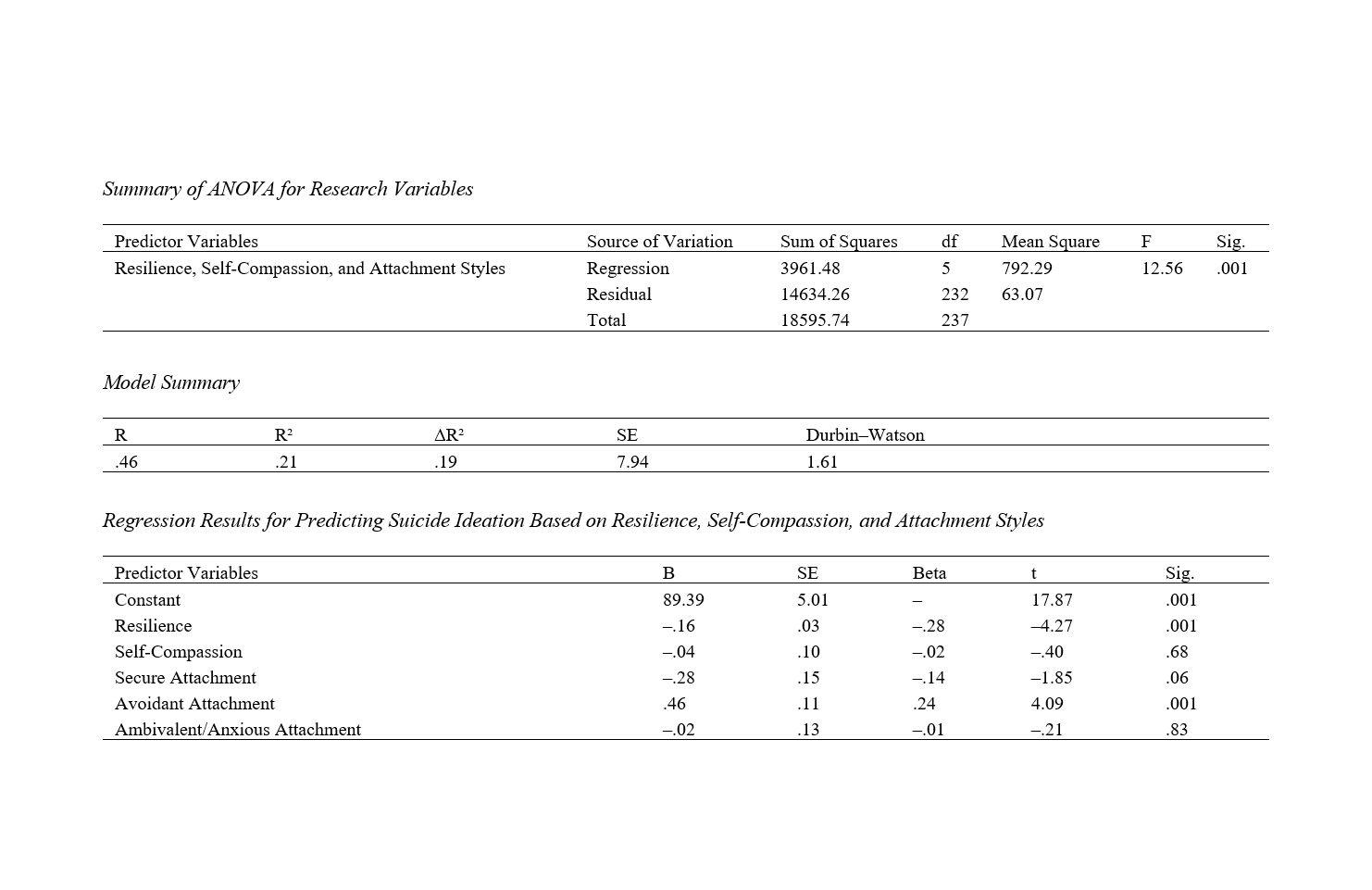
Findings: Correlation analysis showed that resilience (r = –.36), self-compassion (r = –.14), and secure attachment (r = –.19) were significantly and negatively associated with suicidal ideation, while avoidant (r = .32) and ambivalent/anxious attachment styles (r = .19) exhibited significant positive correlations (p < .05). Regression analysis revealed that the overall model significantly predicted suicidal ideation (F(5,232) = 12.56, p = .001), explaining 21% of the variance (R² = .21). Among the predictors, resilience (β = –.28, p = .001) and avoidant attachment (β = .24, p = .001) were significant predictors, whereas self-compassion, secure attachment, and ambivalent/anxious attachment were not significant predictors.
Conclusion: The findings indicate that resilience and avoidant attachment style play significant roles in predicting suicidal ideation among adolescent girls, underscoring the importance of enhancing adaptive coping resources and addressing maladaptive attachment patterns in suicide prevention efforts targeting this population.
Downloads
References
Ahmadi Marvili, N., Mirza Hosseini, H., & Monirpour, N. (2019). Predictive model of self-harming behaviors and suicidal tendencies based on attachment styles and personality organization in adolescent students: The mediating role of cognitive emotion regulation strategies. Applied Psychological Research, 10(3), 101-117. https://doi.org/10.22059/japr.2019.274866.643162
Asadi, M., Nazari-Far, M., Ebrahimizadeh, H., Fathi, A., & Daneshpour, M. (2022). Comparison of psychological disorders and resilience in relation to suicide in individuals with and without a history of suicide attempts. Counseling Research, 21(82), 114-140. https://doi.org/10.1001.1.2717400.1401.21.82.6.0
Azimi, E., Yazdkhasti, F., Marati, M. R., & Ebrahimi, A. (2022). Comparison of the effectiveness of culture-based therapy and cognitive-behavioral therapy on depression and suicidal thoughts considering the moderating role of brain-derived neurotrophic factor in adolescent girls. New Advances in Cognitive Sciences, 24(3), 148-163. https://doi.org/10.30514/icss.24.3.148
Connor, K. M., & Davidson, J. R. (2003). Development of a new resilience scale: The Connor‐Davidson resilience scale (CD‐RISC). Depression and Anxiety, 18(2), 76-82. https://doi.org/10.1002/da.10113
Denneson, L. M., Smolenski, D. J., McDonald, K. L., Shull, S., Hoffmire, C. A., Britton, P. C., & Dobscha, S. K. (2024). Gender differences in risk and resilience for suicidal thoughts and behaviors: A national longitudinal survey study of United States veterans with a recent suicide attempt. Journal of affective disorders. https://doi.org/10.1016/j.jad.2024.05.133
Farhadi, M., Mohagheghi, H., & Nasai Moqaddam, B. (2020). The relationship between attachment styles and interpersonal problems in students: The mediating role of emotional intelligence. Razi Journal of Medical Sciences, 27(1), 73-84. https://doi.org/10.22059/rjms.2020.5660
Golmahr, S., Aghamohammadi, S., & Khanzadeh, M. (2023). Testing the structural model of the relationships between insecure attachment styles and suicidal tendencies in women: Investigating the mediating roles of emotion regulation strategies and interpersonal cognitive distortions. New Psychological Research, 18(71), 233-243. https://doi.org/10.22034/jmpr.2023.54902.5368
Hazan, C., & Shaver, P. R. (1987). Romantic love conceptualized as an attachment process. Journal of personality and social psychology, 52, 511-524. https://doi.org/10.1037/0022-3514.52.3.511
Imonova, M. B. (2023). Causes of Suicide Tendency in Adolescents. Journal of Discoveries in Applied and Natural Science, 1(1), 62-67. https://doi.org/10.1542/peds.2023-064800
Karemyr, M., Bellander, M., Pontén, M., Ohlis, A., Flygare, O., Walldén, Y., & Bjureberg, J. (2025). Preventing suicide with Safe Alternatives for Teens and Youths (SAFETY): a randomised feasibility trial. BMJ Mental Health, 28(1). https://doi.org/10.1136/bmjment-2025-301575
Lan, X., & Mastrotheodoros, S. (2024). Teacher autonomy support and internalizing problems of adolescents from divorced and intact families: Moderation by personality typologies. Child Psychiatry & Human Development, 55(1), 182-194. https://doi.org/10.1007/s10578-022-01392-x
Mahase, E. (2023). Nearly one in three American teenage girls had suicidal thoughts in 2021, finds CDC. bmj, 380, e380. https://doi.org/10.1136/bmj.p380
Moshtaghi, S., & Hashemi-Pour, F. (2024). Modeling suicidal thoughts based on insecure attachment style, mentalizing ability, and emotional awareness in female students. Psychological Nursing, 12(2), 98-110. https://doi.org/10.22034/IJPN.12.2.98
Moslahi, S. Q., Alipour, F., & Farid, A. (2023). Structural model of the relationship between self-compassion and suicidal tendencies in female students. Second National Conference on Psychotherapy in Iran, Ardabil.
Naifeh, J. A., Ursano, R. J., Stein, M. B., Wang, J., Mash, H. B. H., Aliaga, P. A., & Kessler, R. C. (2024). Prospective association of attachment style with suicide attempts among US Army soldiers. Psychological medicine, 54(4), 785-793. https://doi.org/10.1017/S0033291723002489
Neff, K. D. (2003). The science of self-compassion. Compassion and wisdom in psychotherapy, 1, 79-92. http://soundstrue-ha.s3.amazonaws.com/mandala/microsites/neff-shapiro-tucson-presentations/media/Neff-Handouts.pdf
Nguyen, A., Grummitt, L., Barrett, E. L., Bailey, S., Gardner, L. A., Champion, K. E., & Birrell, L. (2025). The relationship between emotion regulation and mental health in adolescents: Self-compassion as a moderator. Mental Health & Prevention, 38. https://doi.org/10.1016/j.mhp.2025.200430
Pantoja-Urbán, A. H., Richer, S., Mittermaier, A., Giroux, M., Nouel, D., Hernandez, G., & Flores, C. (2024). Gains and losses: resilience to social defeat stress in adolescent female mice. Biological Psychiatry, 95(1), 37-47. https://doi.org/10.1016/j.biopsych.2023.06.014
Patra, S. (2025). Self-Compassion: The Key to Suicide Prevention in Young People. In Handbook of Suicide Prevention: Insights, Strategies and Approaches (pp. 441-461). Springer Nature Singapore. https://doi.org/10.1007/978-981-96-1403-5_24
Shahbazi, M., Rajabi, G., Maghami, A., & Jaloudari, A. (2015). Confirmatory factor structure of the Persian version of the Revised Compassion Scale in a group of prisoners. Psychological Methods and Models, 6(19), 31-46. https://doi.org/10.1001.1.22285516.1394.6.19.3.8
Silva Filho, O. C. D., Avanci, J. Q., Pires, T. D. O., de Vasconcellos Carvalhaes Oliveira, R., & Assis, S. G. (2023). Attachment, suicidal behavior, and self-harm in childhood and adolescence: a study of a cohort of Brazilian schoolchildren. BMC pediatrics, 23(1), 403. https://doi.org/10.1186/s12887-023-04215-7
Suh, H., & Jeong, J. (2021). Association of self-compassion with suicidal thoughts and behaviors and non-suicidal self injury: A meta-analysis. Frontiers in psychology, 12. https://doi.org/10.3389/fpsyg.2021.633482
Szeifert, N. M., Oláh, B., & Gonda, X. (2025). The mediating role of adult attachment styles between early traumas and suicidal behaviour. Scientific reports, 15(1), 15855. https://doi.org/10.1038/s41598-025-00831-8
Wang, X., Lu, Z., & Dong, C. (2022). Suicide resilience: A concept analysis. Frontiers in Psychiatry, 13. https://doi.org/10.3389/fpsyt.2022.984922
Williams, Z., & Baptist, J. (2023). Relationship satisfaction in Black heterosexual couples: The role of self‐compassion and openness. Journal of marital and family therapy, 49(4), 918-938. https://doi.org/10.1111/jmft.12666
Wu, W., Cui, Z., Lei, C., Duan, Y., Qu, D., Wu, J., & Zhang, C. (2025). The 1st SpeechWellness Challenge: Detecting Suicidal Risk Among Adolescents. arXiv preprint. https://doi.org/10.48550/arXiv.2501.06474
Xu, L., Zhang, H., Zhou, C., Zhang, Z., Li, G., Lu, W., & Lin, K. (2023). Deficits in psychological resilience and problem-solving ability in adolescents with suicidal ideation. Child and adolescent psychiatry and mental health, 17(1), 31. https://doi.org/10.1186/s13034-023-00577-z
Yuan, G. F., Zhong, S., Liu, C., Liu, J., & Yu, J. (2025). The influence of family resilience on non-suicidal self-injury among Chinese adolescents: The mediating roles of mindfulness and individual resilience. Archives of Psychiatric Nursing. https://doi.org/10.1016/j.apnu.2025.01.003
Downloads
Additional Files
Publication Timeline
- Submitted
- Revised
- Accepted