Ranking Internalized Beliefs Contributing to Body Image Dissatisfaction
DOI:
https://doi.org/10.61838/kman.jayps.4740Keywords:
Body image dissatisfaction, internalized beliefs, sociocultural ideals, self-worth contingency, perfectionismAbstract
Objective: This study aimed to identify and rank the internalized belief systems that contribute to body image dissatisfaction among adults through an integrated qualitative–quantitative framework.
Methods and Materials: A sequential exploratory mixed-method design was employed. In the qualitative phase, a systematic literature review of 126 scholarly sources published between 2010 and 2025 was conducted to identify belief domains related to body image dissatisfaction. Data were analyzed using NVivo 14 through open, axial, and selective coding until theoretical saturation was achieved, resulting in seven overarching belief themes. In the quantitative phase, a structured survey derived from these qualitative results was distributed to 215 participants in Malaysia, aged 18–35 years. Responses were analyzed in SPSS 26 using the Friedman ranking test to determine the relative importance of each belief domain. Reliability was confirmed with Cronbach’s alpha above 0.70, and demographic variations were explored via independent t-tests and ANOVA.
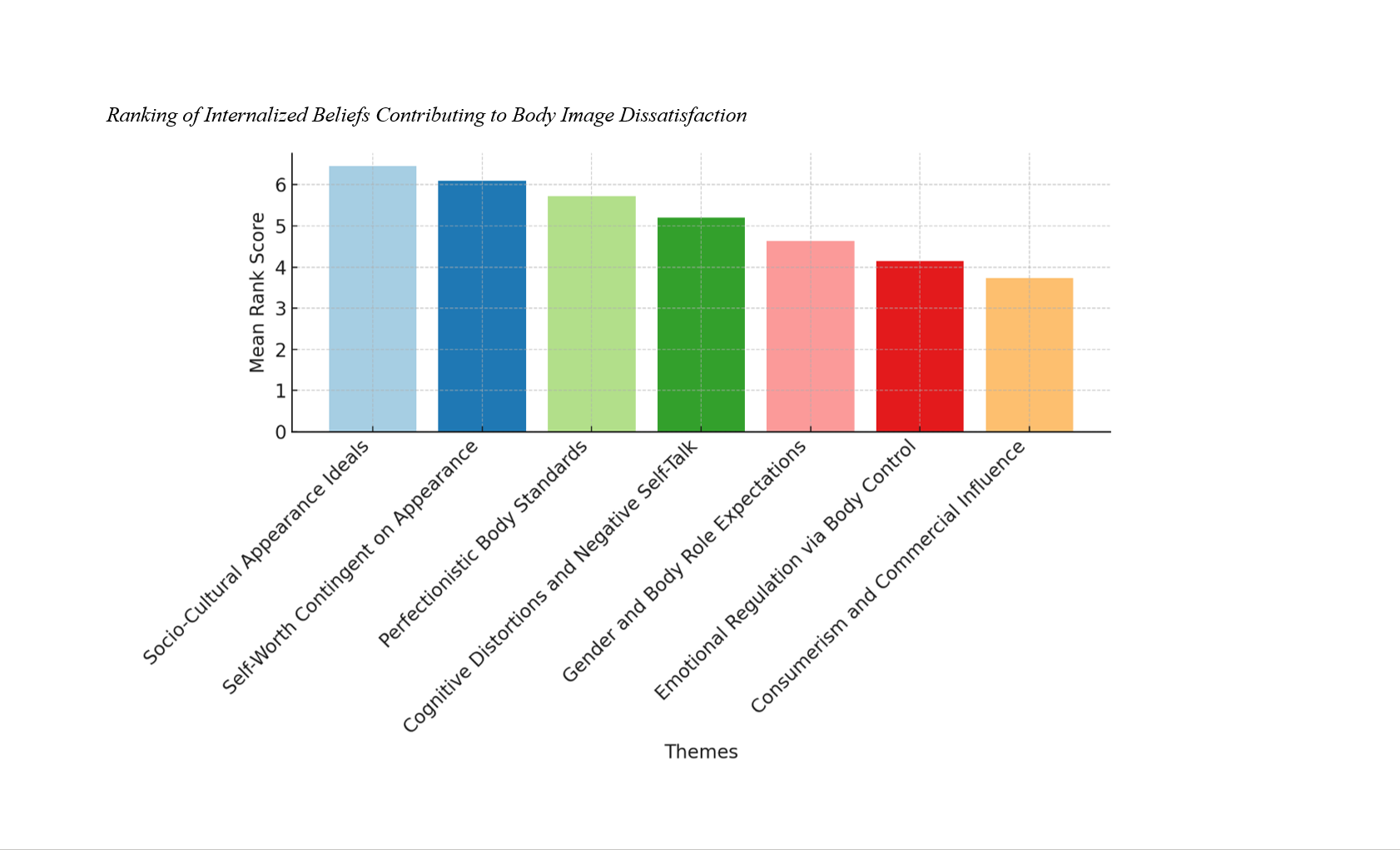
Findings: The Friedman test revealed significant differences across belief domains (χ² = 198.37, p < 0.001). The highest mean ranks were recorded for socio-cultural appearance ideals (6.45) and self-worth contingent on appearance (6.10), indicating that external cultural pressures and appearance-based self-evaluation are dominant predictors of body dissatisfaction. Perfectionistic body standards (5.72) and cognitive distortions and negative self-talk (5.21) were moderately influential, while gender and body role expectations (4.63), emotional regulation via body control (4.15), and consumerism and commercial influence (3.74) ranked lower. These results highlight a cognitive–sociocultural hierarchy of internalized beliefs shaping dissatisfaction.
Conclusion: The findings suggest that body image dissatisfaction is primarily sustained by sociocultural idealization and self-worth dependency, with perfectionistic and cognitive distortions acting as reinforcing mechanisms. Addressing these internalized beliefs through integrative psychological, educational, and media-based interventions may reduce vulnerability to body dissatisfaction.
Downloads
References
Abrevaya, S., Bravo, I., Stancanelli, S., & Ramenzoni, V. C. (2023). Individual Differences in Weight Concern Predict Sensitivity to Weight Differences in Other People. https://doi.org/10.31234/osf.io/zhuky
Ahadzadeh, A. S., Amini, M., Wu, S. L., & Haolin, Z. (2022). The Role of Appearance Self-Schema in the Perceived Impact of Fitspiration Images on the Self and Others: A Study on Body Image. Makara Human Behavior Studies in Asia, 26(1), 25-36. https://doi.org/10.7454/hubs.asia.3281121
Alokandeh, R. S. (2024). Enhancing Emotion Regulation and Psychological Flexibility, and Body Image Concern in Girls With Body Image Dissatisfaction Through Schema Modes Therapy. Jarac, 6(2), 177-184. https://doi.org/10.61838/kman.jarac.6.2.22
Bertuccelli, M., Cantele, F., & Masiero, S. (2022). Body Image and Body Schema in Adolescents With Idiopathic Scoliosis: A Scoping Review. Adolescent Research Review, 8(1), 97-115. https://doi.org/10.1007/s40894-022-00187-4
Brun, D. D., Pescarini, E., Calonaci, S., Bonello, E., & Meneguzzo, P. (2024). Body Evaluation in Men: The Role of Body Weight Dissatisfaction in Appearance Evaluation, Eating, and Muscle Dysmorphia Psychopathology. Journal of eating disorders, 12(1). https://doi.org/10.1186/s40337-024-01025-9
Cai, Z., Gui, Y., Wang, D., Yang, H., Mao, P., & Wang, Z. (2021). Body Image Dissatisfaction and Impulse Buying: A Moderated Mediation Model. Frontiers in psychology, 12. https://doi.org/10.3389/fpsyg.2021.653559
Dumstorf, K., Halbeisen, G., & Paslakis, G. (2024). How Evaluative Pairings Improve Body Dissatisfaction in Adult Women: Evidence From a Randomized-Controlled Online Study. Journal of eating disorders, 12(1). https://doi.org/10.1186/s40337-024-00975-4
Fathansyah, A., & Nazhan, B. (2024). Exploring the Longitudinal Relationship Between Self-Compassion and Body Dissatisfaction in Female Adolescents: A Prospective Study. Psychologia, 2(4), 115-122. https://doi.org/10.35335/psychologia.v2i4.44
Galhardo, A., Gregori, P. E. M., Ferreira, C., & Cunha, M. (2024). The Relationship Between Body Image Dissatisfaction, Psychopathological Symptoms, Social Comparisons With Peers and Celebrities, and Self-Compassion in Men. Psychological Reports. https://doi.org/10.1177/00332941241270652
Guillén, V., Jiménez, P. A., Zubero-Linaza, J., Aira, Z., & Sobera, I. B. (2025). Relating Proprioceptive Embodiment to Body Dissatisfaction in Anorexia and Bulimia Patients: Effect of Visual Body Images. European Archives of Psychiatry and Clinical Neuroscience. https://doi.org/10.1007/s00406-025-01982-5
Khan, S., Khilji, M. N., M, M. R., & Iqbal, M. M. (2022). Mediating Role of Body Image in the Relationship Between Appearance Schemas and Indirect Aggression in Adolescents. ASEAN Journal of Psychiatry, 23(06). https://doi.org/10.54615/2231-7805.47265
Lestari, H., Hutahaean, E. S. H., & Fahrudin, A. (2023). Body Image Dissatisfaction in Body Shaming Victims. Kesans International Journal of Health and Science, 3(1), 22-29. https://doi.org/10.54543/kesans.v3i1.229
Maher, A. L., Lane, B. R., & Mulgrew, K. E. (2021). Self-Compassion and Body Dissatisfaction in Men: Extension of the Tripartite Influence Model. Psychology of Men & Masculinity, 22(2), 345-353. https://doi.org/10.1037/men0000271
Majeed, M. (2023). Relationship Between Body Image, Body Mass Index and Self Esteem Among Obese and Non Obese Female Adolescents. Annals of Human and Social Sciences, 4(I). https://doi.org/10.35484/ahss.2023(4-i)14
Mokuolu, B. O., Ojo, A. E., & Oloogunebi, A. J. (2023). Influence of Self-Concept and Body Dissatisfaction on Social Introversion. International Journal of Research and Innovation in Social Science, VII(XI), 763-769. https://doi.org/10.47772/ijriss.2023.7011059
Möri, M., Mongillo, F., & Fahr, A. (2022). Images of Bodies in Mass and Social Media and Body Dissatisfaction: The Role of Internalization and Self-Discrepancy. Frontiers in psychology, 13. https://doi.org/10.3389/fpsyg.2022.1009792
Naraindas, A. M., & Cooney, S. (2023). Body Image Disturbance, Interoceptive Sensibility and the Body Schema Across Female Adulthood: A Pre-Registered Study. https://doi.org/10.31234/osf.io/jmn9g
Naraindas, A. M., McInerney, A., Deschênes, S. S., & Cooney, S. (2025). Differences in the Relationships Between Interoceptive Sensibility and Self-Objectification in Women With High and Low Body Dissatisfaction: A Network Analysis. PLoS One, 20(5), e0323524. https://doi.org/10.1371/journal.pone.0323524
Naraindas, A. M., Moreno, M. C., & Cooney, S. (2023). Beyond Gender: Interoceptive Sensibility as a Key Predictor of Body Image Disturbances. Behavioral Sciences, 14(1), 25. https://doi.org/10.3390/bs14010025
Naraindas, A. M., Mulvaney, P., Rogers, R., Fergus, D., Rooney, B., & Cooney, S. (2025). The Role of Appearance Comparison and Body Dissatisfaction in Influencing Passability Judgements Across Body and Non-Body Apertures in VR. https://doi.org/10.31219/osf.io/ebfw5_v1
Park, W. (2020). Body Image Dissatisfaction and Self-Esteem Among Korean Pre- And Early Adolescent Girls and Boys: A Five-Year Longitudinal Panel Study. Family and Environment Research, 58(2), 163-176. https://doi.org/10.6115/fer.2020.012
Pereira, H. S., Naliato, E., Moraes, A. B., Gadelha, M. R., Neto, L. V., Renan Moritz Varnier Rodrigues de, A., Nardi, A. E., & Violante, A. (2020). Body Self-Image Disturbances in Women With Prolactinoma. Brazilian Journal of Psychiatry, 42(1), 33-39. https://doi.org/10.1590/1516-4446-2018-0325
Qasim, I., Yasmin, H., & Riaz, M. A. (2021). Effect of Sociocultural Attitude Towards Appearance and Self-Esteem on Body Image Dissatisfaction Among Working Women. Journal of Peace Development & Communication, volume 05(issue 2), 284-294. https://doi.org/10.36968/jpdc-v05-i02-25
Saeed, F., Munir, R., Tariq, S., Shahzad, J. F., Ijaz, M., Syed, K., Sarwar, H. M., Mirza, M. S., Din, S., Cheema, C. Z. M., Javaid, M., & Zaidi, S. M. H. (2021). Body Image Dissatisfaction in Healthy Medical Students and Its Association to Body Mass Index, Gender and Age. Annals of King Edward Medical University, 27(1), 15-23. https://doi.org/10.21649/akemu.v27i1.4394
Sampath, H., Soohinda, G., Mishra, D., & Dutta, S. K. (2019). Body Dissatisfaction and Its Relation to Big Five Personality Factors and Self-Esteem in Young Adult College Women in India. Indian Journal of Psychiatry, 61(4), 400. https://doi.org/10.4103/psychiatry.indianjpsychiatry_367_18
ŞEntÜRk, G., & Göbel, P. (2023). The Relationship Between Body Composition and Self-Esteem and Body Image in Male Bodybuilding Athletes. Uluslararası Egzersiz Psikolojisi Dergisi, 5(1), 9-14. https://doi.org/10.51538/intjourexerpsyc.1250281
Sung, J., & Yan, R. N. (2020). Predicting Clothing Behaviors of Generation Y Men Through Self-Esteem and Body Dissatisfaction. Fashion and Textiles, 7(1). https://doi.org/10.1186/s40691-019-0200-6
Szily, D., Kelemen, R., Nagy, Z. S., Szabó, D., & Unoka, Z. (2023). Disturbed Body Schema, Perceptual Body Image, and Attitudinal Body Image in Patients With Borderline Personality Disorder. Frontiers in Psychiatry, 14. https://doi.org/10.3389/fpsyt.2023.1168611
Valencia, A., Bejarano, L., Lizcano, Y. C., Osorio, G., & Román-Acosta, D. (2022). Body Perception, Dissatisfaction and Quality of Life in University Women in Pereira, Colombia. Health Leadership and Quality Of Life, 1, 84. https://doi.org/10.56294/hl202284
Widiastuti, N. N. E., Wulanyani, N. M. S., & Shaheen, S. (2023). The Role of Instagram Usage Intensity on Body Dissatisfaction in Adolescent Girls in Denpasar With Self-Esteem as a Moderating Variable. Psychology, 1(1), 1-16. https://doi.org/10.61194/psychology.v1i1.47
Downloads
Additional Files
Publication Timeline
- Submitted
- Revised
- Accepted