Exploring the Psychological Dimensions of Post-Traumatic Growth among Youth Exposed to Adversity
DOI:
https://doi.org/10.61838/kman.jayps.4643Keywords:
Post-traumatic growth, Adolescents, Resilience, Meaning-making, Qualitative study, Hungary, Psychological transformationAbstract
Objective: The objective of this study was to explore and interpret the psychological dimensions of post-traumatic growth (PTG) among Hungarian youth who have experienced adversity, focusing on how they reconstruct identity, relationships, meaning, and resilience through lived experiences.
Methods and Materials: This qualitative study employed a phenomenological design to understand adolescents’ and young adults’ subjective experiences of growth after trauma. A purposive sample of 18 Hungarian participants aged 17–25 years, each having experienced significant adversity such as family conflict, bereavement, illness, or socioeconomic hardship, was selected. Data were gathered through semi-structured, in-depth interviews lasting 60–90 minutes and continued until theoretical saturation was reached. All interviews were audio-recorded, transcribed verbatim, and analyzed thematically using NVivo 14 software. The analysis followed Braun and Clarke’s six-phase framework, incorporating open, axial, and selective coding to identify key psychological dimensions of PTG. Trustworthiness was ensured through member checking, peer debriefing, and an audit trail of analytic decisions.
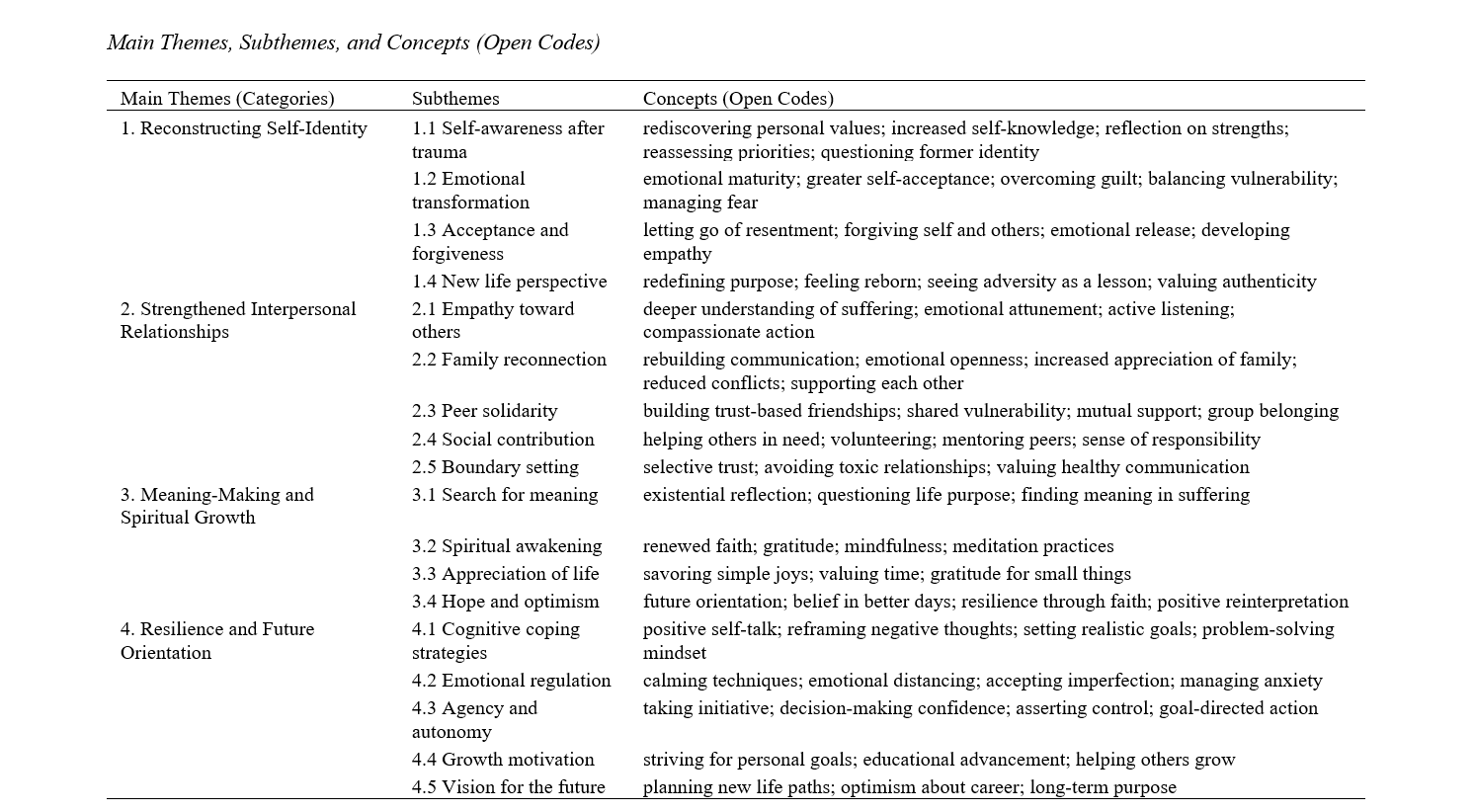
Findings: Data analysis revealed four overarching dimensions of post-traumatic growth: (1) Reconstructing self-identity—youth reported enhanced self-awareness, emotional maturity, and value reorientation; (2) Strengthened interpersonal relationships—participants demonstrated increased empathy, family reconnection, and social responsibility; (3) Meaning-making and spiritual growth—adolescents engaged in existential reflection, gratitude, and spiritual or mindful coping; and (4) Resilience and future orientation—youth developed adaptive coping skills, self-efficacy, and forward-looking motivation. These findings highlight PTG as a multidimensional process integrating cognitive restructuring, emotional regulation, and relational transformation within sociocultural contexts.
Conclusion: The study concludes that post-traumatic growth among Hungarian youth represents a transformative journey characterized by self-redefinition, relational strengthening, and renewed purpose.
Downloads
References
Arpacı, R., Ayar, D., & Karasu, F. (2024). The Mediating Role of Trauma Centrality in the Correlation Between Coping Self-Efficacy and Posttraumatic Growth Level of Disaster Volunteers. The Journal of Nervous and Mental Disease, 212(10), 520-527. https://doi.org/10.1097/nmd.0000000000001798
Beainy, S. A., & Hassan, K. E. (2023). Coping Strategies and Personal Growth: The Case of Palestinian Refugees in Shatila Camp, Lebanon. Frontiers in psychology, 14. https://doi.org/10.3389/fpsyg.2023.1083998
Boga, D. J., & Dale, S. K. (2022). Black Women Living With HIV: A Latent Profile Analysis of Intersectional Adversities, Resilience, and Mental Health. Aids Patient Care and STDS, 36(9), 364-374. https://doi.org/10.1089/apc.2022.0053
Bowling, J., Vercruysse, C., Krinner, L. M., Greene, T., Bello‐Ogunu, F., & Webster, C. (2022). A Simultaneous Concept Analysis of Resilience, Coping, Posttraumatic Growth, and Thriving. Nursing Forum, 57(5), 905-919. https://doi.org/10.1111/nuf.12754
Caetano, S., & Pereira, H. (2024). The Mediating Effect of Post-Traumatic Growth on the Relationship Between Adverse Childhood Experiences and Psychological Distress in Adults. Social Sciences, 13(5), 262. https://doi.org/10.3390/socsci13050262
Cërmjani, B., & Kelmendi, K. (2024). Exploring Resilience and Post-Traumatic Growth Among Bereaved Adults in Kosovo. OMEGA - Journal of Death and Dying. https://doi.org/10.1177/00302228241265391
Dankevych, V., Коломієць, Т., & Lytvynchuk, A. (2023). Mental Health of Rural Communities in Wartime Conditions. Věda a Perspektivy(6(25)). https://doi.org/10.52058/2695-1592-2023-6(25)-201-211
Gu, Y., Bie, F., Hu, M., Huang, L., Chen, J., Hu, X., Luo, C., & Ye, Z. (2023). Social Support and Posttraumatic Growth Among Postoperative Patients With Breast Cancer: A Latent Profile and Moderated Mediation Analysis. Perspectives in psychiatric care, 2023(1). https://doi.org/10.1155/2023/9289446
Hamby, S., Taylor, E., Segura, A., & Weber, M. C. (2022). A Dual-Factor Model of Posttraumatic Responses: Which Is Better, High Posttraumatic Growth or Low Symptoms? Psychological Trauma Theory Research Practice and Policy, 14(S1), S148-S156. https://doi.org/10.1037/tra0001122
King, D., Lopiano, G. R., & Fattoracci, E. S. M. (2024). A Stigma-Conscious Framework for Resilience and Posttraumatic Change. American psychologist, 79(8), 1155-1170. https://doi.org/10.1037/amp0001330
Knauer, K., Bach, A., Schäffeler, N., Stengel, A., & Graf, J. (2022). Personality Traits and Coping Strategies Relevant to Posttraumatic Growth in Patients With Cancer and Survivors: A Systematic Literature Review. Current Oncology, 29(12), 9593-9612. https://doi.org/10.3390/curroncol29120754
Latif, H., Hussain, F., Rehman, A. U., & Aisha, S. (2024). Role of Coping Strategies in the Association Between Resilience and Posttraumatic Growth Among Cancer Patients. MJSP, 5(1), 95-101. https://doi.org/10.61581/mjsp.vol05/01/15
Lu, W. C., Xu, C., Hu, X., Liu, J., Zhang, Q., Li, P., Li, M., & Li, W. (2022). The Relationship Between Resilience and Posttraumatic Growth Among the Primary Caregivers of Children With Developmental Disabilities: The Mediating Role of Positive Coping Style and Self-Efficacy. Frontiers in psychology, 12. https://doi.org/10.3389/fpsyg.2021.765530
Ma, A., Yang, Y., Guo, S., Li, X., Zhang, S., & Chang, H. (2022). Adolescent Resilience and Mobile Phone Addiction in Henan Province of China: Impacts of Chain Mediating, Coping Style. PLoS One, 17(12), e0278182. https://doi.org/10.1371/journal.pone.0278182
Miller, O., Shakespeare‐Finch, J., & Bruenig, D. (2024). Predicting Burnout, Well-Being, and Posttraumatic Growth in Correctional Officers. Criminal Justice and Behavior, 51(5), 724-742. https://doi.org/10.1177/00938548241233932
Peer, A., & Slone, M. (2022). Media Exposure to Armed Conflict: Dispositional Optimism and Self-Mastery Moderate Distress and Post-Traumatic Symptoms Among Adolescents. International journal of environmental research and public health, 19(18), 11216. https://doi.org/10.3390/ijerph191811216
Perasso, G., Serantoni, G., Lillo, C., Paoletti, P., Maculan, A., Vianello, F., & Giuseppe, T. D. (2024). Resilience Predictors in the Post-Pandemic Era: A Study on Italian Adolescents. Ricerche Di Psicologia(4), 93-111. https://doi.org/10.3280/rip2023oa18275
Sazonova, I., & Chuiko, O. (2023). A Program Called "Time Travellers" for Strengthening Resilience and Stimulation of Post-Traumatic Growth in Children and Adolescents Traumatised by War. Bulletin of Taras Shevchenko National University of Kyiv Social Work(9), 63-68. https://doi.org/10.17721/2616-7786.2023/9-1/10
Shao, L., Zhong, J., Wu, H. P., Yan, M., & Zhang, J. (2022). The Mediating Role of Coping in the Relationship Between Family Function and Resilience in Adolescents and Young Adults Who Have a Parent With Lung Cancer. Supportive Care in Cancer, 30(6), 5259-5267. https://doi.org/10.1007/s00520-022-06930-w
She, R., Li, L., Yang, Q., Lin, J., Ye, X., Wu, S., Yang, Z., Guan, S., Zhang, J., & Lau, J. T. F. (2025). Resilience and Mindfulness as Factors of Posttraumatic Stress and Growth Among Chinese Healthcare Workers During the COVID‐19 Pandemic: Mediation via Adaptive Coping and Stigmatisation. Stress and Health, 41(3). https://doi.org/10.1002/smi.70037
Sikorová, L., & Strakošová, T. (2022). Posttraumatic Growth in Children and Adolescents With Type 1 Diabetes. Pielegniarstwo Xxi Wieku / Nursing in the 21st Century, 21(3), 158-162. https://doi.org/10.2478/pielxxiw-2022-0024
Suffah, F. K., & Kilis, G. (2024). Religious Coping and Posttraumatic Growth in Women After Perinatal Loss in Indonesia: Literature Review. Konselor, 13(1), 1-15. https://doi.org/10.24036/0202413157-0-86
Türk, N., Yıldırım, M., Batmaz, H., Aziz, I. A., & Gómez‐Salgado, J. (2025). Resilience and Meaning-Centered Coping as Mediators in the Relationship Between Life Satisfaction and Posttraumatic Outcomes Among Earthquake Survivors in Turkey. Medicine, 104(10), e41712. https://doi.org/10.1097/md.0000000000041712
Wu, L., Chen, S.-C., & Tang, S. (2025). Relationship Between Resilience and Mental Health Among COVID-19 Bereaved People: The Mediating Role of Dual Process Coping. Therapeutic Advances in Psychopharmacology, 15. https://doi.org/10.1177/20451253251328607
Ye, T., Huang, Y., Chen, Y., Ni, Y., Zhang, X., Song, B., Lan, J., Feng, L., Liao, C., & Zheng, Y. (2025). The Mediating Role of Death Coping Between Moral Resilience and Vicarious Posttraumatic Growth Among ICU Nurses. Journal of Advanced Nursing. https://doi.org/10.1111/jan.70249
Zahrani, F. T., Aini, S., Firjatullah, C. T., Faizah, F. S. A., & Islaha, S. (2024). The Resurgence of Cianjur Earthquake Adolescent Survivors: The Role of Coping Mechanisms and Resilience. Jurnal Psikologi Teori Dan Terapan, 15(03), 247-255. https://doi.org/10.26740/jptt.v15n03.p247-255
Zhang, L., Wu, X., Liu, M., & Liu, A. (2025). Relationship Between Complex Posttraumatic Stress Disorder Symptoms and Posttraumatic Growth Among Adolescents and Emerging Adults With Adverse Childhood Experiences. Psychological Trauma Theory Research Practice and Policy. https://doi.org/10.1037/tra0001932
Zhang, X., Deng, X., Mo, Y., Li, Y., Song, X. Q., & Li, H. (2021). Relationship Between Infertility-Related Stress and Resilience With Posttraumatic Growth in Infertile Couples: Gender Differences and Dyadic Interaction. Human Reproduction. https://doi.org/10.1093/humrep/deab096
Zheng, Y., Wang, X., Deng, Y., & Wang, J. (2024). Effect of Psychological Resilience on Posttraumatic Growth Among Midwives: The Mediating Roles of Perceived Stress and Positive Coping Strategies. Nursing Open, 11(11). https://doi.org/10.1002/nop2.70076
Downloads
Additional Files
Publication Timeline
- Submitted
- Revised
- Accepted