Exploring the Psychological Indicators of Online Gaming Dependency in Teenagers
DOI:
https://doi.org/10.61838/kman.jayps.4642Keywords:
Online gaming dependency, Adolescents, Emotional regulation, Cognitive distortion, Social belonging, Behavioral addictionAbstract
Objective: This study aimed to explore the psychological indicators underlying online gaming dependency among teenagers, focusing on emotional regulation, cognitive distortions, social belonging, and behavioral control mechanisms.
Methods and Materials: A qualitative exploratory design was employed to examine the lived experiences of adolescents exhibiting signs of online gaming dependency. Data were collected through semi-structured, in-depth interviews with 19 teenagers aged 14–18 years from various regions of Greece. Participants were selected using purposive sampling until theoretical saturation was achieved. Each interview lasted between 45 and 70 minutes, addressing topics such as emotional motivations, gaming habits, and social relationships. Data were transcribed verbatim and analyzed thematically using NVivo 14 software. Coding followed Braun and Clarke’s six-phase framework, ensuring rigor through member checking, peer debriefing, and audit trail documentation to enhance trustworthiness and confirmability of the findings.
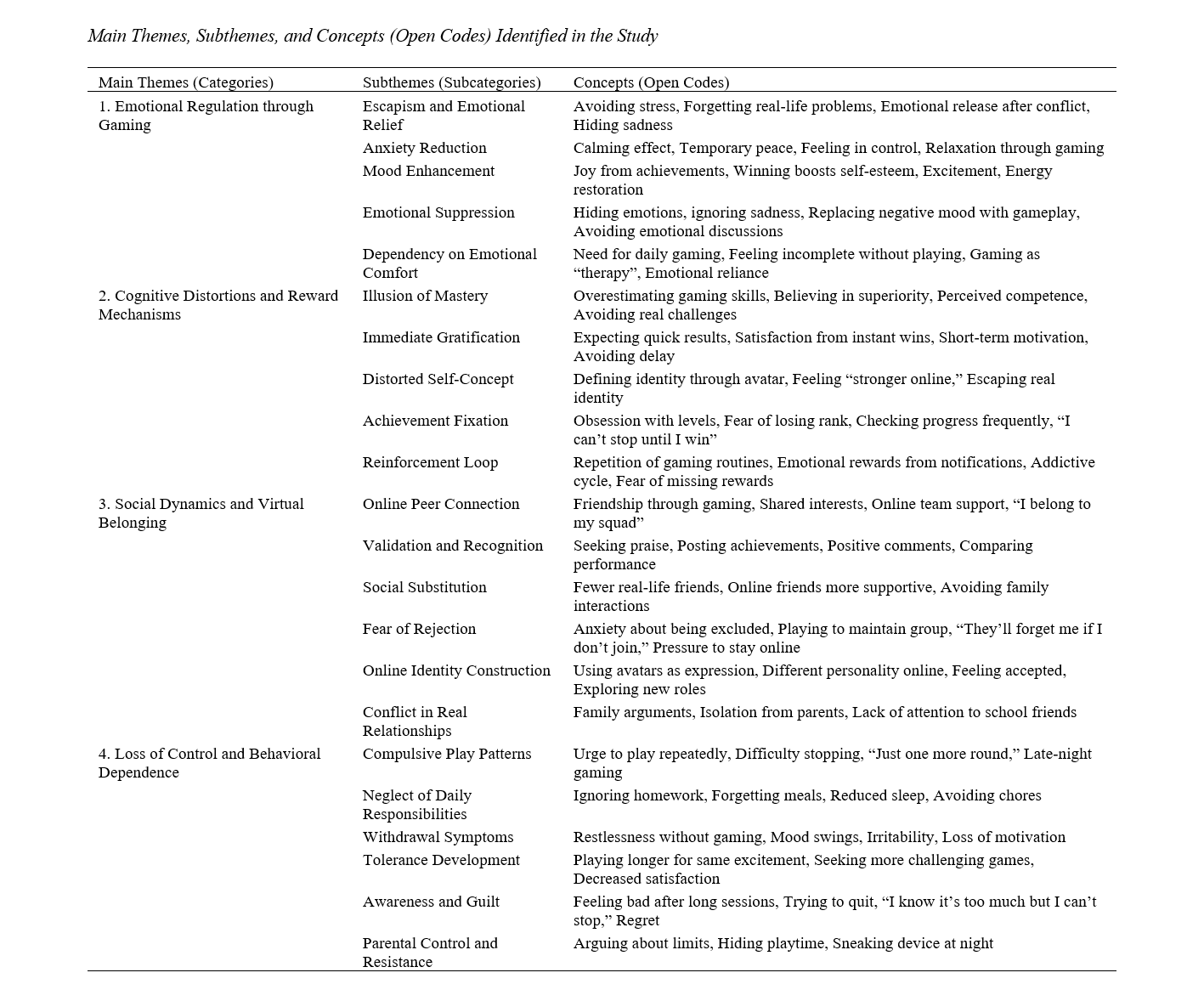
Findings: Thematic analysis yielded four main categories: (1) emotional regulation through gaming, where adolescents used gaming as a coping mechanism for stress, anxiety, and emotional discomfort; (2) cognitive distortions and reward mechanisms, highlighting the influence of illusion of mastery, instant gratification, and reinforcement loops on dependency; (3) social dynamics and virtual belonging, revealing that online relationships provided validation and identity formation but often replaced real-world connections; and (4) loss of control and behavioral dependence, characterized by compulsive play, neglect of daily tasks, withdrawal symptoms, and tolerance development. Together, these themes depict online gaming as an emotionally and cognitively reinforcing behavior that fulfills psychological and social needs while fostering dependency.
Conclusion: Online gaming dependency among adolescents emerges from a complex interplay of emotional, cognitive, social, and behavioral factors. Effective prevention requires integrating emotional regulation training, digital literacy education, and family-based interventions to promote healthy engagement with technology.
Downloads
References
A-zzahrah, M., Sriwenda, D., & Sofiyanti, S. (2024). The Relationship Between Online Games on Sleep Quality in Aldolescent Girls at Senior High School Kartika Xix-2 Bandung City. Hearty, 12(3), 544-550. https://doi.org/10.32832/hearty.v12i3.16352
Abas, B., Bukhari, S. A., Farrukh, M., & Iqbal, S. (2024). Examining the Socio-Psychological Dynamics of Interpersonal and Organizational Deviances: The Moderating Influence of Interpersonal Justice and Perceived Organizational Support. Leadership & Organization Development Journal, 45(6), 935-953. https://doi.org/10.1108/lodj-07-2023-0350
Azahra, A. S., Saputra, J., & Kalfin, K. (2024). Study of the Influence of Online Games on Adolescent Psychology in Parungponteng District: Analysis of Intensity of Use, Type of Game, and Psychological Impact. International Journal of Ethno-Sciences and Education Research, 4(1), 1-6. https://doi.org/10.46336/ijeer.v4i1.568
Chiang, S. C., & Bai, S. (2024). Testing Family-of-Origin Sensitization: Parent-Adolescent Conflict, Emotional Reactivity, and Adolescent Internalizing Psychopathology. Development and Psychopathology, 37(4), 2172-2180. https://doi.org/10.1017/s0954579424001779
Dodanwala, T. C., & Shrestha, P. (2021). Work–family Conflict and Job Satisfaction Among Construction Professionals: The Mediating Role of Emotional Exhaustion. On the Horizon the International Journal of Learning Futures, 29(2), 62-75. https://doi.org/10.1108/oth-11-2020-0042
E.O, O., Enamudu, G. P., & Faith, N. (2024). Adolescent Pregnancy in Nigeria: A MIMIC Modelling of Risk and Protective Factors. International Journal of Research and Innovation in Applied Science, IX(V), 182-194. https://doi.org/10.51584/ijrias.2024.905016
Elattar, N. F. M., A.Zaki, R., & Mohamed, S. M. N. (2022). Relationship Between Adolescents’ Perception of Inter-Parental Conflict, the Feeling of Emotional Security in Their Family, and Academic Achievement. Egyptian Journal of Health Care, 13(2), 1803-1816. https://doi.org/10.21608/ejhc.2022.260893
Elvadari, A. F. (2023). Peran Keluarga Dalam Mencegah Kecanduan Game Online Pada Remaja. JKKP (Jurnal Kesejahteraan Keluarga Dan Pendidikan), 10(02), 149-160. https://doi.org/10.21009/jkkp.102.03
Emeka, I. O., Onu, U., Agwu, C., & Catherine, O. (2023). Cyberbullying and Game Addiction, Its Effect on Students Mental Health. International Research Journal of Modernization in Engineering Technology and Science. https://doi.org/10.56726/irjmets44192
Fahrul, A., & Nurfarhanah, N. (2025). Dampak Kecanduan Game Online Pada Siswa SMP. Ahkam, 4(1), 145-157. https://doi.org/10.58578/ahkam.v4i1.4923
Farrukh, M., Abas, B., Ghazzawi, I. A., & Rafiq, M. (2024). From Bad Bosses to Weakened Marriages: The Role of Abusive Supervision in Emotional Exhaustion, Work–family Conflict and Marital Strain. Management Decision, 63(7), 2597-2615. https://doi.org/10.1108/md-01-2024-0198
Feng, J. (2025). Emotional Exhaustion as a Mediator Between Emotional Labor and Work-to-Family Conflict. Scientific and Social Research, 7(1), 98-102. https://doi.org/10.26689/ssr.v7i1.9333
Fitria, I., Pangestu, B., Mardikawati, B., Tjahyadi, I., & Bawamenewi, A. (2023). The Role of Digital Technology in Overcoming Game Addiction in Post-Covid-19. Al-Hijr Journal of Adulearn World, 3(1), 108-119. https://doi.org/10.55849/alhijr.v2i4.553
Gunawan, V., & Setiawan, T. (2023). Fasilitas Rehabilitasi Dan Pengembangan Bakat Bagi Pecandu Internet. Jurnal Sains Teknologi Urban Perancangan Arsitektur (Stupa), 5(2), 1493-1506. https://doi.org/10.24912/stupa.v5i2.24295
Guo, Y., & Li, T. (2022). Dynamics and Optimal Control of an Online Game Addiction Model With Considering Family Education. Aims Mathematics, 7(3), 3745-3770. https://doi.org/10.3934/math.2022208
Haryati, O., Novita, N., Nurhalimah, N., & Banon, E. (2023). Factors Influencing Online Game Addiction Among Teenagers in Junior High Schools in the East Jakarta Indonesia (2022). International Journal of Applied Science and Research, 06(06), 85-96. https://doi.org/10.56293/ijasr.2023.5612
Hsieh, C. C., Liang, J. K., & Li, H. C. (2022). Bi-Directional Work-Family Conflict of Home-Based Teachers in Taiwan During COVID-19: Application Of job Demands-Resources Model. Journal of Professional Capital and Community, 7(4), 353-367. https://doi.org/10.1108/jpcc-04-2022-0022
Iskajyan, A., Avetisyan, M., & Konjoyan, H. (2024). The Impact of Destructive Internet Games on Adolescent Mental Health. Sush Scientific Proceedings, 134-142. https://doi.org/10.54151/27382559-24.1pb-134
Kasantarino, A., & Taubih, L. A. (2023). Analisis Faktor Penyebab Anak Remaja Kecanduan Bermain Game Online. Mandub, 1(3), 39-53. https://doi.org/10.59059/mandub.v1i3.264
Khisomudin, M., Solehudin, S., & Hasanah, N. N. (2024). Pengaruh Konflik Pekerjaan-Keluarga, Kelelahan Emosional Dan Stres Kerja Terhadap Kinerja Di PT Penerbit Erlangga Karawang. Jurnal Ilmiah Universitas Batanghari Jambi, 24(3), 2712. https://doi.org/10.33087/jiubj.v24i3.5378
Kolomiets, O., & Demydenko, T. (2023). Social Prevention of Adolescent Online Gaming Addiction. Scientific Bulletin of Uzhhorod University Series «pedagogy Social Work»(1(52)), 72-77. https://doi.org/10.24144/2524-0609.2023.52.72-77
LaMontagne, L., Diehl, D. C., Doty, J., & Smith, S. (2022). The Mediation of Family Context and Youth Depressive Symptoms by Adolescent Emotion Regulation. Youth & Society, 55(3), 552-580. https://doi.org/10.1177/0044118x211067266
Lestari, D., & Budiono, B. (2021). Pengaruh Work Family Conflict Dan Emotional Exhaution Terhadap Kinerja Perawat Wanita Melalui Organizational Commitment Pada Rumah Sakit Petrokimia Gresik. Jurnal Ilmu Manajemen, 9(1), 167. https://doi.org/10.26740/jim.v9n1.p167-181
Li, Z. (2023). Factors That Predispose Teens to Video Game Addiction During COVID-19. Lecture Notes in Education Psychology and Public Media, 6(1), 698-703. https://doi.org/10.54254/2753-7048/6/20220647
Moroń, M., Jach, Ł., Atłas, K., & Moroń, R. (2023). Parental and Pandemic Burnout, Internalizing Symptoms, and Parent-Adolescent Relationships: A Network Analysis. Journal of psychopathology and behavioral assessment, 45(2), 428-443. https://doi.org/10.1007/s10862-023-10036-w
Muliana, L., Nazaruddin, M., Alwi, A., Chalid, I., & Kasim, F. M. (2022). Social Control Against Online Game-Addicted Teensin Padang Seurahet Village, Johan Heroes District Barat Aceh District. Malikussaleh Social and Political Reviews, 3(2), 37-41. https://doi.org/10.29103/mspr.v3i2.8707
Nadeak, B. (2021). The Impact of Online Game Addiction on the Quality of Student Education During the COVID-19 Pandemic. Jurnal Pendidikan Dan Pengajaran, 54(3). https://doi.org/10.23887/jpp.v54i3.35480
Napitupulu, C. M., & Desiana, P. M. (2023). Role Conflict – Job Resources Impact on Emotional Exhaustion: Work-Family Conflict as Mediator. 1667-1675. https://doi.org/10.2991/978-94-6463-234-7_175
Nurhidayati, S. W., & Iqbal, M. (2024). Fenomena Kecanduan Game Online Pada Remaja (Studi Kasus Di Kec. Sukaraja, Kab. Seluma, Prov. Bengkulu). Khatulistiwa Jurnal Pendidikan Dan Sosial Humaniora, 4(2), 01-15. https://doi.org/10.55606/khatulistiwa.v4i2.2636
Nursalam, N., Iswanti, D. I., Agustiningsih, N., Rohmi, F., Permana, B., & Erwansyah, R. A. (2023). Factors Contributing to Online Game Addiction in Adolescents: A Systematic Review. International Journal of Public Health Science (Ijphs), 12(4), 1763. https://doi.org/10.11591/ijphs.v12i4.23260
Okechukwu, B. I. U., Anayo, C. C., Paschaline, O., & Udochukwu, C. (2023). The Moderating Role of Psychological Capital on the Relationship Between Work-Family Conflict and Burnout Among Artisans. International Journal of Research and Innovation in Social Science, VII(X), 2064-2076. https://doi.org/10.47772/ijriss.2023.701157
Peláez-Fernández, M. Á., Mérida‐López, S., Yudes, C., & Extremera, N. (2024). How Can the Social Family Climate Contribute to Emotional Intelligence in Preventing Suicidal Ideation and Promoting Life Satisfaction Among Adolescents? Applied Research in Quality of Life, 19(5), 2915-2932. https://doi.org/10.1007/s11482-024-10354-5
Qu, X. (2023). An Overview of Online Games and Their Effects on Adolescents. Open Journal of Social Sciences, 11(11), 310-320. https://doi.org/10.4236/jss.2023.1111021
Refnandes, R., Fajria, L., & Nelwati, N. (2022). Analisis Hubungan Kondisi Psikologis Dengan Kecanduan Gadget Pada Remaja Selama Masa Pandemi Covid 19 Di Kota Padang. Jurnal Ilmiah Universitas Batanghari Jambi, 22(2), 1318. https://doi.org/10.33087/jiubj.v22i2.2361
said, M. a., & Magistarina, E. (2024). The Relationship of Self-Control With Online Game Addiction Among Teenagers in Kenagarian Taeh Bukik. In Trend, 1(2), 71-81. https://doi.org/10.62260/intrend.v1i2.122
Saputra, I. (2024). Perilaku Sosial Pecandu Game Online Di Kalangan Remaja Desa Blang Baru Kecamatan Labuhan Haji Barat Kabupaten Aceh Selatan. Jarow, 2(2), 25-44. https://doi.org/10.22373/jarow.v2i2.4223
Segovia, A. O., & Recuero, L. H. (2023). Actor–partner Effects of Coping Strategies on Emotional Exhaustion in Dual‐earner Couples. Family Relations, 73(2), 1219-1234. https://doi.org/10.1111/fare.12948
Silva, A. d., Gao, M., Barni, D., Donato, S., Miller‐Graff, L. E., & Cummings, E. M. (2020). Interparental Conflict on Italian Adolescent Adjustment: The Role of Insecurity Within the Family. Journal of Family Issues, 42(3), 671-692. https://doi.org/10.1177/0192513x20927749
Silva, A. J. (2024). How Guilt Drives Emotional Exhaustion in Work–Pet Family Conflict. Animals, 14(23), 3503. https://doi.org/10.3390/ani14233503
Singh, A., & Suvidha. (2024). An Evaluation of Online Gaming Addiction Among Children and Adolescents. International Journal of Scientific Research in Science and Technology, 333-340. https://doi.org/10.32628/ijsrst52411135
Triantoro, P. A. S., Laily, N., & Sholicha, I. F. (2023). The Effect of Perceptions of Parents' Democratic Parenting on Online Game Addiction. Journal Universitas Muhammadiyah Gresik Engineering Social Science and Health International Conference (Umgeshic), 2(1), 229. https://doi.org/10.30587/umgeshic.v2i1.5189
Tunny, I. S. (2022). Deskripsi Kecanduan Game Online Pada Remaja Di Kebun Cengkeh Rt.01/Rw.09 Desa Batu Merah Kecamatan Sirimau Kota Ambon. Jurnal Riset Rumpun Ilmu Kesehatan, 1(1), 223-228. https://doi.org/10.55606/jurrikes.v1i1.2176
Wang, Y., Xia, Q., Yue, H., & Teng, W. (2024). Chinese Rural Kindergarten Teachers’ Work–Family Conflict and Their Turnover Intention: The Role of Emotional Exhaustion and Professional Identity. Behavioral Sciences, 14(7), 597. https://doi.org/10.3390/bs14070597
Wardana, D. A., & Waskito, J. (2024). Peran Kelelahan Emosional Sebagai Pemediasi Pada Pengaruh Tuntutan Pekerjaan, Dukungan Supervisor, Dan Rekan Kerja Terhadap Work-Family Conflict (Studi Di Pt TMNC Manufacturing International). Jurnal Manajemen Dirgantara, 17(1), 250-269. https://doi.org/10.56521/manajemen-dirgantara.v17i1.1175
Widyaningrum, A. R., Musthofa, S. B., & Agushybana, F. (2023). Analisis Faktor Yang Berhubungan Dengan Perilaku Gaya Hidup Sehat Pada Remaja Kecanduan Game Online. Journal of Telenursing (Joting), 5(2), 2196-2204. https://doi.org/10.31539/joting.v5i2.6624
Xu, L. (2025). How Do Online Multiplayer Video Games Shape Teenagers’ Sense of Social Identity and Belonging Within Gaming Communities? An Ethical Perspective. International Journal of Education and Humanities, 19(3), 235-237. https://doi.org/10.54097/afg33a45
Yan, W., Cheng, Z., Di, X., Wang, H., Du, X., Li, L., & Song, C. (2024). Patient Mistreatment, Work-Family Conflict and Emotional Exhaustion Among Nurses: A Moderated Mediation Model of Social Sharing and Perceived Organizational Support. https://doi.org/10.21203/rs.3.rs-4247921/v1
Yaseen, F., Ain, Q. U., & Jamal, Y. (2021). The Emotional Labor and Burnout in Married Female Doctors of Pakistan: The Moderating Role of Work-Family Conflict. Gomal University Journal of Research, 37(04), 422-432. https://doi.org/10.51380/gujr-37-04-05
Yeh, T. F., Chang, Y. C., Hsu, Y. H., Huang, L. L., & Yang, C. C. (2020). Causes of Nursing Staff Burnout: Exploring the Effects of Emotional Exhaustion, Work–family Conflict, and Supervisor Support. Japan Journal of Nursing Science, 18(2). https://doi.org/10.1111/jjns.12392
Zhang, H., Tang, L., Ye, Z., Zou, P., Shao, J., Wu, M., Zhang, Q., Qiao, G., & Mu, S. (2020). The Role of Social Support and Emotional Exhaustion in the Association Between Work-Family Conflict and Anxiety Symptoms Among Female Medical Staff: A Moderated Mediation Model. BMC psychiatry, 20(1). https://doi.org/10.1186/s12888-020-02673-2
Downloads
Additional Files
Publication Timeline
- Submitted
- Revised
- Accepted