Comparison of the Effectiveness of Cognitive and Metacognitive Strategies Training and Mindfulness on Academic Self-Regulation Components in Female High School Students
DOI:
https://doi.org/10.61838/kman.jayps.4610Keywords:
Academic self-regulation, cognitive strategies, metacognitive strategies, mindfulness, motivation, adolescents, educational interventionAbstract
The objective of this study was to compare the effectiveness of cognitive and metacognitive strategy training and mindfulness training on the components of academic self-regulation—metacognition, cognition, and motivation—among female high school students. This applied, semi-experimental study employed a pre-test, post-test, and follow-up design with a control group. The statistical population consisted of female high school students in District 13 of Tehran during the 2024–2025 academic year. Using cluster sampling, 45 students with low academic self-regulation, hope, and buoyancy scores were selected and randomly assigned to three groups: cognitive and metacognitive strategies training (n = 15), mindfulness training (n = 15), and control (n = 15). Interventions consisted of eight weekly one-hour sessions based on McCombs’ cognitive-metacognitive training protocol and Kabat-Zinn’s mindfulness training protocol. Data were collected using the validated Academic Self-Regulation Questionnaire (Bouffard et al., 1995; Ghasemi & Fooladchang, 2011) at pre-test, post-test, and three-month follow-up. Data were analyzed using mixed ANOVA and Bonferroni post-hoc tests in SPSS v.22.
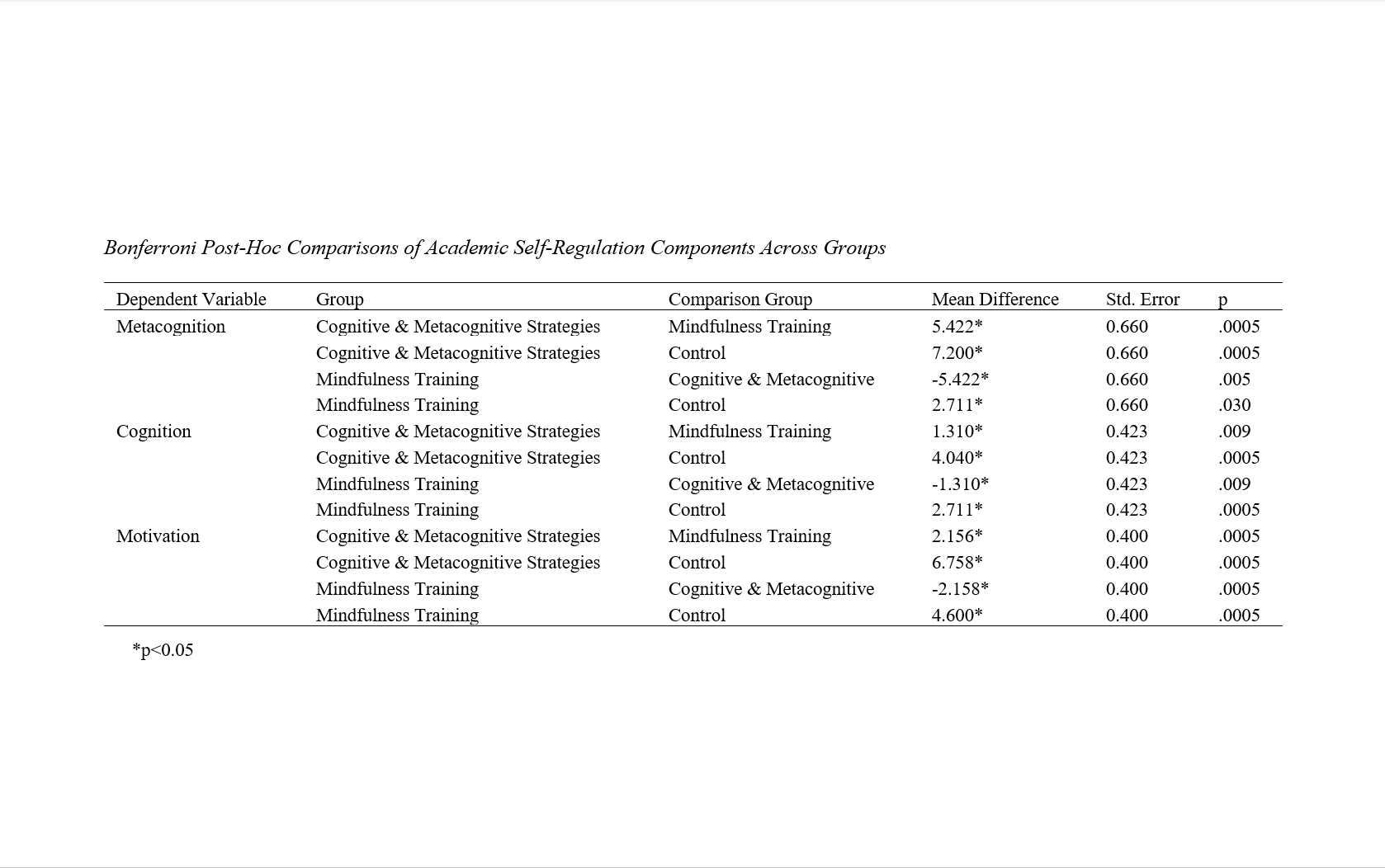
Inferential results showed significant main effects of time and significant time-by-group interactions for all components of academic self-regulation (p < .0005). Cognitive and metacognitive strategy training produced the largest improvements in cognition and motivation, whereas mindfulness training was particularly effective in enhancing metacognitive awareness and demonstrated sustained improvements at follow-up. Bonferroni comparisons indicated that both intervention groups significantly outperformed the control group across all components, with cognitive and metacognitive strategies training showing stronger effects on motivation and cognition, while mindfulness training exhibited more durable effects on metacognition.
Downloads
References
Asdolahzadeh, P., Sadeghi, J., & Abbasi Asfajir, A. A. (2021). Modeling the Structural Equations of Mode Metacognition with a Tendency to Cyberspace Mediated by Self-efficacy in Gifted Students [Research Article]. Iranian Journal of Educational Sociology, 4(2), 14-23. https://doi.org/10.52547/ijes.4.2.14
Ashoori, J., Azadmard, S. H., Jalil Abkenar, S., & Moeini Kia, M. (2014). A prediction model of academic achievement based on cognitive and metacognitive strategies, achievement goals orientation and spiritual intelligence in biology. Journal of School Psychology, 2(6-24/4), 118-136. https://jsp.uma.ac.ir/article_7.html
Babaei-Monqari, M. M., Hamednia, M., & Abedi Qelich Qashlaki, M. (2022). Modeling the Relationship Between Motivational Strategies and Metacognitive Self-Regulation with Peer Learning in High School Students. Journal of Psychology, 1(26), 91-99. https://www.researchgate.net/publication/325228817_Modeling_the_relationship_between_motivational_beliefs_cognitive_learning_strategies_and_academic_performance_of_teacher_education_students
Babakhanlou, A. (2023). Presenting Structural Model of Emotional Eating in People with Obesity based on Self-Regulation with the Mediating Role of Emotional Processing. Journal of Psychological Dynamics in Mood Disorders (PDMD), 2(2), 30-40. https://doi.org/10.22034/pdmd.2023.185859
Bargamadi, M., Mahdian, H., & Yamini, M. (2019). Comparison of the Effectiveness of Working Memory and Mindfulness Training on Educational Well-Being, Academic Self-Regulation and Academic Achievement Motivation of High School Students. Iranian Journal of Educational Sociology, 2(2), 100-111. https://doi.org/10.29252/ijes.2.2.100
Enayati Shabkolai, M., Enayati Shabkalai, M., & Bagheri Dadokolai, M. (2023). The Effectiveness of Treatment based on Acceptance and Commitment on Social Adaptation, Academic Self-Regulation and Cognitive Flexibility of Students with Specific Learning Disorders. International Journal of Education and Cognitive Sciences, 4(1), 33-41. https://doi.org/10.61838/kman.ijecs.4.1.5
Ghasemi, M., Islami, & Dartaj. (2025). The effectiveness of a cognitive therapy program based on mindfulness on social comparison and emotional self-regulation in students addicted to the internet. Journal of News Sciences. https://journals.lww.com
Hoseini-Motlaq, M., Azari, Z., & Aminian, S. (2012). Prediction of integrated self-knowledge based on self-compassion, self-discovery, and mindfulness with the mediating role of emotional cognitive self-regulation in students. Psychological Methods and Models, 12(46), 99-112. https://jpmm.marvdasht.iau.ir/article_5100.html
Hosseini Motlagh, M., Azari, Z., & Aminimanesh, S. (2022). Predicting integrative self- knowledge based on self-compassion, self-discovery and mindfulness with the mediating role of emotional cognitive self-regulation in the university students. Psychological Models and Methods, 12(46), 99-112. https://doi.org/10.30495/jpmm.2022.28152.3412
Ihor, P., & Ruslana, K. (2021). Metacognitive awareness and academic self-regulation of HEI students. International Journal of Cognitive Research in Science, Engineering and Education, 9(2), 161-172. https://doi.org/10.23947/2334-8496-2021-9-2-161-172
Jafari, L., & Bigdeli, K. (2023). The Relationship Between Self-Regulation (Cognitive and Metacognitive) and Academic Procrastination With Adaptation to Goals in Islamic Azad University Students. Analytical Cognitive Psychology Quarterly, 13(51), 15-32.
Mohammadi Darvish Bighal, N., Hatami, H., Asadzadeh, H., & Ahadi, H. (2020). The effect of self-regulation (cognitive and metacognitive) strategy training on motivational beliefs (academic motivation, self-efficacy, test anxiety) in high school students. Educational Psychology (Psychology & Educational Sciences), 9(27), 49-66. https://doi.org/10.1007/s12345-012-0359-0
Osuli, A., Shariatmadar, A., & Kalantar Hormozi, A. (2016). Investigating the relationship between metacognitive beliefs, academic self-regulation and conflict between students and parents. Journal of Counseling and Psychotherapy, 7(27), 83-104. https://qccpc.atu.ac.ir/article_6726.html
Puthusserry, S. T., & Delariarte, C. F. (2023). Development and implementation of mindfulness-based psychological intervention program on premenstrual dysphoric symptoms and quality of life among late adolescents: A pilot study. Journal of Affective Disorders Reports, 11, 100461. https://doi.org/10.1016/j.jadr.2022.100461
Rafezi, Z., Pirabbasi, G., & Eskandari, H. (2021). Efficacy of group metacognitive therapy on emotional self-regulation and ego strength of anxious students. Monthly Journal of Psychological Science, 20(108), 2243-2254. https://doi.org/10.52547/JPS.20.108.2239
Ramli, N. H. H., Alavi, M., Mehrinezhad, S. A., & Ahmadi, A. (2018). Academic Stress and Self-Regulation Among University Students in Malaysia: Mediator Role of Mindfulness. Behavioral Sciences, 8(1), 12. https://doi.org/10.3390/bs8010012
Sayedi, F., Yazdanbakhsh, K., & Karami, J. (2017). The relationship between attachment styles, self-regulation, and academic achievement in students [Original Article]. International Journal of Educational and Psychological Researches, 3(4), 250-254. https://doi.org/10.4103/jepr.jepr_63_16
Tajoldini, S., Tohidi, A., & Mousavinasab, H. (2018). The effect of mindfulness-based-stress reduction (MBSR) training on academic buoyancy and academic self-regulation in high shool students. Journal of Educational Psychology Studies, 15(31), 59-88. https://doi.org/10.22111/jeps.2018.4267
Ziegler, N., & Opdenakker, M. C. (2018). The development of academic procrastination in first-year secondary education students: the link with metacognitive self-regulation, self-efficacy, and effort regulation. Learn Individ Differ, 64, 71-82. https://doi.org/10.1016/j.lindif.2018.04.009
Downloads
Additional Files
Publication Timeline
- Submitted
- Revised
- Accepted