Identifying and Ranking Psychological Determinants of Teacher Readiness for AI Integration
DOI:
https://doi.org/10.61838/kman.jayps.4602Keywords:
Artificial intelligence integration, teacher readiness, technological self-efficacy, educational innovationAbstract
Objective: This study aimed to identify and rank the key psychological determinants influencing teachers’ readiness for integrating artificial intelligence (AI) into educational practices.
Methods and Materials: The research followed a sequential exploratory mixed-method design. In the first phase, a qualitative content analysis was conducted through a systematic literature review of peer-reviewed studies published between 2022 and 2025. Data were analyzed using NVivo 14, following open, axial, and selective coding until theoretical saturation was reached. Seven major psychological determinants emerged. In the second phase, a quantitative ranking analysis was performed using SPSS 26. A structured questionnaire, based on the qualitative findings, was distributed to 200 teachers in Tehran. The relative significance of each determinant was analyzed using Friedman’s test, with reliability and validity verified through Cronbach’s alpha and exploratory factor analysis.
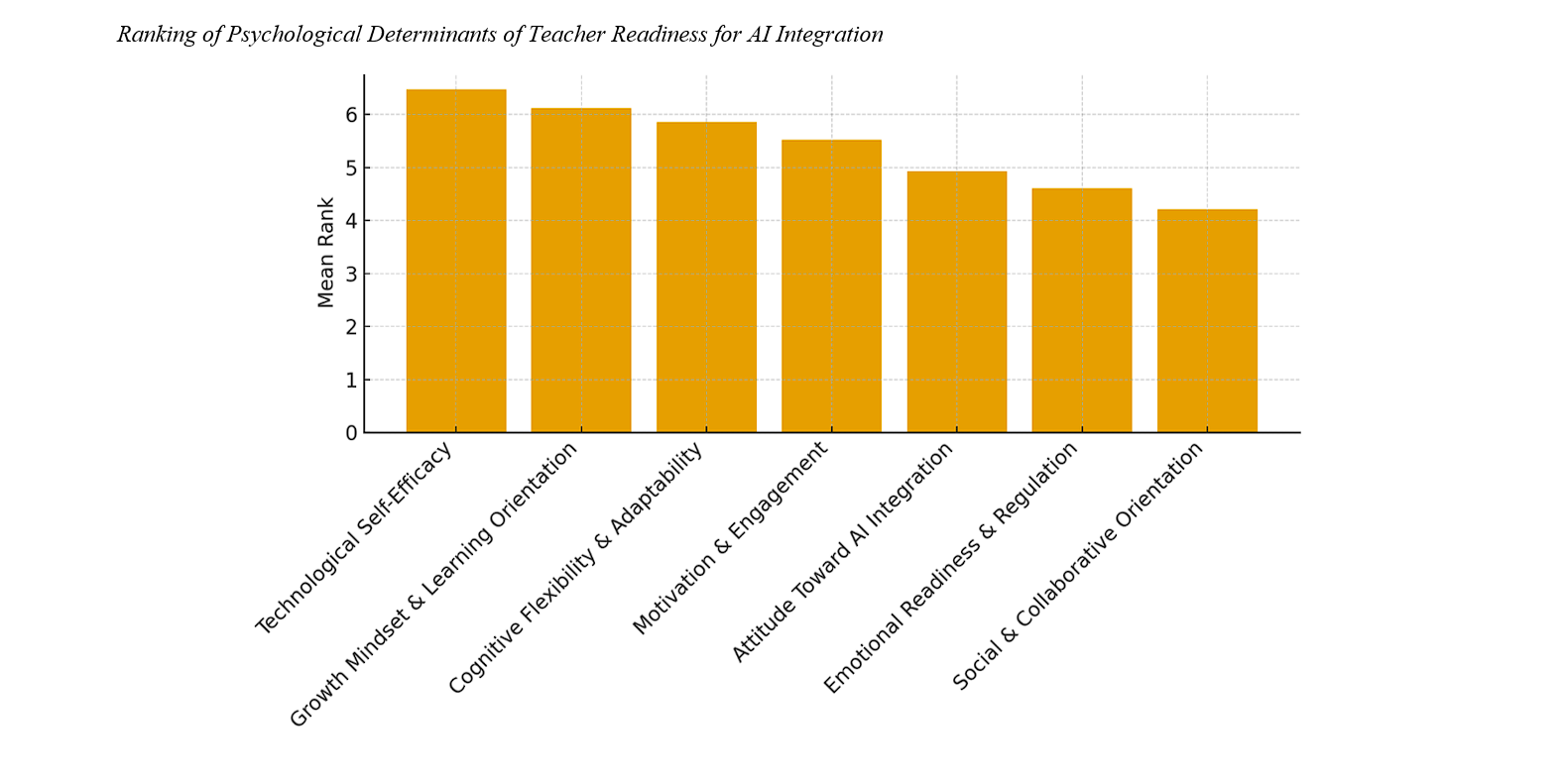
Findings: Results indicated a statistically significant difference among the seven determinants (χ² = 187.42, df = 6, p < 0.001). Technological self-efficacy ranked highest, followed by growth mindset and learning orientation, and cognitive flexibility and adaptability. Motivation and engagement and attitude toward AI integration occupied mid-ranks, while emotional readiness and regulation and social and collaborative orientation ranked lowest. These findings reveal that teachers’ internal cognitive and motivational capacities are stronger predictors of AI readiness than emotional or institutional factors.
Conclusion: Teacher readiness for AI integration is primarily shaped by self-efficacy, continuous learning orientation, and adaptability. Psychological empowerment and professional reflection precede emotional and social readiness, underscoring the need for professional development programs that foster confidence, growth mindset, and adaptive cognition.
Downloads
References
Aboushi, M. M. J., & Obied, A. (2025). From Creativity to Confidence: Predicting Teachers’ Perspectives on STEM Integration. Asian Journal of Interdisciplinary Research, 89-105. https://doi.org/10.54392/ajir2537
Ajlouni, A. O., Ibrahim, A., & Hendawi, M. (2025). Predicting Preservice Teachers' Intentions to Integrate AI-Based Mobile Applications in Special Education: Examining the Role of Technology Self-Efficacy and Attitudes. International Journal of Interactive Mobile Technologies (Ijim), 19(07), 22-43. https://doi.org/10.3991/ijim.v19i07.53177
Alconis, S. F. B. (2023). Teachers’ Self Efficacy, Attitude and Motivation Towards Adaptation to Blended Learning: A Basis for Professional Learning Cycle Plan. Aide Interdisciplinary Research Journal, 3, 279-293. https://doi.org/10.56648/aide-irj.v3i1.69
Aloka, P. J. O., Ooko, M., Onyango, P. A., & Birech, J. K. (2024). Teacher Self-Efficacy in Managing Diverse Classrooms. 297-310. https://doi.org/10.4018/979-8-3693-1147-9.ch020
Alshorman, S. (2024). The Readiness to Use Ai in Teaching Science: Science Teachers' Perspective. Journal of Baltic Science Education, 23(3), 432-448. https://doi.org/10.33225/jbse/24.23.432
Carvalho, M., Simó‐Pinatella, D., Azevedo, H., & Adam‐Alcocer, A. L. (2024). Inclusive Education in Portugal: Exploring Sentiments, Concerns and Attitudes of Teachers. Journal of Research in Special Educational Needs, 24(3), 729-741. https://doi.org/10.1111/1471-3802.12663
Eke, E. O. (2024). Assessing the Readiness and Attitudes of Nigerian Teacher Educators Towards Adoption of Artificial Intelligence in Educational Settings. Journal of Educational Technology and Online Learning, 7(4 - ICETOL 2024 Special Issue), 473-487. https://doi.org/10.31681/jetol.1503305
Farooq, Y. (2025). Exploring Teachers' Psychological Readiness for Effective AI Integration in the Classroom. CRSSS, 3(3), 351-364. https://doi.org/10.59075/fbwe9b83
Fuentes, W. A. F., & Chiappe, A. (2025). Integrating AI Into Education: Preparation Factors and Teachers' Digital Competencies. Revista Colombiana de Educación(97), e20825. https://doi.org/10.17227/rce.num97-20825
Gatlin, M. (2023). Assessing Pre-Service Teachers’ Attitudes and Perceptions of Using Artificial Intelligence in the Classroom. TxEP, 7(2), 1-8. https://doi.org/10.59719/txep.v7i2.35
Jiang, N., Li, H., Ju, S.-Y., Kong, L.-K., & Li, J. (2025). Pre-Service Teachers’ Empathy and Attitudes Toward Inclusive Education—The Chain Mediating Role of Teaching Motivation and Inclusive Education Efficacy. PLoS One, 20(4), e0321066. https://doi.org/10.1371/journal.pone.0321066
Korkmaz, H., & Keçik, İ. (2024). Pre-Service English Language Teacher Readiness Before and After a Practicum Interrupted by the Pandemic. Manisa Celal Bayar Üniversitesi Eğitim Fakültesi Dergisi, 12(1), 111-128. https://doi.org/10.52826/mcbuefd.1368024
Krause, J. M., & Jenny, S. E. (2023). Physical Educators’ Exergaming Integration Experiences, Attitudes, and Self-Efficacy Beliefs. The Physical Educator, 80(1). https://doi.org/10.18666/tpe-2023-v80-i1-11057
Levkovich, I., & Stregolev, B. (2024). Non-Suicidal Self-Injury Among Adolescents: Effect of Knowledge, Attitudes, Role Perceptions, and Barriers in Mental Health Care on Teachers’ Responses. Behavioral Sciences, 14(7), 617. https://doi.org/10.3390/bs14070617
Martín, C. S., Calvo, R., Sharma, U., Vega, C. R., & Martínez, M. Y. M. (2024). Attitudes, Self-Efficacy, and Intention to Teach in Inclusive Classrooms of in-Service Teachers in Chile: Validating Scales. Revista Brasileira De Educação Especial, 30. https://doi.org/10.1590/1980-54702024v30e0101
Natividad, A. C. A., Perez, J., & Bondoc, B. G. (2024). Exploring the Research Drive: Unveiling Motivation, Attitude, and Self-Efficacy Among Public High School Teachers. Academia Lasalliana Journal of Education and Humanities, 6(1), 145-154. https://doi.org/10.55902/yvnk4687
Ofem, U. J., Orim, F. S., Edam-Agbor, I. B., Amanso, E. O. I., Eni, E., Ukatu, J. O., Ovat, S. V., Osang, A. W., Dien, C. A., & Abuo, C. B. (2025). Teachers’ Preparedness for the Utilization of Artificial Intelligence in Classroom Assessment: The Contributory Effects of Attitude Toward Technology, Technological Readiness, and Pedagogical Beliefs With Perceived Ease of Use and Perceived Usefulness as Mediators. Frontiers in Education, 10. https://doi.org/10.3389/feduc.2025.1568306
Saidi, S. M., Hoon, T. S., Singh, P., & Retnawati, H. (2024). The Relationship Between Teachers’ Personalities and Students’ Attitudes. Jurnal Pendidikan Sains Dan Matematik Malaysia, 14(1), 61-70. https://doi.org/10.37134/jpsmm.vol14.1.6.2024
Szász, K., Orbán, R., & Gergely, R. H. (2024). Teachers’ Attitudes Toward Inclusive Education in Romania. Journal of Educational Sciences & Psychology, 15 (76)(2), 65-78. https://doi.org/10.51865/jesp.2024.2.07
Tahir, M. S., Noor, A., & Raza, H. (2025). Explore the Role of Artificial Intelligence to Support Teachers at Higher Education Institutions in South Punjab. CRSSS, 3(3), 2421-2433. https://doi.org/10.59075/c098vs88
Thapliyal, R. M. (2024). A Study on the Impact of Self-Efficacy on Teachers' Attitude Towards Mainstreaming of Children With Disabilities. International Journal of Special Education (Ijse), 39(2), 62-74. https://doi.org/10.52291/ijse.2024.39.22
Woo, H. (2023). Pre-Service Primary School Teachers’ Self-Efficacy and Attitudes Towards Gifted Education: A Survey Study. Korea Science Educ Soc Gifted, 15(1), 58-68. https://doi.org/10.29306/jseg.2023.15.1.58
Yılmaz, G., & Saraç, L. (2023). The Relationship Between Attitudes Towards Supervision and Perceived Self-Efficacy in Physical Education Teaching Majors. E-Kafkas Eğitim Araştırmaları Dergisi, 10(2), 196-209. https://doi.org/10.30900/kafkasegt.1198008
Downloads
Additional Files
Publication Timeline
- Submitted
- Revised
- Accepted