Comparison of the Effectiveness of Compassion-Focused Therapy and Schema Therapy on the Severity of Clinical Symptoms in Adolescents with Social Anxiety Disorder
DOI:
https://doi.org/10.61838/kman.jayps.4598Keywords:
Schema therapy, Compassion-focused therapy, Clinical symptoms, Adolescents, Social anxiety disorderAbstract
Objective: This study aimed to compare the effectiveness of compassion-focused therapy (CFT) and schema therapy (ST) on reducing the severity of clinical symptoms in adolescents diagnosed with social anxiety disorder.
Methods and Materials: The research employed a quasi-experimental design with a pretest–posttest control group and a 2-month follow-up period. The statistical population consisted of male adolescents aged 14 to 18 years who attended psychological centers in Ramsar during the first quarter of 2024. Using purposive sampling, 45 participants were selected and randomly assigned to three groups: CFT experimental group (n = 15), ST experimental group (n = 15), and control group (n = 15). The Connor et al. (2000) Social Anxiety Questionnaire and the Derogatis et al. (1973) Symptom Checklist-90 (SCL-90) were used for data collection. The interventions were conducted according to Gilbert’s (2014) CFT protocol and Young et al.’s (2003) ST protocol. Data were analyzed using repeated-measures ANOVA and the Bonferroni post-hoc test via SPSS version 26.
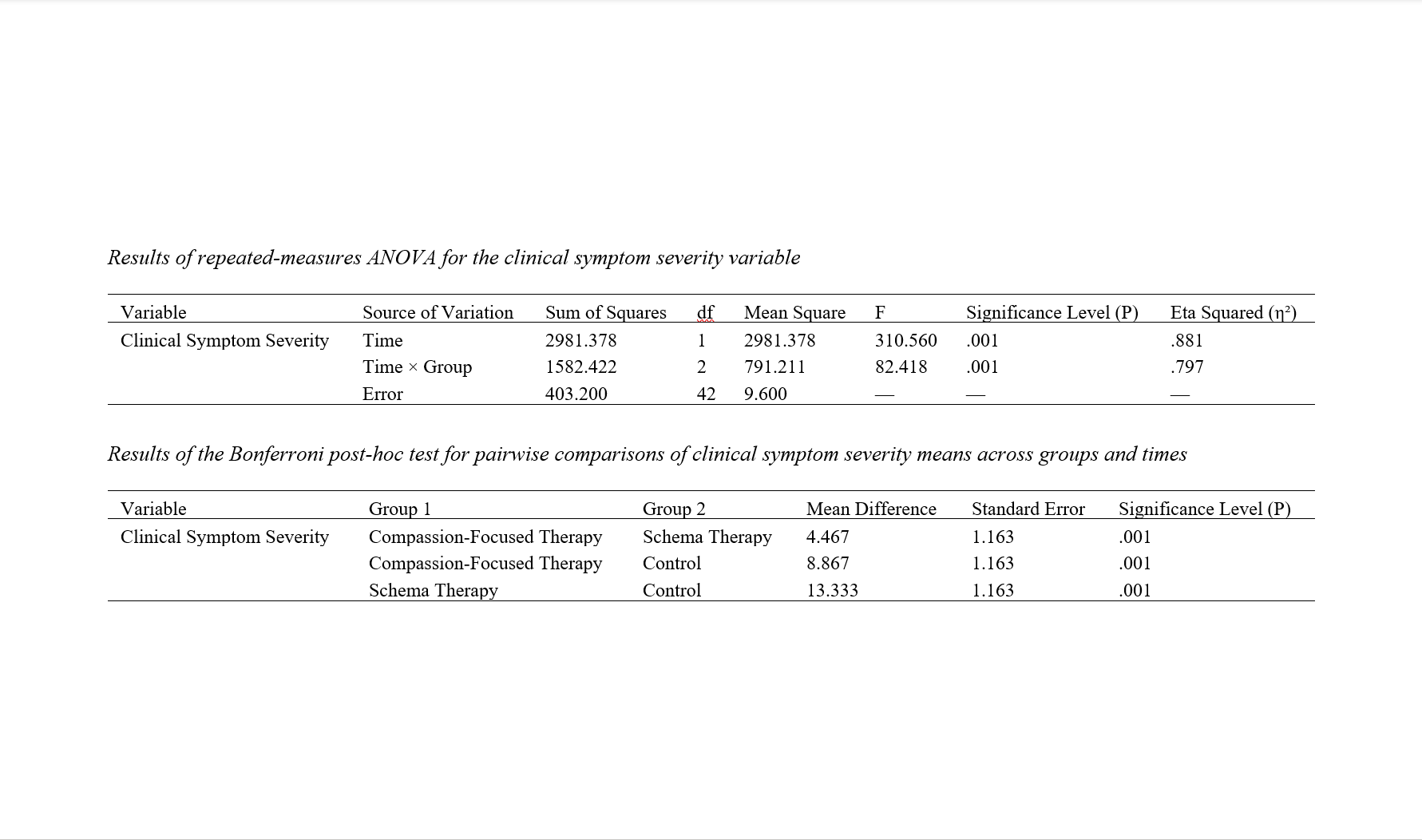
Findings: Results indicated a significant effect of time (P < .001, η² = .881) and a significant interaction between group and time (P < .001, η² = .797) on the severity of clinical symptoms. Both CFT and ST led to a significant reduction in symptom severity compared to the control group (P < .001). However, schema therapy demonstrated a greater effect than compassion-focused therapy in reducing clinical symptoms. No significant difference was observed between the posttest and follow-up scores, indicating the stability of treatment effects over time.
Conclusion: Both compassion-focused therapy and schema therapy effectively reduced the severity of clinical symptoms in adolescents with social anxiety disorder, though schema therapy was found to be more effective overall. These findings highlight the importance of cognitive–emotional interventions in the treatment of adolescent social anxiety.
Downloads
References
Bahadori, Z., Baba Pour, J., Mahmoudi Aluloo, M., & Ahmadi, P. (2022). The Effectiveness of Emotional Schema Therapy on the Severity of Clinical Symptoms and Emotional Schemas in Patients with Functional Neurological Symptom Disorder. Journal of Psychological Sciences, 21(110), 305-320. https://doi.org/10.52547/JPS.21.110.305
Bjaasted, J. F., Lillevoll, K., Hoffart, A., Nilsen, T. S., Kjoteroe, J., & Prescott, P. (2025). The effect of behavioral rehearsal in the training of clinical psychology students in cognitive therapy for social anxiety disorder: A randomized controlled trial. Behaviour Research and Therapy, 193, 104849. https://doi.org/10.1016/j.brat.2025.104849
Diedrich, A., Grant, M., Hofmann, S. G., Hiller, W., & Berking, M. (2024). Self-compassion as an emotion regulation strategy in major depressive disorder. Behavior Research and Therapy, 58, 43-51. https://doi.org/10.1016/j.brat.2014.05.006
Fadaei, G., Sotout, H., Mikaili, F., Emami, A., & Rashidi, A. (2021). Assessing the Prevalence of Mental Disorders Among First-Year Middle School Students in West Azerbaijan Province. Journal of Medical Science Studies, 32(7), 516-524. https://doi.org/10.52547/umj.32.7.516
Fox, N. A., Buzzell, G. A., Morales, S., Valadez, E. A., Wilson, M., & Henderson, H. A. (2021). Understanding the emergence of social anxiety in children with behavioral inhibition. Biological Psychiatry, 89(7), 681-689. https://doi.org/10.1016/j.biopsych.2020.10.004
Ismailzadeh Rizi, F., & Izadi, F. (2024). The Effectiveness of Schema Therapy on Cognitive Bias Dimensions in Adolescent Girls with Body Dysmorphic Symptoms in Isfahan.
Izadi, F., Ashrafi, E., & Fathi Ashtiani, A. (2019). The Effectiveness of Emotional Schema Therapy on Reducing Negative Emotional Schemas, Alexithymia, and Symptoms in Patients with Somatic Symptoms. Journal of Behavioral Science Research, 17(2), 232-243. https://doi.org/10.52547/rbs.17.2.232
James, A. C., Reardon, T., Soler, A., James, G., & Creswell, C. (2020). Cognitive behavioural therapy for anxiety disorders in children and adolescents. Cochrane Database of Systematic Reviews, 18(11), 132-148. https://doi.org/10.1002/14651858.CD013162.pub2
Karami, Z., Karbalaei, F. S., Khalatbari, J., & Fardin, M. A. (2025). The Effectiveness of Integrating Schema Therapy and Acceptance and Commitment Therapy on Mental Well-Being and Body Image Concerns. Journal of Psychological Sciences, 24(145), 197-220. https://www.sid.ir/paper/1520142/fa
Korteling, J. E., Brouwer, A. M., & Toet, A. (2020). A neural network framework for cognitive bias. Frontiers in psychology, 9(11), 1561-1578. https://doi.org/10.3389/fpsyg.2018.01561
Krieger, T., Altenstein, D., Baettig, I., Doerig, N., & Holtforth, M. G. (2019). Self-compassion in depression: Associations with depressive symptoms, rumination, and avoidance in depressed outpatients. Behavior therapy, 44, 501-513. https://doi.org/10.1016/j.beth.2013.04.004
Mehrabani, M., Basak Nejad, S., & Mehrabi Zadeh, M. (2024). The Impact of Self-Compassion Training on Body Image Concerns, Thought-Shape Fusion, and Physical Self-Compassion in Students. QUARTERLY JOURNAL OF HEALTH PSYCHOLOGY, 45, 63-82. https://hpj.journals.pnu.ac.ir/article_9672.html
Nakhaei, S., Ekati, A., Ranjbar, H., & Mir, A. (2022). Evaluating the Impact of Emotion Regulation on Optimism and Anxiety in Students. Quarterly Journal of Innovative Psychological Ideas, 13(17), 1-12. http://jnip.ir/article-1-736-fa.html
Renner, F., DeRubeis, R., Arntz, A., Peeters, F., Lobbestael, J., & Huibers, M. J. H. (2018). Exploring mechanisms of change in schema therapy for chronic depression. Journal of Behavior Therapy and Experimental Psychiatry, 58, 97-105. https://doi.org/10.1016/j.jbtep.2017.10.002
Seabra, D., Carvalho, S. A., Gato, J., Petrocchi, N., & Salvador, M. D. C. (2024). (Self) tainted love: Shame and self-criticism as self-discriminatory processes underlying psychological suffering in sexual minority individuals. Journal of Human Behavior in the Social Environment, 12, 1-19. https://doi.org/10.1080/10911359.2024.2333777
Visani, M., Qasemi, S., & Manzari, V. (2024). The Effectiveness of Teaching Schema Therapy Concepts on Delusional Beliefs and Cognitive Avoidance in Individuals with Obsessive-Compulsive Symptoms. Scientific-Research Journal of Sabzevar University of Medical Sciences, 31(4), 456-466.
Wilson, A. C., Mackintosh, K., Power, K., & Chan, S. (2019). Effectiveness of Self-Compassion Related Therapies: A Systematic Review and Meta-analysis. Mindfulness, 10(6), 995-979. https://doi.org/10.1007/s12671-018-1037-6
Downloads
Additional Files
Publication Timeline
- Submitted
- Revised
- Accepted