Effectiveness of Cognitive-Analytic Therapy on Improving Personality Organization, Worry, and Experiential Avoidance in Adolescents with Borderline Personality Disorder
DOI:
https://doi.org/10.61838/kman.jayps.4517Keywords:
cognitive-analytic therapy, personality organization, worry, experiential avoidance, borderline personality disorderAbstract
Objective: The present study aimed to examine the effectiveness of cognitive-analytic therapy (CAT) in improving personality organization, reducing worry, and decreasing experiential avoidance among adolescents diagnosed with borderline personality disorder (BPD).
Methods and Materials: This quasi-experimental study employed a pretest–posttest control group design. The statistical population included all adolescents with BPD referred to counseling and social work centers in Tehran in 2025. Thirty participants were selected through purposive sampling and randomly assigned to experimental (n = 15) and control (n = 15) groups. The experimental group received eight sessions of group CAT (90 minutes each, twice per week), while the control group was placed on a waiting list for two months. Data collection tools included the Inventory of Personality Organization (IPO), the Penn State Worry Questionnaire (PSWQ), and the Acceptance and Action Questionnaire–II (AAQ-II). Data were analyzed using multivariate analysis of covariance (MANCOVA) in SPSS-26.
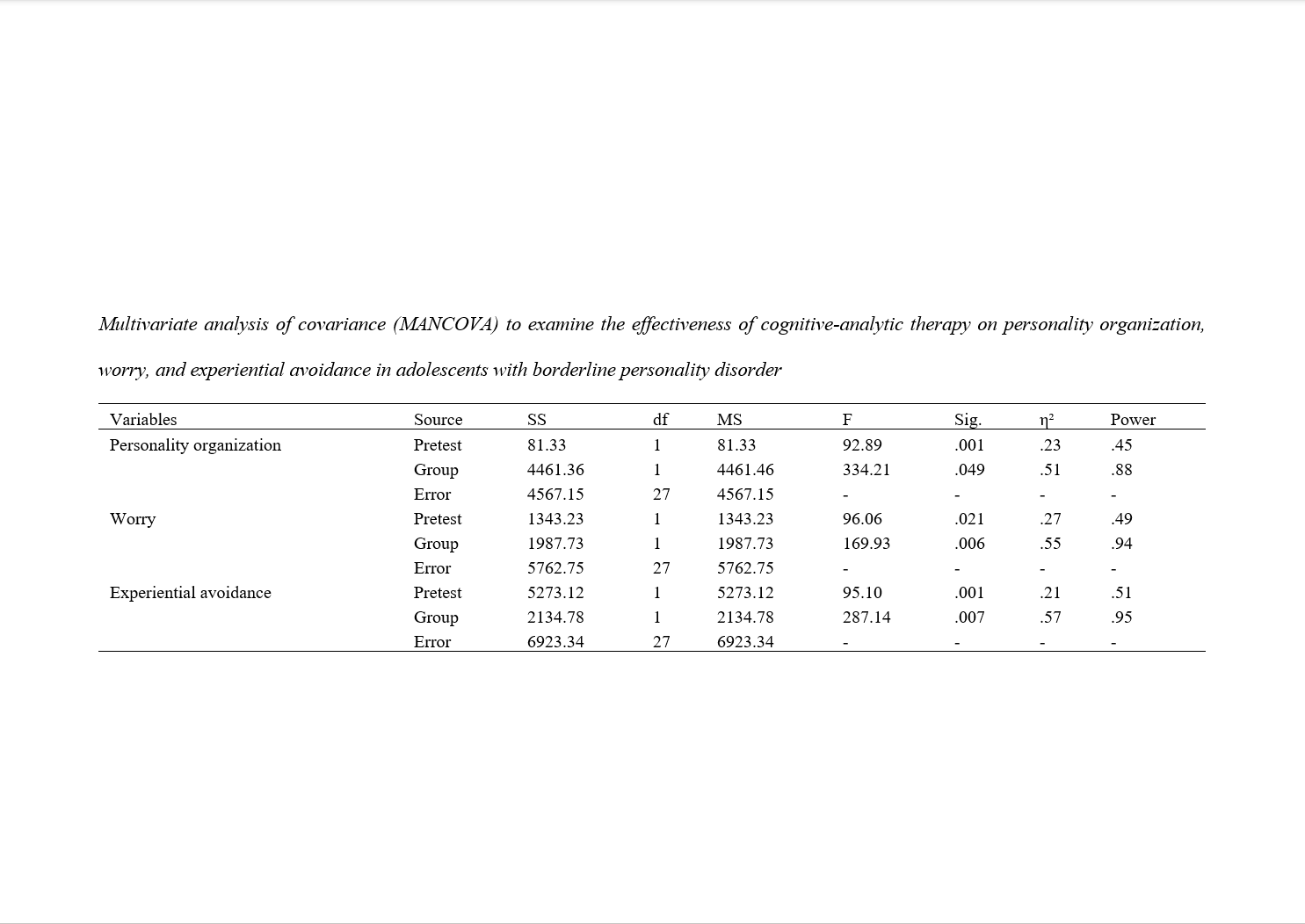
Findings: The results demonstrated that, after controlling for pretest effects, there were statistically significant differences between the experimental and control groups in the posttest scores of personality organization (F = 333.19, p < .049, η² = .51), worry (F = 169.93, p < .006, η² = .55), and experiential avoidance (F = 287.14, p < .007, η² = .57). These findings indicate that CAT significantly improved personality organization while reducing worry and experiential avoidance in adolescents with BPD.
Conclusion: The therapy enhances self-awareness, reduces maladaptive avoidance strategies, and improves overall personality functioning, making it a promising option for clinical practice with this population.
Downloads
References
Abadi, D. B. N., Badihi, M., Rabiee, Z., & Shokrolahi, M. (2024). Effectiveness of Cognitive Analytic Therapy on Anxiety Sensitivity and Pain Catastrophizing in Patients With Chronic Pain and Alexithymia. The Journal of Tolooebehdasht. https://doi.org/10.18502/tbj.v22i6.15212
Abdi, R., & Kaboudi, N. (2016). The moderating role of experiential avoidance in the relationship between anxiety sensitivity and perceived stress in students. Quarterly Journal of Thought and Behavior in Clinical Psychology, 10(40), 57-66. https://www.sid.ir/paper/172082/
Abdolpour, Q., Hashemi, T., Shiri, M. R., & Alizadeh, F. (2018). The relationship between personality organization and metacognitive beliefs with worry in individuals exhibiting depressive symptoms. Journal of Cognitive Psychology and Psychiatry, 5(2), 15-26. https://doi.org/10.29252/shenakht.5.2.15
Aftab, R. (2016). The mediator role of interpersonal difficulties in relationship between experiential avoidance with depression and anxiety. Journal of Applied Psychology, 4(40), 523-542. https://apsy.sbu.ac.ir/index.php/test/issue/view/Downloads/article_96757.html?lang=en
Alexander, J. R., Houghton, D. C., Twohig, M. P., Franklin, M. E., Saunders, S. M., Neal-Barnett, A. M., & et al. (2017). Clarifying the relationship between Trichotillomania and anxiety. Journal Obsessive Compuls Relat Disord, 13(4), 30-34. https://doi.org/10.1016/j.jocrd.2017.02.004
Bardeen, J. R., & Fergus, T. A. (2016). The interactive effect of cognitive fusion and experiential avoidance on anxiety, depression, stress and posttraumatic stress symptoms. Journal of Contextual Behavioral Science, 5(1), 1-6. https://doi.org/10.1016/j.jcbs.2016.02.002
Chen, S., Yao, N., & Qian, M. (2018). The influence of uncertainty and intolerance of uncertainty on anxiety. Journal of Behavior Therapy and Experimental Psychiatry, 61, 60-65. https://doi.org/10.1016/j.jbtep.2018.06.005
Clarke, S., Thomas, P., & James, K. (2013). Cognitive analytic therapy for personality disorder: randomized controlled trial. The British Journal of Psychiatry, 202(2), 129-134. https://doi.org/10.1521/pedi.2013.27.3.303
Dabashi, L., Najafi, M., & Rahimian-Bogar, I. (2018). The effectiveness of cognitive-analytical group therapy on impulsivity and dissociative experiences in adolescents with borderline personality disorder. Clinical Psychology Journal, 10(2), 15-27. https://journals.semnan.ac.ir/article_3422.html
Dar, K. A., Iqbal, N., & Mushtaq, A. (2017). Intolerance of uncertainty, depression, and anxiety: Examining the indirect and moderating effects of worry. Asian Journal Psychiatry, 29, 129-133. https://doi.org/10.1016/j.ajp.2017.04.017
Eini, S., Narimani, M., Atadokht, A., Basharpoor, S., & Sadeghi-Moayed, F. (2018). The effectiveness of cognitive-analytical therapy on ego strength and object relations in individuals with borderline personality disorder. Urmia Medical Journal, 29(1), 1-11. http://umj.umsu.ac.ir/browse.php?a_code=A-10-2707-2&slc_lang=fa&sid=1
Farhadi, A., Abasi, M., Bagiyan-Kulemarz, M.-J., & Azim-Pour, A. (2015). The effectiveness and efficiency of cognitive-analytical psychotherapy in mental well-being and reducing impulsive behaviors in men with borderline personality disorder. Quarterly Journal of Clinical Psychology Studies, 6(21), 119-149. https://www.noormags.ir/view/en/articlepage/1122971/
Ghanavati, M. (2024). Comparison the Effectiveness of Cognitive-Analytical Therapy and Emotional Schema Therapy on Cognitive Emotion Regulation and Worry of Patients With Generalized Anxiety Disorder. PDMD, 3(4), 114-128. https://doi.org/10.61838/kman.pdmd.3.4.8
Glass, D. J. (2012). Factor Structure of OCD: Toward an Evolutionary Neuro-Cognitive Model of Obsessive-Compulsive Disorder State University of New York at New Paltz]. https://soar.suny.edu/handle/20.500.12648/670
Hayes, S. C., Levin, M. E., Plumb-Vilardaga, J., Villatte, J. L., & Pistorello, J. (2013). Acceptance and commitment therapy and contextual behavioral science: Examining the progress of a distinctive model of behavioral and cognitive therapy. Behavior therapy, 44(2), 180-198. https://doi.org/10.1016/j.beth.2009.08.002
Hershenberg, R., Mavandadi, S., Wright, E., & Thase, M. E. (2017). Anhedonia in the daily lives of depressed veterans: A pilot report on experiential avoidance as a moderator of emotional reactivity. Journal of affective disorders, 208, 414-417. https://doi.org/10.1016/j.jad.2016.10.011
Hong, J. S., Kim, S. M., Jung, H. Y., Kang, K. D., Min, K. J., & Han, H. D. (2017). Cognitive avoidance and aversive cues related to tobacco in male smokers. Journal of Addictive Behaviors, 73, 158-164. https://doi.org/10.1016/j.addbeh.2017.05.003
Jensen, D., Kind, A. J., Morrison, A. S., & Heimberg, R. G. (2014). Intolerance of uncertainty and immediate decision-making in high-risk situations. Journal of Experimental Psychopathology, 5(2), 178-190. https://doi.org/10.5127/jep.035113
Karimi, J., & Izadi, R. (2015). Investigating the role of experiential avoidance and sensitivity to anxiety symptoms on mental health and general health among nursing students. Iranian Journal of Nursing Research, 10(4), 32-42. https://ijnr.ir/browse.php?a_id=1625&slc_lang=fa&sid=1&printcase=1&hbnr=1&hmb=1
Kellett, S., Stockton, C., Marshall, H., Hall, J., Jennings, C., & Delgadillo, J. (2018). Efficacy of narrative reformulation during cognitive analytic therapy for depression: Randomized dismantling trial. Journal of affective disorders, 239, 37-47. https://doi.org/10.1016/j.jad.2018.05.070
Lawrence, P. J., Rooke, S. M., & Creswell, C. (2017). Review: prevention of anxiety among at-risk children and adolescents— a systematic review and meta-analysis. Child and Adolescent Mental Health, 22, 118-130. https://doi.org/10.1111/camh.12226
Masoudian, Z., Atef Vahid, M. K., Malihi Alzakerini, S., Kraskian Mojmenari, A., & Delavari, A. (2023). Comparison of the effectiveness of metacognitive therapy and analytical cognitive therapy on reducing anxiety in patients with irritable bowel syndrome (IBS). Rooyesh-e-Ravanshenasi, 12(6), 121-132. https://frooyesh.ir/article-1-4081-en.html
McCutcheon, K. L., Kerr, A. B., & Chanen, A. M. (2019). Chapter 6 - Cognitive Analytic Therapy: A Relational Approach to Young People With Severe Personality Disorder. Journal of Case Formulation for Personality Disorders, 33(12), 95-111. https://doi.org/10.1016/B978-0-12-813521-1.00006-0
Peter, J., Lawrence, D. C., Murayama, K., & Creswell, C. (2019). Systematic review and meta-analysis: Anxiety and depressive disorders in offspring of parents with anxiety disorders. Journal of the American Academy of Child & Adolescent Psychiatry, 58(1), 46-60. https://doi.org/10.1016/j.jaac.2018.07.898
Pour-Mohammad-Qoochani, K. (2021). The effectiveness of cognitive-analytical therapy on improving uncertainty tolerance and reducing worry and experiential avoidance in patients with obsessive-compulsive disorder. Clinical Psychology, 13(4), 65-76. https://doi.org/10.22075/jcp.2021.20257.1868
Rahmatinia, M., & Gorji, Y. (2023). The effectiveness of cognitive analytical therapy on improving generalized anxiety disorder and reducing anxiety symptoms in women of Isfahan city. Psychology of Woman Journal, 4(3), 28-40. https://journals.kmanpub.com/index.php/psywoman/article/view/710
Ross, R. M., Hartig, B., & McKay, R. (2017). Analytic cognitive style predicts paranormal explanations of anomalous experiences but not the experiences themselves: Implications for cognitive theories of delusions. Journal of Behavior Therapy and Experimental Psychiatry, 56, 90-96. https://doi.org/10.1016/j.jbtep.2016.08.018
Sadat Madani, S. A. (2023). Comparison of the effectiveness of cognitive analytical hypnotherapy and life therapy on self-esteem, adaptability, emotional regulation and self-efficacy in clients with generalized anxiety disorder Dissertation for receiving a specialized doctorate in psychology, Islamic Azad University, Sari branch].
Simmonds-Buckley, M., Osivwemu, E.-O., Kellett, S., & Taylor, C. (2022). The acceptability of cognitive analytic therapy (CAT): Meta-analysis and benchmarking of treatment refusal and treatment dropout rates. Clinical psychology review, 96(1), 102187-102197. https://doi.org/10.1016/j.cpr.2022.102187
Soleimani, I., Azmoudeh, S., & Habibi, M. (2017). Structural modeling of the relationships between cognitive avoidance and rumination with clinical symptoms: Cognitive impairment as a mediating variable in OCD. Journal of Medical Sciences of Arak University, 20(9), 33-44. https://www.sid.ir/FileServer/JF/651139612604.pdf
Stumper, A., Danzig, A. P., Dyson, M. W., Olino, T. M., Carlson, G. A., & Klein, D. N. (2017). Parents' behavioral inhibition moderates association of preschoolers' BI with risk for age 9 anxiety disorders. Journal of affective disorders, 210, 35-42. https://doi.org/10.1016/j.jad.2016.12.008
Taj Ilayifar, S., Ali Panah, S., Majidpour, Z., Qanbarnejad, M., Aqaee, N., & Pour-Mohammad-Qoochani, K. (2024). The effectiveness of schema therapy on frustration tolerance and internalized shame in individuals with borderline personality disorder. Quarterly Journal of Experimental and Cognitive Psychology, 1(4), 103-116. https://doi.org/10.61838/qecp.111
Taj Iliayifar, S. G., Alipanah, S., Majidpour, Z., Ghanbarnezhad, M., Aghayee, N., & Pourmohammad ghouchani, K. (2025). The Effectiveness of Schema Therapy on Frustration Tolerance and Internalized Shame in Individuals with Borderline Personality Disorder. Quarterly of Experimental and Cognitive Psychology, 1(4), 103-116. https://doi.org/10.61838/qecp.111
Yar Allah, I., Ni'mat, I., & Mohammad, R. (2018). Investigating the role of experiential avoidance in predicting general health in a non-clinical population. Journal of Cognitive Psychology and Psychiatry, 5(3), 1-11. https://doi.org/10.29252/shenakht.5.3.1
Yousefi, A., Rahimian-Bogar, I., & Rezaei, A. M. (2013). The effectiveness of cognitive-analytical therapy on the mental health of adolescents with borderline obsessive-compulsive personality disorder. Clinical Psychology Journal, 5(3), 1-12. https://sid.ir/paper/88419/fa
Downloads
Additional Files
Publication Timeline
- Submitted
- Revised
- Accepted
Issue
Section
License
Copyright (c) 2025 Maryam Dehghan, Masoumeh Mirzaei, Mina Rezaei, Najla Didehjahan (Author); Kamran Pourmohammad Ghouchani (Corresponding Author)

This work is licensed under a Creative Commons Attribution-NonCommercial 4.0 International License.