Childhood Adversity and Health Anxiety: The Mediating Role of Intolerance of Uncertainty
DOI:
https://doi.org/10.61838/kman.jayps.4504Keywords:
childhood adversity, health anxiety, intolerance of uncertaintyAbstract
Objective: This study aimed to examine the relationship between childhood adversity and health anxiety in Taiwanese adolescents and young adults, with intolerance of uncertainty as a mediating variable.
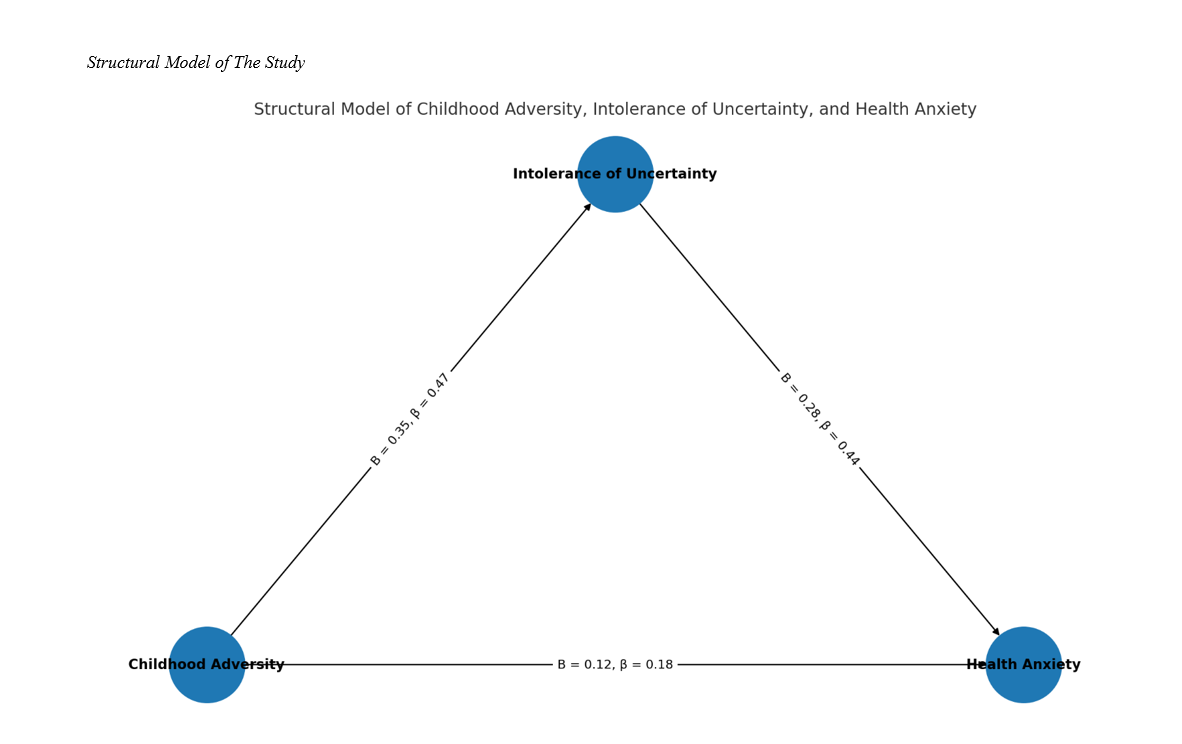
Methods and Materials: A descriptive correlational design was employed with a sample of 412 participants recruited from educational and community centers in Taiwan. The sample size was determined using the Morgan and Krejcie table to ensure adequacy for multivariate analysis. Data were collected using standardized self-report measures: the Childhood Trauma Questionnaire (CTQ) for childhood adversity, the Intolerance of Uncertainty Scale (IUS) for cognitive vulnerability, and the Health Anxiety Inventory (HAI) for health anxiety. Data analysis was conducted using SPSS-27 and AMOS-21. Pearson correlation coefficients were computed to assess bivariate associations, and structural equation modeling (SEM) was applied to evaluate the mediating role of intolerance of uncertainty. Model fit was assessed using χ²/df, CFI, TLI, and RMSEA indices.
Findings: Pearson correlations revealed significant positive associations between childhood adversity and health anxiety (r = .42, p < .001), as well as between childhood adversity and intolerance of uncertainty (r = .47, p < .001). Intolerance of uncertainty was also significantly associated with health anxiety (r = .51, p < .001). SEM results confirmed that intolerance of uncertainty partially mediated the relationship between childhood adversity and health anxiety. The structural model demonstrated acceptable fit (χ²/df = 2.11, CFI = .95, TLI = .94, RMSEA = .052). The indirect effect of childhood adversity on health anxiety through intolerance of uncertainty was statistically significant (β = .21, p < .01).
Conclusion: The findings highlight intolerance of uncertainty as a key mechanism linking childhood adversity to health anxiety, underscoring the importance of addressing cognitive vulnerabilities in prevention and intervention strategies for at-risk youth.
Downloads
References
Ahn, S., Kim, S., Zhang, H., Dobalian, A., & Slavich, G. M. (2023). Lifetime Adversity Prospectively Predicts Depression, Anxiety, and Cognitive Impairment in a Nationally Representative Sample of Older Adults in the United States. https://doi.org/10.22541/au.167407887.71569947/v1
Ahn, S., Kim, S., Zhang, H., Dobalian, A., & Slavich, G. M. (2024). Lifetime Adversity Predicts Depression, Anxiety, and Cognitive Impairment in a Nationally Representative Sample of Older Adults in the United States. Journal of Clinical Psychology, 80(5), 1031-1049. https://doi.org/10.1002/jclp.23642
Azaria, R. G., & Syakarofath, N. A. (2024). Peran Adverse Childhood Experience Terhadap Kecemasan Sosial Pada Remaja. Cognicia, 12(1), 39-45. https://doi.org/10.22219/cognicia.v12i1.30469
Berk‐Clark, C. v. d., Grant, A., & Ferber, M. (2023). Internalizing Disorders as a Mediator of the Association Between Adverse Childhood Experiences and Perceived Medication Intolerance or Poly-Allergy. The International Journal of Psychiatry in Medicine, 58(6), 591-604. https://doi.org/10.1177/00912174231175742
Buchanan, M., Newton‐Howes, G., Cunningham, R., McLeod, G. F. H., & Boden, J. M. (2024). The Role of Social Support in Reducing the Long-Term Burden of Cumulative Childhood Adversity on Adulthood Internalising Disorder. Social Psychiatry and Psychiatric Epidemiology, 59(12), 2165-2175. https://doi.org/10.1007/s00127-024-02674-6
Cabacungan, A. M., Delima, K. R. M., Mortiz, J. N. B., Loressa Joy De Claro, P., & Billones, R. (2022). Recovery From Long COVID: How College Students Thrive During Lockdown. Tazkiya Journal of Psychology, 10(2), 85-96. https://doi.org/10.15408/tazkiya.v10i2.26341
Fazal, A., Tanvir, S., Sikander, S., Naseem, A., & Babar, M. (2022). Childhood Adversity and Mental Health Status of Young Adults: A Cross-Sectional Study at the Universities of Islamabad and Rawalpindi, Pakistan. Pakistan Armed Forces Medical Journal, 72(3), 952-955. https://doi.org/10.51253/pafmj.v72i3.5277
Feiler, T., Vanacore, S., & Dolbier, C. L. (2023). Relationships Among Adverse and Benevolent Childhood Experiences, Emotion Dysregulation, and Psychopathology Symptoms. Adversity and Resilience Science, 4(3), 273-289. https://doi.org/10.1007/s42844-023-00094-0
Gehrt, T. B., Obermann, M. L., Toth, F. E., & Frostholm, L. (2022). Adverse Childhood Experiences in Patients With Severe Health Anxiety: No Evidence for an Increased Frequency Compared to Patients With Obsessive–compulsive Disorder. Scandinavian journal of psychology, 63(6), 565-572. https://doi.org/10.1111/sjop.12856
Jacobsen, S. A., Bibby, B. M., Frostholm, L., Petersen, M. W., Ørnbøl, E., Schovsbo, S. U., Dantoft, T. M., & Carstensen, T. B. W. (2022). Development and Validation of the Weighted Index for Childhood Adverse Conditions (WICAC). International journal of environmental research and public health, 19(20), 13251. https://doi.org/10.3390/ijerph192013251
Lei, M. K., Berg, M. T., Simons, R. L., & Beach, S. R. H. (2022). Specifying the Psychosocial Pathways Whereby Child and Adolescent Adversity Shape Adult Health Outcomes. Psychological medicine, 53(13), 6027-6036. https://doi.org/10.1017/s003329172200318x
Li, X., Zhang, J., & Zhou, H. (2023). Associations Between Adverse Childhood Experience Patterns and Anxiety and Depressive Symptoms Among Chinese College Students. https://doi.org/10.21203/rs.3.rs-3229786/v1
Lian, J., Anstey, K. J., & Kiely, K. M. (2022). The Relationship Between Childhood Adversity and Mental Health in Older Adults. Innovation in Aging, 6(Supplement_1), 741-741. https://doi.org/10.1093/geroni/igac059.2698
Lian, J., Kiely, K. M., Callaghan, B., & Anstey, K. J. (2023). Childhood Adversity Is Associated With Mental Health but Not Cognitive Decline in Older Adults. Innovation in Aging, 7(Supplement_1), 1002-1002. https://doi.org/10.1093/geroni/igad104.3221
McCullen, J. R., Counts, C. J., & John‐Henderson, N. A. (2023). Childhood Adversity and Emotion Regulation Strategies as Predictors of Psychological Stress and Mental Health in American Indian Adults During the COVID-19 Pandemic. Emotion, 23(3), 805-813. https://doi.org/10.1037/emo0001106
Mirhosseini, T., Guastello, A. D., Dale, L. P., Sambuco, N., Allen, B. R., & Mathews, C. A. (2023). Effects of COVID-19 Stress, Proximity, and Adverse Childhood Experiences on Healthcare Workers’ Mental Health. Frontiers in psychology, 14. https://doi.org/10.3389/fpsyg.2023.1228515
Morales‐Muñoz, I., Mallikarjun, P., Chandan, J. S., Thayakaran, R., Upthegrove, R., & Marwaha, S. (2023). The Impact of Anxiety and Depression Across Childhood and Adolescence on Adverse Outcomes in Young Adulthood: A UK Birth Cohort Study. European Psychiatry, 66(S1), S725-S726. https://doi.org/10.1192/j.eurpsy.2023.1521
Nowak, J. A., Nikendei, C., Rollmann, I., Orth, M., Friederich, H. C., & Kindermann, D. (2023). Adverse Childhood Experiences Lead to Slower Symptom Improvement During Psychotherapy of Patients With Anxiety Disorders. https://doi.org/10.21203/rs.3.rs-3698147/v1
Nowak, J. A., Nikendei, C., Rollmann, I., Orth, M., Friederich, H. C., & Kindermann, D. (2024). Examining Childhood Experiences and Personality Functioning as Potential Predictors for the Speed of Recovery During Psychotherapy of Patients With Anxiety Disorders. Frontiers in Psychiatry, 15. https://doi.org/10.3389/fpsyt.2024.1381105
Oltean, L.-E., & Șoflău, R. (2022). Childhood Adversity, Reward Processing, and Health During the COVID-19 Outbreak: The Mediating Role of Reward Learning. Psychological Trauma Theory Research Practice and Policy, 14(2), 301-309. https://doi.org/10.1037/tra0001208
Patten, S. B. (2024). Adverse Childhood Experience and Vulnerability to Mood and Anxiety Disorders During the COVID-19 Pandemic. https://doi.org/10.20944/preprints202411.0160.v1
Sawafi, A. A., Fotouhi, A., Al‐Adawi, S., Jaju, S., Qadire, M. A., & Azri, Z. A. (2024). Adverse Childhood Experiences (ACE) and Its Association With Mental Health Outcomes: Cross Sectional Study. International Journal of Social Psychiatry. https://doi.org/10.1177/00207640241300950
Xu, F. (2023). An Analysis of Sleep Disturbances Interacting With Rumination and Childhood Adversity as a Longitudinal Predictor for Depression and Anxiety. Lecture Notes in Education Psychology and Public Media, 17(1), 267-279. https://doi.org/10.54254/2753-7048/17/20231259
Downloads
Additional Files
Publication Timeline
- Submitted
- Revised
- Accepted
Issue
Section
License

This work is licensed under a Creative Commons Attribution-NonCommercial 4.0 International License.