Comparison of the Effectiveness of Parenting-Based Identity Formation Training and Positive Youth Development Training on Social Interaction Quality and Gender Schemas in Adolescent Girls
DOI:
https://doi.org/10.61838/kman.jayps.4494Keywords:
parenting-based identity training, positive youth development training, quality of social interaction, gender schemas, adolescent girlsAbstract
Objective: This study aimed to compare the effectiveness of parenting-based identity formation training and positive youth development training on social interaction quality and gender schemas in adolescent girls.
Methods and Materials: The present research employed a quasi-experimental design with three stages: pretest, posttest, and follow-up, including a control group. The statistical population consisted of adolescent girls in Isfahan during the spring of 2024. From this population, 45 adolescent girls were selected through convenience sampling and assigned to three groups (15 participants per group). The Glass Social Interaction Quality Scale (1994) and the Bem Sex Role Inventory (1981) were administered to measure the dependent variables across the three stages. Both experimental groups participated in ten 60-minute training sessions, while the control group received no intervention. Data were analyzed using repeated measures analysis of variance and the Bonferroni post hoc test via SPSS version 26.
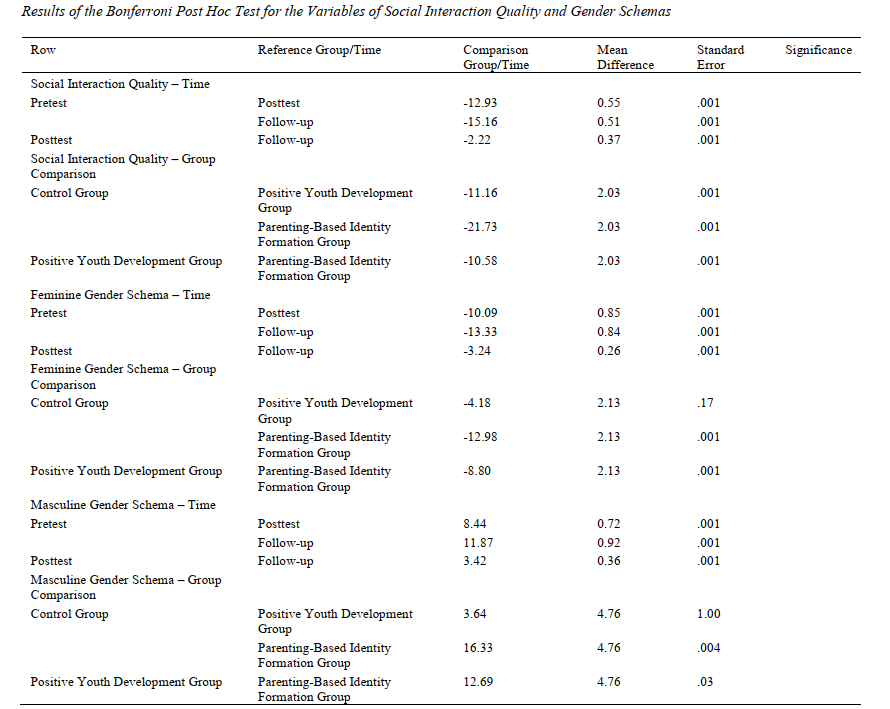
Findings: The results showed a significant difference in social interaction quality between the parenting-based identity formation and positive youth development training groups compared to the control group, and in gender schema variables, a significant difference was observed only between the two intervention groups and the control group (p < .01). Furthermore, parenting-based identity formation training proved to be more effective than positive youth development training in improving social interaction quality and modifying gender schemas.
Conclusion: Given the results, it is recommended that these two training approaches be incorporated into adolescent psychological counseling centers.
Downloads
References
Alizadeh, S., Raheb, G., Mirzaei, Z., & Hosinzadeh, S. (2020). The effectiveness of social competence training on the inclination towards risky behaviors in adolescent boys in welfare overnight centers in Mashhad and Sabzevar. Rehabilitation Journal, 21(1), 54-73. https://doi.org/10.32598/RJ.21.1.2874.1
Asgarpour, N., & Chahrazad, Y. (2023). The effectiveness of moral intelligence training on identity and self-esteem in adolescents. Eighteenth International Conference on Psychology, Counseling, and Educational Sciences, Poland.
Chao, K. (2022). The quarter-life crisis: The lack of identity development support in adolescents. Journal of Student Research, 11(4), 1-8. https://doi.org/10.47611/jsrhs.v11i4.3049
Chater, N., Zeitoun, H., & Melkonyan, T. (2022). The paradox of social interaction: Shared intentionality, we-reasoning, and virtual bargaining. Psychological review, 129(3), 415-437. https://doi.org/10.1037/rev0000343
Christiaens, A., Nelemans, S., Meeus, W., & Branje, S. (2021). Identity development across the transition from secondary to tertiary education: A 9‐wave longitudinal study. Journal of adolescence, 93(1), 245-256. https://doi.org/10.1016/j.adolescence.2021.03.007
Crocetti, E. (2017). Identity formation in adolescence: The dynamic of forming and consolidating identity commitments. Child Development Perspectives, 11(2), 145-150. https://doi.org/10.1111/cdep.12226
Ghobadi, A., & Heydari, A. (2020). Construction and representation of gender identities in Laki proverbs. Iranian Anthropology Research, 10(2), 35-53. https://ijar.ut.ac.ir/article_84479.html?lang=fa
Hjerm, M., Eger, M. A., & Danell, R. (2018). Peer attitudes and the development of prejudice in adolescence. Socius, 4, 2378023118763187. https://doi.org/10.1177/2378023118763187
Horn, N. K. (2019). Finding meaning after rape: An examination of meaning-making strategies and consequences in rape survivors Unpublished Doctoral Dissertation, Miami University]. https://search.proquest.com/openview/5ded980e5fc46a433e2701ba80c5f0d0/1?pq-origsite=gscholar&cbl=18750&diss=y
Hosseinabad, N., Najafi, M., & Rezaei, A. (2019). The effectiveness of a positive adolescent transformation educational program on psychological well-being components in adolescents. Clinical Psychology Studies, 9(35), 223-239. https://jcps.atu.ac.ir/article_10394.html
Hosseinabad, N., Najafi, M., & Rezaei, A. (2020). The effectiveness of a positive adolescent transformation educational program on positive development indicators in adolescents. Developmental Psychology (Iranian Psychologists), 17(65), 15-25. https://journals.iau.ir/article_677168_100d9650784192b8e98963acfccb8ea7.pdf
Hu, J., & Cheung, C. K. J. (2024). Social identity and social integration: a meta-analysis exploring the relationship between social identity and social integration. Frontiers in psychology, 15, 1361163. https://doi.org/10.3389/fpsyg.2024.1361163
Iloponu, D., Hanafi, H., & Muziatun. (2025). Exploring Social Influences on Self-Identity Formation Through English Language Proficiency. Research Rev. JIM, 4(1), 33-37. https://doi.org/10.54923/researchreview.v4i1.118
Johnson, S. K., & Ettekal, A. V. (2023). The five Cs of positive youth development: configurations of thriving in four US adolescent samples. Journal of Research on Adolescence, 33(2), 656-679. https://doi.org/10.1111/jora.12806
Karimi-Moghadam, H., Qasemzadeh, S., & Arjmandnia, A. A. (2023). The effectiveness of schema-based parenting on the resilience of adolescents with behavioral problems. Applied Psychological Research, 14(2), 217-229. https://www.noormags.ir/view/en/articlepage/2091465/
Landry, M., Vyas, A., Malhotra, G., & Nagaraj, N. (2020). Adolescents' development of gender equity attitudes in India. International Journal of Adolescence and Youth, 25(1), 94-103. https://doi.org/10.1080/02673843.2019.1590852
Lerner, R. M. (2021). Individuals as producers of their own development: the dynamics of person-context coactions. Taylor & Francis. https://doi.org/10.4324/9781003089407
Martin-Barrado, A. D., & Gomez-Baya, D. (2024). A scoping review of the evidence of the 5Cs model of positive youth development in Europe. Youth, 4, 56-79. https://doi.org/10.3390/youth4010005
Milot Travers, A. S., & Mahalik, J. R. (2021). Positive youth development as a protective factor for adolescents at risk for depression and alcohol use. Applied Developmental Science, 25(4), 322-331. https://doi.org/10.1080/10888691.2019.1634569
Morelli, M., Chirumbolo, A., Baiocco, R., & Cattelino, E. (2023). Self-regulated learning self-efficacy, motivation, and intention to drop-out: The moderating role of friendships at University. Current Psychology, 42(18), 15589-15599. https://doi.org/10.1007/s12144-022-02834-4
Pfeifer, J. H., & Berkman, E. T. (2018). The development of self and identity in adolescence: Neural evidence and implications for a value-based choice perspective on motivated behavior. Child Development Perspectives, 12(3), 158-164. https://doi.org/10.1111/cdep.12279
Riewestahl, E. L., Lazar, L., Rivas-Lara, S. A., & Uhls, Y. T. (2023). Beyond the ivory tower to the silver screen: promoting positive development in children and adolescents through outreach to content creators. The Journal of Positive Psychology, 1-11. https://doi.org/10.1080/17439760.2023.2218346
Soh, S., Talaifar, S., & Harari, G. (2024). Identity development in the digital context. Social and Personality Psychology Compass, 18(2), e12940. https://doi.org/10.1111/spc3.12940
Swanepoel, M. (2021). Exploring meaning making mechanisms in a group of South African women survivors of childhood sexual abuse Unpublished Doctoral Dissertation, North-West University, South-Africa]. https://books.google.com/books/about/Exploring_Meaning_Making_Mechanisms_in_a.html?id=DjDJzgEACAAJ
Ullrich, R., Becker, M., & Scharf, J. (2022). The development of gender role attitudes during adolescence: Effects of sex, socioeconomic background, and cognitive abilities. Journal of youth and adolescence, 51(11), 2114-2129. https://doi.org/10.1007/s10964-022-01651-z
Zhang, Y., & Qin, P. (2023). Comprehensive review: Understanding adolescent identity. Studies in Psychological Science, 1(2), 17-31. https://doi.org/10.56397/SPS.2023.09.02
Zhu, M., Yao, X. a., & Talib, M. A. (2025). Fostering Learning Engagement: The Impact of Different Interpersonal Relationships From the Perspective of Positive Youth Development. Frontiers in psychology, 15. https://doi.org/10.3389/fpsyg.2024.1419588
Downloads
Additional Files
Publication Timeline
- Submitted
- Revised
- Accepted