The Effectiveness of the Chronic Care Model on Treatment Adherence Based on the ACT Approach on Personality Traits in Patients with Diabetes
DOI:
https://doi.org/10.61838/kman.jayps.4480Keywords:
adherence to treatment, Acceptance and Commitment Therapy, personality traitsAbstract
Objective: The aim of this study was to develop a chronic care model for treatment adherence based on Acceptance and Commitment Therapy (ACT) and to examine its effect on personality traits in patients with diabetes.
Methods and Materials: This research employed a sequential exploratory design (qualitative–quantitative). In the qualitative phase, data were collected through in-depth interviews with diabetic patients and the opinions of 15 health psychology experts, and analyzed using Colaizzi’s seven-step method. The developed intervention protocol was structured around key components: causal conditions (emotional, cognitive, and social experiences), central conditions (physical symptoms and functional impairments), contextual factors (cultural, social, and economic barriers), intervening conditions (facilitators and barriers to treatment adherence), strategies (emotion regulation, self-care), and outcomes (increased psychological flexibility, improved adherence to treatment, and enhanced quality of life). Content validity of the protocol was confirmed using Lawshe’s CVR (>0.49) and CVI (>0.70), indicating satisfactory validity. In the quantitative phase, a quasi-experimental design with pre-test–post-test, control group, and a two-month follow-up was conducted. Measurement tools included the short form of the NEO Five-Factor Inventory (McCrae & Costa, 1985).
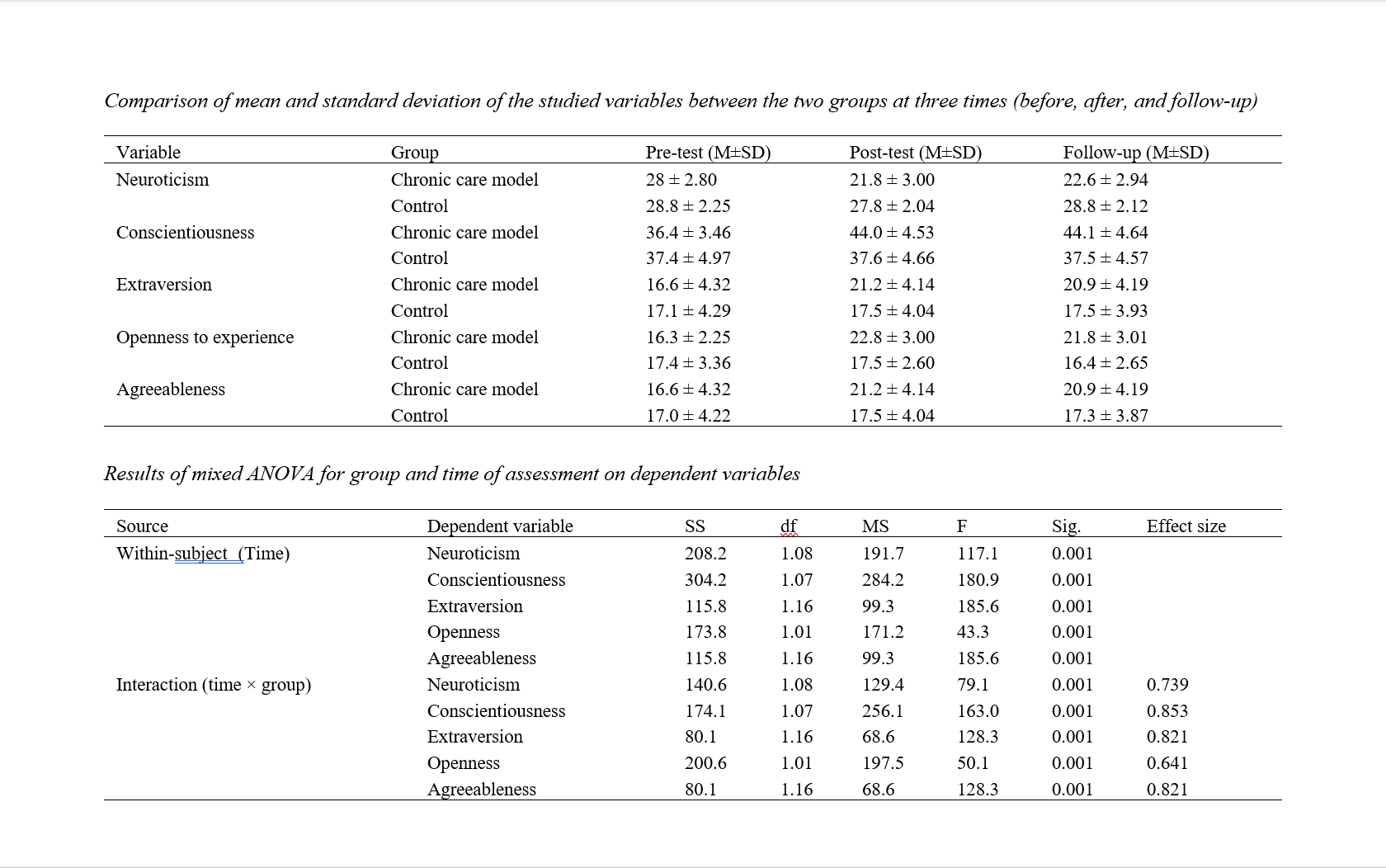
Findings: Results of repeated-measures ANOVA indicated that the ACT-based chronic care model significantly improved personality traits in the experimental group (p < 0.05).
Conclusion: These findings confirm the effectiveness and practical applicability of the model in improving psychological health and behavioral outcomes in diabetic patients.
Downloads
References
Adiloğlu, Z. (2023). Effectiveness of the acceptance and commitment therapy-based intervention program for women. Türk Psikolojik Danışma Ve Rehberlik Dergisi, 13(69), 240-255. https://doi.org/10.17066/tpdrd.1230447zh
Aghili, S. M., & Khoshbakht, F. (2025). The effectiveness of acceptance and commitment therapy on depression, perfectionism, and blood glucose levels in type 2 diabetic patients with psychological and physical anhedonia. Clinical Psychology Achievements, 11(1), 53-69. https://jacp.scu.ac.ir/article_19842.html?lang=en
Ahmadian, A., Taghipour, B., Alirezaei Hoor, M., Sabzi, N., Davoudi, S. M., & Mirzapour Binkolai, M. (2022). The effectiveness of acceptance and commitment therapy on coping styles and perceived stress in infertile women. Journal of Modern Psychological Researches, 17(66), 25-33. https://psychologyj.tabrizu.ac.ir/article_15280.html?lang=en
Albuquerque, E., Pinto, L., Neto, V., & Fragoso, T. (2022). Medication adherence in systemic lupus erythematosus during brazilian covid-19 pandemic. Lupus, 31(2), 221-227. https://doi.org/10.1177/09612033221074177
Bigdeli, R., Chin Aveh, M., & Jafari, D. (2023). Comparison of the effectiveness of emotion-focused therapy and acceptance and commitment therapy on emotional self-regulation and self-efficacy in women with type 2 diabetes. Diabetes Nursing Quarterly, 11(2), 2142-2159. https://jdn.zbmu.ac.ir/article-1-590-en.html
Chen, T. Y., Kao, C. W., Cheng, S. M., & Liu, C. Y. (2023). Factors influencing self-care among patients with primary hypertension: Path analysis of mediating roles of self-efficacy and depressive symptoms. European Journal of Cardiovascular Nursing. https://doi.org/10.1093/eurjcn/zvad011
Chen, Z., Zhang, Z., Zeng, F., & Wu, S. (2023). Visualizing detection of diabetic liver injury by a biomarker-activatable probe via nir-ii fluorescence imaging. Chemical & Biomedical Imaging, 1(8), 716-724. https://doi.org/10.1021/cbmi.3c00030
Dehghani, A., Korozhdehi, H., Hossein Khalilzadeh, S., Fallahzadeh, H., & Rahmanian, V. (2023). Prevalence of diabetes and its correlates among Iranian adults: Results of the first phase of Shahedieh cohort study. Health Science Reports, 6(4), e1170. https://doi.org/10.1002/hsr2.1170
Ebn-Nasir, S., & Khaleghipour, S. (2018). The effectiveness of acceptance and commitment therapy on anxiety sensitivity and quality of life in hypertensive patients with avoidant personality trait. Behavioral Sciences Research, 16(2), 198-205. https://rbs.mui.ac.ir/browse.php?a_id=600&sid=1&slc_lang=en
Freitas, I. S., Sá, R. G. P., Pires, L. B. C., Prado, C. B., Muniz, V. M., & Salaroli, L. B. (2023). Food and nutrition actions to face Noncommunicable Chronic Diseases from the perspective of Primary Health Care in Brazil: a scope review. J Hum Growth Dev, 33(1), 18-32. https://doi.org/10.36311/jhgd.v33.14273
Frögéli, E., Djordjevic, A., Rudman, A., Livheim, F., & Gustavsson, P. (2016). A randomized controlled pilot trial of acceptance and commitment training (ACT) for preventing stress-related ill health among future nurses. Anxiety, Stress, & Coping, 29(2), 202-218. https://doi.org/10.1080/10615806.2015.1025765
Graham, C. D., McCracken, L. M., Harrison, A., Walburn, J., & Weinman, J. (2022). Outlining an acceptance and commitment therapy approach to treatment non-adherence. British Journal of Health Psychology, 27(1), 1-12. https://doi.org/10.1111/bjhp.12579
Hashemi, S. M., & Bouya, S. (2017). Treatment adherence in patients with diabetes: An important but forgotten issue. Diabetes Nursing Quarterly, 6(1), 341-351. https://jdn.zbmu.ac.ir/article-1-307-en.html
Huang, F. Y., Deng, T., Meng, L. X., & Ma, X. L. (2019). Dietary ginger as a traditional therapy for blood sugar control in patients with type 2 diabetes mellitus: A systematic review and meta-analysis. Medicine, 98(13). https://doi.org/10.1097/MD.0000000000015054
Isvand, M., Boghooli, H., Javidi, H., & Barzegar, M. (2023). A comparison of the effectiveness of cognitive behavioral therapy and acceptance and commitment therapy on rumination, cognitive flexibility, resilience, and perceived stress in women with depressive disorder. Psychological Achievements. https://psychac.scu.ac.ir/jufile?ar_sfile=226308
Jin, X., Li, H., Chong, Y., Mann, K., Yao, W., & Wong, C. (2022). Feasibility and preliminary effects of acceptance and commitment therapy on reducing psychological distress and improving the quality of life of the parents of children with cancer: a pilot randomised controlled trial. Psycho-Oncology, 32(1), 165-169. https://doi.org/10.1002/pon.5941
Joshanloo, M. (2023). Longitudinal relationship between psychological distress and personality traits. Stress and Health, 40(2). https://doi.org/10.1002/smi.3305
Khalid, A., Dong, Q., Chuluunbaatar, E., Haldane, V., Durrani, H., & Wei, X. (2023). Implementation Science Perspectives on Implementing Telemedicine Interventions for Hypertension or Diabetes Management: Scoping Review. Journal of medical Internet research, 25, e42134. https://doi.org/10.2196/42134
Lee, S., & Li, C. (2021). Personality as a predictor of hba1c level in patients with type 2 diabetes mellitus. Medicine, 100(27), e26590. https://doi.org/10.1097/MD.0000000000026590
Majid, M. (2024). Proper: personality recognition based on public speaking using electroencephalography recordings. IEEE Access, 1, 1. https://doi.org/10.1109/ACCESS.2024.3411034
McGloin, H., Devane, D., McIntosh, C. D., Winkley, K., & Gethin, G. (2021). Psychological interventions for treating foot ulcers, and preventing their recurrence, in people with diabetes. The Cochrane Database of Systematic Reviews, 2(2), CD012835. https://doi.org/10.1002/14651858.CD012835.pub2
Melichova, J., Sivco, P., Rusnak, M., Phuong Truc, P., & Majdan, M. (2023). International evidence-based guidelines on hypertension and type 2 diabetes mellitus: A systematic review. Journal of Public Health Research, 12(1), 22799036221146913. https://doi.org/10.1177/22799036221146913
Mousavi, N. (2024). Prevalence of psychiatric disorders among patients with granulomatosis with polyangiitis (wegener's) and the predictive role of personality traits. Clinical Practice and Epidemiology in Mental Health, 20(1). https://doi.org/10.2174/0117450179276345240117043037
Nemati, R., Vahedparast, H., Rashedi, Y., Mirzaei, K., & Bahreini, M. (2023). The role of personality factors in predicting resilience and coping styles of patients with type 2 diabetes: a cross-sectional study. Journal of Holistic Nursing And Midwifery, 33(1), 25-33. https://doi.org/10.32598/jhnm.33.1.2274
Pan, L. (2024). Latent profile analysis of eysenck's personality dimensions and psychological constructs in university students. Frontiers in psychology, 15. https://doi.org/10.3389/fpsyg.2024.1379705
Rahimi, F. (2023). A comparison of cognitive reserve and executive functioning in adults with type 2 diabetes and non-diabetic individuals Payame Noor University of Isfahan Province, Zarrin Shahr Center].
Rahimi, R., Ahadi, H., Tajeri, B., & Khosh Lajeh Sedgh, A. (2023). The effectiveness of acceptance and commitment therapy on perceived stress, chronic pain, and treatment adherence in elderly diabetic patients. Islamic lifestyle with a focus on health, 7(Special Issue), 76-85. https://www.islamiilife.com/article_185891_en.html
Rauwenhoff, J., Bol, Y., Heugten, C., Batink, T., Geusgens, C., Hout, A., & Peeters, F. (2023). Acceptance and commitment therapy for people with acquired brain injury: rationale and description of the brainact treatment. Clinical Rehabilitation, 37(8), 1011-1025. https://doi.org/10.1177/02692155231154124
Rivera-Picón, C. (2024). Involvement of personality and health status in the psychological wellbeing of subjects with chronic disease. Behavioral Sciences, 14(2), 99. https://doi.org/10.3390/bs14020099
Stefanescu, C., Tatu, A. L., Nechita, A., Iacob, C. I., Secara, E., Nicolescu, S., & Huiu, G. A. (2024). Brief online acceptance and commitment therapy for adults with type 1 diabetes: a pilot study. Frontiers in Clinical Diabetes and Healthcare, 5, 1378946. https://doi.org/10.3389/fcdhc.2024.1378946
Versteeg, S. J. (2023). The antidote to burn-out The experience of MBSR as a form of self care for mental health counselors in Greece https://sphere.acg.edu/jspui/handle/123456789/2294
Zaidman, E. A., Scott, K. M., Hahn, D., Bennett, P., & Caldwell, P. H. (2023). Impact of parental health literacy on the health outcomes of children with chronic disease globally: A systematic review. Journal of Paediatrics and Child Health, 59(1), 12-31. https://doi.org/10.1111/jpc.16297
Downloads
Additional Files
Publication Timeline
- Submitted
- Revised
- Accepted
Issue
Section
License
Copyright (c) 2025 Mina Khajeh Babarsad (Author); Mansour Ali Mahdi (Corresponding Author); Mahtab Moraveji, Abbas Haghayegh (Author)

This work is licensed under a Creative Commons Attribution-NonCommercial 4.0 International License.