Structural Equation Modeling of Social Media Addiction Based on Subjective Well-Being with the Mediating Role of Cognitive Emotion Regulation Difficulties
DOI:
https://doi.org/10.61838/kman.jayps.4477Keywords:
social media addiction, subjective well-being (emotional, psychological, social, cognitive emotion regulation difficulties.Abstract
Objective: The aim of this study was to model the structural equation of social media addiction based on subjective well-being with the mediating role of cognitive emotion regulation difficulties.
Methods and Materials: This was an applied study using a descriptive-correlational design based on structural equation modeling. From a statistical population of 98,562 undergraduate students enrolled at the North Branch of Islamic Azad University, a sample of 403 students was selected through multi-stage cluster random sampling. Participants responded to the Mobile-based Social Networks Addiction Questionnaire by Khajeh Ahmadi et al. (2016), the Subjective Well-Being Scale (SWS) by Keyes and Magyar-Moe (2003), and the Difficulties in Emotion Regulation Scale (DERS) by Gratz and Roemer (2004). Data analysis was performed using structural equation modeling in SPSS version 26 and AMOS version 24.
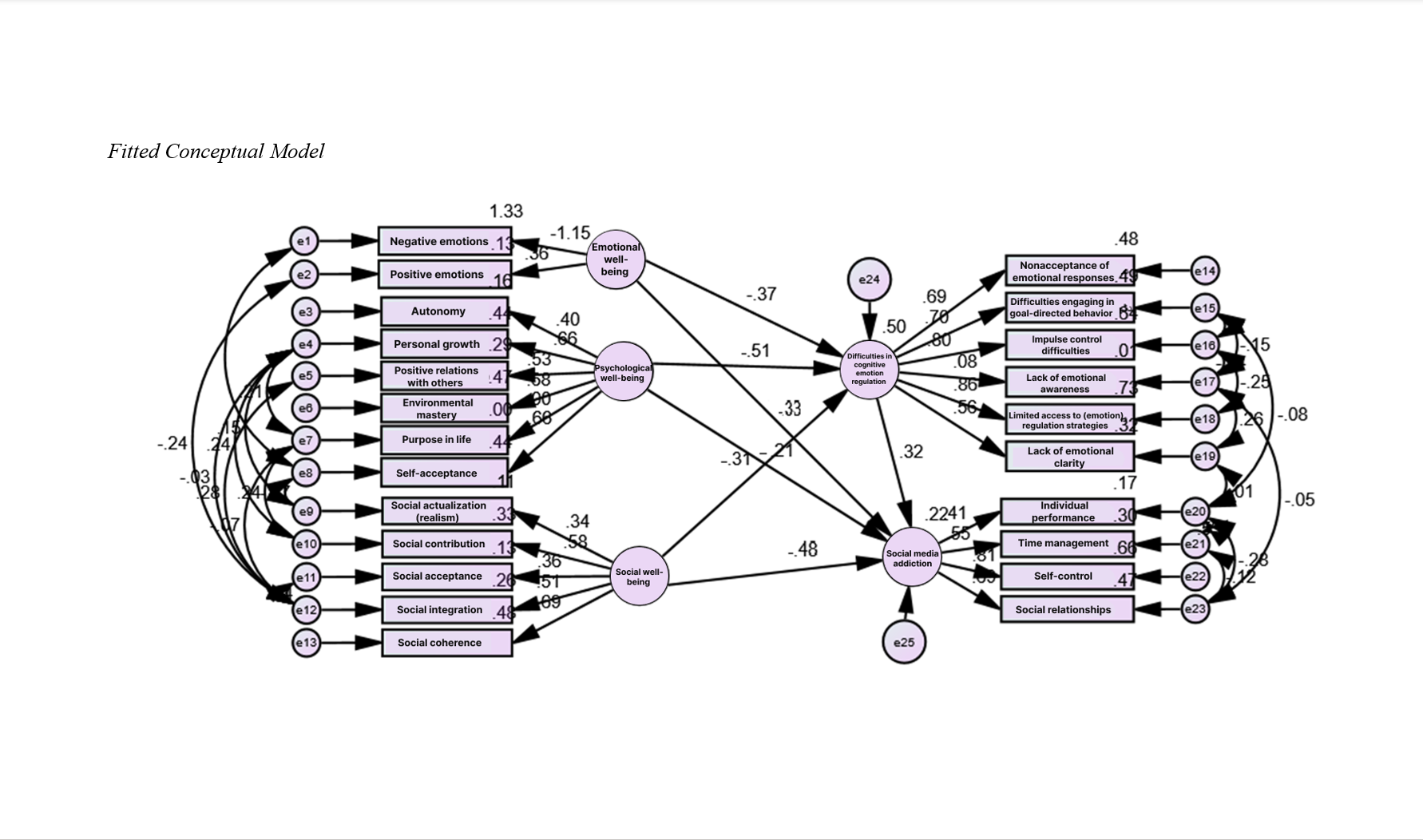
Findings: The findings showed that the direct paths from subjective well-being (emotional, psychological, social) and cognitive emotion regulation difficulties to social media addiction were positive and statistically significant (P < .01). Subjective well-being (emotional, psychological, social) also indirectly affected social media addiction through cognitive emotion regulation difficulties; thus, cognitive emotion regulation difficulties played a mediating role in this model.
Conclusion: These findings highlight that students with lower levels of subjective well-being and greater difficulties in regulating their emotions are more likely to become addicted to social media. It can be concluded that cognitive emotion regulation difficulties may serve as a key factor in preventing social media dependence and in enhancing the quality of life among students.
Downloads
References
Al-musawi, M. A. N. (2024). A study of the effects of social media addiction on psychological well-being among secondary school students in Al-Emara city. Journal of Medical and Allied Sciences, 6(3), 429-442. https://doi.org/10.21608/jmals.2024.383359
Fokker, E., Zong, X., & Treur, J. (2021). A second-order adaptive network model for emotion regulation in addictive social media behaviour. Cognitive Systems Research, 70, 52-62. https://doi.org/10.1016/j.cogsys.2021.07.006
Giordano, A. L., Schmit, M. K., & McCall, J. M. (2022). Exploring Adolescent Social Media and Internet Gaming Addiction: The Role of Emotion Regulation. Journal of Addictions & Offender Counseling, 44(1), 69-80. https://doi.org/10.1002/jaoc.12116
Gong, L., & Liu, Q. (2023). Mobile phone addiction and sleep quality: The mediating role of anxiety and the moderating role of emotion regulation. Behavioral Sciences, 13(3), 250. https://doi.org/10.3390/bs13030250
Huang, P. C., Latner, J. D., O’Brien, K. S., Chang, Y. L., Hung, C. H., Chen, J. S., & Lin, C. Y. (2023). Associations between social media addiction, psychological distress, and food addiction among Taiwanese university students. Journal of eating disorders, 11(1), 43. https://doi.org/10.1186/s40337-023-00769-0
Kingsley, K. (2024). Adolescent Emotional Well-Being and Social Media Addiction: The COVID-19 Pandemic's Influence on Mental Health. Medical Research Archives, 12(5). https://doi.org/10.18103/mra.v12i4.5289
Koç, T., & Turan, A. H. (2021). The relationships among social media intensity, smartphone addiction, and subjective well-being of Turkish college students. Applied Research in Quality of Life, 16(5), 1999-2021. https://doi.org/10.1007/s11482-020-09857-8
Malik, L., Shahnawaz, M. G., Rehman, U., Pragyendu, Uniyal, R., & Griffiths, M. D. (2023). Mediating roles of fear of missing out and boredom proneness on psychological distress and social media addiction among Indian adolescents. Journal of Technology in Behavioral Science, 1-11. https://doi.org/10.1007/s41347-023-00323-4
Mohtadin, M., Dartaj, F., Ghaeimi, F., & Ghorban Jahromi, R. (2023). Causal model of harmful internet use based on emotion regulation needs and avoidant coping. New Media Studies, 3(34), 79-103. https://doi.org/10.22054/nms.2023.70126.1462
Naderifar, N., Akbari, B., & Sadeghi, A. (2023). Structural Modeling of the Relationship between Spiritual Health with Addiction Tendency in Adolescents: The Mediating Role of Emotional well-being. Social Welfare, 31(9), 7038-7050. https://doi.org/10.18502/ssu.v31i9.14187
Negahdari, S., & Sayf, M. H. (2022). Presenting a causal model of cognitive flexibility and social media addiction: The mediating role of self-efficacy, psychological well-being and cognitive empathy among high school students in Shiraz. Social Cognition, 11(22), 53-65. https://sc.journals.pnu.ac.ir/article_9901.html
Özer, D., Altun, Ö. Ş., & Avşar, G. (2023). Investigation of the relationship between internet addiction, communication skills, and difficulties in emotion regulation in nursing students. Archives of Psychiatric Nursing, 42, 18-24. https://doi.org/10.1016/j.apnu.2022.12.004
Parchami Khoram, M., Imani, S., & Ansari, D. (2022). Predicting psychological well-being based on basic psychological needs: The mediating role of social media addiction. Behavioral Sciences Research, 20(2), 317-328. https://doi.org/10.52547/rbs.20.2.317
Parchami Khorram, M., Eimani, S., & Ansari, D. (2023). Predicting psychological well-being based on fundamental psychological needs: The mediating role of social media addiction. Behavioral Science Research, 20(2), 317-328. https://doi.org/10.52547/rbs.20.2.317
Quaglieri, A., Biondi, S., Roma, P., Varchetta, M., Fraschetti, A., Burrai, J., & Mari, E. (2021). From emotional (dys) regulation to internet addiction: A mediation model of problematic social media use among Italian young adults. Journal of clinical medicine, 11(1), 188. https://doi.org/10.3390/jcm11010188
Rahimi, V. A., Babapour, J., Khanjani, Z., Hashemi, T., & Rudsari, A. B. (2024). The Structural Relationships Between Family Functioning, Positive Development, Psychological Distress and Social Media Addiction With the Mediating of Cognitive Emotion Regulation Strategies in Adolescents. Depiction of Health, 15(3), 341-357. https://doi.org/10.34172/doh.2024.26
Roberts, J. E., & David, M. E. (2021). Social media addiction, emotional intelligence, and self regulation: Impact on student grades. Journal of Behavioral Addictions, 10(3), 303-313. https://doi.org/10.1556/2006.2021.00039
Rustamov, E. (2023). Aggression Mediates Relationships Between Social Media Addiction and Adolescents’ Wellbeing. The Open Psychology Journal, 16(1). https://doi.org/10.2174/0118743501251575230925074655
Sánchez-Fernández, M., Borda-Más, M., & Mora-Merchan, J. (2023). Problematic internet use by university students and associated predictive factors: A systematic review. Computers in human Behavior, 139, 107532. https://doi.org/10.1016/j.chb.2022.107532
Seddigh, R. A., Kermani, A., Memarian, N., Almasirad, N., & Glavizh, N. (2022). Structural equation model of emotion regulation and addiction readiness in social harms with the mediating role of spirituality dimensions. Culture in Islamic University, 12(43), 313-330. https://publish.kne-publishing.com
Steinberger, P., & Kim, H. (2023). Social comparison of ability and fear of missing out mediate the relationship between subjective well-being and social network site addiction. Frontiers in psychology, 14, 1157489. https://doi.org/10.3389/fpsyg.2023.1157489
Taghvaei, S., Solati Anaghezi, R., & Mousavi, S. M. (2023). Comparison of emotion regulation difficulties, cyber violence, and nomophobia in addicted and regular virtual network students. Curriculum and Educational Planning Research, 13(1), 1-12. https://www.noormags.ir/view/fa/articlepage/2058471/
Turan, M. E., Adam, Firdevs, Kaya, Alican, Yıldırım, Murat. (2024). The mediating role of the dark personality triad in the relationship between ostracism and social media addiction in adolescents. Education and Information Technologies, 29(4), 3885-3901. https://doi.org/10.1007/s10639-023-12002-1
Türk, F., & Koçyiğit, B. (2025). The Relationship Between Fear of Missing Out and Loneliness Among Adolescents in the Digital Age: The Mediating Roles of Emotion Dysregulation and Social Media Addiction. Malaysian Online Journal of Educational Technology, 13(1), 19-36. https://doi.org/10.52380/mojet.2025.13.1.566
Wang, Q., Azam, S., Murtza, M. H., Shaikh, J. M., & Rasheed, M. I. (2023). Social Media Addiction And employee Sleep: Implications for Performance and Wellbeing In the Hospitality Industry. Kybernetes, 53(12), 5972-5990. https://doi.org/10.1108/k-06-2023-0939
Yan, X., Gao, W., Yang, J., & Yuan, J. (2022). Emotion regulation choice in internet addiction: Less reappraisal, lower frontal alpha asymmetry. Clinical EEG and Neuroscience, 53(4), 278-286. https://doi.org/10.1177/15500594211056433
Zhang, W., Pu, J., He, R., Yu, M., Xu, L., He, X., Chen, Z., Gan, Z., Liu, K., Tan, Y., & Xiang, B. (2022). Demographic characteristics, family environment and psychosocial factors affecting internet addiction in Chinese adolescents. Journal of affective disorders, 315, 130-138. https://doi.org/10.1016/j.jad.2022.07.053
Zhao, L. (2021). The impact of social media use types and social media addiction on subjective well-being of college students: A comparative analysis of addicted and non-addicted students. Computers in Human Behavior Reports, 4, 100122. https://doi.org/10.1016/j.chbr.2021.100122
Downloads
Additional Files
Publication Timeline
- Submitted
- Revised
- Accepted