The Lived Experiences of Adolescents Born in the 2000s Engaged in Opposite-Sex Relationships
DOI:
https://doi.org/10.61838/kman.jayps.4474Keywords:
Adolescence, Opposite-sex relationships, Lived experience, Grounded theory, Identity development, Emotional well-beingAbstract
Objective: This study aimed to explore and interpret the lived experiences of adolescents born in the 2000s who are engaged in opposite-sex relationships, focusing on the psychosocial, emotional, and cultural dynamics that shape these relationships.
Methods and Materials: This qualitative study was conducted using a grounded theory design to capture the subjective experiences of adolescents. The study population consisted of high school, pre-university, and undergraduate students in Shiraz, Iran, who were born in the 2000s and had been involved in opposite-sex relationships. Participants were selected through purposive sampling until theoretical saturation was achieved, resulting in a final sample of ten adolescents (five females and five males). Data were collected using in-depth semi-structured interviews and analyzed according to Anselm Strauss and Juliet Corbin’s three-stage coding approach (open, axial, and selective coding). Trustworthiness was enhanced through member checking, peer debriefing, negative case analysis, and maintaining a detailed audit trail. Ethical approval was obtained from the Islamic Azad University Ethics Committee, and informed consent was secured from all participants.
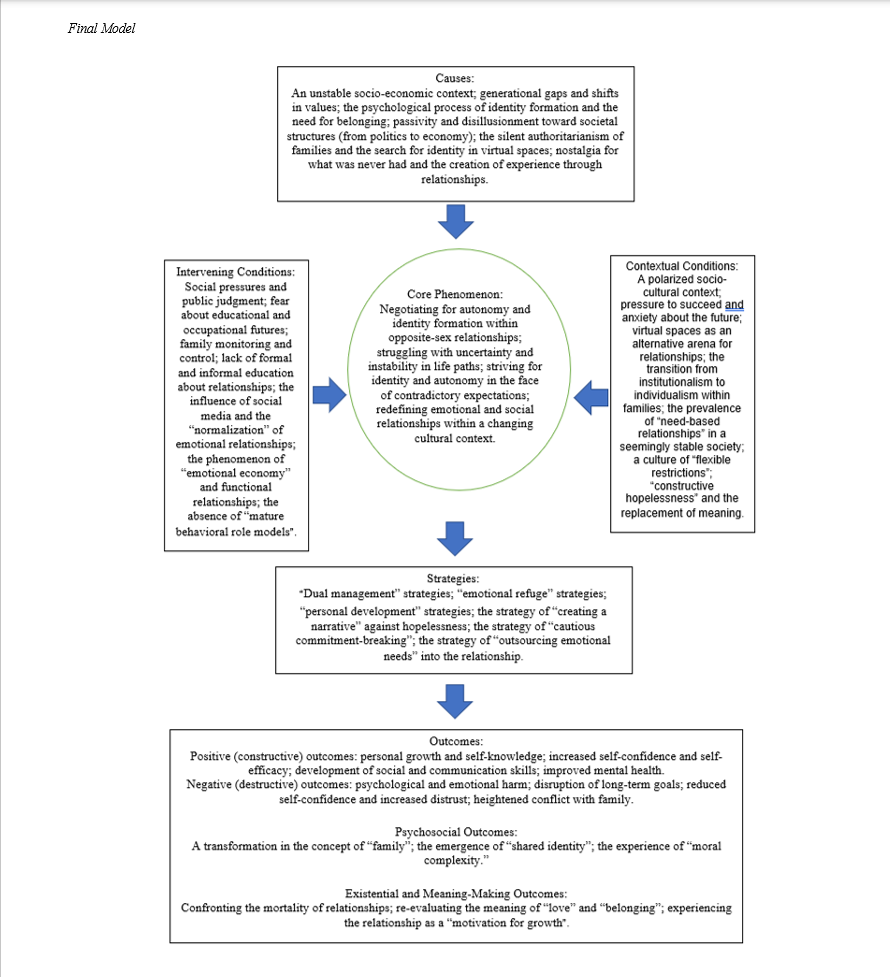
Findings: The analysis revealed eleven axial categories capturing the core dynamics of these adolescents’ experiences: identity and future concerns, generational conflict and family pressure, factors of attraction and relationship maintenance, psychological and emotional effects of relationships, influence of family role models, socio-cultural changes, relationship dynamics and attraction patterns, coping mechanisms against pressure, psychological consequences of relationships, normative and cultural shifts, and the impact of future concerns on relationships. The emerging core category reflected adolescents’ negotiation of autonomy and identity within relationships while managing socio-cultural contradictions, emotional vulnerabilities, and aspirations for personal growth.
Conclusion: Adolescent opposite-sex relationships constitute complex psychosocial phenomena shaped by intersecting personal, familial, and cultural forces. These relationships serve as arenas for identity exploration and emotional development, yet also expose adolescents to psychological risks, highlighting the need for supportive educational and counseling interventions.
Downloads
References
Akbarzadeh, F., & Hashemianfar, S. (2022). Investigating the Lived Experience of Love in White Marriage. Journal of Social Development, 17(1), 25-68. https://www.magiran.com/paper/2542377
Amanelahi, A., Tardast, K., & Aslani, K. H. (2015). Prediction of love trauma syndrome based on self compassion among female students having experienced romantic breakups. Journal of Applied Psychology, 8(4), 43-61. https://ensani.ir/fa/article/download/544970
Ebrahim, Akbari, Mahmoudalilou, M., Khanjani, Z., Poursharifi, H., Fahimi, S., Amiri Pichaklavi, A., & Azimi, Z. (2016). Comparison of Students with and without Clinical Symptoms of Romantic Relationship Failure in Early Maladaptive Schemas and Parenting Patterns. http://ensani.ir/fa/article/405414/
Eken, E., & Çankaya, Z. C. (2022). The Relationship Between Early Maladaptive Schemas and Psychological Tendencies Associated With the Romantic Relationships in University Students: An Investigation Through the Schema Therapy Model. Cukurova University Faculty of Education Journal, 51(1), 689-717. https://doi.org/10.14812/cuefd.935734
Hadzigeorgiou, Y., & Schulz, R. M. (2019). Engaging students in science: the potential role of 'narrative thinking' and 'romantic understanding'. Frontiers in Education, 4(38). https://doi.org/10.3389/feduc.2019.00038
Huey, C. n. W., Aziz, A. A. A., Hoesni, S. M., Razak, M. A. A., & Kamaluddin, M. R. (2021). Effects of Psychosocial Factors Towards Emotional Abuse Among University Students Who Have Been in Romantic Relationships. Educatum Journal of Social Sciences, 7(2), 107-120. https://doi.org/10.37134/ejoss.vol7.2.10.2021
Kaur, J. (2024). Romantic Relationship Satisfaction, Attachment Style and Love Style Among College Going Students. Eatp. https://doi.org/10.53555/kuey.v30i5.4252
Khorasaniyan, M. (2022). Validating Marital Commitment Inventory in Iranian state university students. International Journal of Education and Cognitive Sciences, 3(3), 7-19. https://doi.org/10.22034/injoeas.2022.160140
Körük, S., & Kurt, A. A. (2019). The predictive role of early maladaptive schemas in the evaluation of pre-marital romantic relationships among university students. Yaşam Becerileri Psikoloji Dergisi, 3(5), 73-83. https://doi.org/10.31461/ybpd.556424
Lazzaro, A., Bolton, M. J., & Kieffer, K. (2022). A Brief Report on Amusement in College Students: The Positive Effects of Affiliative and Self-Enhancing Humor Styles on Romantic Relationship Satisfaction and Psychological Wellbeing. https://doi.org/10.31234/osf.io/cu5yh
Loan, N. T., Minh, T. T. K., Truc, N. V. T., & My, T. T. H. (2023). The Mediating Role Of Rumination In Breakup Distress After Romantic Relationships And Sleep Disturbance Of The Students And A Five-Day-Proposed Intervention Program. Journal of Namibian Studies: History Politics Culture, 33, 1464-1496.
Özabacı, N., & Eryılmaz, A. (2015). The sources of self-esteem: Initating and maintaining romantic intimacy at emerging adulthood in Turkey. Journal of Human Sciences, 12(1), 179-191. https://www.j-humansciences.com/ojs/index.php/IJHS/article/view/3014
Pourmohseni-Koluri, F. (2016). Gender Differences in Attachment Style and Personality Traits in Prediction of Love Styles in University Students. Research in cognitive and behavioral sciences, 6(1), 17-32. https://doi.org/10.22108/cbs.2016.20751
Rahimi, C., Jamalabadi, P., & Sedaghat Pour Haghighi, M. M. (2022). Cognitive Behavioral Treatment on Self-Esteem and Emotional Self-Efficacy of Female Students with Failure in Love [Original Research Article]. Middle Eastern Journal of Disability Studies, 12(0), 19-19. https://doi.org/10.29252/mejds.0.0.78
Rajabi Vandechali, A., Hadanzadeh, R., & Abbasi, G. (2022). Effect of positive therapy on self-harm thoughts and psychological well-being in students’ dissolution of romantic relationships. Razavi International Journal of Medicine, 10(2), 102-108. https://journal.razavihospital.ir/article_118471.html
Ratelle, C. F., Simard, K., & Guay, F. (2013). University Students’ Subjective Well-being: The Role of Autonomy Support from Parents, Friends, and the Romantic Partner. Journal of Happiness Studies, 14(3), 893-910. https://doi.org/10.1007/s10902-012-9360-4
Ritter, L. J., Hilliard, T., & Knox, D. (2023). “Lovesick”: Mental Health and Romantic Relationships among College Students. International journal of environmental research and public health, 20(1).
Santona, A., De Cesare, P., Tognasso, G., De Franceschi, M., & Sciandra, A. (2019). The Mediating Role of Romantic Attachment in the Relationship Between Attachment to Parents and Aggression [Original Research]. Frontiers in psychology, 10. https://doi.org/10.3389/fpsyg.2019.01824
Saqqezi, A., & YazdaniEsfidvajani, H. (2020). Predict marriage desire based on premarital Relationship attitude: Control the role of gender and experience the relationship with the opposite sex. frooyesh, 9(7), 139-146. http://frooyesh.ir/article-1-2086-en.html
Simon, H. L. M., DiPlacido, J., & Conway, J. M. (2019). Attachment styles in college students and depression: The mediating role of self differentiation. Mental Health & Prevention, 13, 135-142. https://doi.org/10.1016/j.mhp.2019.01.011
Wang, Y., Zheng, Z., Wang, X., & Li, Y. (2022). Unraveling the effect of ambivalence over emotional expression on subjective wellbeing in Chinese college students in romantic relationships: A multiple mediation model [Original Research]. Frontiers in Psychiatry, 13. https://doi.org/10.3389/fpsyt.2022.982406
Yaridhenavi, M., & Ebrahimi Shahabadi, F. (2023). Narrating and analyzing the lived experience of female students' relationships with the opposite gender and providing preventive solutions from the perspective of the philosophy of education. Research in Islamic Education, 15(Spring-Summer), 2-20. https://researchinislamicedu.ir/article_90560.html
Downloads
Additional Files
Publication Timeline
- Submitted
- Revised
- Accepted
Issue
Section
License
Copyright (c) 2025 Negin Akhtari (Author); Nazanin Honarparvaran (Corresponding Author)

This work is licensed under a Creative Commons Attribution-NonCommercial 4.0 International License.