Reputation in the Digital Age: Strategies of Online Redemption after Peer-Exposed Mistakes
DOI:
https://doi.org/10.61838/kman.jayps.4428Keywords:
online reputation, peer exposure, mistake management, redemption strategies, digital literacyAbstract
Objective: This study investigates how individuals navigate reputational challenges after peer-exposed mistakes in digital environments, with a focus on strategies of online redemption and long-term adaptations.
Methods and Materials: A qualitative research design was employed to capture lived experiences and interpretive meanings associated with reputational repair. Data were collected through semi-structured interviews with 21 participants from Armenia, selected purposively to ensure diversity in gender, age, and professional background. Interviews lasted between 45 and 70 minutes, were audio-recorded with consent, and transcribed verbatim. Data collection continued until theoretical saturation was reached. Thematic analysis was conducted using NVivo 14 software, following iterative cycles of coding, categorization, and theme refinement. Reflexive memos and constant comparison techniques were used to enhance validity and minimize researcher bias.
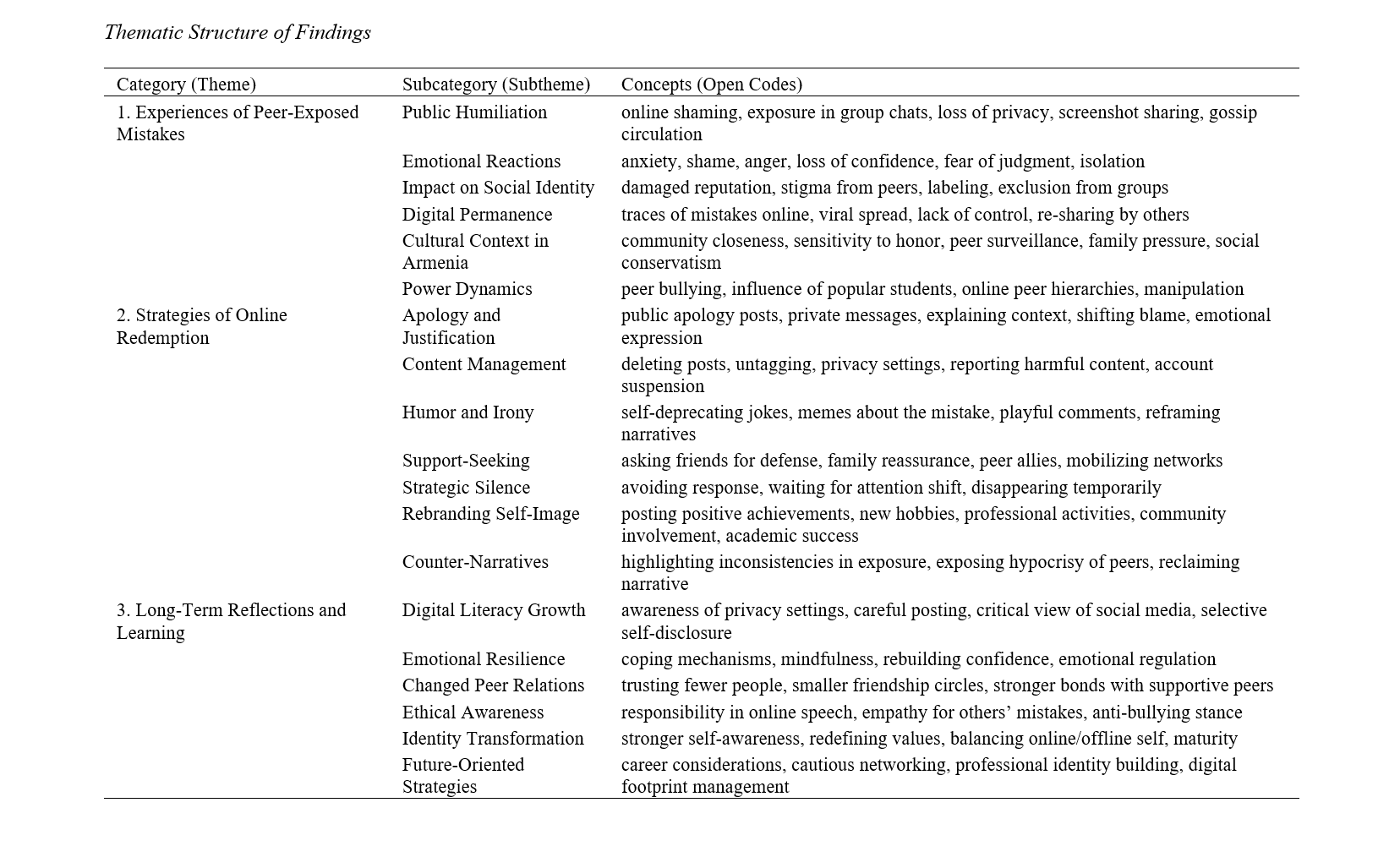
Findings: Three overarching themes were identified: (1) experiences of peer-exposed mistakes, including public humiliation, emotional distress, social identity erosion, digital permanence, cultural pressures, and peer power dynamics; (2) strategies of online redemption, encompassing apology, content management, humor, support-seeking, strategic silence, rebranding, and counter-narratives; and (3) long-term reflections and learning, which involved digital literacy growth, emotional resilience, restructured peer relations, ethical awareness, identity transformation, and future-oriented strategies.
Conclusion: The study demonstrates that online redemption after peer-exposed mistakes is a dynamic and socially embedded process that combines discursive, relational, and strategic elements. Redemption strategies are influenced not only by digital tools but also by cultural contexts and peer dynamics.
Downloads
References
Borţun, D. (2014). Reputation and Credibility. Mistakes In… Mistake Management. Procedia - Social and Behavioral Sciences, 163, 57-66. https://doi.org/10.1016/j.sbspro.2014.12.286
D'Arbelles, K., Berry, P. M., & Theyyil, A. (2020). Electronic Word-of-Mouth Marketing on Amazon: Exploring How and to What Extent Amazon Reviews Affect Sales. The McMaster Journal of Communication, 12(1), 50-79. https://doi.org/10.15173/mjc.v12i1.2384
Deciu, V. (2018). Frequent Mistakes in Romanian Management Practice. 5, 107-116. https://doi.org/10.18662/lumproc.40
Hennis, T., Lukosch, S., & Veen, W. (2012). Reputation in Peer-Based Learning Environments. 95-128. https://doi.org/10.4018/978-1-61350-489-5.ch005
Keijzer, M. A., & Corten, R. (2022). Socioeconomic Status, Reputation, and Interpersonal Trust in Peer-to-Peer Markets: Evidence From an Online Experiment. Rationality and Society, 35(1), 34-60. https://doi.org/10.1177/10434631221131771
Lei, Y., & Chen, G. (2012). Recommendation-Based Trust Model in P2P Network Environment. 305-310. https://doi.org/10.1007/978-3-642-32891-6_38
Li, Y., Yang, K., Chen, J., Gupta, S., & Ning, F. (2019). Can an Apology Change After-Crisis User Attitude? The Role of Social Media in Online Crisis Management. Information Technology and People, 32(4), 802-827. https://doi.org/10.1108/itp-03-2017-0103
Liu, F., Lai, K. h., & He, C. (2023). The Influence of Online Host–guest Interaction on Listing Popularity in Peer-to-Peer Accommodation: The Role of Listing Price and Reputation. Information Technology and People, 37(6), 2302-2323. https://doi.org/10.1108/itp-11-2022-0832
Livan, G., Caccioli, F., & Aste, T. (2017). Excess Reciprocity Distorts Reputation in Online Social Networks. SSRN Electronic Journal. https://doi.org/10.2139/ssrn.3112117
Park, K., Kwak, H., Song, H., & Cha, M. (2020a). "Trust Me, I Have a Ph.D.": A Propensity Score Analysis on the Halo Effect of Disclosing One's Offline Social Status in Online Communities. https://doi.org/10.48550/arxiv.2004.00105
Park, K., Kwak, H., Song, H., & Cha, M. (2020b). “Trust Me, I Have a Ph.D.”: A Propensity Score Analysis on the Halo Effect of Disclosing One's Offline Social Status in Online Communities. Proceedings of the International Aaai Conference on Web and Social Media, 14, 534-544. https://doi.org/10.1609/icwsm.v14i1.7321
Peco-Torres, F., Peña, A. I. P., & Jamilena, D. M. F. (2023). Antecedents and Consequences of Strategic Online-Reputation Management: Moderating Effect of Online Tools. Journal of Hospitality and Tourism Technology, 14(3), 384-400. https://doi.org/10.1108/jhtt-05-2021-0144
Polo, M. P., & Eyzaguirre, L. B. (2016). “Recomendación Entre Iguales”: El Papel De Los Prosumidores en La Reputación Online De Las Organizaciones. Pensar La Publicidad Revista Internacional De Investigaciones Publicitarias, 10, 49-62. https://doi.org/10.5209/pepu.53773
Proserpio, D., & Zervas, G. (2015). Online Reputation Management. 79-79. https://doi.org/10.1145/2764468.2764474
Ran, Y., & Hu, J. (2025). How Public Discourse Functions to Restore Moral Orders. Pragmatics Quarterly Publication of the International Pragmatics Association (Ipra). https://doi.org/10.1075/prag.24035.ran
Ranchordás, S. (2018). Online Reputation and the Regulation of Information Asymmetries in the Platform Economy. Cal, 5(1). https://doi.org/10.33137/cal.v5i1.29508
Ratnayaka, R., Tham, J., Azam, S. M. F., & shukri, S. m. (2023). Moderating Impact of Online Reputation Management on Firm Created Contents and the Online Reputation of Destination Management Companies in Sri Lanka Tourism Industry. International Center for Research and Resource Development (Icrrd) Quality Index Research Journal, 4(2). https://doi.org/10.53272/icrrd.v4i2.9
Šontaitė-Petkevičienė, M. (2014). Crisis Management to Avoid Damage for Corporate Reputation: The Case of Retail Chain Crisis in the Baltic Countries. Procedia - Social and Behavioral Sciences, 156, 452-457. https://doi.org/10.1016/j.sbspro.2014.11.220
Susilo, W., Chow, Y.-W., & Wiangsripanawan, R. (2012). Towards Formalizing a Reputation System for Cheating Detection in Peer-to-Peer-Based Massively Multiplayer Online Games. 291-304. https://doi.org/10.1007/978-3-642-34601-9_22
Watling, D. (2019). Reputation Management. 1-10. https://doi.org/10.1002/9781119171492.wecad399
Waxer, J. F., Srivastav, S., DiBiase, C. S., & DiBiase, S. J. (2018). Investigation of Radiation Oncologists’ Awareness of Online Reputation Management (Preprint). https://doi.org/10.2196/preprints.10530
Downloads
Additional Files
Publication Timeline
- Submitted
- Revised
- Accepted
Issue
Section
License

This work is licensed under a Creative Commons Attribution-NonCommercial 4.0 International License.