The Effect of Emotional Intelligence on Conflict Resolution Skills Mediated by Empathic Concern in Youth
DOI:
https://doi.org/10.61838/kman.jayps.4359Keywords:
Emotional intelligence, empathic concern, conflict resolution skills, youthAbstract
Objective: This study aimed to examine the relationship between emotional intelligence and conflict resolution skills among youth, with empathic concern as a potential mediator, in order to better understand the mechanisms through which emotional competencies influence constructive conflict management.
Methods and Materials: A descriptive correlational research design was employed with a sample of 415 youth from Iraq, selected according to the Morgan and Krejcie table. Data were collected using the Emotional Intelligence Scale (Schutte et al., 1998), the Empathic Concern subscale of the Interpersonal Reactivity Index (Davis, 1980), and the Conflict Resolution Skills Scale (Johnson & Johnson, 1996). Pearson’s product–moment correlation coefficients were calculated to assess bivariate associations between variables, and Structural Equation Modeling (SEM) was performed in AMOS 21 to test the hypothesized mediation model. Model fit was evaluated using χ²/df, GFI, AGFI, CFI, RMSEA, and TLI indices.
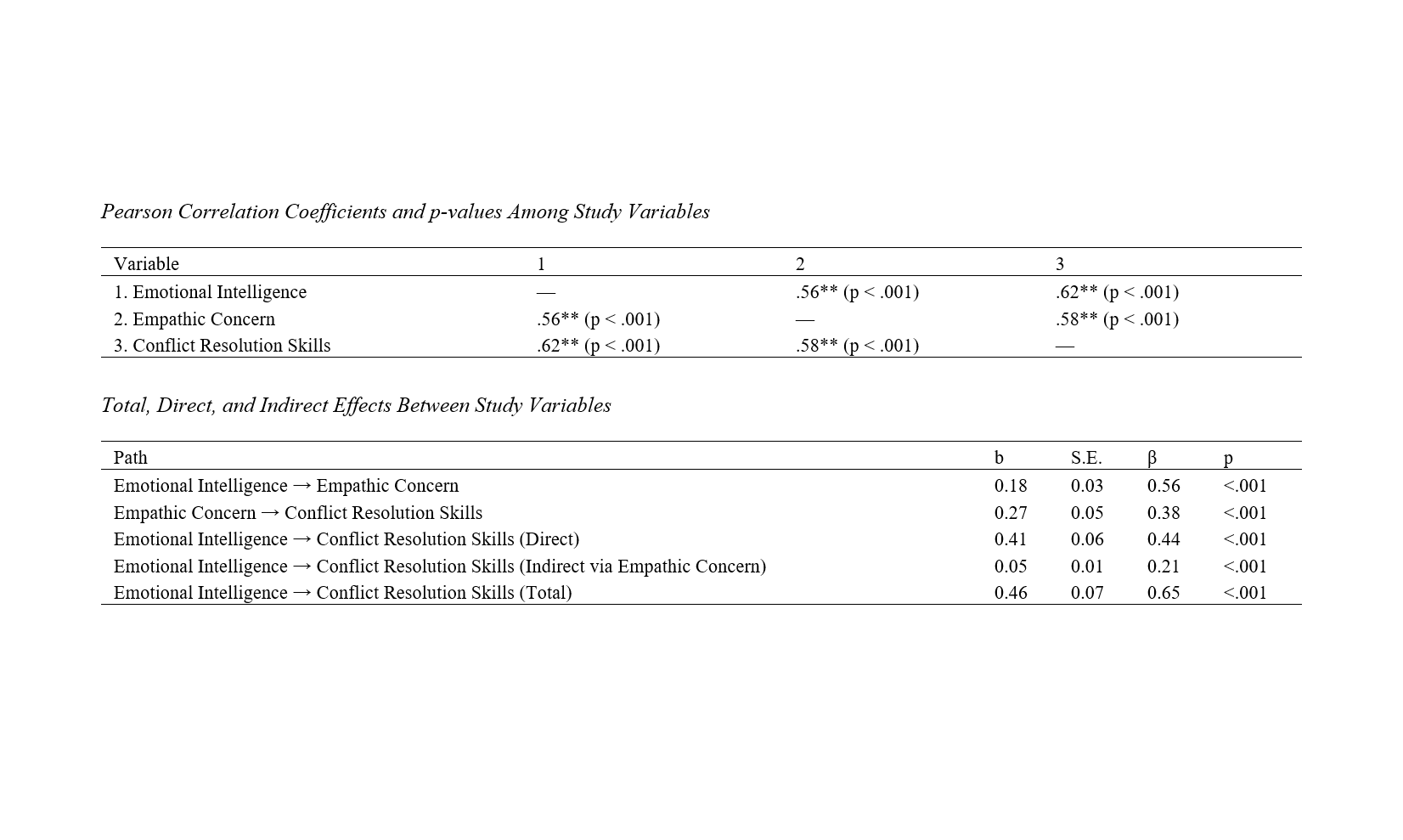
Findings: Correlation analysis revealed significant positive associations between emotional intelligence and empathic concern (r = .56, p < .001), emotional intelligence and conflict resolution skills (r = .62, p < .001), and empathic concern and conflict resolution skills (r = .58, p < .001). The SEM demonstrated excellent model fit (χ²/df = 1.38, GFI = 0.96, AGFI = 0.94, CFI = 0.98, RMSEA = 0.031, TLI = 0.97). Emotional intelligence significantly predicted conflict resolution skills both directly (β = 0.44, p < .001) and indirectly through empathic concern (β = 0.21, p < .001), with the total effect being substantial (β = 0.65, p < .001).
Conclusion: The results highlight emotional intelligence as a key determinant of effective conflict resolution among youth, with empathic concern serving as a significant mediator. These findings underscore the importance of integrating emotional and empathy training into educational and youth development programs to enhance interpersonal competencies and reduce destructive conflict behaviors.
Downloads
References
Aalsubhien, A. M. S., Alqudah, M. F., Aldhaidan, A. M., Alenazi, A. K., & Heilat, M. (2019). Moral Intelligence and Its Relation to Conflict Resolution Skill Among King Saud University Students in the Light of Some Variables. The Arab Journal for Quality Assurance in Higher Education, 12(40), 107-132. https://doi.org/10.20428/ajqahe.v12i40.1546
Abdelrahman, M. M., Abdelaziz, F. S., & Hassan, A. A. A. (2023). Emotional Intelligence Practice and Its Relation to Conflict Resolution Styles Among Academic Nursing Students. Egyptian Journal of Health Care, 14(4), 874-885. https://doi.org/10.21608/ejhc.2023.334884
Adamu, A., Sabo, A., Saad, H., & Shehu, Y. (2024). Assessment of Relationship Between Emotional Intelligence and Conflict Resolution Among Nurse Managers at Tertiary Health Institutions of North Eastern States of Nigeria. Dutse Journal of Pure and Applied Sciences, 10(3c), 221-229. https://doi.org/10.4314/dujopas.v10i3c.21
Amedome, S. N., Kartadinata, S., Ilfiandra, I., & Suherman, U. (2024). Cultural Perceptions, Emotional Intelligence, and Conflict Resolution Abilities of High School Students: A Study on the Influence of Ghanaian Traditional Culture. Jurnal Pendidikan Dan Pengajaran, 57(2), 276-286. https://doi.org/10.23887/jpp.v57i2.78147
Assi, M. D., & Eshah, N. F. (2023). Emotional Intelligence and Conflict Resolution Styles Among Nurse Managers: A Cross-Sectional Study. British Journal of Healthcare Management, 29(6), 1-11. https://doi.org/10.12968/bjhc.2021.0108
Cuevas, K. G. Z., Pendon, L. A. T., Rijon, K. C., Vibar, J. M., & Villa, E. B. (2024). Emotional Intelligence and Conflict Management Strategies Among Junior and Senior Uniformed Personnel in Philippine National Police. International Journal of Multidisciplinary Applied Business and Education Research, 5(6), 2116-2124. https://doi.org/10.11594/ijmaber.05.06.14
Dissanayake, B., Valente, S., & Kodagoda, T. (2024). Emotional Intelligence and Conflict Resolution in University Students: The Moderating Effect of the Need for Power. Electronic Journal of Research in Educational Psychology, 22(64), 649-670. https://doi.org/10.25115/ejrep.v22i64.9910
Dissanayake, W., & Kodagoda, D. T. D. (2021). Nexus of Emotional Intelligence (EI), Need for Affiliation (Naff), Integrating Style of Conflict Resolution: A Case Study of Dispute Resolution Among Undergraduates in Sri Lankan State Universities. Kdu Journal of Multidisciplinary Studies, 3(2), 35-47. https://doi.org/10.4038/kjms.v3i2.27
G., S., & P., M. D. (2024). Exploring the Interplay of Emotional Intelligence and Conflict Resolution Approaches in the IT Industry Workplace. International Journal for Multidisciplinary Research, 6(2). https://doi.org/10.36948/ijfmr.2024.v06i02.16579
Hazem, R., Badawy, T. A. E., & Magdy, M. M. (2020). The Role of Emotional Intelligence in Conflict Management Style Adoption. Ijbe, 5(2), 9-23. https://doi.org/10.58885/ijbe.v05i2.009.rm
Khan, S., Khan, S., Raza, H., Abbasi, P., & Munawar, S. (2025). Relationship Between Emotional Intelligence and Life Satisfaction: Mediated by Empathy and Moderated by Conflict Resolution Skills. Jssa, 3(1), 429-439. https://doi.org/10.59075/jssa.v3i1.129
Malik, A., Rana, H., & Ashraf, R. (2023). Emotional Intelligence and Conflict Resolution as a Predictor of Resilience in Rescue Workers. Life and Science, 4(3), 9. https://doi.org/10.37185/lns.1.1.331
Mohd Khairul Bazli Mohd, A., Derasol, M. Y., Hasbullah, R., & Baqutayan, S. M. S. (2024). Can Emotional Intelligence Mediate the Relationship Between Conflict and Conflict Management Style Among Students? Journal of Science Technology and Innovation Policy, 10(2), 12-21. https://doi.org/10.11113/jostip.v10n2.151
Mutongi, C., Muchuri, T., Nyazema, M. T., & Kandufa, P. (2024). The Role of Emotional Intelligence in Conflict Management. International Journal of Research and Scientific Innovation, XI(V), 178-187. https://doi.org/10.51244/ijrsi.2024.1105011
Norin, O. R. N. (2024). A Model for Enhancing EI Performance in Conflict Resolution. Frontiers in Business Economics and Management, 15(2), 272-278. https://doi.org/10.54097/jrpx7r79
Pohan, N. H., Helga, P. D., Sinuhaji, S. J., Manurung, C. E., & Nurhidayah, R. E. (2023). Gambaran Kecerdasan Emosional Dengan Gaya Manajemen Konflik Perawat. Jurmik, 3(2), 19-26. https://doi.org/10.53416/jurmik.v3i2.139
Ranjbar, M., & Bahariniya, S. (2021). The Relationship Between Emotional Intelligence and Conflict Management in Healthcare Systems: A Case Study in Iran. British Journal of Healthcare Management, 27(10), 1-7. https://doi.org/10.12968/bjhc.2019.0107
Santiago, N. (2024). Role of Emotional Intelligence in Conflict Resolution and Prevention in Colombia. Journal of Conflict Management, 4(1), 14-25. https://doi.org/10.47604/jcm.2381
Sathyamurthy, M., Nair, V., Mohamed, I. S., Ts, D., & Shreelakshmi, P. (2024). Interpersonal Communication, Emotional Intelligence, Conflict Resolution, Relational Satisfaction Among Intimate Partners. Public Administration and Law Review(4(20)), 65-72. https://doi.org/10.36690/2674-5216-2024-4-65-72
Sharma, P., Dhanta, R., & Sharma, A. (2023). Emotional Intelligence and Conflict Resolution in the Workplace. 102-121. https://doi.org/10.4018/979-8-3693-1902-4.ch007
Shkëmbi, F., & Treska, V. (2024). The Influence of Emotional Intelligence in the Choice of Conflict Resolution Strategy. International Research Journal of Multidisciplinary Scope, 05(01), 144-146. https://doi.org/10.47857/irjms.2024.v05i01.0181
Sinelnikova, E. S. (2021). Emotional Intelligence and Conflict Interaction in Russia and in the Netherlands. 490-495. https://doi.org/10.15405/epsbs.2021.12.61
Singh, P. (2025). The Role of Emotional Intelligence in Conflict Resolution Among Adolescent Students. Nijms, 1(4), 38-44. https://doi.org/10.71126/nijms.v1i4.36
Tahir, Z., & Qurat-ul-ain, A. (2024). Perceived Parenting Styles, Emotional Intelligence and Conflict Resolution Styles Among Young Adults. International journal of psychology, 9(5), 60-76. https://doi.org/10.47604/ijp.2976
Theodoratou, M., & Papadopoulos, A. (2024). “Emotional Intelligence, Psychological Distress, and Conflict Resolution Among Healthcare Professionals”. European Psychiatry, 67(S1), S832-S833. https://doi.org/10.1192/j.eurpsy.2024.1737
Wu, B. S. (2025). Exploring the Role of Robots in Interactive Art With the Silver Generation. Highlights in Art and Design, 10(1), 57-68. https://doi.org/10.54097/mpzdgb52
Zenawi, M. (2024). Role of Emotional Intelligence in Managing Interpersonal Conflicts in Ethiopia. Journal of Conflict Management, 4(3), 53-64. https://doi.org/10.47604/jcm.2866
Downloads
Additional Files
Publication Timeline
- Submitted
- Revised
- Accepted
Issue
Section
License

This work is licensed under a Creative Commons Attribution-NonCommercial 4.0 International License.