The Relationship Between Impulsivity and Problematic Internet Use Mediated by Boredom Proneness in Adolescents
DOI:
https://doi.org/10.61838/kman.jayps.4357Keywords:
Impulsivity, boredom proneness, problematic internet use, adolescentsAbstract
Objective: This study aimed to investigate the relationship between impulsivity and problematic internet use in adolescents, with boredom proneness as a mediating variable.
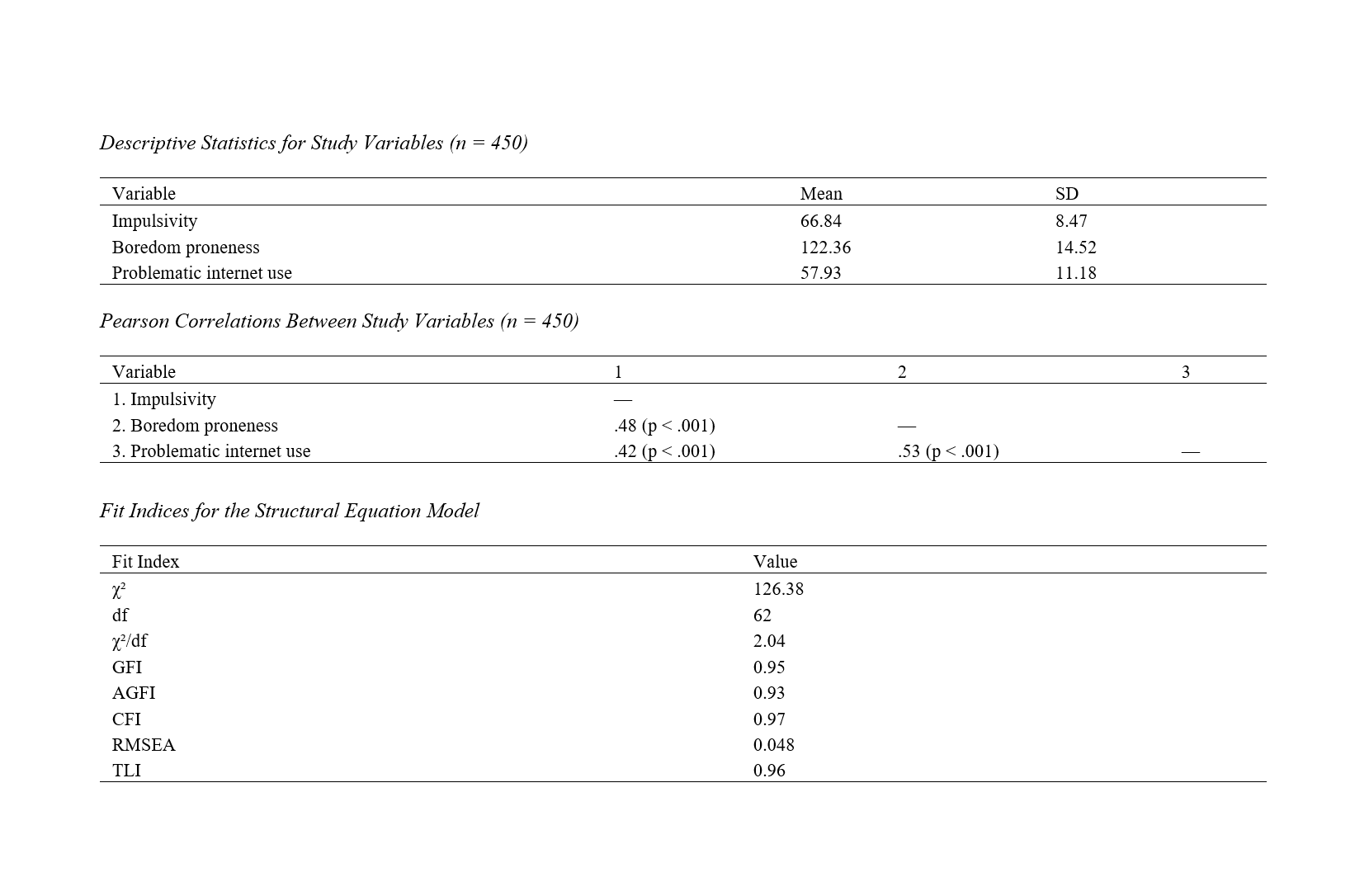
Methods and Materials: A descriptive correlational design was employed, involving 450 Brazilian adolescents aged 13 to 18 years, selected using multistage cluster sampling. Data were collected through the Barratt Impulsiveness Scale – Version 11 (BIS-11), the Boredom Proneness Scale (BPS), and Young’s Internet Addiction Test (IAT). Statistical analyses included Pearson correlation to examine bivariate associations, and Structural Equation Modeling (SEM) with maximum likelihood estimation in AMOS 21 to test the hypothesized mediation model. Model fit was assessed using χ², χ²/df, GFI, AGFI, CFI, RMSEA, and TLI indices.
Findings: Pearson correlation analyses revealed significant positive associations between impulsivity and boredom proneness (r = .48, p < .001), impulsivity and problematic internet use (r = .42, p < .001), and boredom proneness and problematic internet use (r = .53, p < .001). The SEM analysis indicated a good model fit (χ²/df = 2.04, GFI = 0.95, AGFI = 0.93, CFI = 0.97, RMSEA = 0.048, TLI = 0.96). Impulsivity significantly predicted boredom proneness (β = 0.48, p < .001) and problematic internet use both directly (β = 0.22, p < .001) and indirectly through boredom proneness (β = 0.22, p < .001), with the total effect being substantial (β = 0.44, p < .001). These findings confirm partial mediation, indicating that boredom proneness explains a significant portion of the link between impulsivity and problematic internet use.
Conclusion: The results highlight boredom proneness as a key mechanism linking impulsivity to problematic internet use among adolescents. Interventions aiming to reduce excessive internet use in this population should address both impulsive tendencies and the ability to tolerate boredom, fostering adaptive coping strategies in low-stimulation contexts.
Downloads
References
Aquino, A. P. S., & Kimong, P. J. (2022). Boredom and Distress Tolerance on Problematic Internet Use Among Public University Students. Malaysian Journal of Social Sciences and Humanities (MJSSH), 7(5), e001477. https://doi.org/10.47405/mjssh.v7i5.1477
Cannito, L., Ceccato, I., Annunzi, E., Bortolotti, A., D’Intino, E., Palumbo, R., D’Addario, C., Domenico, A. D., & Palumbo, R. (2023). Bored With Boredom? Trait Boredom Predicts Internet Addiction Through the Mediating Role of Attentional Bias Toward Social Networks. Frontiers in human neuroscience, 17. https://doi.org/10.3389/fnhum.2023.1179142
Chandran, V., Vinayan, V., Anandan, A., & Joy, E. A. (2023). Relationship Between Impulsivity and Boredom Proneness in Emerging Adults. International Journal of Engineering Technology and Management Sciences, 7(4), 569-573. https://doi.org/10.46647/ijetms.2023.v07i04.077
Cui, G., Chen, J., Wang, C., Zhang, C., Zhang, X., & Hu, Y. (2021). Dampening Effects of Perceived Teacher Enthusiasm on Class-Related Boredom in College Students: Longitudinal Mediation Effects of Perceived Task Value. Frontiers in psychology, 12. https://doi.org/10.3389/fpsyg.2021.712441
Ding, H., & Si, S. (2024). Boredom Proneness and Phubbing: Fear of Missing Out as a Mediator. Social Behavior and Personality an International Journal, 52(4), 1-8. https://doi.org/10.2224/sbp.13000
Fioravanti, G., Spada, M. M., Benucci, S. B., Casale, S., & Gori, A. (2024). How Metacognitions Contribute to Compulsive Online Shopping: An Exploratory Study. Journal of Clinical Psychology, 81(2), 71-80. https://doi.org/10.1002/jclp.23752
Gao, B., Liu, Y., Shen, Q., Fu, C., Li, W., & Xu, L. (2023). Why Cannot I Stop Phubbing? Boredom Proneness and Phubbing: A Multiple Mediation Model. Psychology research and behavior management, Volume 16, 3727-3738. https://doi.org/10.2147/prbm.s423371
Hsu, C.-F., Chen, V. C., Ni, H. C., Chueh, N., & Eastwood, J. D. (2025). Boredom Proneness and Inattention in Children With and Without ADHD: The Mediating Role of Delay Aversion. Frontiers in Psychiatry, 16. https://doi.org/10.3389/fpsyt.2025.1526089
Kim, G., & Choi, E.-S. (2025). Pace of Life Is Faster for a Bored Person: Exploring the Relationship Between Trait Boredom and Fast Life History Strategy. Evolutionary Psychology, 23(1). https://doi.org/10.1177/14747049241310772
Li, X., Feng, X.-C., Xiao, W., & Zhou, H. (2021). Loneliness and Mobile Phone Addiction Among Chinese College Students: The Mediating Roles of Boredom Proneness and Self-Control. Psychology research and behavior management, Volume 14, 687-694. https://doi.org/10.2147/prbm.s315879
Li, X., Zhou, H., & Xiao, W. (2021). Boredom Proneness and Core Self‐evaluation as Mediators Between Loneliness and Mobile Phone Addiction Among Chinese College Students. Psychology in the Schools, 59(3), 628-638. https://doi.org/10.1002/pits.22635
Liu, Y., Chen, L., Wang, Z., Guo, G., Zhang, M., & Chen, S. (2022). Role of Alexithymia in Predicting Internet Novel Addiction Through Boredom Proneness. International journal of environmental research and public health, 19(14), 8708. https://doi.org/10.3390/ijerph19148708
Liu, Y., Liu, J., & Wang, W. (2023). The Effect of Future Time Perspective on Internet Dependence Among College Students in Pandemic Time: A Moderated Mediation Analysis. Psychology research and behavior management, Volume 16, 509-520. https://doi.org/10.2147/prbm.s396622
Lv, S., & Wang, H. (2023). The Effect of College Students’ Boredom Proneness on Phubbing: The Chain‐Mediating Effects of Fear of Missing Out and Online Vigilance. Perspectives in psychiatric care, 2023(1). https://doi.org/10.1155/2023/9713789
Maftei, A., Merlici, I.-A., & Opariuc‐Dan, C. (2024). Fun in a Box? Loneliness and Adolescents’ Problematic Smartphone Use: A Moderated Mediation Analysis of the Underlying Mechanisms. Psychological Reports. https://doi.org/10.1177/00332941241226681
Senyk, O., Mostovyi, Y., & Wittmann, M. (2024). Time Perspective, Impulsiveness, and the Perception of Waiting Time: The Mediating Role of Boredom. https://doi.org/10.31234/osf.io/swz2b
Sümer, C., & Büttner, O. B. (2022). I’ll Do It – After One More Scroll: The Effects of Boredom Proneness, Self-Control, and Impulsivity on Online Procrastination. Frontiers in psychology, 13. https://doi.org/10.3389/fpsyg.2022.918306
Xu, C., Gu, Z.-H., Yan, J., Lock, M., Chen, S., & Zhuang, Q. (2025). The Separation of Adult ADHD Inattention and Hyperactivity-Impulsivity Symptoms and Their Association With Problematic Short-Video Use: A Structural Equation Modeling Analysis. Psychology research and behavior management, Volume 18, 461-474. https://doi.org/10.2147/prbm.s491731
Zhang, L., Wang, B., Xu, Q., & Fu, C. (2023). The Role of Boredom Proneness and Self-Control in the Association Between Anxiety and Smartphone Addiction Among College Students: A Multiple Mediation Model. Frontiers in Public Health, 11. https://doi.org/10.3389/fpubh.2023.1201079
Zhang, Y., Bu, R., & Li, X. (2024). Social Exclusion and Short Video Addiction: The Mediating Role of Boredom and Self-Control. Psychology research and behavior management, Volume 17, 2195-2203. https://doi.org/10.2147/prbm.s463240
Zhao, J., Chen, S., Xie, X., Wang, J., & Wang, X. (2022). Boredom Proneness and Online Deviant Behaviors: The Mediating Role of Rumination and the Moderating Role of Gender. Behavioral Sciences, 12(11), 455. https://doi.org/10.3390/bs12110455
Zhenyu, Z., Zhao, M., Wang, R., Pan, H., Li, L., & Luo, H. (2024). The Effects of Negative Life Events on College Students’ Problematic Online Gaming Use: A Chain-Mediated Model of Boredom Proneness Regulation. Frontiers in psychology, 15. https://doi.org/10.3389/fpsyg.2024.1426559
Zhu, Y., Liu, J., Wang, Q., Huang, J., Li, X., & Liu, J. (2023). Examining the Association Between Boredom Proneness and Bedtime Procrastination Among Chinese College Students: A Sequential Mediation Model With Mobile Phone Addiction and Negative Emotions. Psychology research and behavior management, Volume 16, 4329-4340. https://doi.org/10.2147/prbm.s431615
Downloads
Additional Files
Publication Timeline
- Submitted
- Revised
- Accepted
Issue
Section
License

This work is licensed under a Creative Commons Attribution-NonCommercial 4.0 International License.