Lived Experiences of Adolescents Undergoing Rehabilitation After Sports-Related Concussions: A Phenomenological Approach
DOI:
https://doi.org/10.61838/kman.jayps.6.6.18Keywords:
sports-related concussion, adolescents, rehabilitation, phenomenologyAbstract
Objective: This study aimed to explore the lived experiences of adolescents undergoing rehabilitation after sports-related concussions (SRCs).
Methods and Materials: A qualitative research design grounded in a phenomenological approach was employed to capture the essence of participants’ subjective experiences. Twenty adolescents aged 13–18 years, all from Minnesota and with a medically diagnosed SRC within the past 12 months, were recruited through purposive sampling from rehabilitation clinics, sports medicine centers, and school athletic departments. Data were collected through semi-structured, in-depth interviews conducted in private, comfortable settings and lasting between 45 and 75 minutes. Interviews explored participants’ symptoms, coping strategies, academic reintegration, and social support networks. Recruitment continued until theoretical saturation was reached. All interviews were audio-recorded, transcribed verbatim, and analyzed using NVivo 14 software.
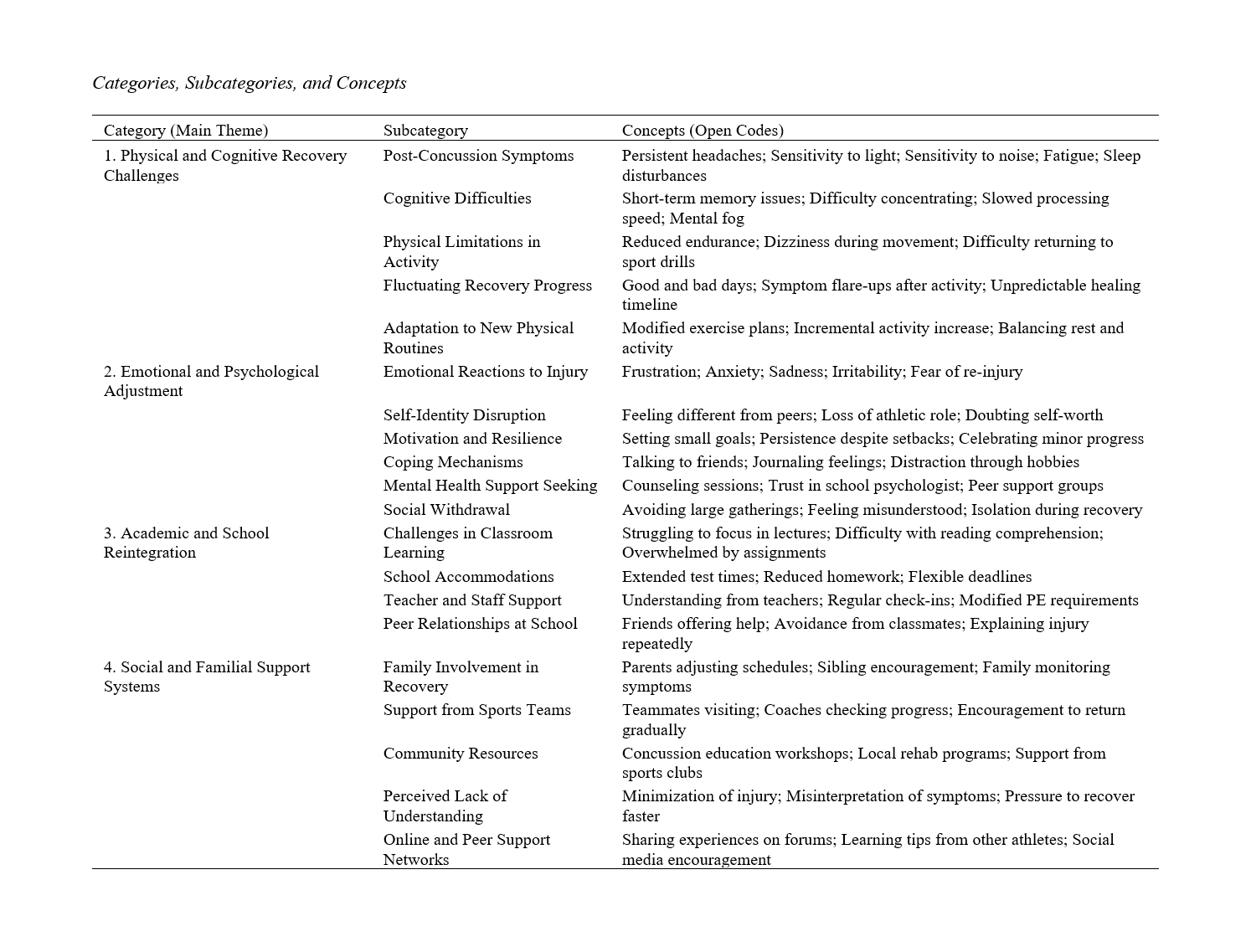
Findings: Four major themes emerged: (1) Physical and Cognitive Recovery Challenges, encompassing persistent symptoms, fluctuating recovery patterns, and adaptation to modified routines; (2) Emotional and Psychological Adjustment, including emotional distress, identity disruption, coping mechanisms, and social withdrawal; (3) Academic and School Reintegration, highlighting classroom challenges, the role of accommodations, and teacher and peer support; and (4) Social and Familial Support Systems, involving family engagement, team and coach encouragement, community resources, and experiences of misunderstanding.
Conclusion: Recovery from SRCs in adolescence is a multifaceted process shaped by interrelated physical, cognitive, psychological, academic, and social factors. Effective rehabilitation requires multidisciplinary, individualized approaches that address both clinical recovery and the lived realities of young athletes, incorporating medical, educational, and psychosocial support to optimize outcomes.
Downloads
References
Biese, K. M., Kliethermes, S., Watson, A., McGuine, T. A., Lang, P. J., Bell, D. R., & Brooks, M. A. (2021). Musculoskeletal Injuries and Their Association With Previous Concussion History: A Prospective Study of High School Volleyball and Soccer Players. The American Journal of Sports Medicine, 49(6), 1634-1641. https://doi.org/10.1177/0363546521997116
Bramley, H., Foley, K. C., Williams, R. J., Lewis, M. M., Kong, L., & Silvis, M. (2018). Impact of Body Mass Index on Postconcussion Symptoms in Teenagers Aged 13 to 18 Years. The Permanente Journal, 22(3). https://doi.org/10.7812/tpp/17-211
D’Alonzo, B. A., Schneider, A. L., Erz, A., Master, C. L., Barnett, I., Hamilton, R. H., Wiebe, D. J., & Szymczak, J. E. (2025). A Qualitative Study of Collegiate Student-Athlete Experiences of Recovery After Concussion. Journal of Head Trauma Rehabilitation. https://doi.org/10.1097/htr.0000000000001067
Dalecki, M., Gorbet, D. J., Macpherson, A., & Sergio, L. E. (2019). Sport Experience Is Correlated With Complex Motor Skill Recovery in Youth Following Concussion. European Journal of Sport Science, 19(9), 1257-1266. https://doi.org/10.1080/17461391.2019.1584249
Daly, E., & Ryan, L. (2024). A Qualitative Analysis of Existing Concussion Return to Play Protocols and Psychological Recovery Management in Gaelic Games. International Journal of Sports Science & Coaching, 20(1), 225-235. https://doi.org/10.1177/17479541241289983
Ferry, B., Means, G. E., Green, C. L., Risoli, T., Martinez, C., Vomer, R., Reinke, E. K., Pyles, C., & Bytomski, J. (2023). Early Initiation of Vestibular Therapy Following Sports-Related Concussions: A Retrospective Cohort Study. Cureus. https://doi.org/10.7759/cureus.39764
Finnegan, E., Daly, E., & Ryan, L. (2024). Nutritional Considerations of Irish Performance Dietitians and Nutritionists in Concussion Injury Management. Nutrients, 16(4), 497. https://doi.org/10.3390/nu16040497
Hainline, B., Gurin, L. J., & Torres, D. M. (2019). Multiple Concussions and Retirement From Sport. 165-168. https://doi.org/10.1093/med/9780190937447.003.0028
Jaffee, M. S., Broshek, D. K., & Svingos, A. M. (2023). Athletes and Sport-Related Concussions. 135-150. https://doi.org/10.1093/oso/9780190630119.003.0012
Long, C. C., Dugan, J. E., Jo, J., Williams, K. L., Jonzzon, S., Terry, D. P., Yengo‐Kahn, A. M., & Zuckerman, S. L. (2024). Initial Symptom Severity and Recovery of Sport-Related Concussion in Team Versus Individual Sport Athletes. Neurosurgery, 96(6), 1261-1271. https://doi.org/10.1227/neu.0000000000003225
Lowe, L., Castillo, F., Gokun, Y., Williams, D. K., Israel, M., & Yates, C. (2021). Static and Dynamic Balance Assessment in Healthy and Concussed Adolescent Athletes. Clinical Journal of Sport Medicine, 32(4), 385-390. https://doi.org/10.1097/jsm.0000000000000979
Lucas, S., Bolter, N. D., Petranek, L. J., Nilsson, K., Pardue, K., & Flint, H. (2023). Parents’/Guardians’ Experiences With Their Adolescents’ Prolonged Recovery From a Sport-Related Concussion. Journal of Concussion, 7. https://doi.org/10.1177/20597002231160946
Master, C. L., Katz, B. P., Arbogast, K. B., McCrea, M., McAllister, T. W., Pasquina, P. F., LaPradd, M., Zhou, W., & Broglio, S. P. (2020). Differences in Sport-Related Concussion for Female and Male Athletes in Comparable Collegiate Sports: A Study From the NCAA-DoD Concussion Assessment, Research and Education (CARE) Consortium. British Journal of Sports Medicine, 55(24), 1387-1394. https://doi.org/10.1136/bjsports-2020-103316
Mathew, A. S., Datoc, A., Choi, D. M., Tak, C. R., & Abt, J. P. (2025). Time to Rehabilitation in Pediatric Concussion Patients Influences Recovery Outcomes. Journal of Sport Rehabilitation, 34(3), 297-307. https://doi.org/10.1123/jsr.2024-0094
McLeod, T. C. V., Wagner, A. J., Parsons, J. T., & Bacon, C. E. W. (2017). Adolescent Athletes’ Social Perspectives Following a Sport-Related Concussion. British Journal of Sports Medicine, 51(11), A46.41-A46. https://doi.org/10.1136/bjsports-2016-097270.118
Miller, D., Snyder, R., & Manos, A. (2022). Understanding Baseline Concussion Testing: A Resource for School Nurses as Members of Concussion Management Teams. Nasn School Nurse, 37(5), 245-249. https://doi.org/10.1177/1942602x221082329
Moser, R. S., Riegler, K. E., Uhrig, C., Choi, D., Broglio, S. P., Mayer, B., Boltz, A. J., Master, C. L., & Schatz, P. (2024). A - 26 a Survey of Sports Concussion Specialists’Clinical Criteria to Determine Concussion Recovery. Archives of Clinical Neuropsychology, 39(7), 1279-1279. https://doi.org/10.1093/arclin/acae052.26
Moser, R. S., Schatz, P., Choi, D., & Mayer, B. (2023). Sports Neuropsychologists’ Ratings of Clinical Criteria Used to Help Determine Concussion Recovery: A Brief Survey Report. Archives of Clinical Neuropsychology, 39(2), 214-220. https://doi.org/10.1093/arclin/acad082
Murdaugh, D. L., Ono, K. E., Morris, S., & Burns, T. G. (2018). Effects of Developmental Age on Symptom Reporting and Neurocognitive Performance in Youth After Sports-Related Concussion Compared to Control Athletes. Journal of Child Neurology, 33(7), 474-481. https://doi.org/10.1177/0883073818766815
Neidecker, J., Gealt, D. B., Lambert, K., Luksch, J., & Weaver, M. (2021). First-Time Sports-Related Concussion Recovery Revisited: Management Changes and Impact on Recovery. Journal of Osteopathic Medicine, 121(1), 49-56. https://doi.org/10.1515/jom-2020-0106
Pate, J. W., Cummins, I., Cooper, K., Mooney, J., McLeod, M. C., & Gould, S. (2022). Evaluation of Sports-Related Concussion in Children (5–12) and Adolescents (13–18). Neurology, 98(1_Supplement_1). https://doi.org/10.1212/01.wnl.0000801848.01575.87
Podolak, O. E., Arbogast, K. B., Master, C. L., Sleet, D. A., & Grady, M. F. (2021). Pediatric Sports-Related Concussion: An Approach to Care. American Journal of Lifestyle Medicine, 16(4), 469-484. https://doi.org/10.1177/1559827620984995
Russell, K., Selci, E., Rozbacher, A., & Ellis, M. J. (2017). Role of Sport-Related Concussion on Academic Achievement Among Youth Athletes. British Journal of Sports Medicine, 51(11), A20.22-A21. https://doi.org/10.1136/bjsports-2016-097270.51
Sargeant, M., Sykes, E., Saviour, M., Sawhney, A., Calzolari, E., Arthur, J., McGoldrick, A., & Seemungal, B. M. (2018). The Utility of the Sports Concussion Assessment Tool in Hospitalized Traumatic Brain Injury Patients. Journal of Concussion, 2. https://doi.org/10.1177/2059700218808121
Schneider, K., Emery, C. A., Black, A. M., Yeates, K. O., Debert, C. T., Lun, V., & Meeuwisse, W. (2019). Adapting the Dynamic, Recursive Model of Sport Injury to Concussion: An Individualized Approach to Concussion Prevention, Detection, Assessment, and Treatment. Journal of Orthopaedic and Sports Physical Therapy, 49(11), 799-810. https://doi.org/10.2519/jospt.2019.8926
Valovich, T., DiSanti, J. S., Williams, R. M., & Bacon, C. E. W. (2022). Adolescent Athletes’ Perspectives on the Social Implications of Sport-Related Concussion. Internet Journal of Allied Health Sciences and Practice. https://doi.org/10.46743/1540-580x/2022.2161
Wortley, K., & Schellenberg, B. J. I. (2024). Self-Compassion and Willingness to Adhere to Return-to-Play Protocol Following Sport-Related Concussions. https://doi.org/10.31234/osf.io/3jm2b
Downloads
Additional Files
Publication Timeline
- Submitted
- Revised
- Accepted
Issue
Section
License

This work is licensed under a Creative Commons Attribution-NonCommercial 4.0 International License.