Comparison of the Effectiveness of Behavioral Activation and Its Combination with Mental Contrasting with Implementation Intentions on the Psychological Well-Being of Adolescent Girls with Depressed Mood
DOI:
https://doi.org/10.61838/kman.jayps.4312Keywords:
Behavioral activation, mental contrasting with implementation intentions, psychological well-being, adolescent girls, depressionAbstract
Objective: The present study aimed to compare the effectiveness of behavioral activation and its combination with mental contrasting with implementation intentions on the psychological well-being of adolescent girls with depressed mood.
Materials and Methods: This quasi-experimental study employed a pretest–posttest–follow-up design with a control group. From among 300 questionnaires collected from lower secondary school girls in Karaj during the 2021–2022 academic year, 45 participants were randomly assigned to two experimental groups and one control group after screening and applying inclusion criteria. The first experimental group received a 10-session intervention of behavioral activation (each session lasting 90 minutes), while the second experimental group received a combined intervention of behavioral activation and mental contrasting with implementation intentions. The Beck Depression Inventory-II (BDI-II) was used for initial screening, and Ryff’s Psychological Well-Being Scale was administered at the pretest, posttest, and three-month follow-up stages. Data were analyzed using repeated measures analysis of variance, along with the Shapiro–Wilk, Levene's, M. Box, and Mauchly's sphericity tests, as well as the Bonferroni post-hoc test. All analyses were conducted using SPSS version 24 at a significance level of p < 0.01. In the final analysis, data from 40 participants were included.
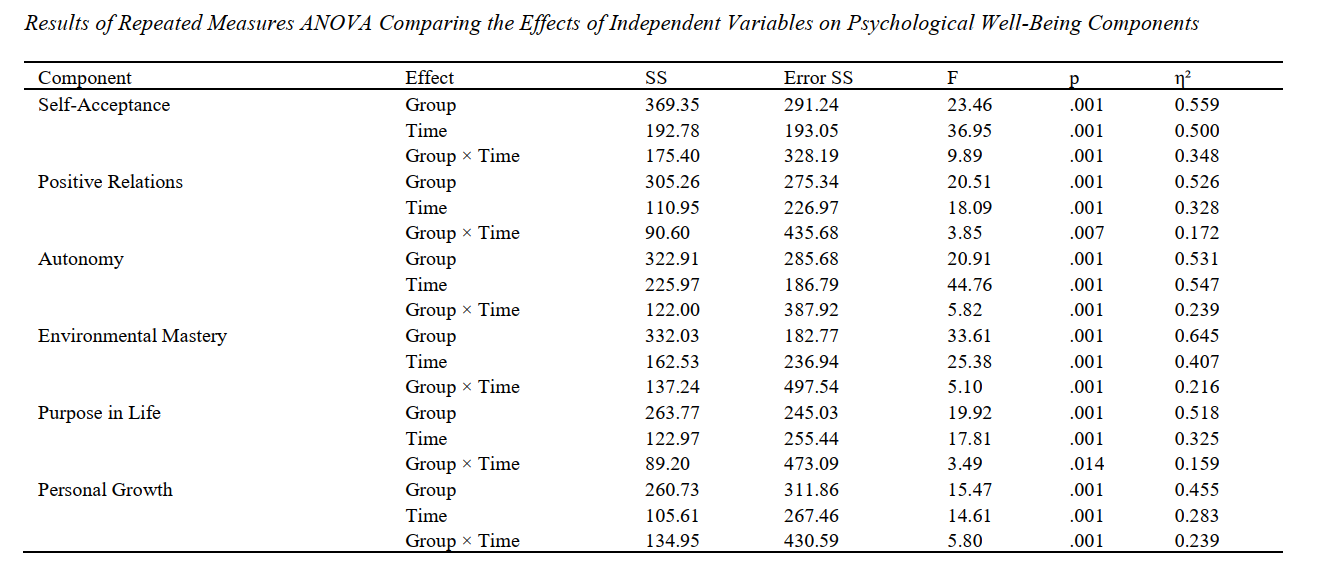
Findings: The mean differences in psychological well-being components between the two intervention groups (behavioral activation and its combination with mental contrasting with implementation intentions) and the control group were statistically significant. Both independent variables led to an increase in the mean scores of psychological well-being components. Additionally, a significant difference was observed between the effects of behavioral activation and the combined intervention on the components of self-acceptance (p = .041), autonomy (p = .042), and environmental mastery (p = .029). The combined intervention led to greater increases in these components compared to behavioral activation alone.
Conclusion: Although behavioral activation is an effective method for enhancing psychological well-being in adolescent girls with depressed mood, its combination with mental contrasting and implementation intentions yields more substantial outcomes. Given the results of this study and the psychological challenges experienced by this age group, the use of these interventions is recommended to improve the psychological well-being of adolescent girls with depressed mood.
Downloads
References
Abbott, R. A., Ploubidis, G. B., Huppert, F. A., Kuh, D., & Croudace, T. J. (2010). An evaluation of the precision of measurement of Ryff's Psychological Well-Being Scales in a population sample. Social Indicators Research, 97(3), 357-373. https://doi.org/10.1007/s11205-009-9506-x
Bayani, A. A., Koocheky, A. M., & Bayani, A. (2008). The reliability and validity of Ryff's psychological well-being scales. Iran Journal of Psychiatry and Clinical Psychology, 14(2), 146-151. https://ijpcp.iums.ac.ir/browse.php?a_id=464&slc_lang=en&sid=1&printcase=1&hbnr=1&hmb=1
Beck, A. T., Steer, R. A., & Brown, G. K. (1996). The Beck Depression Inventory-II: A revised version of the BDI. Psychological assessment, 8(2), 77-84. https://doi.org/10.1037/t00742-000
Brodersen, G., & Oettingen, G. (2017). Mental contrasting of a negative future with a positive reality regulates state anxiety. Frontiers in psychology, 8, 1596. https://doi.org/10.3389/fpsyg.2017.01596
Ceri, V., & Cicek, I. (2021). Psychological well-being, depression and stress during COVID-19 pandemic in Turkey: A comparative study of healthcare professionals and non-healthcare professionals. Psychology, Health & Medicine, 26(1), 85-97. https://doi.org/10.1080/13548506.2020.1859566
Cuijpers, P., Pineda, B. S., Ng, M. Y., Weisz, J. R., Muñoz, R. F., Gentili, C., Quero, S., & Karyotaki, E. (2021). A meta-analytic review: psychological treatment of subthreshold depression in children and adolescents. Journal of the American Academy of Child & Adolescent Psychiatry, 60(9), 1072-1084. https://doi.org/10.1016/j.jaac.2020.11.024
Denneson, L. M., Trevino, A. Y., Kenyon, E. A., Ono, S. S., Pfeiffer, P. N., & Dobscha, S. K. (2019). Health coaching to enhance psychological well-being among veterans with suicidal ideation: A pilot study. Journal of General Internal Medicine, 34, 192-194. https://doi.org/10.1007/s11606-018-4677-2
Diaz, D., Rodriguez-Carvajal, R., Blanco, A., Moreno-Jimenez, B., Gallardo, I., Valle, C., & Van Dierendonck, D. (2006). Adaptation of the Psychological Well-Being Scale by Carol Ryff into Spanish: A study of validity and reliability in a sample of university students. Psicothema, 18(3), 572-577. https://www.researchgate.net/publication/6509428_Spanish_adaptation_of_the_Psychological_Well-Being_Scales_PWBS
Fritzsche, A., Müller, V., & Oettingen, G. (2016). Mental contrasting with implementation intentions enhances goal pursuit and emotional wellbeing in adolescents. Journal of Happiness Studies, 17(4), 1289-1305.
Ghodrati, S., & Vaziri Nekoo, R. (2019). The Effectiveness of Behavioral Activation (BA) on Psychological Well-being and Psychological Flexibility in Female Students. Journal of Medical Council of I.R.I., 36(4), 233-240. https://jmciri.ir/article-1-2868-en.html
Guamanga, M. H., Saiz, C., Rivas, S. F., & Bueno, P. M. (2025). Critical Thinking and Metacognition: Pathways to Empathy and Psychological Well-Being. Journal of Intelligence, 13(3), 34. https://doi.org/10.3390/jintelligence13030034
Hallam, G. P., Webb, T. L., Sheeran, P., Miles, E., Wilkinson, I. D., Hunter, M. D., Barker, A. T., Woodruff, P. W. R., Totterdell, P., Lindquist, K. A., & Farrow, T. F. D. (2015). The neural correlates of emotion regulation by implementation intentions. PLoS One, 10(3), e0119500. https://doi.org/10.1371/journal.pone.0119500
Hamidi, R., Fekrizadeh, Z., Azadbakht, M., Garmaroudi, G., Taheri Tanjani, P., Fathizadeh, S., & Ghisvandi, E. (2015). Validity and reliability Beck Depression Inventory-II among the Iranian elderly population. Journal of Sabzevar University of Medical Sciences, 22(1), 189-198. https://jsums.medsab.ac.ir/article_550_en.html
Joshanloo, M. (2016). Structural and discriminant validity of the tripartite model of mental well-being in Iran. Journal of Mental Health, 25(6), 455-460.
Kappes, A., & Oettingen, G. (2014). The emergence of goal pursuit: mental contrasting connects future and reality. Journal of Experimental Social Psychology, 54, 25-39. https://doi.org/10.1016/j.jesp.2014.03.014
Lejuez, C. W., Hopko, D. R., Acierno, R., Daughters, S. B., & Pagoto, S. L. (2011). Ten year revision of the brief behavioral activation treatment for depression: revised treatment manual. Behavior Modification, 35(2), 111-161. https://doi.org/10.1177/0145445510390929
Mahmudi, L., Karimi, P., Fatemeh Sadat, A., Arghavan, M., Shokri, G., Badfar, F., & Kazemi, M. (2021). The prevalence of depression in Iranian children: A systematic review and meta-analysis. Asian Journal of Psychiatry, 58. https://doi.org/10.1016/j.ajp.2021.102579
McCauley, E., Schloredt, K. A., Gudmundsen, G. R., Martell, C. R., & Dimidjian, S. (2016). Behavioral activation with adolescents: A clinician's guide. Guilford Publications. https://books.google.com/books?id=9JHmsgEACAAJ&source=gbs_navlinks_s
Nunes, A. R., Lee, K., & O'Riordan, T. (2016). The importance of an integrating framework for achieving the Sustainable Development Goals: the example of health and well-being. BMJ Global Health, 1(3), e000068. https://doi.org/10.1136/bmjgh-2016-000068
Oettingen, G. (2000). Expectancy effects on behavior depend on self-regulatory thought. Social Cognition, 18(2), 101-129. https://doi.org/10.1521/soco.2000.18.2.101
Oettingen, G. (2012). Future thought and behaviour change. European Review of Social Psychology, 23(1), 1-63. https://doi.org/10.1080/10463283.2011.643698
Ryff, C. D. (1989). Happiness is everything, or is it? Explorations on the meaning of psychological well-being. Journal of personality and social psychology, 57(6), 1069. https://doi.org/10.1037/0022-3514.57.6.1069
Ryff, C. D. (2014). Psychological well-being revisited: Advances in the science and practice of eudaimonia. Psychotherapy and psychosomatics, 83(1), 10-28. https://doi.org/10.1159/000353263
Ryff, C. D., & Keyes, C. L. (1995). The structure of psychological well-being revisited. Journal of personality and social psychology, 69(4), 719. https://doi.org/10.1037/0022-3514.69.4.719
Scarborough, M. K., Lewis, C. M., & Kulkarni, S. (2010). Enhancing adolescent brain development through goal-setting activities. Social Work, 55(3), 276-278. https://doi.org/10.1093/sw/55.3.276
Scott, J. E., Mazzucchelli, T. G., Walker, R., Luszcz, M. A., & Windsor, T. D. (2024). A randomized controlled trial of a behavioral activation intervention to increase engagement with life and well-being in older adults. Gerontology, 70(11), 1188-1201. https://doi.org/10.1159/000541079
Sezer, B., Ntoumanis, N., Riddell, H., & Gucciardi, D. F. (2025). An experimental investigation of daily mental contrasting with implementation intentions and goal motives in reducing bedtime procrastination: A registered report. Psychology & Health, 1-29. https://doi.org/10.1080/08870446.2025.2491593
Steer, R. A., Ball, R., Ranieri, W. F., & Beck, A. T. (1999). Dimensions of the Beck Depression Inventory‐II in clinically depressed outpatients. Journal of Clinical Psychology, 55(1), 117-128. https://doi.org/10.1002/(SICI)1097-4679(199901)55:1<117::AID-JCLP12>3.0.CO;2-A
Stein, A. T., Carl, E., Cuijpers, P., Karyotaki, E., & Smits, J. A. (2021). Looking beyond depression: A meta-analysis of the effect of behavioral activation on depression, anxiety, and activation. Psychological medicine, 51(9), 1491-1504. https://doi.org/10.1017/S0033291720003050
Tindall, L., Kerrigan, P., Li, J., Hayward, E., & Gega, L. (2024). Is behavioural activation an effective treatment for depression in children and adolescents? An updated systematic review and meta-analysis. European Child & Adolescent Psychiatry, 33(12), 4133-4156. https://doi.org/10.1007/s00787-024-02429-3
Toosi, F., Rahimi, C., & Sajjadi, S. (2017). Psychometric Properties of Beck Depression Inventory-II for High School Children in Shiraz City, Iran. International Journal of School Health, 4(3), 1-6. https://doi.org/10.5812/intjsh.41069
Tryon, G. S. (2018). Goals and psychotherapy. In Working with goals in psychotherapy and counselling (pp. 87). https://doi.org/10.1093/med-psych/9780198793687.003.0005
Van Dierendonck, D., Diaz, D., Rodriguez-Carvajal, R., Blanco, A., & Moreno-Jimenez, B. (2008). Ryff's six-factor model of psychological well-being: A Spanish exploration. Social Indicators Research, 87(3), 473-479. https://doi.org/10.1007/s11205-007-9174-7
Wiese, B. S. (2017). Successful pursuit of personal goals and subjective well-being. In Personal project pursuit (pp. 301-328). Psychology Press. https://www.taylorfrancis.com/chapters/edit/10.4324/9781315089928-11/successful-pursuit-personal-goals-subjective-well-being-bettina-wiese
World Health Organization. (2017). Depression and other common mental disorders: Global health estimates. https://www.who.int/publications/i/item/depression-global-health-estimates
Downloads
Additional Files
Publication Timeline
- Submitted
- Revised
- Accepted
Issue
Section
License
Copyright (c) 2025 Mona Mohammadi Elizei (Author); Mohammad Reza Seirafi (Corresponding Author); Mohammad Hossein Taghdisi, Fatemeh Mohammadi Shirmahaleh (Author)

This work is licensed under a Creative Commons Attribution-NonCommercial 4.0 International License.