Suicide Prevention Based on the Lived Experience of Students Who Attempted Suicide (A Case Study of Lower Secondary School Girls in Delfan, Lorestan Province)
DOI:
https://doi.org/10.61838/kman.jayps.4267Keywords:
Suicide, Lived Experience, Prevention Package, Adolescent GirlsAbstract
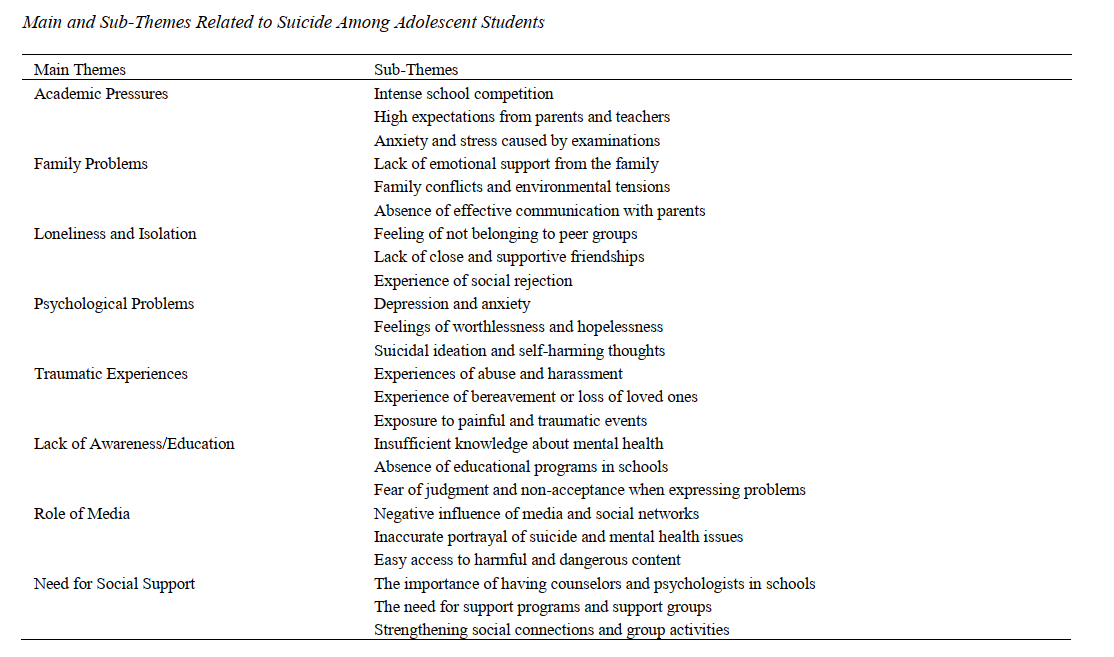
This study aimed to design and evaluate a suicide prevention educational package based on the lived experiences of adolescent girls who had previously attempted suicide and compare its effectiveness with a meaning-centered intervention grounded in logotherapy. This research employed a mixed-methods design, including both qualitative and quantitative components. The statistical population consisted of all lower secondary school girls in Delfan County, Lorestan Province, during the 2023–2024 academic year. In the qualitative phase, data were collected through in-depth semi-structured interviews using a phenomenological approach and snowball sampling until theoretical saturation was reached. Thematic analysis was used to extract the main themes related to suicidal ideation. Based on these findings, a 10-session educational package was developed. In the quantitative phase, 45 participants were randomly assigned to three groups: a lived-experience-based intervention group, a meaning-centered intervention group, and a control group. The Beck Suicide Ideation Questionnaire was administered pre- and post-intervention. Data were analyzed using analysis of covariance (ANCOVA). Thematic analysis revealed eight main themes contributing to suicidal ideation, including academic pressure, family conflict, loneliness, psychological problems, trauma, lack of awareness, media influence, and insufficient social support. ANCOVA results showed that both intervention packages significantly reduced suicidal ideation compared to the control group. Although no statistically significant difference was found between the two intervention groups, the lived-experience-based package had a slightly greater effect size. Adjusted means indicated lower suicidal ideation scores in the lived-experience group post-intervention.
Downloads
References
Abbasi-Ghahramanloo, A., Jafarzadeh, M., Pourfarzi, F., Afrashteh, S., Azimi, A., Yusuf, M. A., & Moradi-Asl, E. (2024). Characteristics of suicide attempts in Northwestern Iran: a five-year population-based survey. BMC psychiatry, 24(1), 15. https://doi.org/10.1186/s12888-023-05483-4
Amiri, A., Al Yasin, S. A., & Amiri, L. (2016). The adaptation of human values from the perspective of the Masnavi and the Quran. Studies in Literature, Mysticism, and Philosophy, 8(2), 518-534. https://www.google.com/url?sa=t&source=web&rct=j&opi=89978449&url=https://en.civilica.com/doc/581915/&ved=2ahUKEwim3oXom9KOAxWPD1kFHRtqGSwQFnoECB8QAQ&usg=AOvVaw2xQY1JG87GPCb7fFOAaRsW
Bell, J. (2025). Public and Mental Health Professionals’ Perspectives on Social Media and Suicide Exposure. BMC public health, 25(1). https://doi.org/10.1186/s12889-025-22587-6
Diktaş Yerli, G. (2023). Sosyolojik Bir Olgu Olarak İntihar ve Türkiye'deki Boyutu. https://doi.org/10.35826/ijoess.3285
Fakhari, A., Farahbakhsh, M., Esmaeili, E. D., & Azizi, H. (2021). A longitudinal study of suicide and suicide attempt in northwest of Iran: incidence, predictors, and socioeconomic status and the role of sociocultural status. BMC public health, 21(1), 1486. https://doi.org/10.1186/s12889-021-11527-9
Ghaderi, S., & Nazari, H. (2019). A sociological analysis of suicide in Iran (based on statistics from 2010 to 2014). Social Issues in Iran (Kharazmi University), 10(1), 195-215. https://www.google.com/url?sa=t&source=web&rct=j&opi=89978449&url=https://sid.ir/paper/173548/fa&ved=2ahUKEwi5otr4m9KOAxWQNlkFHcpMNioQFnoECBYQAQ&usg=AOvVaw3uFAWcf9zTrvknGjaXnP8b
Gould, M. S., Greenberg, T., Velting, D. M., & Shaffer, D. (2003). Youth suicide prevention programs: A meta-analysis. American Academy of Child & Adolescent Psychiatry, 42(5), 513-520. https://doi.org/10.1097/01.CHI.0000046821.95464.CF
Haj Zain al-Abidin, F., Ahmadinejad, K., Mohseni Hanjani, F., & Lotfi Azimi, A. (2022). A historical journey through the mystical teachings in the Masnavi of Molana. Quarterly Journal of History, 17(66). https://www.google.com/url?sa=t&source=web&rct=j&opi=89978449&url=https://journals.iau.ir/article_691773.html%3Flang%3Den&ved=2ahUKEwiTza2FnNKOAxXGKFkFHdoPF6oQFnoECB0QAQ&usg=AOvVaw11b6U-S2se6XQN7X4BoqOb
Hawton, K., Saunders, K. E. A., & O'Connor, R. C. (2012). Self-harm and suicide in adolescents. The lancet, 379(9834), 2373-2382. https://doi.org/10.1016/S0140-6736(12)60322-5
Karimi Dastaki, A., & Mahmudi, M. (2024). The Effectiveness of Life Meaning Workshops on Resilience, Negative Affect, and Perceived Social Support in Students. Journal of Psychological Dynamics in Mood Disorders (PDMD), 3(1), 187-197. https://doi.org/10.22034/pdmd.2024.448984.1063
Kompani Zare, M. (2019). Molana and the meaning of life. Contemporary Look Publications.
Lu, J., Tang, X., Jin, X., Luo, X., Fan, T., & Shen, Y. (2025). A network analysis-based study of the correlations between internet addiction, insomnia, physical activity, and suicide ideation in adolescents. Computers in human Behavior, 163, 108483. https://doi.org/10.1016/j.chb.2024.108483
Mahdavi, N. (2021). Molana and the tale of human suffering. Doostan Publications.
Marshall, M., & Translated by Rahim, R. (2017). The Charter of Meaning Therapy (Guide to the Fundamental Principles of Viktor Frankl's Meaning Therapy). Rooshd Publications.
Mohammadi, R., Rezaei, M., & Soleimani, S. (2022). Lived experiences of suicide attempts: A phenomenological study. Qualitative Research in Behavioral Sciences, 1(1), 1-14.
Mohibi, Z., Qamari Givi, H., Falsafi Nejad, M. R., & Khodabakhshi Koulai, A. (2020). A phenomenological study of the experience of self-harm without suicide in adolescent girls. Social Health, 7(3), 265-277. https://journals.sbmu.ac.ir/ch/index.php/ch/article/view/25327
Roozbehaneh, M. (2021). Frankl's existential therapy in alignment with the thoughts of Molavi. National Conference on Professional Research in Psychology and Counseling from the Teacher's Perspective, Minab.
Sun, F. K., Chiu, N. M., Yao, Y., Wu, M. K., Hung, C. F., Chen, C. C., Lee, Y. H., & Chiang, C. Y. (2022). The effects of logotherapy on meaning in life, depression, hopelessness, and suicidal ideation, in patients with depression: An intervention study. Perspectives in psychiatric care, 58(4), 1891-1899. https://doi.org/10.1111/ppc.13003
Tahmasbi Pour, N. (2020). Meaning therapy: From theory to practice from Frankl's perspective. Existential Research, 9(18), 499-522. https://orj.sru.ac.ir/mobile/article_1518.html
Tiranaz, M. A. (2018). The engineering of meaning in the Masnavi of Molana. Contemporary Look Publications.
Yeşilkaya, S., & Hocaoğlu, Ç. (2025). Recurrent suicide attempts in a patient with chronic obstructive pulmonary disease: A case report. Aksaray University Journal of Medical Sciences, 5(2), 83-86. https://dergipark.org.tr/en/pub/asujms/issue/91853/1553301
Zekri, S. M., Yasagh, F., Jalalvand, A., Mokarram, M., & Eghbalpour, F. (2024). The Effectiveness of Integrative Approach Logo Therapy and Hope Therapy on Dysfunctional Metacognitive Beliefs of Mothers of Autistic Children: The effectiveness of integrated method on mothers of autistic children. International Journal of Body, Mind and Culture, 11(5), 687-701. https://doi.org/10.22122/ijbmc.v11i5.646
Downloads
Additional Files
Publication Timeline
- Submitted
- Revised
- Accepted
Issue
Section
License
Copyright (c) 2025 Seyedeh Farzaneh Babaei Mohammadi (Author); Ata Shakerian (Corresponding Author); Yahya Yarahmadi (Author)

This work is licensed under a Creative Commons Attribution-NonCommercial 4.0 International License.