Tendency Toward Risky Behaviors Based on Differentiation of Self, Cognitive Flexibility, and Perceived Social Support in Adolescent Girls with a History of Running Away from Home
DOI:
https://doi.org/10.61838/kman.jayps.4198Keywords:
Risky behaviors, Differentiation of self, Cognitive flexibility, Perceived social support, Runaway adolescents, Adolescent girlsAbstract
Objective: This study aimed to examine the predictive roles of differentiation of self, cognitive flexibility, and perceived social support in risky behavior tendencies among adolescent girls with a history of running away from home.
Methods and Materials: This descriptive-correlational study was conducted among 390 adolescent girls aged 13 to 18 with documented histories of running away, selected through purposive sampling from social service and rehabilitation centers in Tehran. Participants completed four standardized questionnaires measuring risky behavior tendency, differentiation of self, cognitive flexibility, and perceived social support. Data were analyzed using Pearson correlation coefficients and multiple linear regression in SPSS version 27. All statistical assumptions were tested and confirmed before analysis.
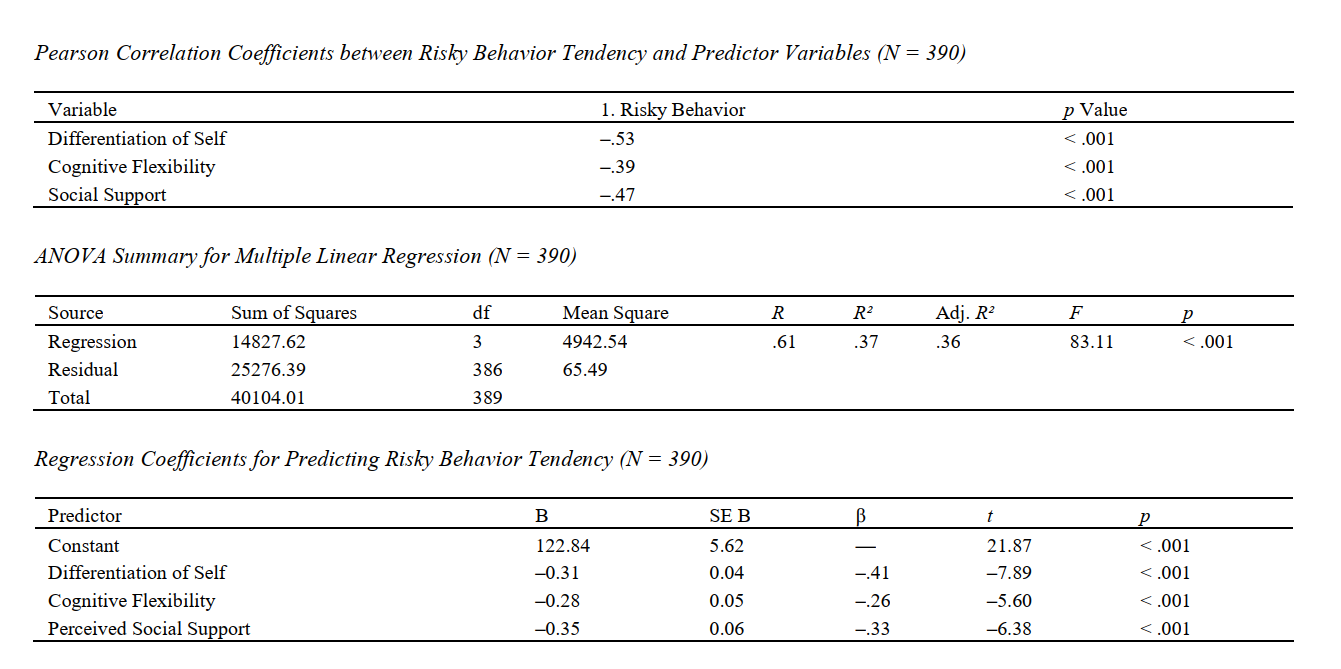
Findings: The results showed that risky behavior tendency had significant negative correlations with differentiation of self (r = –.53, p < .001), cognitive flexibility (r = –.39, p < .001), and perceived social support (r = –.47, p < .001). Multiple regression analysis indicated that the three predictors collectively accounted for 37% of the variance in risky behavior (R² = .37, F(3, 386) = 83.11, p < .001). Differentiation of self (β = –.41, p < .001), perceived social support (β = –.33, p < .001), and cognitive flexibility (β = –.26, p < .001) were all significant predictors, with differentiation of self showing the strongest effect.
Conclusion: The findings suggest that lower levels of self-differentiation, cognitive flexibility, and perceived social support significantly increase the likelihood of engaging in risky behaviors among adolescent girls with a history of running away. Interventions aiming to strengthen these psychological and social capacities may be effective in reducing high-risk behavior in this vulnerable population.
Downloads
References
Aghajani, S., Rahimzadegan, S., & Taheri, h. (2022). The Relation between tendency to suicide with self-differentiation and cognitive flexibility among girl students. Knowledge & Research in Applied Psychology, -. https://doi.org/10.30486/jsrp.2022.1957087.3431
Aghayousefi, A., Oraki, M., Ghorbani, T., & Mahdieh, M. (2016). The Effect of Dialectic Behavior Therapy to Increase the Self-Differentiation in Women with Borderline Personality Disorder and Substance Use. Clinical Psychology Studies, 6(23), 61-80. https://doi.org/10.22054/jcps.2016.4558
Behroozi, N., Mohammadi, F., & Omidian, M. (2018). Social Support, Metacognitive Beliefs, Mental Health and Vitality of Normal and Delinquent Adolescent Boys in Correction and Rehabilitation Centers of Ahvaz. Strategic Research on Social Problems, 7(1), 81-96. https://doi.org/10.22108/ssoss.2018.103836.1072
Borouki Milan, H., Shaker Dolagh, A., & Khademi, A. (2020). The Role of Social Support, Spiritual Health, and Health Literacy in Predicting Risky Behaviors in Adolescents. Journal of Social Psychology, 14(58), 11-20. http://iase-idje.ir/article-1-857-en.html
Buser, T. J., Pertuit, T. L., & Muller, D. L. (2019). Nonsuicidal self‐injury, stress, and self‐differentiation. Adultspan Journal, 18(1), 4-16. https://doi.org/10.1002/adsp.12065
Chaghousaz, M., Asghari, M., & Reyhani, M. (2020). Predicting the Tendency Toward High-Risk Behaviors Among Students Based on Psychological Hardiness, Coping Styles, and Psychological Flexibility. Journal of Modern Psychological Ideas, 6(10), 1-13. https://jnip.ir/article-1-338-en.html
Cutrona, C., Bodenmann, G., Randall, A. K., Clavél, F. D., & Johnson, M. (2018). Stress, Dyadic Coping, and Social Support: Moving toward Integration. In A. L. Vangelisti & D. Perlman (Eds.), The Cambridge Handbook of Personal Relationships (2 ed., pp. 341-352). Cambridge University Press. https://doi.org/10.1017/9781316417867.027
Cyders, M. A., Smith, G. T., Spillane, N. S., Fischer, S., Annus, A. M., & Peterson, C. (2007). Integration of impulsivity and positive mood to predict risky behavior: Development and validation of a measure of positive urgency. Psychological assessment, 19(1), 107-118. https://doi.org/10.1037/1040-3590.19.1.107
Heiman, T., & Olenik-Shemesh, D. (2022). Cyber-Victimization Experience among Higher Education Students: Effects of Social Support, Loneliness, and Self-Efficacy. International journal of environmental research and public health, 19(12).
Kashefizadeh, M., Taher, M., Hosseinkhanzadeh, A., & Haj Aboutalebi, N. (2022). The effecacy of motivational interview on intentional self-regulation, distress tolerance and psychological flexibility in men with substance abuse disorder undergoing maintenance therapy. Journal-of-Psychological-Science, 21(117), 1815-1832. https://doi.org/10.52547/JPS.21.117.1815
Kecojevic, A., Basch, C. H., Kernan, W. D., Montalvo, Y., & Lankenau, S. E. (2019). Perceived Social Support, Problematic Drug Use Behaviors, and Depression Among Prescription Drugs-Misusing Young Men Who Have Sex With Men. Journal of Drug Issues, 49(2), 324-337. https://doi.org/10.1177/0022042619829246
Li, P., & Ma, J. (2025). The Influence of Parent-Child Relationship on Prosocial Risk-Taking Behavior in Adolescents: Understanding the Chain Mediating Role of Perceived Social Support and Psychological Capital. Journal of Educational Research and Policies, 7(2), 41-45. https://doi.org/10.53469/jerp.2025.07(02).08
Liu, M., Xiao, J., Kamper-DeMarco, K. E., & Fu, Z. (2023). Problematic internet use and suicidality and self-injurious behaviors in adolescents: Effects of negative affectivity and social support. Journal of affective disorders, 325, 289-296. https://doi.org/10.1016/j.jad.2023.01.019
Luo, X., LI, H., Zhao, W., Zhu, Y., MA, X., & Wang, X. (2013). Effects of self-differentiation, social support and social adaption on suicidal ideation in college students. Chinese Journal of Behavioral Medicine and Brain Science, 1119-1121.
Marcowski, P., Białaszek, W., Dudek, J., & Ostaszewski, P. (2017). Higher Behavioral Profile of Mindfulness and Psychological Flexibility Is Related to Reduced Impulsivity in Smokers, and Reduced Risk Aversion Regardless of Smoking Status. Polish Psychological Bulletin. https://doi.org/10.1515/ppb-2017-0051
Mashhadizade, M., Kazemi, S., Khayer, M., & Samani, S. (2019). The Role of Family Cohesion and Flexibility in Predicting Parental Self-efficacy in Secondary Education Teachers in Yasuj. Journal of Excellence in counseling and psychotherapy, 8(31), 69-78. https://www.researchgate.net/publication/358734707_The_role_of_family_cohesion_and_self-worth_in_predicting_tendency_towards_risky_behavior_in_adolescents
Owens, C. R., Codd, E. L., & Haskett, M. E. (2020). Risk-Taking Behaviors of Homeless Youth: Moderation by Parental Monitoring and Social Support. Journal of Children and Poverty, 26(2), 237-251. https://doi.org/10.1080/10796126.2020.1834804
Pourjaberi, B., Shirkavand, N., & Ashoori, J. (2023). The Effectiveness of Cognitive Rehabilitation Training on Prospective Memory and Cognitive Flexibility in Individuals with Depression. International Journal of Education and Cognitive Sciences, 4(3), 45-53. https://doi.org/10.61838/kman.ijecs.4.3.5
Sadri Damirchi, E., Honarmand Ghojebegloo, P., Amir, S. M. B., & Gholizade, B. (2019). Predicting Risk-Taking Behaviors Based on the Role of Perceived Social Support Components, Emotional Expression and Brain- Behavioral Systems in Addicts. QHMS, 25(4), 282-297. https://doi.org/10.32598/hms.25.4.282
Stepanyan, S. T., Natsuaki, M. N., Cheong, Y., Hastings, P. D., Zahn-Waxler, C., & Klimes-Dougan, B. (2020). Early pubertal maturation and externalizing behaviors: Examination of peer delinquency as mediator and cognitive flexibility as a moderator. Journal of adolescence, 84(1), 45-55. https://doi.org/10.1016/j.adolescence.2020.07.008
Vaghee, S., Salarhaji, A., Rezaei Ardani, A., Mazlom, S., & Alizadeh, F. (2017). The relationship of Self-Differentiation with Stress-Coping Strategies and Suicide in Patients with Mood Disorders [Research]. Journal title, 5(1), 17-25. http://jms.thums.ac.ir/article-1-392-en.html
Yang, X., Ebo, T. O., Wong, K., & Wang, X. (2023). Relationships between psychological flexibility and internet gaming disorder among adolescents: Mediation effects of depression and maladaptive cognitions. PLoS One, 18(2), e0281269. https://doi.org/10.1371/journal.pone.0281269
Downloads
Additional Files
Publication Timeline
- Submitted
- Revised
- Accepted
Issue
Section
License
Copyright (c) 2025 Zahra Fadaeimoghadam , Mehri Saadat, Souraya Abbasgholipoor , Amin Allah Gholami (Author); Forud Gholami (Corresponding Author)

This work is licensed under a Creative Commons Attribution-NonCommercial 4.0 International License.