The Role of Family Functioning and Emotional Autonomy in Predicting Adolescent Depression
DOI:
https://doi.org/10.61838/kman.jayps.4186Keywords:
Depression, family functioning, emotional autonomyAbstract
Objective: The primary objective of the present study was to investigate the role of family functioning and emotional autonomy in predicting depression among adolescents in Boyer-Ahmad County.
Methods and Materials: In this descriptive-correlational study, the statistical population comprised all adolescents in Boyer-Ahmad County in 2024. A sample of 312 participants was selected using convenience sampling. Data were collected using Beck’s Depression Inventory (1996), McMaster’s Family Functioning Questionnaire (1983), and Sternberg and Silverberg’s Emotional Autonomy Scale (1986). Data were analyzed using Pearson correlation coefficient and stepwise regression.
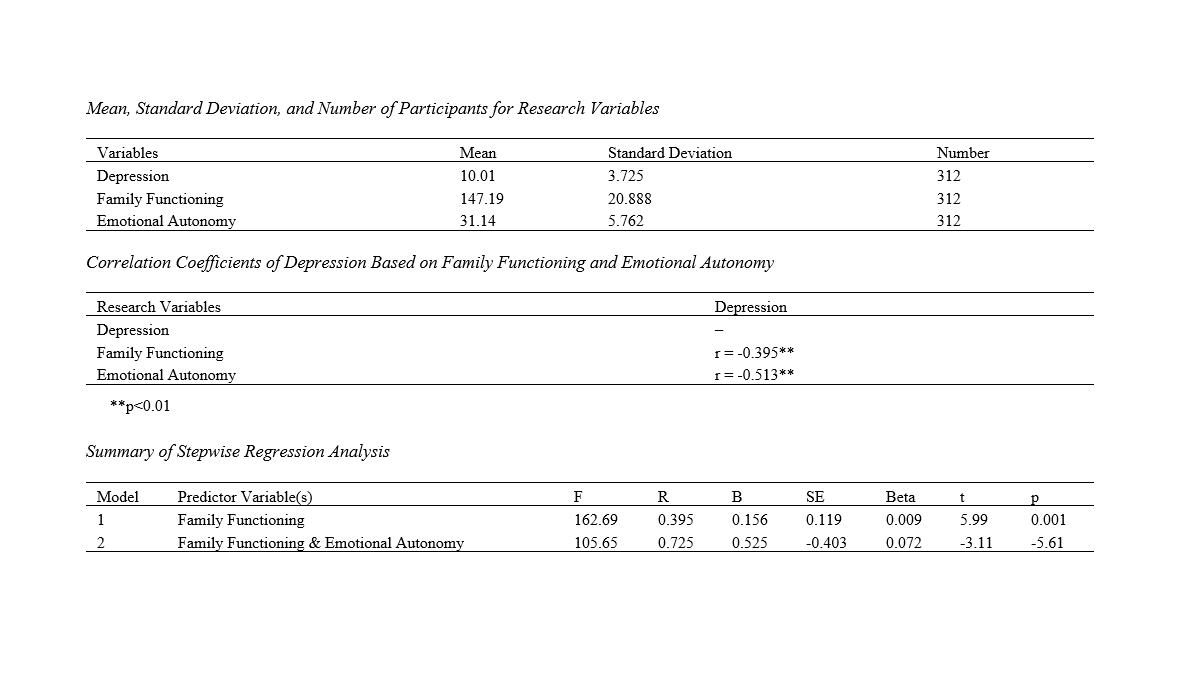
Findings: The results indicated that family functioning had a significant negative relationship with depression, and emotional autonomy also had a significant negative relationship with depression. Family functioning and emotional autonomy predicted 52% of the variance in students’ depression, with family functioning contributing more significantly to adolescent depression.
Conclusion: Given the findings, the importance of addressing family functioning and emotional autonomy in depression is increasingly evident. Therefore, organizations and policy-making centers for adolescents should implement educational programs for parents and relevant authorities to enhance awareness regarding family functioning and dynamics, thereby reducing the prevalence of adolescent depression.
Downloads
References
Chelebianlu, G., & Parvaz, R. (2022). The role of temperament dimensions, rumination, cognitive flexibility, and anxiety traits in predicting depressive mood. Psychological studies, 18(1), 11-24.
Chen, L., Fosco, G. M., & Tornello, S. L. (2024). Who benefits from autonomy-supportive parenting? Considering individual difference in adolescent emotional reactivity. Journal of Child and Family Studies, 1(14), 1-14.
Cheng, W. Y., Cheung, R. Y., & Chung, K. K. H. (2021). Understanding adolescents' perceived social responsibility: The role of family cohesion, interdependent self-construal, and social trust. Journal of adolescence, 89, 55-62. https://doi.org/10.1016/j.adolescence.2021.04.003
Gao, X., Sun, F., Marsiglia, F. F., & Dong, X. (2019). Elder mistreatment among older Chinese Americans: The role of family cohesion. The International Journal of Aging and Human Development, 88(3), 266-285. https://doi.org/10.1177/0091415019836920
García-Mendoza, M. D. C., Parra, Á., Sánchez-Queija, I., & Arranz Freijo, E. B. (2020). Emotional autonomy and adjustment among emerging adults: The moderating role of family relationships. Scandinavian journal of psychology, 61(3), 380-387. https://doi.org/10.1111/sjop.12606
Garcia, M., & Martinez, P. (2023). The role of parental support in mitigating the effects of self-handicapping behaviors on adolescent depression. Journal of School Psychology, 87, 98-110. https://doi.org/10.1016/j.jsp.2023.02.003
Grossberg, A., & Rice, T. (2023). Depression and suicidal behavior in adolescents. Medical Clinics, 107(1), 169-182. https://doi.org/10.1016/j.mcna.2022.05.001
Jackson, S. Z., Pinto-Martin, J. A., Deatrick, J. A., Boyd, R., & Souders, M. C. (2024). High depressive symptoms, low family functioning, and low self-efficacy in mothers of children with Autism Spectrum Disorder compared to two control groups. Journal of the American Psychiatric Nurses Association, 30(2), 300-312. https://doi.org/10.1177/10783903231179812
Kautz, M. M., McArthur, B. A., Moriarity, D. P., Ellman, L. M., Klugman, J., Coe, C. L., & Alloy, L. B. (2023). The impact of early and recent life stress on trajectories of inflammatory biomarkers in a diverse sample of adolescents. Research on Child and Adolescent Psychopathology, 51(12), 1883-1894. https://doi.org/10.1007/s10802-023-01093-6
Kaveh Farasani, Z., & Rajaei, M. (2022). Investigating the mediating role of pleasure beliefs in the relationship between family functioning, life satisfaction, and depression. Cognitive and Behavioral Science Research, 12(1), 121-140.
Liu, L., Han, Y., & Lu, Z. (2022). The relationship between perfectionism and depressive symptoms among Chinese college students: The mediating roles of self-compassion and impostor syndrome. Current Psychology. https://doi.org/10.1007/s12144-022-03772-x
Nezamzadeh, B., Tayebi, S., Maleki Rostamabadi, M., Akbari, H., & Namjoo, F. (2021). Predicting high-risk behaviors based on psychological distress and distress tolerance in delinquent adolescents. Psychological Studies of Adolescents and Youth, 2(1), 13-23.
Rhodes, R. E., Hollman, H., & Sui, W. (2024). Family-based physical activity interventions and family functioning: A systematic review. Family Process, 63(1), 392-413. https://doi.org/10.1111/famp.12921
Samani, S., & Razavieh, A. (2007). The relationship between family cohesion and emotional autonomy with emotional problems. Research in Psychological Health, 1(8), 30-37.
Seyedfatemi, N., Rahmani, F., Baradaran Rezaei, M., & Sedaghat, K. (2009). Investigating the relationship between parental upbringing styles and the level of independence among adolescent students in Tabriz schools. Iranian Journal of Nursing, 22(62), 75-84.
Suh, H. N., Pigott, T., Rice, K. G., Davis, D. E., & Andrade, A. C. (2023). Meta-analysis of the relationship between self-critical perfectionism and depressive symptoms: Comparison between Asian American and Asian international college students. Counseling Psychology, 70(2), 203-211. https://doi.org/10.1037/cou0000661
Wang, C., Xia, Y., Li, W., Wilson, S. M., Bush, K., & Peterson, G. (2016). Parenting behaviors, adolescent depressive symptoms, and problem behavior: The role of self-esteem and school adjustment difficulties among Chinese adolescents. Journal of Family Issues, 37(4), 520-542. https://doi.org/10.1177/0192513X14542437
World Health Organization. (2018). European health report 2018: More than numbers–evidence for all. World Health Organization. Regional Office for Europe.
Zhang, C., Zhang, Q., Zhuang, H., & Xu, W. (2023). The reciprocal relationship between depression, social anxiety and aggression in Chinese adolescents: The moderating effects of family functioning. Journal of affective disorders, 329, 379-384. https://doi.org/10.1016/j.jad.2023.02.077
Downloads
Additional Files
Publication Timeline
- Submitted
- Revised
- Accepted
Issue
Section
License
Copyright (c) 2025 Farzaneh Pourmand (Author); Naser Noshadi (Corresponding Author); Alireza Maredpour (Author)

This work is licensed under a Creative Commons Attribution-NonCommercial 4.0 International License.