Comparison of the Effectiveness of Group Cognitive Behavioral Hypnotherapy, Mindfulness-Based Cognitive Behavioral Stress Management, and Meaning Therapy Based on the Healthy Human Theory on Academic Engagement in Eleventh-Grade Students
DOI:
https://doi.org/10.61838/kman.jayps.6.6.2Keywords:
group cognitive behavioral hypnotherapy, cognitive behavioral stress management, mindfulness, meaning therapy, healthy human theory, academic engagementAbstract
Objective: This study aimed to compare the effectiveness of group cognitive behavioral hypnotherapy, mindfulness-based cognitive behavioral stress management, and meaning therapy based on the healthy human theory on academic engagement in eleventh-grade students.
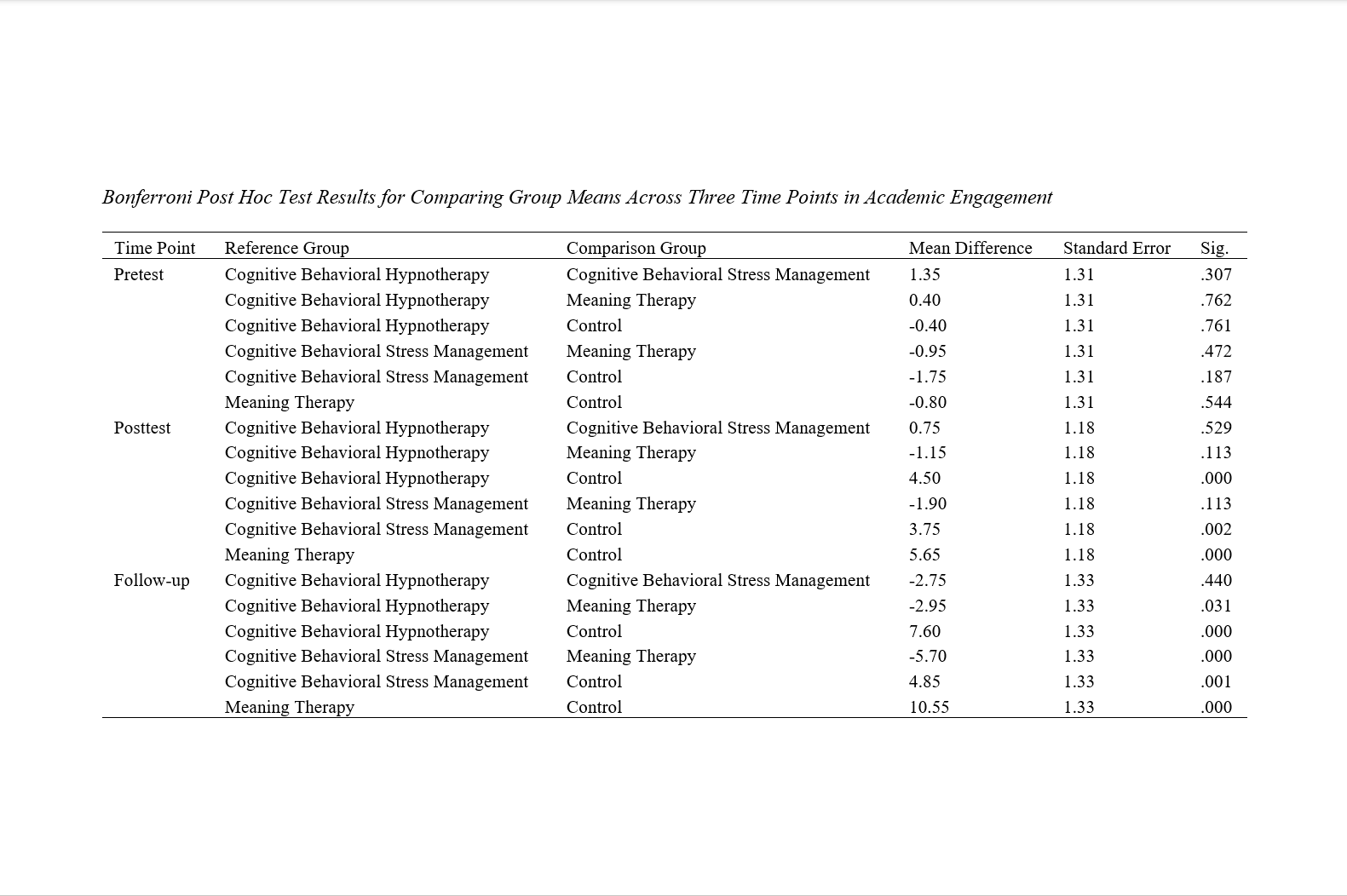
Methods and Materials: The research employed a quasi-experimental design using a pretest-posttest-follow-up format with four groups. The statistical population included all male students in Isfahan, from whom 80 students were selected through non-random sampling and were randomly assigned to three experimental groups and one control group (20 students per group). The research instrument was the Academic Engagement Scale developed by Fredricks et al. (2012). While the control group remained on the waiting list, the three experimental groups received their respective educational interventions in eight 90-minute sessions. The collected data were analyzed using descriptive statistics (mean and standard deviation) and inferential statistics (repeated measures ANOVA and Bonferroni post hoc test).
Findings: The results indicated that all three methods had a statistically significant effect on improving academic engagement. The post hoc test results demonstrated that in both posttest and follow-up stages, there were significant differences in academic engagement scores between the intervention groups and the control group, and all three methods were effective in enhancing academic engagement (p < .05). No significant differences were found among the three interventions in the posttest phase; however, during the follow-up phase, the mindfulness-based cognitive behavioral stress management approach was more effective than cognitive behavioral hypnotherapy, and meaning therapy based on the healthy human theory was more effective than both of the other approaches.
Conclusion: Accordingly, it can be concluded that meaning therapy based on the healthy human theory was the most effective method among the three.
Downloads
References
Abadi Al-Naz, Y., Yousefi, E., Khajehpour, L., & Jookar, S. (2023). The effectiveness of mindfulness training on academic adjustment, academic anxiety, and academic hope in students. Psychological Studies of Adolescents and Youth, 4(8), 36-51. https://doi.org/10.61838/kman.jayps.4.8.4
Asgari, M. (2019). The effectiveness of cognitive-behavioral stress management training on exam anxiety, academic achievement, and entrance exam performance of university applicants. Quarterly Journal of Educational Psychology, 15(51), 175-194. https://doi.org/10.22054/jep.2019.30875.2190
Batra, A., Eck, S., Riegel, B., Friedrich, S., Fuhr, K., Torchalla, I., & Tönnies, S. (2024). Hypnotherapy compared to cognitive-behavioral therapy for smoking cessation in a randomized controlled trial. Frontiers in psychology, 15, 1330362. https://doi.org/10.3389/fpsyg.2024.1330362
Eby, L. T., Allen, T. D., Conley, K. M., Williamson, R. L., Henderson, T. G., & Mancini, V. S. (2019). Mindfulness-based training interventions for employees: A qualitative review of the literature. Human Resource Management Review, 29(2), 156-178. https://doi.org/10.1016/j.hrmr.2017.03.004
Fredricks, J. A. (2022). The measurement of student engagement: Methodological advances and comparison of new self-report instruments. In Handbook of research on student engagement (pp. 597-616). Cham: Springer International Publishing. https://doi.org/10.1007/978-3-031-07853-8_29
Fredricks, J. A., & McColskey, W. (2012). The measurement of student engagement: A comparative analysis of various methods and student self-report instruments. In Handbook of research on student engagement (pp. 37). New York: Springer. https://doi.org/10.1007/978-1-4614-2018-7_37
Fuhr, K., Meisner, C., & Batra, A. (2023). Long-term outcomes of depression treatment with hypnotherapy or cognitive behavioral therapy. The Journal of Nervous and Mental Disease, 211(7), 519-524. https://doi.org/10.1097/NMD.0000000000001647
Fuhr, K., Meisner, C., Broch, A., Cyrny, B., Hinkel, J., Jaberg, J., & Batra, A. (2021). Efficacy of hypnotherapy compared to cognitive behavioral therapy for mild to moderate depression-Results of a randomized controlled rater-blind clinical trial. Journal of affective disorders, 286, 166-173. https://doi.org/10.1016/j.jad.2021.02.069
Haipt, A., Rosenbaum, D., Fuhr, K., Batra, A., & Ehlis, A. C. (2024). Differential effects of hypnotherapy and cognitive behavioral therapy on the default mode network of depressed patients. Frontiers in psychology, 15, 1401946. https://doi.org/10.3389/fpsyg.2024.1401946
Hashemi, M. (2024). The effectiveness of hypnotherapy in increasing academic self-efficacy and reducing exam anxiety symptoms in university entrance exam candidates. Studies in Educational Measurement and Evaluation, 13(43), 161-186. https://jresearch.sanjesh.org/article_709678.html
Hojjati, M., Yousefi, Z., & Golparvar, M. (2020). Construction and psychometric evaluation of the college entrance exam anxiety scale among high school students. Knowledge and research in applied psychology. https://journals.iau.ir/article_667696.html
Jahantigh, H., Nikmanesh, Z., & Noori Moghadam, S. (2023). The effectiveness of mindfulness-based cognitive therapy on academic motivation in students. Journal of the Medical School of Mashhad University of Medical Sciences, 66(4). https://doi.org/10.22038/mjms.2023.24344
Kabat-Zinn, J. (2019). Foreword: Seeds of a necessary global renaissance in the making: the refining of psychology's understanding of the nature of mind, self, and embodiment through the lens of mindfulness and its origins at a key inflection point for the species. Current opinion in psychology, 28, xi-xvii. https://doi.org/10.1016/j.copsyc.2019.02.005
Kabat-Zinn, J. (2021). The liberative potential of mindfulness. Mindfulness, 12(6), 1555-1563. https://doi.org/10.1007/s12671-021-01608-6
Kabat-Zinn, J., & Kabat-Zinn, M. (2021). Mindful parenting: Perspectives on the heart of the matter. Mindfulness, 12(2), 266-268. https://doi.org/10.1007/s12671-020-01564-7
Khabaz Shirazi, A., Golparvar, M., & Yousefi, E. (2021). Comparison of the effectiveness of cognitive-social career counseling and acceptance and commitment therapy on life satisfaction and self-efficacy in female students. Career and Organizational Counseling, 13(4), 71-92. https://www.sid.ir/paper/1036614/fa
Lahrab Galle, M., Sharifi, T., & Ghazanfari, A. (2024). The mediating role of academic motivation between self-efficacy and academic enthusiasm in secondary school students. Health Promotion Management, 13(4), 1-13. https://jhpm.ir/article-1-1756-fa.html
Narimani, M., Taghizadeh, S., & Narimani, A. (2022). The effectiveness of the Calm Cognitive Rehabilitation Program on improving working memory and attention in children with learning disabilities. Learning Disabilities, 12(1), 85-97. https://jld.uma.ac.ir/article_1945.html
Nasajpour Isfahani, F., & Aghayi, A. (2021). The effectiveness of group satisfaction training based on the healthy human theory on marital burnout in couples with marital conflict. Innovative Ideas in Psychology, 12(8), 219-229. https://ensani.ir/fa/article/461202/
Nighnam Khadijeh, P. Z. Z., & Zangeneh Motlaq, F. (2024). A comparative study of the effectiveness of mindfulness training based on stress reduction and time management skills training on academic emotions and academic motivation. Journal of Psychological Sciences, 23(143), 135-154. https://ensani.ir/fa/article/597312/
Norian, F., Rasouli, N., & Fathi, M. (2023). The Effectiveness of Cognitive Behavioral Hypnotherapy on Self-efficacy, Resilience, Mental Health and Sleep Disorders of Treatment Staff Involved in the Care of Patients with COVID-19: A Semi-Experimental Study. Journal of Critical Care Nursing, 16(1). https://doi.org/10.61186/iau.34.3.324
Sadighi, R., Fathimi, F. S., & Sadri, I. (2024). The effectiveness of mindfulness training on psychological well-being and academic motivation in students with low academic achievement. Quarterly Journal of Applied Psychological Research, 14(1), 129-144. https://japr.ut.ac.ir/article_92139.html
Sadri, M., Golparvar, M., Aghayi, A., & Gilliam, L. (2021). Comparison of the effectiveness of meaning-centered educational training and positive psychology education on academic optimism and academic meaning. Journal of Positive Psychology Research, 7(3), 31-50. https://ppls.ui.ac.ir/article_26227.html
Salmani, R., Roshni Khiyavi, N., & Esmaeili, S. (2023). Investigating the effectiveness of mindfulness-based cognitive therapy on academic motivation and social adjustment in students with social anxiety. School Psychology and Education, 12(1), 46-61. https://jsp.uma.ac.ir/article_2468.html
Soleimani, E., Esmaieli, A., Taştan, K., Yoruk, N., Işık, M., Taştan, K., Yoruk, N., & Işık, M. (2021). The Effectiveness of Cognitive-Behavioral Hypnotherapy on clinical symptoms of Irritable Bowel Syndrome A Comparison of the Effectiveness of Hypnotherapy and Cognitive Behavioral Therapy in the Treatment of Primary Vaginismus. Rooyesh-e-Ravanshenasi Journal (RRJ), 13(3), 536-541. https://doi.org/10.18521/ktd.881318
Taştan, K., Yoruk, N., & Işık, M. (2021). A Comparison of the Effectiveness of Hypnotherapy and Cognitive Behavioral Therapy in the Treatment of Primary Vaginismus. Konuralp Medical Journal, 13(3), 536-541. https://doi.org/10.18521/ktd.881318
Vordiloo, A., & Jarareh, J. (2020). The effectiveness of cognitive hypnotherapy on students' self-efficacy. Thought and Behavior in Clinical Psychology, 57(15), 7-15. https://sid.ir/paper/958594/fa
Williams, M., Teasdale, J., Segal, Z., & Kabat-Zinn, J. (2024). The mindful way through depression: Freeing yourself from chronic unhappiness. Guilford Publications.
Downloads
Additional Files
Publication Timeline
- Submitted
- Revised
- Accepted
Issue
Section
License
Copyright (c) 2025 Hassan Tavakoli (Author); Mahdi Khorvash (Corresponding Author); Hajar Torkan (Author)

This work is licensed under a Creative Commons Attribution-NonCommercial 4.0 International License.