The Mediating Role of Gratitude in the Link Between Parental Warmth and Subjective Well-being in Youth
DOI:
https://doi.org/10.61838/kman.jayps.6.6.11Keywords:
Parental Warmth, Gratitude, Subjective Well-being, AdolescentsAbstract
Objective: This study aimed to investigate the mediating role of gratitude in the relationship between perceived parental warmth and subjective well-being among adolescents.
Methods and Materials: A descriptive correlational research design was employed, involving 412 adolescents aged 15–18 years from secondary schools across Georgia. Standardized instruments were used to assess parental warmth (Parental Acceptance-Rejection Questionnaire – Warmth/Affection subscale), gratitude (Gratitude Questionnaire–Six-Item Form), and subjective well-being (Satisfaction with Life Scale). Data were analyzed using SPSS-27 for descriptive statistics and Pearson correlation, and AMOS-21 for Structural Equation Modeling (SEM). Assumptions of normality, linearity, and multicollinearity were confirmed prior to analysis.
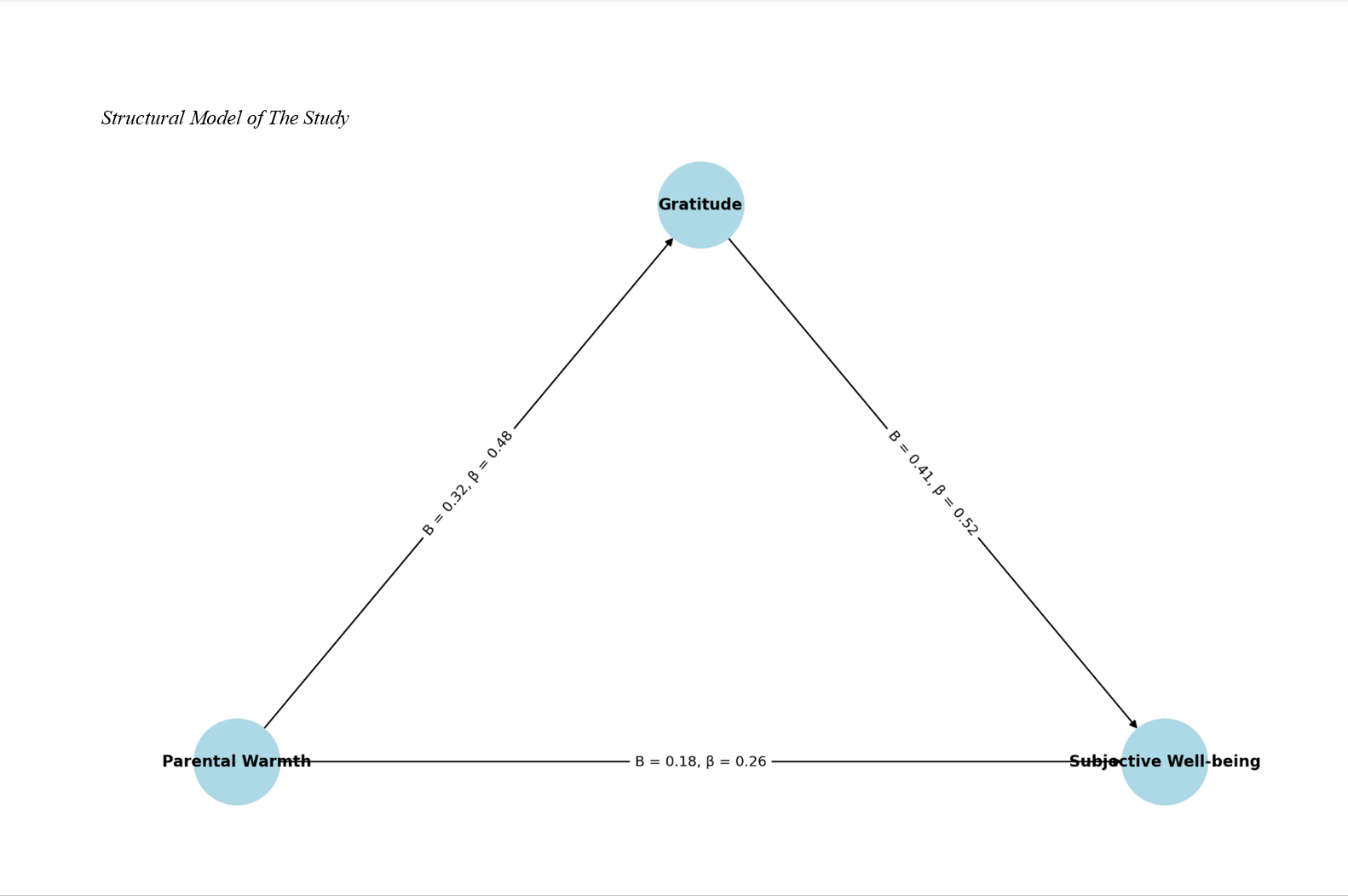
Findings: Descriptive analysis indicated relatively high mean scores for parental warmth (M = 67.42), gratitude (M = 34.57), and subjective well-being (M = 27.68). Pearson correlation coefficients revealed significant positive associations between all variables: parental warmth and gratitude (r = .48, p < .001), parental warmth and subjective well-being (r = .41, p < .001), and gratitude and subjective well-being (r = .56, p < .001). The structural model showed good fit indices (χ²/df = 2.08, CFI = 0.97, RMSEA = 0.051). SEM results confirmed that gratitude significantly mediated the relationship between parental warmth and subjective well-being. The direct path from parental warmth to well-being was also significant (β = 0.26, p < .001), as was the indirect path through gratitude (β = 0.25, p < .001).
Conclusion: The findings support a robust mediation model, demonstrating that gratitude plays a crucial intermediary role in linking parental warmth to adolescents’ subjective well-being. These results underscore the importance of fostering both supportive parenting and gratitude practices to enhance psychological well-being in youth.
Downloads
References
Ade, F. S., Irdam, & Riyanda, H. F. (2022). Gratitude (Kebersyukuran) Dan Psychological Well-Being Remaja Panti Asuhan Rahmatan Lil’alamiin. Psyche 165 Journal, 43-49. https://doi.org/10.35134/jpsy165.v15i2.157
Arora, P., Dabas, V., Mittal, A., Teotia, I., Dhama, T., Singh, A., Chugh, S., Sharma, H. C., Pal, M., Gauri, J., & Sharma, K. (2023). Impact of Gratitude and Optimism on Psychological Well-Being. International Journal of Advanced Research in Science Communication and Technology, 363-373. https://doi.org/10.48175/ijarsct-13864
Bohlmeijer, E. T., Kraiss, J. T., Schotanus-Dijkstra, M., & Klooster, P. M. t. (2022). Gratitude as Mood Mediates the Effects of a 6-Weeks Gratitude Intervention on Mental Well-Being: Post Hoc Analysis of a Randomized Controlled Trial. Frontiers in psychology, 12. https://doi.org/10.3389/fpsyg.2021.799447
Buckingham, S., & Buckingham, J. O. L. (2020). Gratitude, Subjective Well-Being and Prosociality: Implications for Adolescence and Education. 183-202. https://doi.org/10.4324/9780429197741-9
Cui, H., Chen, W.-Y., Bi, X., Li, J., Song, M., Gao, T., & Ma, Y. (2023). Gratitude and Academic Engagement: Multiple Mediating Effects of Internal Locus of Control and Subjective Well-Being. https://doi.org/10.21203/rs.3.rs-2824805/v1
Dewi, L., Tentama, F., & Diponegoro, A. M. (2021). Subjective Well-Being: Mental Health Study Among Student in the Islamic Boarding School. International Journal of Public Health Science (Ijphs), 10(1), 146. https://doi.org/10.11591/ijphs.v10i1.20610
Disabato, D. (2022). Gratitude and Well-Being in Adolescence. https://doi.org/10.17605/osf.io/6p4ef
Halleyda, N., & Japar, M. (2023). The Gratitude Training to Enhance the Psychological Well-Being Among Adolescents With Single Parents. Humanitas Indonesian Psychological Journal, 174-183. https://doi.org/10.26555/humanitas.v20i2.348
Hasanah, N., Novembli, M. S., Iskandar, P. Q. H., & Sindiasari, D. (2023). Subjective Well-Being Examined From Sincerity and Gratitude Among Cleaning Service Personnel. Empathy Jurnal Fakultas Psikologi, 6(2), 149. https://doi.org/10.12928/empathy.v6i2.26109
Imaniyah, W., & Kamila, A. (2022). Pengaruh Gratitude Journal Terhadap Subjective Well-Being Pada Remaja Di Yayasan Pendidikan Dan Penyantunan Anak Yatim Piatu. Psycomedia Jurnal Psikologi, 2(1), 1-6. https://doi.org/10.35316/psycomedia.2022.v2i1.1-6
Jovančević, A., & Milićević, N. (2021). Gratitude and Loneliness as Predictors of Subjective Well-Being. Facta Universitatis Series Philosophy Sociology Psychology and History, 001. https://doi.org/10.22190/fupsph2101001j
Kaur, J. (2020). Gratitude and Well Being Among Adolescents. 289-300. https://doi.org/10.31995/book.ab130-ju20.chapter29
Li, J., Li, Y., & Ding, Y. (2025). Self-Concept Promote Subjective Well-Being Through Gratitude and Prosocial Behavior During Early Adolescence? A Longitudinal Study. BMC psychology, 13(1). https://doi.org/10.1186/s40359-025-02652-w
Li, Y., Liu, S., Li, D., & Yin, H. (2023). How Trait Gratitude Influences Adolescent Subjective Well-Being? Parallel–Serial Mediating Effects of Meaning in Life and Self-Control. Behavioral Sciences, 13(11), 902. https://doi.org/10.3390/bs13110902
Loyalia Tisyri Mekar Untung, S., & Ambarwati, K. D. (2025). Exploring the Impact of Gratitude on Subjective Well-Being Among Fatherless: Implications for Counseling Interventions. Jurnal Bimbingan dan Konseling Terapan, 9(1), 74-85. https://doi.org/10.30598/bkt.v9i1.17111
Lu, B. H., Shen, X., Gai, X., & Xie, X. (2024). Can Friendship Quality Buffer the Impact of Parental Phubbing on Adolescents’ Gratitude? The Longitudinal Mediating Role of Basic Psychological Needs’ Satisfaction. Behavioral Sciences, 14(11), 1083. https://doi.org/10.3390/bs14111083
Majdi, M. Z. Z. (2025). The Role of Happiness and Gratitude on Subjective Well-Being Among Students. Counsenesia Indonesian Journal of Guidance and Counseling, 6(1), 35-45. https://doi.org/10.36728/cijgc.v6i1.4782
Mihara, S., & Nishiyama, K. (2020). Influence of Gratitude and Resilience on Subjective Well-Being. The Proceedings of the Annual Convention of the Japanese Psychological Association, 84(0), PD-030-PD-030. https://doi.org/10.4992/pacjpa.84.0_pd-030
Nourialeagha, B., Ajilchi, B., & Kisely, S. (2020). The Mediating Role of Gratitude in the Relationship Between Attachment Styles and Psychological Well-Being. Australasian Psychiatry, 28(4), 426-430. https://doi.org/10.1177/1039856220930672
Rahayu, A., Shaleh, A. R., Baidun, A., Marliani, R., Istiqlal, A., & Latifah, U. (2020). Examining Impact Gratitude and Hope on Fishermen’s Subjective Well-Being. https://doi.org/10.4108/eai.18-9-2019.2293467
Semya, G. V., Zaitsev, G. O., Zaytseva, N. G., & Telitsyna, A. Y. (2024). The Impact of Violence in Cyberspace on the Subjective Well-Being of Adolescents. Social Sciences and Childhood, 4(3), 32-46. https://doi.org/10.17759/ssc.2023040302
Sulistyarini, R. R. I., Novita, D. A., Pambudiarti, D. A., Pratiwi, E. A., & Andriansyah, Y. (2022). Gratitude, Optimism, Religiosity, and Subjective Well-Being Among Asthma Patients in Yogyakarta, Indonesia. International Journal of Innovative Research and Scientific Studies, 5(2), 145-154. https://doi.org/10.53894/ijirss.v5i2.445
Taruna, T., Singh, S. K., & Shikha. (2022). Psychological Well-Being of Youth: The Role of Gratitude and Hope. Journal of Psychology and Behavior Studies, 2(1), 01-04. https://doi.org/10.32996/jpbs.2022.1.1
Wisnu, H., Ardiani, D., Ilhami, N., & Octiawati, T. (2022). Hubungan Rasa Syukur Dan Resiliensi Dengan Kesejahteraan Psikologis Remaja Selama Pandemi Covid-19. Jurnal Psikologi Jurnal Ilmiah Fakultas Psikologi Universitas Yudharta Pasuruan, 9(2), 159-177. https://doi.org/10.35891/jip.v9i2.2699
Yoo, J. (2020). Gratitude and Subjective Well-Being Among Koreans. International journal of environmental research and public health, 17(22), 8467. https://doi.org/10.3390/ijerph17228467
Downloads
Additional Files
Publication Timeline
- Submitted
- Revised
- Accepted
Issue
Section
License

This work is licensed under a Creative Commons Attribution-NonCommercial 4.0 International License.