The Relationship Between Personality Traits and Phubbing in Generation Z Students: The Mediating Role of Fear of Missing Out (FoMO
DOI:
https://doi.org/10.61838/kman.jayps.6.5.2Keywords:
Personality traits, phubbing, fear of missing out (FoMO).Abstract
Objective: The present study aimed to investigate the mediating role of Fear of Missing Out (FoMO) in the relationship between personality traits and phubbing.
Methods and Materials: This research was a cross-sectional study and examined the fit of a structural equation modeling (SEM) framework, analyzing correlations and relationships among variables within a causal model. The statistical population included all Generation Z students (born between 1997 and 2012) enrolled at Islamic Azad University branches in Tehran during the first half of 2024. A total of 556 participants were selected using multi-stage cluster sampling. Data collection tools included the Generic Scale of Phubbing (Chotpitayasunondh & Douglas, 2018), the NEO Five-Factor Personality Inventory (Costa & McCrae, 1985), and the Fear of Missing Out Scale (Przybylski et al., 2013).
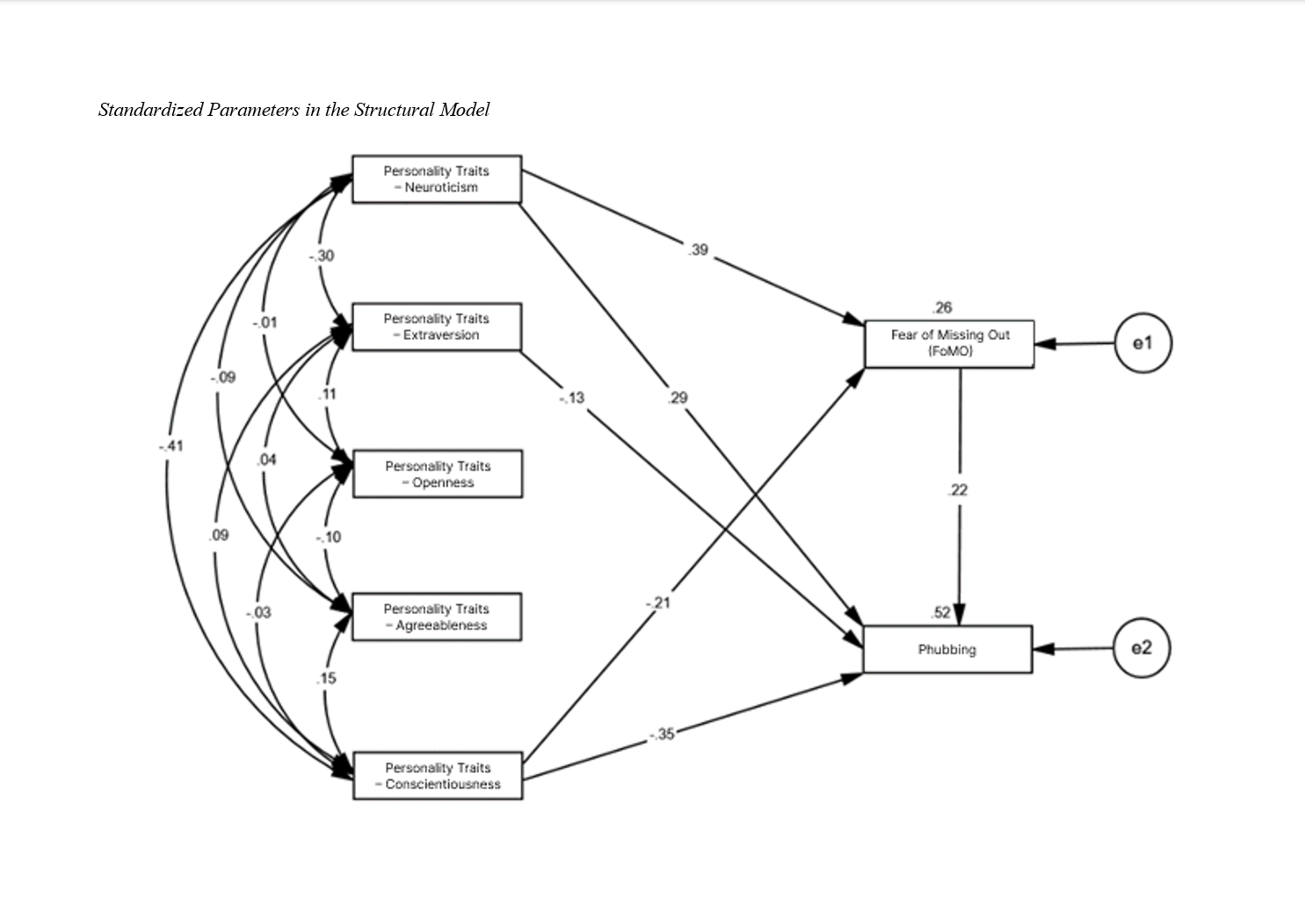
Findings: The results indicated that the direct path coefficient between the personality traits of conscientiousness (β = −0.354, p = .001) and extraversion (β = −0.134, p = .001) with phubbing was negative and significant. In contrast, the direct path coefficient between neuroticism and phubbing (β = 0.290, p = .001) was positive and significant. Additionally, the path coefficient between FoMO and phubbing (β = 0.219, p = .001) was positive and significant. The indirect path between conscientiousness and phubbing through FoMO (β = −0.045, p = .001), as well as the indirect path between neuroticism and phubbing through FoMO (β = 0.085, p = .001), were also significant.
Conclusion: It was concluded that Fear of Missing Out negatively mediates the relationship between conscientiousness and phubbing, and positively mediates the relationship between neuroticism and phubbing in Generation Z students. It is recommended that educational programs be designed to raise students’ awareness regarding the negative impacts of FoMO and phubbing.
Downloads
References
Akat, M., Arslan, C., & Hamarta, E. (2023). Dark triad personality and phubbing: The mediator role of fomo. Psychological Reports, 126(4), 1803-1821. https://doi.org/10.1177/00332941221109119
Albalá-Genol, M. Á., Etchezahar, E., Gómez-Yepes, T., & Ungaretti, J. (2025). Phubbing as a Social Norm: Effects on Fear of Missing Out (FoMO) and Perceived Exclusion. Revista Latinoamericana de Tecnología Educativa-RELATEC, 24(1), 65-75. https://doi.org/10.17398/1695-288X.24.1.65
Alroubaie, M. M., & Doghri, S. B. S. (2024). Creative Thinking as a Mediating Variable for the Relationship Between Strategic Alertness and Service Quality. Evolutionary Studies in Imaginative Culture, 8(2), 1140-1154. https://doi.org/10.70082/esiculture.vi.2559
Angelique, B. M., Sotto, M., & Ryan, B. J. (2025). Influence of Tiktok Trends on the Buying Intentions of Gen-Zs. International Journal of Research and Innovation in Social Science, 9(14), 438-452. https://doi.org/10.47772/IJRISS.2025.914MG0034
Anggrainy, N. E., Mansyur, Z., & Maddusa, S. S. (2024). Neuroticism, Fear of Missing Out, and Phubbing on Teenager Girls who Used Social Media. AL-MAIYYAH: Media Transformasi Gender dalam Paradigma Sosial Keagamaan, 16, 155-166. https://doi.org/10.35905/almaiyyah.v16i2.8709
Anjum, S., Kanwal, S., & Mughal, B. (2024). Narcissism, Fear of Missing out, and Phubbing: The Moderating Role of Mindfulness. Carc Research in Social Sciences, 3(3), 365-375. https://doi.org/10.58329/criss.v3i3.158
Ansari, S., Azeem, A., Khan, I., & Iqbal, N. (2024). Association of phubbing behavior and fear of missing out: A systematic review and meta-analysis. Cyberpsychology, Behavior, and Social Networking, 27(7), 467-481. https://doi.org/10.1089/cyber.2023.0761
Atashrouz, B., Pakdaman, S., & Asgari, A. (2008). The relationship between the big five personality traits and academic achievement. Journal of Developmental Psychology: Iranian Psychologists, 16(4), 367-376. http://sanad.iau.ir/fa/Article/1055059
Ayala, M. J., Alegre de la Rosa, O. M., Chambi Catacora, M. A. D. P., Vargas Onofre, E., Cari Checa, E., & Díaz Flores, D. (2025). Nomophobia, phubbing, and deficient sleep patterns in college students. Frontiers in Education, 9, 1421162. https://doi.org/10.3389/feduc.2024.1421162
Bayrami, R., Moghaddam tabrizi, F., Talebi, E., & Ebrahimi, S. (2019). A Survey On Relation Between Fear Of Missing Out And Social Media Use Among Students In Urmia University Of Medical Sciences. Nursing and Midwifery Journal, 17(5), 355-362. http://unmf.umsu.ac.ir/article-1-3796-fa.html
Brazil, C. K., & Rys, M. J. (2020). Is smartphone usage predicting fear of missing out and loneliness in a sample from the generation Z.
Chakrabarti, D. (2024). A Study on How Social Media FOMO (Fear of Missing Out) Impacts the Gen Z Audience. https://doi.org/10.54105/ijmcj.E1083.04010924
Chi, L. C., Tang, T. C., & Tang, E. (2022). The phubbing phenomenon: A cross-sectional study on the relationships among social media addiction, fear of missing out, personality traits, and phubbing behavior. Current Psychology, 41(2), 1112-1123. https://doi.org/10.1007/s12144-021-02468-y
Chotpitayasunondh, V., & Douglas, K. M. (2018). The effects of "phubbing" on social interaction. Journal of Applied Social Psychology, 48(6), 304-316. https://doi.org/10.1111/jasp.12506
Costa, P. T., & McCrae, R. R. (1999). Revised NEO personality inventory and NEO five factor inventory. Psychological Assessment Resource, Inc. https://www.semanticscholar.org/paper/Revised-NEO-Personality-Inventory-(NEO-PI-R)-and-Costa-Mccrae/c743ed852f6187bf87e57c7ab336f614d37b2713
Duradoni, M., Raimondi, T., Buttà, F., & Guazzini, A. (2023). Moving beyond an addiction framework for phubbing: unraveling the influence of intrinsic motivation, boredom, and online vigilance. Human Behavior and Emerging Technologies, 2023(1), 6653652. https://doi.org/10.1155/2023/6653652
Field, T. (2024). Phubbing: a narrative review. Journal of Psychology & Clinical Psychiatry, 15(5), 274-280. https://doi.org/10.15406/jpcpy.2024.15.00792
Fransiati, S., Aini, N. A., Ar-Rasyid, M. F., Safitri, S. A., & Septiani, R. (2024). Group Guidance in Helping to Overcome the Phenomenon of Fear of Missing out in Generation Z. BICC Proceedings, 2, 187-191. https://doi.org/10.30983/bicc.v1i1.126
Gao, B., Liu, Y., Shen, Q., Fu, C., Li, W., & Li, X. (2023). Why cannot i stop phubbing: boredom proneness and phubbing: a multiple mediation model. Psychology research and behavior management, 16, 3727-3738. https://doi.org/10.2147/PRBM.S423371
Garver, M. S. (2024). Testing mediating variables and relationships with relative weight analysis. International Journal of Market Research. https://doi.org/10.1177/14707853241306069
Ghasemi, V. (2012). Estimation of optimal sample size in structural equation models and evaluation of its adequacy for social researchers. Iranian Journal of Sociology, 12(1), 138-161. http://www.jsi-isa.ir/article_24095.html?lang=en
Hassan Esfahani, M., Khanjani, M., & Bazram, A. (2021). The factor Structure and psychometric properties of Generic Scale of Phubbing (GSP). Quarterly of Educational Measurement, 12(46), 7-26. https://jem.atu.ac.ir/article_14183.html?lang=en
Hidayat, A., & Rahmiaji, L. R. (2024). The Phenomenon of Phubbing in The Communication Patterns of The Influencer Generation. Jurnal InterAct, 13(1), 1-15. https://doi.org/10.25170/interact.v13i1.5101
Khuzaiyah, L. N. (2024). Hubungan Neuroticism Dengan Perilaku Phubbing Pada Mahasiswa Jurusan Manajemen Informasi Kesehatan Di Stikes Syedza Saintika Padang http://repository.upiyptk.ac.id/13158/
Lauw, E. S., & Jannah, M. (2024). Phubbing Pada Gen Z: Apakah Diprediksi Oleh Fomo. PSIKOSAINS (Jurnal Penelitian dan Pemikiran Psikologi), 19(2), 143-157. https://doi.org/10.30587/psikosains.v19i2.7859
Magfiroh, L., Oktaviani, M., & Kabbaro, H. (2024). Social Interaction of Adolescents: An Impact Analysis of Phubbing Behavior. Journal of Counseling and Educational Research, 1(2), 81-90. https://doi.org/10.63203/jcerch.v1i2.109
Meinanto, D., Putrawan, B. K., & Simangunsong, A. (2022). Degradasi Moral Generasi Z: Suatu Tinjauan Etis Teologis Terhadap Penggunaan Internet. IMMANUEL: Jurnal Teologi Dan Pendidikan Kristen, 3(1), 21-32. https://doi.org/10.46305/im.v3i1.86
Nagar, K. (2024). Why Do Individuals Engage in Phubbing? An Empirical Study Integrating Fear of Missing Out, Boredom Proneness, Smartphone Use. European Economic Letters (EEL), 14(1), 2008-2021. https://doi.org/10.52783/eel.v14i1.1133
Przybylski, A. K., Murayama, K., DeHaan, C. R., & Gladwell, V. (2013). Motivational, emotional, and behavioral correlates of fear of missing out. Computers in human Behavior, 29(4), 1841-1848. https://doi.org/10.1016/j.chb.2013.02.014
Putri, K. R. R., & Chatamallah, M. (2024). Fenomena Phubbing pada Generasi Z di Social Media.
Royantara, A. W., Sugiarti, R., & Suhariadi, F. (2025). Peran FOMO (Fear of missing out) dalam Meningkatkan Kecemasan Terhadap Media Sosial pada Generasi Z. EduInovasi: Journal of Basic Educational Studies, 5(1), 426-441. https://doi.org/10.47467/edu.v5i1.6503
Sanjaya, R. (2022). Pengaruh Fear of Missing Out Dan the Big Five Personality Terhadap Perilaku Phubbing Pada Generasi-Z. Journal Manajemen Bisnis Dan Organisasi, 1(2), 205-231. https://doi.org/10.58290/jmbo.v1i2.33
Sao, R., Chandak, S., Barhate, B., & Mondal, S. (2024). Social Media and Gen Z's Mental Well-Being: Impact of Excessive Usage on Anxiety, Stress, and Depression Levels Analysis. PURUSHARTHA-A journal of Management, Ethics and Spirituality, 17(1), 23-38. https://doi.org/10.21844/16202117102
Sarwar, R., Akhtar, S., Sarwar, A., Shahid, M., Komal, F., Chandni, M., & Majid, M. (2025). Impact of Personality Traits, Social Media Addiction, and Academic Resilience in College Students. ACADEMIA International Journal for Social Sciences, 4(2), 495-503. https://doi.org/10.63056/ACAD.004.02.0192
Suhendriani, N., & Nugroho, S. (2022). Big Five Personality Terhadap Perilaku Phubbing Pada Siswa SMA. Journal of Islamic and Contemporary Psychology, 2(2), 117-128. https://doi.org/10.25299/jicop.v2i2.11568
Taj, S., Abbasi, P. N., & Khan, M. (2025). Impact of Phubbing Behavior on Loneliness: Mediated by Fear of Missing Out among Young Adults. ACADEMIA International Journal for Social Sciences, 4(1), 1119-1130. https://doi.org/10.63056/ACAD.004.01.0159
Tungga, A. F., Hartiwiningsih, & Leo, R. P. (2025). Non-Litigation Paradigm and the Principle of Criminal Proportionality in Corruption Cases with Mild Error Levels. Journal of Posthumanism, 5(3), 1296-1309. https://posthumanism.co.uk/jp/article/view/910
Wahyu, E., & Suhesty, A. (2025). Hubungan Fear Of Missing Out Dengan Perilaku Phubbing Pada Remaja Di Kota Samarinda. Cendekia: Jurnal Ilmu Pengetahuan, 5(1), 217-225. https://doi.org/10.51878/cendekia.v5i1.4281
Wajdi, M., Susanto, B., Sumartana, I. M., Sutiarso, M. A., & Hadi, W. (2024). Profile of generation Z characteristics: Implications for contemporary educational approaches. Kajian Pendidikan, Seni, Budaya, Sosial dan Lingkungan, 1(1), 33-44. https://doi.org/10.58881/kpsbsl.v1i1.8
Winarna, A. (2024). Pengaruh time management, locus of control, dan phubbing terhadap prokrastinasi akademik (studi kasus generasi z di jakarta). Jwm (Jurnal Wawasan Manajemen), 12, 254-266. https://doi.org/10.20527/jwm.v12i3.298
Yüksel, P., Aksoy, S. G., & Hou, H. (2025). Mental Health in a Digital World: How Problematic Cell Phone Use and Personality Predict Fear of Missing Out (FoMO) in Gen Z University Students from Türkiye and the US. Psychiatry and Behavioral Sciences, 15(1), 1-1. https://doi.org/10.5455/PBS.20240918082559
Yulya, T. W., Ghonniyyu, D. H., Efendi, N. P., Hati, K. A. P., Larasati, A. W., Irawan, S. A., Hutaman, S., Hanif, I., Delvin, M., Arina, N. B., Hanum, F., Wijaya, T. A., Khoirunnisa, A., & Anugrah, A. (2022). Fear Of Missing Out (FOMO) Sebagai Gaya Hidup di Era Modernisasi.
Downloads
Additional Files
Publication Timeline
- Submitted
- Revised
- Accepted
Issue
Section
License
Copyright (c) 2025 Somayeh Ashrafifard (Author); Mohammad Mohammadipour (Corresponding Author); Mahmoud Jajarmi (Author)

This work is licensed under a Creative Commons Attribution-NonCommercial 4.0 International License.