Comparison of Cognitive Behavioral Therapy and Acceptance and Commitment Therapy on Enhancing Resilience, Cognitive Flexibility, and Distress Tolerance in Adolescents with Obsessive-Compulsive Disorder
DOI:
https://doi.org/10.61838/kman.jayps.6.6.6Keywords:
Cognitive Behavioral Therapy, Acceptance and Commitment Therapy, Resilience, Cognitive Flexibility, Distress Tolerance, Obsessive-Compulsive DisorderAbstract
Objective: The aim of the present study was to compare the effects of Cognitive Behavioral Therapy (CBT) and Acceptance and Commitment Therapy (ACT) on improving resilience, cognitive flexibility, and distress tolerance in adolescents diagnosed with Obsessive-Compulsive Disorder (OCD).
Methods and Materials: This study employed a quasi-experimental pre-test–post-test design with a control group. The statistical population consisted of all adolescents diagnosed with OCD who were referred to psychological service centers in Mashhad in 2025. Using convenience sampling, 45 participants were selected and randomly assigned to three groups: CBT, ACT, and control. To collect data, the Connor-Davidson Resilience Scale (2003), the Cognitive Flexibility Inventory by Dennis and Vander Wal (2010), and the Distress Tolerance Scale by Simons and Gaher (2005) were administered. The CBT intervention was based on the Wilhelm and Steketee (2006) protocol and delivered over eight 90-minute sessions. The ACT intervention followed the protocol developed by Dahl et al. (2014), also implemented in eight sessions. The control group was placed on a waitlist. After the interventions, a post-test was administered to all groups. Data were analyzed using multivariate analysis of covariance (MANCOVA) with SPSS version 24 in both descriptive and inferential sections.
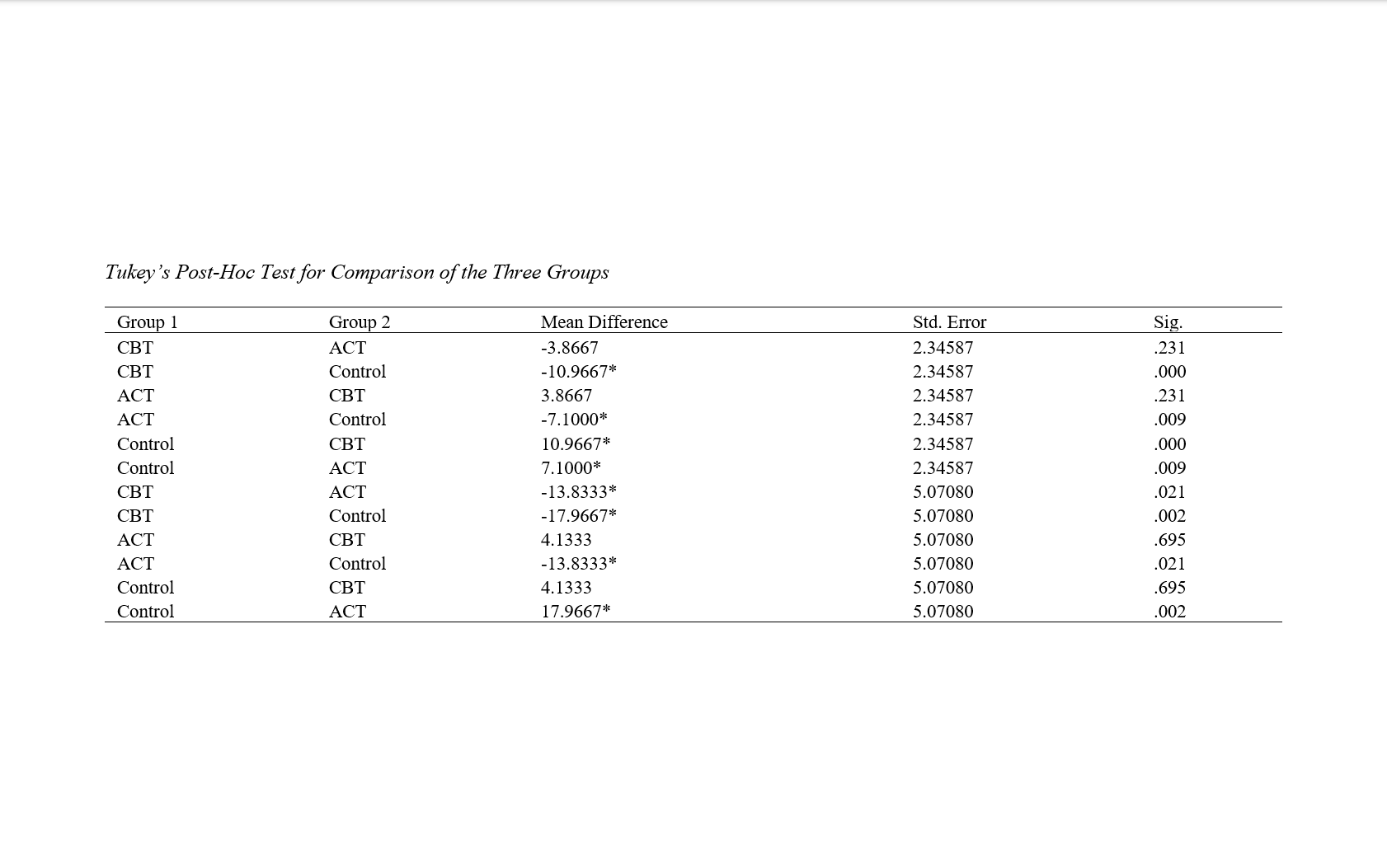
Findings: The results of the analysis indicated that both Cognitive Behavioral Therapy and Acceptance and Commitment Therapy had statistically significant effects on improving resilience, cognitive flexibility, and distress tolerance in adolescents with Obsessive-Compulsive Disorder.
Conclusion: Based on the findings, both Cognitive Behavioral Therapy and Acceptance and Commitment Therapy are recommended for enhancing resilience, cognitive flexibility, and distress tolerance in adolescents suffering from OCD.
Downloads
References
Abramowitz, J. S., & Reuman, L. (2020). Obsessive-compulsive disorder Encyclopedia of personality and individual differences. https://doi.org/10.1007/978-3-319-24612-3_919
Ahadianfard, P., Javaherirenani, R., Maghami-Sharif, Z., Farahani, H., & Aghebati, A. (2023). Psychometric Properties of the Persian Version of Resilience Scale in Iranian Adolescents. Progress in Psychiatry and Behavioral Sciences, 17(2), e123072. https://doi.org/10.5812/ppbs-123072
American Psychiatric Association. (2022). Diagnostic and Statistical Manual of Mental Disorders, Text Revision Dsm-5-tr 5th Edition. Washington DC: American Psychiatric Association. https://doi.org/10.1176/appi.books.9780890425787
Baqeri Sheikhangafshe, F., Sharifipour Chukami, Z., Tajbakhsh, K., Hamideh Moghadam, A., & Haji Aliani, V. (2022). The Relationship of Social Networks, Cognitive Flexibility, and Anxiety Sensitivity in Predicting Corona Phobia Among Students. Psychological Achievements, 29(1), 209-228. https://psychac.scu.ac.ir/article_17478.html?lang=en
Benatti, B., Albert, U., Maina, G., Fiorillo, A., Celebre, L., Girone, N., Fineberg, N., Bramante, S., Rigardetto, S., & Dell'Osso, B. (2020). What happened to patients with obsessive compulsive disorder during the COVID-19 pandemic? A multicentre report from tertiary clinics in northern Italy. Frontiers in Psychiatry, 11, 720. https://doi.org/10.3389/fpsyt.2020.00720
Darbani, S. A., & Parsakia, K. (2023). Investigating the effectiveness of strength-based counseling on adolescent resilience. Journal of Adolescent and Youth Psychological Studies (JAYPS), 4(5), 169-175. https://doi.org/10.61838/kman.jayps.4.5.16
Deveci, N., Uğurlu, M., Uğurlu, G. K., Şahin, E. K., Erdoğan, E. Ç., & Çayköylü, A. (2023). The effects of psychological flexibility and resilience on psychopharmacological treatment response in patients with obsessivecompulsive disorder. International Clinical Psychopharmacology, 10-1097. https://doi.org/10.1097/YIC.0000000000000499
Ejei, J., Sayadshirazy, M., Gholamali Lavasani, M., & Kasaei Esfahani, A. (2018). Compare the Effectiveness of Group Therapy Based on Acceptance and Commitment and Cognitive-Behavioral Therapy on Reducing Anxiety of Mothers of Autistic Children. Journal of Psychology, 22(1), 3-21. http://www.iranapsy.ir/en/Article/21263/FullText
Enea, V., Eisenbeck, N., Petrescu, T. C., & Carreno, D. F. (2021). Perceived impact of quarantine on loneliness, death obsession, and preoccupation with God: Predictors of increased fear of COVID19. Frontiers in psychology, 12, 643977. https://doi.org/10.3389/fpsyg.2021.643977
Ergenc, H., Ergenc, Z., Usanmaz, M., Tor, I. H., Usanmaz, H., & Akcay, E. U. (2020). Investigating Anxiety, Depression and Obsessive-Compulsive Disorders (OCD) among healthcare workers in COVID-19 unit and the control group. Medicine, 9(4), 1072-1075. https://doi.org/10.5455/medscience.2020.07.132
Esmaeili Nasab, M., Andami Khoshk, A. R., Azarmi, H., & Samar Rakhi, A. (2014). The predicting role of difficulties in emotion regulation and distress tolerance in students' addiction potential. Journal of Research on Addiction, 8(29), 49-63. https://etiadpajohi.ir/browse.php?a_id=607&slc_lang=en&sid=1&printcase=1&hbnr=1&hmb=1
Görmezoğlu, M., Bouwens van der Vlis, T., Schruers, K., Ackermans, L., Polosan, M., & Leentjens, A. F. (2020). Effectiveness, timing and procedural aspects of cognitive behavioral therapy after deep brain stimulation for therapy-resistant obsessive compulsive disorder: A systematic review. Journal of clinical medicine, 9(8), 2383. https://doi.org/10.3390/jcm9082383
Hayes, S. C. (2016). Acceptance and Commitment Therapy, Relational Frame Theory, and the Third Wave of Behavioral and Cognitive Therapies-Republished Article. Journal Behavior therapy, 47(6), 869-885. https://doi.org/10.1016/j.beth.2016.11.006
Hayes, S. C., & Strosahl, K. D. (2010). A Practical Guide to Acceptance and Commitment Therapy. New York: Springer Science and Business Media Inc. https://psycnet.apa.org/record/2005-02327-000
Hezel, D. M., Rapp, A. M., Wheaton, M. G., Kayser, R. R., Rose, S. V., Messner, G. R., Middleton, R., & Simpson, H. B. (2022). Resilience predicts positive mental health outcomes during the COVID-19 pandemic in New Yorkers with and without obsessive-compulsive disorder. Journal of psychiatric research, 150, 165-172. https://doi.org/10.1016/j.jpsychires.2022.03.040
Holm, S. E. H., Hansen, B., Kvale, G., Eilertsen, T., Johnsen, B. H., Hystad, S. W., & Solem, S. (2019). Dispositional resilience in treatment‐seeking patients with obsessive‐compulsive disorder and its association with treatment outcome. Scandinavian journal of psychology, 60(3), 243-251. https://doi.org/10.1111/sjop.12531
Hoppen, L. M., Kuck, N., Bürkner, P. C., Karin, E., Wootton, B. M., & Buhlmann, U. (2021). Low intensity technology-delivered cognitive behavioral therapy for obsessive-compulsive disorder: a meta-analysis. BMC psychiatry, 21(1), 1-17. https://doi.org/10.1186/s12888-021-03272-5
Huang, F. F., Wang, P. C., Yang, X. Y., Luo, J., Yang, X. J., & Li, Z. J. (2023). Predicting responses to cognitive behavioral therapy in obsessive-compulsive disorder based on multilevel indices of rs-fMRI. Journal of affective disorders, 323, 345-353. https://doi.org/10.1016/j.jad.2022.11.073
Izadi, R., & Abedi, M. R. (2013). Alleviation of obsessive symptoms in treatment-resistant obsessive-compulsive disorder using acceptance and commitment-based therapy. Feyz, Journal of Kashan University of Medical Sciences, 17(3), 275-286. https://feyz.kaums.ac.ir/article-1-1963-en.html
Izakian, S., Mirzaian, B., & Hosseini, S. H. (2019). The Effectiveness of Acceptance and Commitment Therapy on Emotion Dysregulation and Self-Compassion Among Self-Harm Students. Journal of thought & behavior in clinical psychology, 14(53), 17-26. https://www.sid.ir/paper/363300/en
Macatee, R. J., Capron, D. W., Schmidt, N. B., & Cougle, J. R. (2013). An examination of low distress tolerance and life stressors as factors underlying obsessions. Journal of psychiatric research, 47(10), 1462-1468. https://doi.org/10.1016/j.jpsychires.2013.06.019
Malas, O., & Tolsá, M. D. (2022). The COVID-19 Pandemic and the Obsessive-Compulsive Phenomena, in the General Population and among OCD Patients: A Systematic Review. European Journal of Mental Health, 17(2), 132-148. https://doi.org/10.5708/EJMH.17.2022.2.13
Manning, K., Rogers, A. H., Bakhshaie, J., Hogan, J. B. D., Buckner, J. D., Ditre, J. W., & Zvolensky, M. J. (2018). The association between perceived distress tolerance and cannabis use problems, cannabis withdrawal symptoms, and self-efficacy for quitting cannabis: The explanatory role of pain-related affective distress. Addictive behaviors, 85, 1-7. https://doi.org/10.1016/j.addbeh.2018.05.009
McKay, D., Sookman, D., Neziroglu, F., Wilhelm, S., Stein, D. J., Kyrios, M., Matthews, K., & Veale, D. (2015). Efficacy of cognitive-behavioral therapy for obsessive-compulsive disorder. Psychiatry research, 225(3), 236-246. https://doi.org/10.1016/j.psychres.2014.11.058
Oguz, G., Celikbas, Z., Batmaz, S., Cagli, S., & Sungur, M. Z. (2019). Comparison between obsessive compulsive disorder and panic disorder on metacognitive beliefs, emotional schemas, and cognitive flexibility. International Journal of Cognitive Therapy, 12(3), 157-178. https://doi.org/10.1007/s41811-019-00047-5
Rosa-Alcázar, A. I., Rosa-Alcázar, Á., Martínez-Esparza, I. C., Storch, E. A., & Olivares-Olivares, P. J. (2021). Response Inhibition, Cognitive Flexibility and Working Memory in Obsessive-Compulsive Disorder, Generalized Anxiety Disorder and Social Anxiety Disorder. International journal of environmental research and public health, 18(7), 3642. https://doi.org/10.3390/ijerph18073642
Ruscio, A., Stein, D., Chiu, W., & Kessler, R. (2010). The epidemiology of obsessive-compulsive disorder in the National Comorbidity Survey Replication. Molecular Psychiatry, 15(1), 53-63. https://doi.org/10.1038/mp.2008.94
Sadeghzadeh, R., Razani, M., & Piriaei, H. (2024). Comparing the Effectiveness of Cognitive-Behavioral Therapy and Metacognitive Therapy on Improving Resilience and Quality of Life in Adolescents with Obsessive-Compulsive Disorder. Applied Psychology Quarterly, 18(1), 36-62. https://apsy.sbu.ac.ir/article_104150.html
Schwalm, F. D., Zandavalli, R. B., de Castro Filho, E. D., & Lucchetti, G. (2022). Is there a relationship between spirituality/religiosity and resilience? A systematic review and meta-analysis of observational studies. Journal of Health Psychology, 27(5), 1218-1232. https://doi.org/10.1177/1359105320984537
Simons, J. S., & Gaher, R. M. (2005). The distress tolerance scale: Development and validation of a self-report measure. Motiv Emot, 29(2), 83-102. https://doi.org/10.1007/s11031-005-7955-3
Twohig, M. P., Abramowitz, J. S., Smith, B. M., Fabricant, L. E., Jacoby, R. J., Morrison, K. L., & Ledermann, T. (2018). Adding acceptance and commitment therapy to exposure and response prevention for obsessive-compulsive disorder: A randomized controlled trial. Behaviour Research and Therapy, 108, 1-9. https://doi.org/10.1016/j.brat.2018.06.005
Walser, R. D., Garvert, D. W., Karlin, B. E., Trockel, M., Ryu, D. M., & Taylor, C. B. (2015). Effectiveness of Acceptance and Commitment Therapy in treating depression and suicidal ideation in Veterans. Behaviour Research and Therapy, 74, 25-31. https://doi.org/10.1016/j.brat.2015.08.012
Yarahmadi, M., Owrki, M., Saadat, S. H., Es'haqian, M., & Momeni, A. (2020). The Effectiveness of Acceptance and Commitment Therapy on Distress Tolerance and Severity of Obsessive-Compulsive Symptoms in Adolescents with OCD. Journal of Psychology and Cognitive Psychiatry, 7(6), 66-79. https://doi.org/10.52547/shenakht.7.6.66
Zakiei, A., Alikhani, M., Farnia, V., Khkian, Z., Shakeri, J., & Golshani, S. (2017). Attachment style and resiliency in patients with obsessive-compulsive personality disorder. Korean Journal of Family Medicine, 38(1), 34-39. https://doi.org/10.4082/kjfm.2017.38.1.34
Zhang, C. Q., Leeming, E., Smith, P., Chung, P. K., Hagger, M. S., & Hayes, S. C. (2018). Acceptance and commitment therapy for health behavior change: a contextually driven approach. Frontiers in psychology, 8, 2350. https://doi.org/10.3389/fpsyg.2017.02350
Zvolensky, M. J., Bernstein, A., & Vujanovic, A. A. (2011). Distress tolerance: Theory, Research, and Clinical Application. New York: Guilford Press. https://psycnet.apa.org/record/2011-04021-000
Downloads
Additional Files
Publication Timeline
- Submitted
- Revised
- Accepted
Issue
Section
License
Copyright (c) 2025 Kamal Baniasadi, Rezvaneh Gerdooie, Mona Gorji, Giti Shahbazi, Fatemeh Babaahmadi (Author); Ghazal Ghafourian (Corresponding Author); Kamran Pourmohammad Ghouchani (Author)

This work is licensed under a Creative Commons Attribution-NonCommercial 4.0 International License.