The Effectiveness of Dialectical Behavior Therapy on Self-Control and Attachment Security in Self-Injurious Adolescent Girls
DOI:
https://doi.org/10.61838/kman.jayps.6.6.9Keywords:
dialectical behavior therapy, attachment security, , self-control, self-injuryAbstract
Objective: This study aimed to investigate the effectiveness of dialectical behavior therapy on attachment security and self-control in self-injurious adolescent girls.
Methods and Materials: This research was quasi-experimental with a pretest-posttest-follow-up design. The statistical population included all female students with self-injurious behaviors in Isfahan City, from whom 40 individuals were purposefully selected based on inclusion and exclusion criteria and were randomly assigned to the control and experimental groups. While the control group was placed on a waiting list, the experimental group received eight ninety-minute sessions of dialectical behavior therapy training. The research instruments included the Experiences in Close Relationships Questionnaire (Fraley et al., 2000) and the Self-Control Scale (Tangney et al., 2008), which were administered to participants in both groups at three stages: pretest, posttest, and follow-up. Descriptive statistics (mean and standard deviation) and inferential statistics (repeated measures analysis of variance) were used to analyze the data.
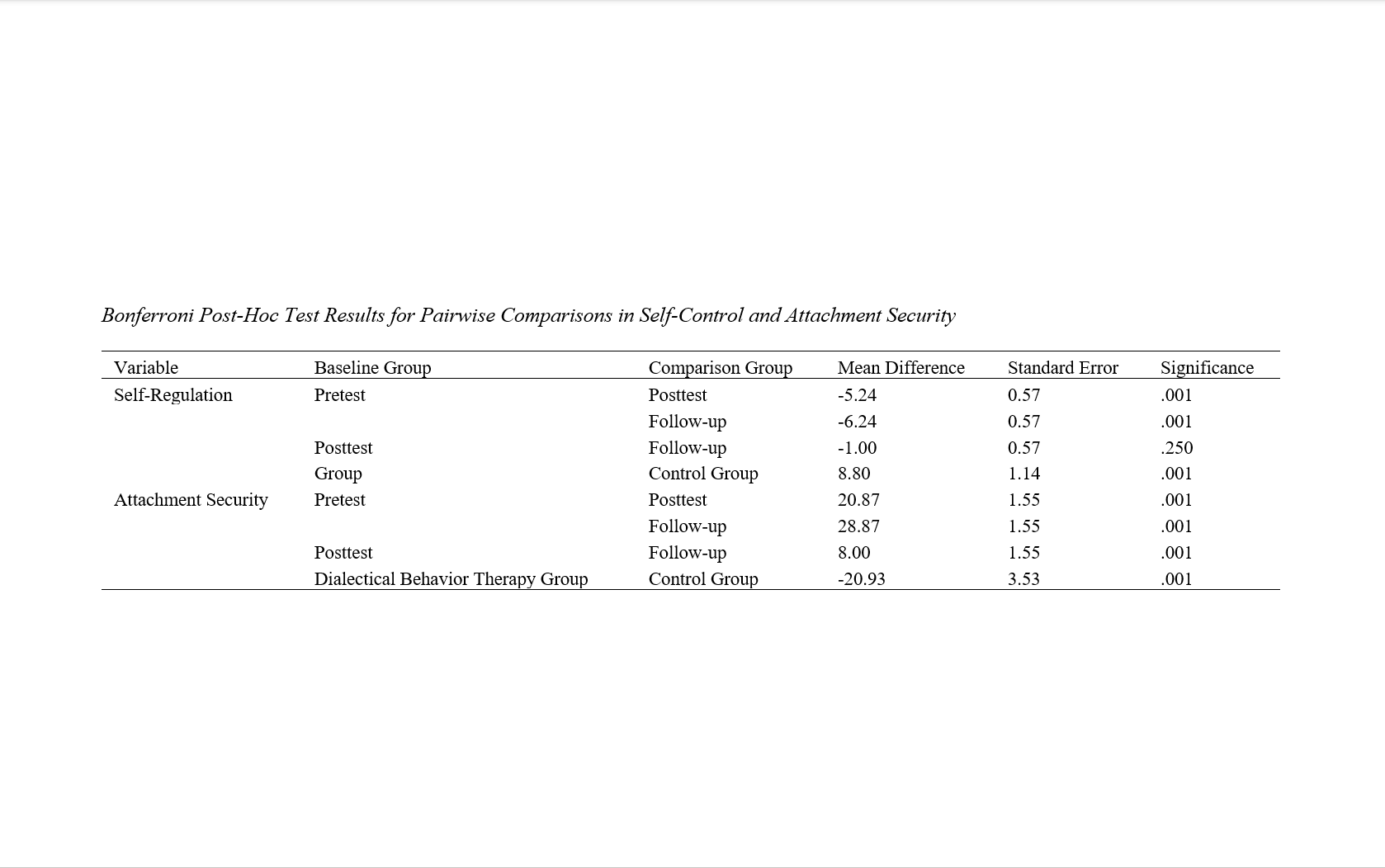
Findings: The results indicated that this method led to improvements in both variables (p < .05).
Conclusion: Based on these findings, it can be concluded that this method is suitable for improving these two variables among girls with high-risk behaviors.
Downloads
References
Abdulahi Beqrabadi, G., & Heidary rad, M. (2025). The Effectiveness of Emotion Regulation Training on Academic Self-Regulation and Procrastination of Male Students with Special Learning Disorder. Rooyesh, 13(11), 193-202. https://frooyesh.ir/article-1-5571-en.html
Almeida, I. L., Rego, J. F., Teixeira, A. C., & Moreira, M. R. (2021). Social isolation and its impact on child and adolescent development: A systematic review. Revista Paulista De Pediatria, 40, e2020385. https://doi.org/10.1590/1984-0462/2022/40/2020385
Asarnow, J. R., Berk, M. S., Bedics, J., Adrian, M., Gallop, R., Cohen, J., Korslund, K., Hughes, J., Avina, C., Linehan, M. M., & McCauley, E. (2021). Dialectical behavior therapy for suicidal self-harming youth: Emotion regulation, mechanisms, and mediators. Journal of the American Academy of Child & Adolescent Psychiatry, 60(9), 1105-1115. https://doi.org/10.1016/j.jaac.2021.01.016
Best, O., & Ban, S. (2021). Adolescence: Physical changes and neurological development. British Journal of Nursing, 30(5), 272-275. https://doi.org/10.12968/bjon.2021.30.5.272
Blair, C., & Ku, S. (2022). A hierarchical integrated model of self-regulation. Frontiers in psychology, 13, 725828. https://doi.org/10.3389/fpsyg.2022.725828
DeCou, C. R., Comtois, K. A., & Landes, S. J. (2019). Dialectical behavior therapy is effective for the treatment of suicidal behavior: A meta-analysis. Behavior therapy, 50(1), 60-72. https://doi.org/10.1016/j.beth.2018.03.009
Emadian, S. O., Ojarastaghi, F., & Mirzaian, B. (2024). The Effectiveness of Skills Training Based on Dialectical Behavior Therapy on Social Problem Solving and Attitude towards Delinquency of Delinquent Teenagers. Rooyesh, 13(10), 131-140. https://frooyesh.ir/article-1-5764-en.html
Eslava, D., Martínez-Vispo, C., Villanueva-Blasco, V. J., Errasti-Pérez, J. M., & Al-Halabí, S. (2023). Family conflict and the use of conventional and electronic cigarettes in adolescence: The role of impulsivity traits. International journal of mental health and addiction, 21(6), 3885-3896. https://doi.org/10.1007/s11469-022-00828-8
Fraley, R. C., Heffernan, M. E., Vicary, A. M., & Brumbaugh, C. C. (2011). The experiences in close relationships-Relationship Structures Questionnaire: A method for assessing attachment orientations across relationships. Psychological assessment, 23(3), 615-625. https://doi.org/10.1037/a0022898
Glazebrook, K., Townsend, E., & Sayal, K. (2015). The role of attachment style in predicting repetition of adolescent self‐harm: A longitudinal study. Suicide and Life‐Threatening Behavior, 45(6), 664-678. https://doi.org/10.1111/sltb.12159
Glazebrook, K., Townsend, E., & Sayal, K. (2016). Do coping strategies mediate the relationship between parental attachment and self-harm in young people? Archives of Suicide Research, 20(2), 205-218. https://doi.org/10.1080/13811118.2015.1004495
Gohari, S., Hoseini almadani, S. A., & Afkari, F. (2023). Efficacy of Child-Centered Mindfulness Therapy on the Attachment Quality in the Divorce-Engaged Children with Difficulty in the Emotional Self-Regulation. Journal of Modern Psychological Researches, 18(70), 213-221. https://journals.tabrizu.ac.ir/article_16505.html?lang=en
Goldstein, T. R., Merranko, J., Rode, N., Sylvester, R., Hotkowski, N., Fersch-Podrat, R., Hafeman, D. M., Diler, R., Sakolsky, D., Franzen, P., & Birmaher, B. (2024). Dialectical behavior therapy for adolescents with bipolar disorder: A randomized clinical trial. JAMA Psychiatry, 81(1), 15-24. https://doi.org/10.1001/jamapsychiatry.2023.3399
Hernandez-Bustamante, M., Cjuno, J., Hernández, R. M., & Ponce-Meza, J. C. (2024). Efficacy of dialectical behavior therapy in the treatment of borderline personality disorder: A systematic review of randomized controlled trials. Iranian Journal of Psychiatry, 19(1), 119. https://doi.org/10.18502/ijps.v19i1.14347
Hink, A. B., Killings, X., Bhatt, A., Ridings, L. E., & Andrews, A. L. (2022). Adolescent suicide—Understanding unique risks and opportunities for trauma centers to recognize, intervene, and prevent a leading cause of death. Current Trauma Reports, 8(2), 41-53. https://doi.org/10.1007/s40719-022-00223-7
Junkes, L., Gherman, B. R., Appolinario, J. C., & Nardi, A. E. (2024). Dialectical Behavior Therapy as an intervention for Treatment Resistant Depression in adults: A protocol for systematic review and meta-analysis. PLoS One, 19(5), e0303967. https://doi.org/10.1371/journal.pone.0303967
López-Martínez, L. F., Carretero, E. M., Carrasco, M. A., & Pérez-García, A. M. (2025). Self-Regulation, Emotional Symptomatology, Substance Use, and Social Network Addiction in Adolescent Self-Harm. Behavioral Sciences, 15(3), 257. https://doi.org/10.3390/bs15030257
Matin, H., & Etemadi, O. (2021). Effect of Compassion Focused Therapy (CFT) on Attachment Styles of couples with Marital Conflict. Clinical Psychology Studies, 12(42), 1-22. https://jcps.atu.ac.ir/article_13195.html?lang=en
McCall, M. H., Boyd, C. T., Kerr, N. D., Daniel, S. S., & Sutfin, E. L. (2025). Dialectical Behavior Therapy Skills Training as a Brief Intervention for Cigarette Smoking by Patients with Cancer: A Scoping Review and Narrative Synthesis of Related Literature. Psycho‐Oncology, 34(1), e70074. https://doi.org/10.1002/pon.70074
Navarro-Haro, M. V., Botella, V. G., Badenes-Ribera, L., Borao, L., & García-Palacios, A. (2021). Dialectical behavior therapy in the treatment of comorbid borderline personality disorder and eating disorder in a naturalistic setting: A six-year follow-up study. Cognitive therapy and research, 45, 480-493. https://doi.org/10.1007/s10608-020-10170-9
Noever, D., & Rosario, G. (2025). Beyond No: Quantifying AI Over-Refusal and Emotional Attachment Boundaries. arXiv preprint. https://arxiv.org/abs/2502.14975
Panaghi, L., Maleki, G., Zabihzadeh, A., Poshtmashhadi, M., & Soltaninezhad, Z. (2014). Validity, Reliability, and Factor Analysis of Experiences in Close Relationship (ECR) Scale. ijpcp, 19(4), 305-313. https://www.ensani.ir/fa/article/405462/
Rahman, F., Webb, R. T., & Wittkowski, A. (2021). Risk factors for self-harm repetition in adolescents: A systematic review. Clinical psychology review, 88, 102048. https://doi.org/10.1016/j.cpr.2021.102048
Rahmanian, M., Kordmirza Nikoozadeh, E., abdolhoseini, A., Agahheris, M., & Shahamat, N. (2024). The effectiveness of dialectical behavior therapy on the tolerance of distress, irrational beliefs, rumination of anger in patients with obsessive-compulsive disorder. Clinical Psychology Studies, 15(55), 48-62. https://jcps.atu.ac.ir/article_18440.html
Rigi, K., Shahriari Ahmadi, M., Tajali, P., & Ghodsi, P. (2024). Effectiveness of Emotional Recognition Intervention on Emotional Self-Regulation and Empathy in Children with Oppositional Defiant Disorder. Psychology of Exceptional Individuals, 14(54), 43-75. https://jpe.atu.ac.ir/article_18025.html
Rizvi, S. L., Bitran, A. M., Oshin, L. A., Yin, Q., & Ruork, A. K. (2024). The state of the science: Dialectical behavior therapy. Behavior therapy. https://www.sciencedirect.com/science/article/abs/pii/S0005789424000303
Russell, C. G., & Russell, A. (2025). Appetite Self-Regulation in Childhood: A Narrative Review and Conceptual Model of Processes and Mechanisms With Implications for Research and Practice. Nutrition Reviews, nuae220. https://doi.org/10.1093/nutrit/nuae220
Sadat Tabatabayi, A., Yosofi, Z., Motamedi, M., & Taheri, S. (2021). The Effectiveness of Dialectical Behavior Therapy on Self-Forgiveness and Depression in Teenager Girls with Self-injury History in Isfahan. Journal of Clinical Psychology, 13(1), 13-22. https://jcp.semnan.ac.ir/article_5058.html
Sahebyar, H., Sardari, M., & Akhoundi-khalan, R. (2025). The effectiveness of concept map training on analytical thinking and self-regulation of elementary school male students. Learner-based Curriculum and instruction Journal, 4(2), -. https://cipj.tabrizu.ac.ir/article_19310.html?lang=en
Salehi, B., Kimiaei, S. A., Amin Yazdi, S. A., & Kareshki, H. (2025). Comparing the Effectiveness of Emotional Safety Training and Its Enrichment with Self-Compassion on Self-Esteem, Attachment, and Social-Emotional Competence in Housewives. Journal of Psychological Science, 24(147), 21-41. https://psychologicalscience.ir/browse.php?a_id=2489&sid=1&slc_lang=en&ftxt=0
Silvers, J. A. (2022). Adolescence as a pivotal period for emotion regulation development. Current opinion in psychology, 44, 258-263. https://doi.org/10.1016/j.copsyc.2021.09.023
Tangney, J. P. (2004). High self‐control predicts good adjustment, less pathology, better grades, and interpersonal success. Journal of personality, 2(April 2004), 54. https://doi.org/10.1111/j.0022-3506.2004.00263.x
Torbati, A. G., Zandi, A., & Abbaspour, S. (2022). Effectiveness of educational intervention-based compassion therapy on emotional regulation and self-control after discharge of patients With COVID-19. Journal of education and health promotion, 11(1), 279. https://doi.org/10.4103/jehp.jehp_66_22
Townsend, E., Ness, J., Waters, K., Rehman, M., Kapur, N., Clements, C., Geulayov, G., Bale, E., Casey, D., & Hawton, K. (2022). Life problems in children and adolescents who self‐harm: Findings from the multicentre study of self‐harm in England. Child and Adolescent Mental Health, 27(4), 352-360. https://doi.org/10.1111/camh.12544
Uh, S., Dalmaijer, E. S., Siugzdaite, R., Ford, T. J., & Astle, D. E. (2021). Two pathways to self-harm in adolescence. Journal of the American Academy of Child & Adolescent Psychiatry, 60(12), 1491-1500. https://doi.org/10.1016/j.jaac.2021.03.010
Zheng, X., Liu, Z., Liu, T., & Mu, S. (2025). Childhood Maltreatment and Non-Suicidal Self-Injury Among Chinese College Students: Roles of Parent-Child Attachment and Negative co-Rumination. Journal of family violence, 1-4. https://doi.org/10.1007/s10896-025-00854-9
Downloads
Additional Files
Publication Timeline
- Submitted
- Revised
- Accepted
Issue
Section
License
Copyright (c) 2025 Neda Alaeinejad (Author); Hajar Torkan (Corresponding Author); Zahra Yousefi (Author)

This work is licensed under a Creative Commons Attribution-NonCommercial 4.0 International License.