Implicit Shame and Avoidant Interpersonal Style: The Mediating Role of Identity Fragility
DOI:
https://doi.org/10.61838/kman.jayps.6.1.18Keywords:
Implicit shame, Identity fragility, Avoidant interpersonal styleAbstract
Objective: This study aimed to investigate the mediating role of identity fragility in the relationship between implicit shame and avoidant interpersonal style among young adults in Vietnam.
Methods and Materials: The research employed a descriptive correlational design with a sample of 424 university students from Vietnam, selected using the Morgan and Krejcie sampling table. Data were collected through standard tools: the Implicit Association Test for Shame (IAT-Shame), the Self-Concept Clarity Scale (SCCS) to assess identity fragility, and the Attachment Style Questionnaire (ASQ) for measuring avoidant interpersonal style. Descriptive statistics and Pearson correlation analyses were performed using SPSS-27 to examine bivariate relationships. Structural Equation Modeling (SEM) was then conducted in AMOS-21 to test the proposed mediation model, and model fit was evaluated using a range of fit indices.
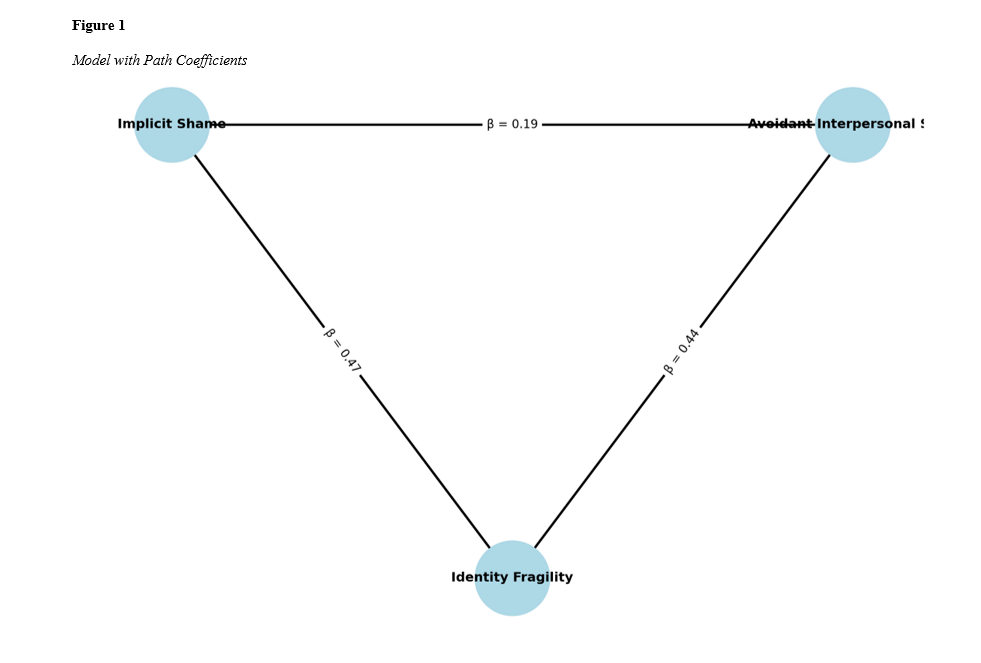
Findings: The results of Pearson correlation showed significant positive relationships between implicit shame and identity fragility (r = .47, p < .001), implicit shame and avoidant interpersonal style (r = .39, p < .001), and identity fragility and avoidant interpersonal style (r = .52, p < .001). The structural equation model showed good fit (χ² = 132.48, df = 74, χ²/df = 1.79, RMSEA = 0.043, CFI = 0.97). Path analysis revealed that implicit shame had a significant direct effect on identity fragility (β = .47, p < .001) and on avoidant interpersonal style (β = .19, p = .004). The indirect effect of implicit shame on avoidant interpersonal style through identity fragility was also significant (β = .21, p < .001), confirming the mediating role.
Conclusion: These findings highlight the importance of implicit shame and unstable identity structures in shaping avoidant relational behaviors, emphasizing the need for psychological interventions that address unconscious emotional vulnerabilities and promote identity coherence.
Downloads
References
Arianfar, N., Hosseinian, S., & Etemadi, O. (2022). Cognitive Emotion Regulation Strategies and Marital Interpersonal Pathologies in Men With Avoidant Attachment: Investigating the Mediating Role of Caregiving Styles. The Family Journal. https://doi.org/10.1177/10664807221139508
Bazezew, A., & Neka, M. (2021). Interpersonal Conflicts and Styles of Managing Conflicts Among Students at Bahir Dar University, Ethiopia. Journal of Student Affairs in Africa, 5(1). https://doi.org/10.14426/jsaa.v5i1.2480
Berenson, K. R., Nynaes, O., Wakschal, E. S., Kapner, L. M., & Sweeney, E. C. (2018). Attributions for Rejection and Acceptance in Young Adults With Borderline and Avoidant Personality Features. Journal of Social and Clinical Psychology, 37(6), 431-452. https://doi.org/10.1521/jscp.2018.37.6.431
Carfagno, M., Barone, E., Arsenio, E., Bello, R., Marone, L., Volpicelli, A., Cascino, G., & Monteleone, A. M. (2024). Mediation Role of Interpersonal Problems Between Insecure Attachment and Eating Disorder Psychopathology. Eating and Weight Disorders - Studies on Anorexia Bulimia and Obesity, 29(1). https://doi.org/10.1007/s40519-024-01673-5
Choe, H. S., & Lee-Jin, K. (2024). Interpersonal Stress and Psychological Well-Being of Infant Teachers in Korea: Focus on the Moderating Effect of Stress Coping Style. Korean Association for Learner-Centered Curriculum and Instruction, 24(7), 201-215. https://doi.org/10.22251/jlcci.2024.24.7.201
Choi, M.-H., & Min, H.-H. (2019). Determining the Relationship Among Organizational Commitment, Occupational Stress, and Interpersonal Relations According to Adult Attachment Styles of Clinical Dental Hygienists. Journal of Dental Hygiene Science, 19(2), 122-132. https://doi.org/10.17135/jdhs.2019.19.2.122
Čiuladienė, G., & Walancik, M. (2020). Being Ready to Lecture a Multicultural Class: Asian Preferences for Conflict Management Style. Cultural Management Science and Education, 4(1), 105-118. https://doi.org/10.30819/cmse.4-1.06
Darawong, C. (2017). Conflict Management Styles and Interpersonal Conflict Between Marketing and R&D Personnel During the New Product Development Process. International Journal of Innovation and Technology Management, 14(06), 1750034. https://doi.org/10.1142/s0219877017500341
Evraire, L. E., Dozois, D. J. A., & Wilde, J. L. (2022). The Contribution of Attachment Styles and Reassurance Seeking to Trust in Romantic Couples. Europe’s Journal of Psychology, 18(1), 19-39. https://doi.org/10.5964/ejop.3059
Fossati, A., Feeney, J., Maffei, C., & Borroni, S. (2014). Thinking about feelings: Affective state mentalization, attachment styles, and borderline personality disorder features among Italian nonclinical adolescents. Psychoanalytic Psychology, 31(1), 41. https://doi.org/10.1037/a0033960
Hassan, N. M., Daud, N., Nik Nor Ronaidi Nik, M., Ibdrahim, M. S., Yusop, Y. M., Pauzi, M. F., & Xuan, O. Y. (2022). Factors Predicting Unsatisfactory Work Performance Among Medical Interns. Future Healthcare Journal, 9, S34. https://doi.org/10.7861/fhj.9-2-s34
Homayouni, M., Keykhosrowani, M., & Pouladi Rishehri, A. (2023). Effectiveness of positive mindfulness on internalized shame, experiential avoidance, and emotional dysregulation in abused women. Rooyesh Psychol, 11(7), 33-44. https://frooyesh.ir/browse.php?a_id=3776&slc_lang=en&sid=1&printcase=1&hbnr=1&hmb=1
Jeon, S., & Park, K.-H. (2023). The Relationship Between Internalized Shame and Self-Concealment: The Mediating Effects of Fear of Negative/Positive Evaluation and Self-Compassion. Korean Association for Learner-Centered Curriculum and Instruction, 23(23), 507-520. https://doi.org/10.22251/jlcci.2023.23.23.507
Kaya, M. D., Kaya, F., & Eroğlu, Y. (2023). Interpersonal Cognitive Distortions: What Is the Role of Childhood Trauma and Attachment? Journal of Education in Science Environment and Health, 292-309. https://doi.org/10.55549/jeseh.1381214
Klimenkova, E. N. (2017). Empaty Ability and the Quality of Interpersonal Relations in Youth. Counseling Psychology and Psychotherapy, 25(4), 59-70. https://doi.org/10.17759/cpp.2017250405
Lee, O. N., & Park, G.-A. (2020). The Mediating Effects of Attachment Styles on the Relationship Between Sensory Processing Styles and Interpersonal Problems in Healthy University Students. Occupational Therapy International, 2020, 1-6. https://doi.org/10.1155/2020/6204120
Li, W., Zhang, X., Chu, M., & Li, G. (2020). The Impact of Adverse Childhood Experiences on Mobile Phone Addiction in Chinese College Students: A Serial Multiple Mediator Model. Frontiers in psychology, 11. https://doi.org/10.3389/fpsyg.2020.00834
Lin, H.-C. K., Tsai, M.-C., & Wu, K.-H. (2020). The Research of Relationship Among Smile Developing Software, Internet Addiction, and Attachment Style. Electronics, 9(12), 2057. https://doi.org/10.3390/electronics9122057
Malivoire, B. L., & Koerner, N. (2021). Interpersonal Dysfunction in Individuals High in Chronic Worry: Relations With Interpersonal Problem-Solving. Behavioural and Cognitive Psychotherapy, 50(2), 142-157. https://doi.org/10.1017/s1352465821000436
Meisel, S. N., & Colder, C. R. (2021). An Examination of the Joint Effects of Adolescent Interpersonal Styles and Parenting Styles on Substance Use. Development and Psychopathology, 34(3), 1125-1143. https://doi.org/10.1017/s0954579420001637
Mukherjee, D. K., & Sinha, S. (2024). The Effect of Attachment Style on Interpersonal Communication and Achievement Motivation of Adolescent (Single Child/Child With Siblings). 42-61. https://doi.org/10.58532/v3bisop1ch4
Nagar, M. P., & Ahmed, A. (2024). Exploring the Relationship Between Self-Concept, Adjustment and Parenting Styles in Adolescents. The Bioscan, 19(Special Issue-1), 877-881. https://doi.org/10.63001/tbs.2024.v19.i02.s.i(1).pp877-881
Ravitz, P., Maunder, R., Hunter, J., Sthankiya, B., & Lancee, W. (2010). Adult attachment measures: A 25-year review. Journal of psychosomatic research, 69(4), 419-432. https://doi.org/10.1016/j.jpsychores.2009.08.006
Rek, I., Ehrenthal, J. C., Strauß, B., Schauenburg, H., Nikendei, C., & Dinger, U. (2018). Attachment Styles and Interpersonal Motives of Psychotherapy Trainees. Psychotherapy, 55(3), 209-215. https://doi.org/10.1037/pst0000154
Rostami, H., Zeinali, S., Sadeghi, S., & Zonouzi, E. (2022). The Relationship Between Attachment Style and Interpersonal Relationship With the Mediating Role of Moral Identity. Health Spirituality and Medical Ethics, 9(3), 145-152. https://doi.org/10.32598/hsmej.9.3.327.2
Stancu, A. (2025). Place Attachment Styles Predict Adaptive and Maladaptive Conducts Under Flood Risk: Evidence via Cognitive and Affective Coping Mediation. Journal of Community & Applied Social Psychology, 35(3). https://doi.org/10.1002/casp.70083
Stuke, F., Bröcker, A. L., Bayer, S., Heinz, A., Bermpohl, F., Lempa, G., Haebler, D. v., & Montag, C. (2020). Between a Rock and a Hard Place: Associations Between Mentzos' “Dilemma”, Self‐reported Interpersonal Problems, and Psychosocial Functioning in Individuals With Non‐affective Psychoses. Clinical Psychology & Psychotherapy, 27(4), 528-541. https://doi.org/10.1002/cpp.2437
Tamaela, J. M., Amir, N., Sanggel, M. J., & Nompo, R. S. (2024). The Impact of Non-Physical Bullying on Adolescents' Self-Concept: An Observational Study in the Adolescent Community in Sausapor, Tambrauw Regency, West Papua, Indonesia. Scientia Psychiatrica, 5(3), 509-519. https://doi.org/10.37275/scipsy.v5i3.171
Tanasescu, C. F. (2024). Making Communication and Organisation More Effective in Interculturality, Multiculturality and Pluriculturality. Studia Universitatis Moldaviae Seria Științe Ale Educației(9(169)), 194-198. https://doi.org/10.59295/sum9(169)2024_29
Wijaya, L. K. S., Jorgy, E., & Latif, M. D. (2024). Manajemen Konflik Interpersonal (Studi Kasus Pada CV Cyber Karya Nusantara Surabaya). JNM, 1(1), 175-187. https://doi.org/10.62237/jnm.v1i1.50
Zhang, B., Pan, B., Chen, J., Wang, J., Zhu, Z., Lajunen, T., & Wang, W. (2023). Hypnotizability and Disordered Personality Styles in Cluster a Personality Disorders. Brain Sciences, 13(2), 182. https://doi.org/10.3390/brainsci13020182
Zubenko, O. (2021). Early Maladaptive Schemas as Determinants of Student's Youth Lifestyle. Visnyk of v N Karazin Kharkiv National University a Series of Psychology(70). https://doi.org/10.26565/2225-7756-2021-70-04
Downloads
Additional Files
Publication Timeline
- Submitted
- Revised
- Accepted
Issue
Section
License

This work is licensed under a Creative Commons Attribution-NonCommercial 4.0 International License.