Comparison of the Effectiveness of Acceptance and Commitment Therapy and Reality Therapy on Social Adaptation of Female High School Students with Symptoms of Nomophobia
DOI:
https://doi.org/10.61838/kman.jayps.6.4.9Keywords:
Acceptance and Commitment Therapy, Reality Therapy, Social Adaptation, NomophobiaAbstract
Objective: The aim of the present study was to compare the effectiveness of Acceptance and Commitment Therapy (ACT) and Reality Therapy on social adaptation of female high school students with symptoms of nomophobia.
Methods and Materials: This study is a fundamental research and, in terms of research method, is a quasi-experimental study with a pre-test, post-test, and follow-up design with a control group. The statistical population consisted of all female high school students in the second grade in District 3 of Tehran during the 2023-2024 academic year. The sampling method was convenience sampling, and the sample size consisted of 45 students. Data collection tools included the Nomophobia Questionnaire by Yildirim and Correia (2015) and the California Social Adjustment Questionnaire (1953). In this study, the group therapy protocol based on ACT by Hayes et al. (1999), adapted from Khatibi et al. (2020), was implemented over eight sessions, and the intervention protocol based on Reality Therapy, adapted from Eskandari (2017), was also implemented over eight sessions. Data were analyzed using repeated measures ANOVA.
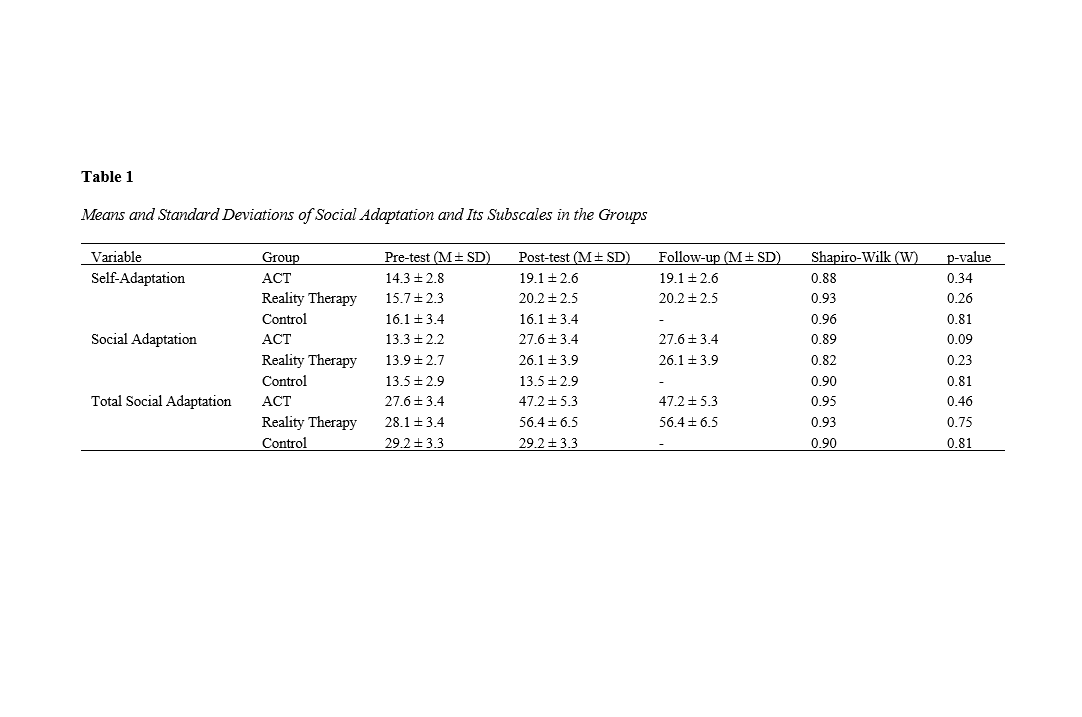
Findings: There was a significant difference between the effectiveness of ACT and Reality Therapy on social adaptation of female high school students with symptoms of nomophobia, with Reality Therapy demonstrating greater improvement in social adaptation compared to ACT.
Conclusion: Reality Therapy demonstrated greater effectiveness than Acceptance and Commitment Therapy in improving social adaptation among female high school students with nomophobia symptoms, emphasizing practical interpersonal skills, responsibility, and problem-solving for enhancing social interactions.
Downloads
References
Abiar, Z., Makvandi, B., Bakhtiarpour, S., Naderi, F., & Hafezi, F. (2018). Comparison of the effectiveness of Acceptance and Commitment Therapy, Mindfulness, and a combined approach (Mindfulness, Commitment, and Acceptance) on depression. Child Mental Health (Child Psychology), 5(4), 27-38. https://childmentalhealth.ir/article-1-399-en.html
Ahmadi, Z., Amiri, S., Abedi, M. R., & Abedi, A. (2016). The effect of Acceptance and Commitment Therapy on risky behaviors in adolescent girls. Cognitive Behavioral Psychotherapy Conference,
Ahmed, S., Pokhrel, N., Roy, S., & Samuel, A. J. (2019). Impact of nomophobia: A nondrug addiction among students of physiotherapy course using an online cross-sectional survey. Indian Journal of Psychiatry, 61(1), 77. https://doi.org/10.4103/0019-5545.226559
Al-Yasin, S. A., Davoudi, H., & Nematollahi, M. (2019). The effectiveness of Acceptance and Commitment Therapy (ACT) on psychological well-being and resilience in women with type 2 diabetes. Mashhad University of Medical Sciences Journal, 62(Special Issue: Psychology). https://mjms.mums.ac.ir/article_18950.html?lang=en
Armani Kian, A., Rostami, B., Mousavi, S. E., Maghbooli, M., & Fakour, E. (2020). The effectiveness of Acceptance and Commitment Therapy on academic procrastination in students at Zanjan University of Medical Sciences. Iranian Journal of Psychiatry and Clinical Psychology, 26(2), 142-153. https://doi.org/10.32598/ijpcp.26.2.2817.1
Awed, H. S., & Hammad, M. A. (2022). Relationship between nomophobia and impulsivity among deaf and hard-of-hearing youth. Scientific reports, 12(1), 14208. https://doi.org/10.1038/s41598-022-17683-1
Babakhani, V. (2020). The effectiveness of Acceptance and Commitment Therapy (ACT) on distress tolerance and self-control in women who have experienced infidelity. Family Psychology, 7(1), 121-132. https://www.ijfpjournal.ir/article_245567.html?lang=en
Burckhardt, R., Manicavasagar, V., Batterham, P. J., Hadzi-Pavlovic, D., & Shand, F. (2017). Acceptance and commitment therapy universal prevention program for adolescents: a feasibility study. Child and adolescent psychiatry and mental health, 11(1), 27. https://doi.org/10.1186/s13034-017-0164-5
Chen, H., Wang, C., Lu, T., Tao, B., Gao, Y., & Yan, J. (2022). The Relationship Between Physical Activity and College Students’ Mobile Phone Addiction: The Chain-Based Mediating Role of Psychological Capital and Social Adaptation. International journal of environmental research and public health. https://doi.org/10.3390/ijerph19159286
Copaja-Corzo, C., Aragón-Ayala, C. J., Taype-Rondan, A., & Nomotest-Group. (2022). Nomophobia and Its Associated Factors in Peruvian Medical Students. International journal of environmental research and public health, 19(9), 5006. https://doi.org/10.3390/ijerph19095006
Davoudi, R., & Manshaei, G. (2020). Comparing the effectiveness of Cognitive Behavioral Therapy, Emotion-Focused Therapy, and Adolescent-Oriented Mindfulness Therapy on nomophobia symptoms and sleep quality in adolescent girls with signs of mobile phone addiction. Journal of psychiatric nursing, 7(5), 62-71. http://ijpn.ir/browse.php?a_id=1400&sid=1&slc_lang=en
Ebrahimi Moghaddam, H., Malmir, T., Rahmani, F., & Ramazani Alizadeh, Z. (2017). The effect of Acceptance and Commitment Therapy (ACT) on anxiety and aggression in individuals with panic attacks. Psychological studies, 13(4), 141-156. https://psychstudies.alzahra.ac.ir/article_3118.html
Faghiharam, B. (2019). The Relationship between Social Health and Social Networks using among Female Student's Parent [Research Article]. Iranian Journal of Educational Sociology, 2(1), 150-160. https://doi.org/10.29252/ijes.2.1.150
Galhardo, A., Loureiro, D., Raimundo, E., Massano-Cardoso, I., & Cunha, M. (2020). Assessing nomophobia: validation study of the European Portuguese version of the Nomophobia Questionnaire. Community Mental Health Journal, 56(8), 1521-1530. https://doi.org/10.1007/s10597-020-00600-z
Glasser, W. (2008). Station of the Mind: New direction for reality therapy. New York. https://books.google.com/books/about/Stations_of_the_Mind.html?id=rvKJbwlVzr8C
Glick, D. M., Millstein, D. J., & Orsillo, S. M. (2014). A preliminary investigation of the role of psychological inflexibility in academic procrastination. Journal of Contextual Behavioral Science, 3(2), 81-88. https://doi.org/10.1016/j.jcbs.2014.04.002
Glick, D. M., & Orsillo, S. M. (2015). An investigation of the efficacy of acceptance-based behavioral therapy for academic procrastination. Journal of Experimental Psychology: General, 144(2), 400-409. https://doi.org/10.1037/xge0000050
Gonçalves, M. M. (2023). Acceptance and commitment therapy and its unacknowledged influences: Some old wine in a new bottle? Clinical Psychology & Psychotherapy, 30(1), 1-9. https://doi.org/10.1002/cpp.2775
Hakimpour, S. (2014). The effectiveness of Acceptance and Commitment Therapy (ACT) on academic burnout and math anxiety in sixth-grade students in Ardabil Master's Thesis in Clinical Psychology, Islamic Azad University, Ardabil Branch].
Hoseini Tabaghdehi, L. (2021). The relationship between loneliness and depressive symptoms with nomophobia (fear of being without a mobile phone) in students. Quarterly Journal of Information and Communication Technology in Educational Sciences, 12(1), 67-85. https://sanad.iau.ir/en/Journal/ictedu/Article/1006842
Hoseinlou, A., Pournaghsh Tehrani, S. S., Jafari Roshan, F., Chehre Sa, A., & Darabi, M. (2021). The effectiveness of Acceptance and Commitment Therapy (ACT) on depressive symptoms and rumination in women after spousal infidelity. Journal of Psychological Sciences, 20(103), 999-1014. https://doi.org/10.52547/JPS.20.103.999
Hoseinzadeh Askouei, A., Samadi Kashan, S., Zamani Zarchi, M. S., Asadi Asadabad, R., & Bakhtiari, M. (2022). The effectiveness of group-based Acceptance and Commitment Therapy on cognitive flexibility and self-esteem in women affected by marital infidelity. Applied Psychological Research Quarterly, 13(4), 203-216. https://japr.ut.ac.ir/article_91194.html?lang=en
Hoseinzadeh, G. S., & Khalatbari, R. (2021). Comparison of the effectiveness of Emotion-Focused Couples Therapy and Reality Therapy on relationship beliefs and marital expectations of couples. Quarterly Journal of Assessment and Research in Applied Counseling, 3(3), 1-13. https://doi.org/10.52547/jarcp.3.2.1
Hsieh, K. Y., Hsiao, R. C., Yang, Y. H., Lee, K. H., & Yen, C. F. (2019). Relationship between Self-Identity Confusion and Internet Addiction among College Students: The Mediating Effects of Psychological Inflexibility and Experiential Avoidance. International journal of environmental research and public health, 3(2), 1-11. https://doi.org/10.3390/su13052680
Hu, J., Ye, B., Yildirim, M., & Yang, Q. (2023). Perceived stress and life satisfaction during COVID-19 pandemic: the mediating role of social adaptation and the moderating role of emotional resilience. Psychology, Health & Medicine, 28(1), 124-130. https://doi.org/10.1080/13548506.2022.2038385
Khanjani, Z., & Sadaqati Fard, M. (2021). Examining the relationship between social adjustment and high-risk sexual behaviors in high school girls. https://journals.kmanpub.com/index.php/jayps/article/view/468
Khosravi, J., Homameddin, M., & Basirian, J. (2021). The impact of a web-based educational program on optimizing smartphone use among students with nomophobia based on the self-efficacy theory: The role of medical librarians. Iranian Journal of Health Education and Health Promotion, 9(3), 246-257. https://doi.org/10.52547/ijhehp.9.3.246
King, A. L. S., Valença, A. M., & Nardi, A. E. (2010). Nomophobia: the mobile phone in panic disorder with agoraphobia: reducing phobias or worsening of dependence? Cognitive and Behavioral Neurology, 23(1), 52-54. https://doi.org/10.1097/WNN.0b013e3181b7eabc
King, A. L. S., Valença, A. M., Silva, A., Baczynski, T., Carvalho, M., & Nardi, A. E. (2013). Nomophobia: Dependency on virtual environments or social phobia? Computers in human Behavior, 29(1), 140-144. https://doi.org/10.1016/j.chb.2012.07.025
King, A. L. S., Valença, A. M., Silva, A. C., Nardi, A. E., Sancassiani, F., & Machado, S. (2014). Nomophobia: Impact of cell phone use interfering with symptoms and emotions of individuals with panic disorder compared with a control group. Clinical Practice and Epidemiology in Mental Health, 10, 28. https://doi.org/10.2174/1745017901410010028
Kulnazarova, G., Namazbaeva, Z., Butabayeva, L., & Tulepova, L. (2023). Cognitive Therapy for Children With Intellectual Disabilities: A New Look at Social Adaptation Skills and Interpersonal Relationships. Occupational Therapy International, 2023, 1-8. https://doi.org/10.1155/2023/6466836
Liang, Y. (2024). Attachment Anxiety and Nomophobia: A Moderated Parallel Mediation Model. Psychological Reports. https://doi.org/10.1177/00332941241226907
Mirani, R., Moradi, A., Noori, R., & Borhani, A. (2017). Examining the effectiveness of Acceptance and Commitment Therapy on emotional independence. Third National Conference on Modern Studies and Research in Educational Sciences and Psychology in Iran, Qom, Soroush Hikmat Mortezavi Islamic Research Center,
Mirlouhian, M., Alizadeh, Z. H., Ashkar, B., & Eshaq, S. (2021). Comparing the effectiveness of Emotion-Focused Couples Therapy and Reality Therapy in reducing depressive symptoms and enhancing functional flexibility in couples with marital issues. Applied Family Therapy, 6(2), 250-269. https://ensani.ir/fa/article/496243/
Namani, E., Keshavarz Afshar, H., & Bahonar, F. (2019). Investigating the effect of group counseling based on Acceptance and Commitment Therapy on happiness and rumination in infertile women. Applied Counseling, 9(2), 92-108. https://jac.scu.ac.ir/article_15356.html?lang=en
Pasha, R., & Golshekoh, F. (2017). Effect of emotional intelligence training on aggression and social adjustment on students with behavioral and emotional disorders. Middle Eastern Journal of Disability Studies, 7, 34. https://jdisabilstud.org/browse.php?a_id=711&sid=1&slc_lang=fa
Racu, J. (2023). Psychosocial Adaptation of Pupil Is the Activities of a Psychologist in the School. https://doi.org/10.46727/c.v1.24-25-03-2023.p86-90
Ranjbar, S., Abui Mehrizi, S., & Ghasemi, M. (2023). Effectiveness of pishanskill enhancement package on promoting social adaptation in children with autism spectrum disorder. Research in Child and Adolescent Psychotherapy, 2(3), 40-31. https://doi.org/10.22098/rcap.2023.14060.1033
Rodríguez-García, A.-M., Moreno-Guerrero, A.-J., & Belmonte, J. L. (2020). Nomophobia: An Individual’s Growing Fear of Being Without a Smartphone—A Systematic Literature Review. International journal of environmental research and public health. https://doi.org/10.3390/ijerph17020580
Santl, L., Brajkovic, L., & Kopilaš, V. (2022). Relationship between Nomophobia, Various Emotional Difficulties, and Distress Factors among Students. European Journal of Investigation in Health, Psychology and Education, 12(7), 716-730. https://doi.org/10.3390/ejihpe12070053
Sepas, L., Shaker Dolaq, A., & Khademi, A. (2022). Comparing the effectiveness of Acceptance and Commitment Therapy and Reality Therapy on reducing anxiety sensitivity in women with Multiple Sclerosis (MS). Counseling and Psychotherapy Culture, 13(51), 85-113. https://qccpc.atu.ac.ir/article_14119.html?lang=en
Sierra, M. A., & Ortiz, E. (2023). Feasibility and effect of a self-help online acceptance and commitment therapy program focused on repetitive negative thinking for Colombian young women. Journal of Contextual Behavioral Science, 28, 127-138. https://doi.org/10.1016/j.jcbs.2023.03.010
Song, T., Wang, W., Chen, S., & Li, Y. (2024). Mothers’ Parental Burnout and Adolescents’ Social Adaptation and Security: The Mediating Role of Parenting Style. Current Psychology, 43(27), 23144-23155. https://doi.org/10.1007/s12144-024-06045-x
Wang, S. H., Zhou, Y., Yu, S., Ran, L. W., Liu, X. P., & Chen, Y. F. (2017). Acceptance and Commitment Therapy and Cognitive-Behavioral Therapy as Treatments for Academic Procrastination: A Randomized Controlled Group Session. Research on Social Work Practice, 27(1), 48-58. https://doi.org/10.1177/1049731515577890
Wen, J., Huang, Y., Liu, G., & Miao, M. (2023). The nature of nomophobia and its associations with contents of smartphone use and fear of missing out: A network perspective. Telematics and Informatics, 82, 102011. https://doi.org/10.1016/j.tele.2023.102011
Yildirim, C., & Correia, A. P. (2015). Exploring the dimensions of nomophobia: Development and validation of a self-reported questionnaire. Computers in human Behavior, 49, 130-137. https://doi.org/10.1016/j.chb.2015.02.059
Downloads
Additional Files
Publication Timeline
- Submitted
- Revised
- Accepted
Issue
Section
License
Copyright (c) 2025 Mansoureh Sadat Ghoreishi (Author); Reza Khakpour (Corresponding Author); Simindokht Rezakhani (Author)

This work is licensed under a Creative Commons Attribution-NonCommercial 4.0 International License.