Identity Styles and High-Risk Behaviors in Adolescence: Evolution from Early to Late Stages
DOI:
https://doi.org/10.61838/kman.jayps.3456Keywords:
adolescence, developmental stages, high-risk behaviors, identity stylesAbstract
Objective: Adolescence involves rapid physical, psychological, and social changes that can increase engagement in high-risk behaviors. Investigating the role of identity styles in these behaviors may aid in developing effective prevention and intervention strategies for adolescents.
Methods and Materials: This cross-sectional study examined male middle and high school students in Siahkal County, Iran, during the 2023-2024 academic year. The sample included 435 students aged 11 to 19, divided equally across three groups representing early, middle, and late adolescence. Data were collected via surveys using Berzonsky's Identity Style Inventory (1989) and the Iranian Adolescent Risk-Taking Scale (2011). Statistical analyses included Pearson correlation, multiple linear regression, and Fisher’s Z-test.
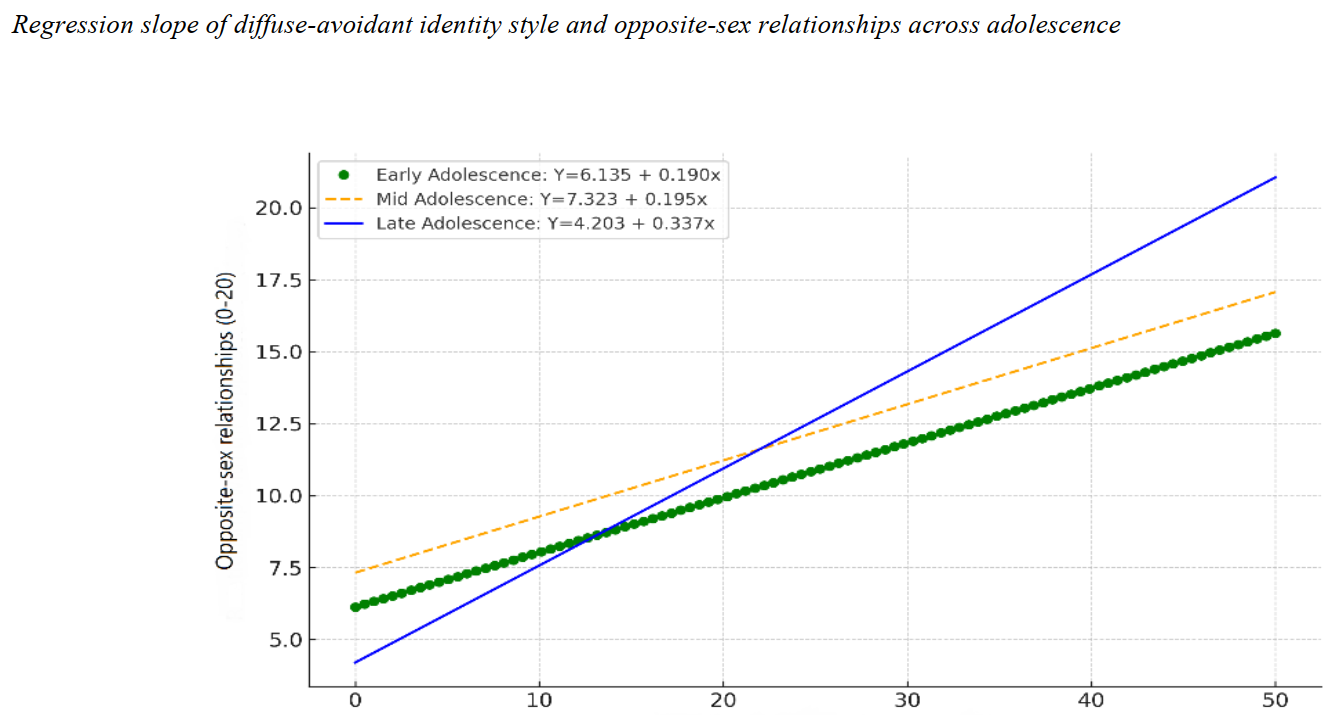
Findings: Distinct patterns emerged between identity styles and high-risk behaviors across adolescence. The normative identity style was consistently associated with reduced high-risk behaviors, with the strongest protective effects observed during late adolescence (p < 0.01). The diffuse-avoidant identity style correlated with increased engagement in high-risk behaviors across all stages of adolescence (p < 0.01), particularly in late adolescence, where a pronounced tendency toward opposite-sex interactions was observed (z > 1.96). The informational identity style demonstrated a significant protective role, especially in late adolescence (p < 0.01), effectively reducing tendencies toward alcohol use.
Conclusion: These findings indicate that distinct identity styles have significant and varying associations with high-risk behaviors throughout adolescence. The results support the design of targeted and predictive interventions and support programs tailored to each identity style and developmental stage to reduce high-risk behaviors.
Downloads
References
Afridi, S. S., & Rahim, S. (2020). Personality Traits, Identity style and Depression as predictors of smoking behavior among university students. FWU Journal of Social Sciences, 12(4). https://doi.org/10.51709/FW12729
Barrett, D. E. (1996). The three stages of adolescence. The High School Journal, 79(4), 333-339. http://www.jstor.org/stable/40364502
Berzonsky, M. D. (1989). Identity style: Conceptualization and measurement. Journal of Adolescent Research, 4(3), 268-282. https://doi.org/10.1177/074355488943002
Berzonsky, M. D., & Ferrari, J. R. (2009). A diffuse-avoidant identity processing style: Strategic avoidance or self-confusion? Identity: An International Journal of Theory and Research, 9(2), 145-158. https://doi.org/10.1080/15283480802683607
Berzonsky, M. D., & Kuk, L. (2022). Identity styles and college adaptation: The mediational roles of commitment, self-agency and self-regulation. Identity, 22(4), 310-325. https://doi.org/10.1080/15283488.2021.1979552
Bogaerts, A., Claes, L., Raymaekers, K., Buelens, T., Bastiaens, T., & Luyckx, K. (2023). Trajectories of adaptive and disturbed identity dimensions in adolescence: developmental associations with self-esteem, resilience, symptoms of depression, and borderline personality disorder features. Frontiers in Psychiatry, 14, 1125812. https://doi.org/10.3389/fpsyt.2023.1125812
Bosch, L. A., & Card, N. A. (2012). A meta-analytic review of Berzonsky's Identity Style Inventory (ISI). Journal of Adolescence, 35(2), 333-343. https://doi.org/10.1016/j.adolescence.2011.08.007
Branch, R. (2023). The relationship among identity development, dark personality, and risk-taking behaviors. Journal of Adolescence, 96, 32-47. https://stars.library.ucf.edu/etd2020/1521/
Branje, S., De Moor, E. L., Spitzer, J., & Becht, A. I. (2021). Dynamics of identity development in adolescence: A decade in review. Journal of Research on Adolescence, 31(4), 908-927. https://doi.org/10.1111/jora.12678
Brinegar, K., & Caskey, M. M. (2022). Developmental characteristics of young adolescents: Research summary. Journal of Adolescent Health, 70(4), 458-466. https://pdxscholar.library.pdx.edu/cgi/viewcontent.cgi?article=1091&context=ci_fac
Choobforoushzadeh, A., Amini, A., Rezapour Mirsaleh, Y., & Nasr Azadani, E. (2024). The Role of Self-efficacy in Predicting High-risk Based on Identity Styles and Parental Monitoring in Adolescents. Journal of Psychological Studies, 19(4), 117-132. https://psychstudies.alzahra.ac.ir/article_7632_en.html?lang=en
Christakou, A., Gershman, S. J., Niv, Y., Simmons, A., Brammer, M., & Rubia, K. (2013). Neural and psychological maturation of decision-making in adolescence and young adulthood. Journal of Cognitive Neuroscience, 25(11), 1807-1823. https://doi.org/10.1162/jocn_a_00447
Ciranka, S., & Van den Bos, W. (2019). Social influence in adolescent decision-making: A formal framework. Frontiers in Psychology, 10, 1915. https://doi.org/10.3389/fpsyg.2019.01915
Crocetti, E. (2017). Identity formation in adolescence: The dynamic of forming and consolidating identity commitments. Child Development Perspectives, 11(2), 145-150. https://doi.org/10.1111/cdep.12226
Crowley, T. J., Dalwani, M. S., Mikulich-Gilbertson, S. K., Young, S. E., Sakai, J. T., & Raymond, K. M. (2015). Adolescents' neural processing of risky decisions: effects of sex and behavioral disinhibition. PLoS One, 10(7). https://doi.org/10.1371/journal.pone.0132322
Czyżowska, N. (2022). Identity processing style and meaning in life among emerging adults: Mediational role of commitment. International Journal of Environmental Research and Public Health, 19(11). https://doi.org/10.3390/ijerph19116585
DiClemente, R. J., Hansen, W. B., & Ponton, L. E. (2013). Handbook of adolescent health risk behavior. Springer Science & Business Media. https://doi.org/10.1007/978-1-4899-0203-0
Erikson, E. H. (1968). Identity: Youth and crisis. W. W. Norton & Company.
Esnaola, I., Sesé, A., Antonio-Agirre, I., & Azpiazu, L. (2020). The development of multiple self-concept dimensions during adolescence. Journal of Research on Adolescence, 30, 100-114. https://doi.org/10.1111/jora.12451
Garavand, H. (2023). Structural modeling of identity styles with tendency to high-risk behaviors in students: The mediating role of alexithymia. Scientific Quarterly Research on Addiction, 16(66), 113-144. https://doi.org/10.52547/etiadpajohi.16.66.113
Hautala, D., & Sittner, K. (2019). Longitudinal mechanisms linking perceived racial discrimination to aggressive delinquency among North American Indigenous youth. Journal of Research in Crime and Delinquency, 56(5), 694-735. https://doi.org/10.1177/0022427819834331
Hegde, A., Chandran, S., & Pattnaik, J. I. (2022). Understanding adolescent sexuality: A developmental perspective. Journal of Psychosexual Health, 4(4), 237-242. https://doi.org/10.1177/26318318221107598
Ingersgaard, M. V., Grabowski, D., Willaing, I., & Tjørnhøj-Thomsen, T. (2024). "It's a part of what I am, but not all of who I am": A qualitative study of identity formation in adolescents and emerging adults with type 1 diabetes. SSM-Qualitative Research in Health, 5, 100391. https://doi.org/10.1016/j.ssmqr.2023.100391
Larsen, B., & Luna, B. (2018). Adolescence as a neurobiological critical period for the development of higher-order cognition. Neuroscience & Biobehavioral Reviews, 94, 179-195. https://doi.org/10.1016/j.neubiorev.2018.09.005
McCormick, B. J., Caulfield, L. E., Richard, S. A., Pendergast, L., Seidman, J. C., Maphula, A., & Mal-Ed Network, I. (2020). Early life experiences and trajectories of cognitive development. Pediatrics, 146(3). https://doi.org/10.1542/peds.2019-3660
Miech, R. A., Johnston, L. D., Patrick, M. E., O'Malley, P. M., Bachman, J. G., & Schulenberg, J. E. (2023). Monitoring the Future National Survey Results on Drug Use, 1975-2022: Secondary School Students. Institute for Social Research.
Mitic, M., Woodcock, K. A., Amering, M., Krammer, I., Stiehl, K. A., & Zehetmayer, S. (2021). Toward an integrated model of supportive peer relationships in early adolescence: A systematic review and exploratory meta-analysis. Frontiers in Psychology, 12, 589403. https://doi.org/10.3389/fpsyg.2021.589403
Peeters, M., Oldehinkel, A., Veenstra, R., & Vollebergh, W. (2019). Unique developmental trajectories of risk behaviors in adolescence and associated outcomes in young adulthood. PLoS One, 14(11), e0225088. https://doi.org/10.1371/journal.pone.0225088
Reingle, J. M., Jennings, W. G., Lynne-Landsman, S. D., Cottler, L. B., & Maldonado-Molina, M. M. (2013). Toward an understanding of risk and protective factors for violence among adolescent boys and men: A longitudinal analysis. Journal of Adolescent Health, 52(4), 493-498. https://doi.org/10.1016/j.jadohealth.2012.08.006
Rizki, D. D. G., & Keliat, B. A. (2021). The relationship between emotional problems with self-identity in adolescents. Enfermería Clínica, 31, S161-S164. https://doi.org/10.1016/j.enfcli.2020.12.014
Ross, J. M., Duperrouzel, J., Vega, M., & Gonzalez, R. (2016). The neuropsychology of risky sexual behavior. Journal of the International Neuropsychological Society, 22(6), 586-594. https://doi.org/10.1017/S1355617716000400
Steinberg, L. (2008). A social neuroscience perspective on adolescent risk-taking. Developmental Review, 28(1), 78-106. https://doi.org/10.1016/j.dr.2007.08.002
Tabrizi, J. S., Doshmangir, L., Khoshmaram, N., Shakibazadeh, E., Abdolahi, H. M., & Khabiri, R. (2024). Key factors affecting health promoting behaviors among adolescents: a scoping review. BMC Health Services Research, 24(1), 58. https://doi.org/10.1186/s12913-023-10510-x
Telzer, E. H., Jorgensen, N. A., Prinstein, M. J., & Lindquist, K. A. (2021). Neurobiological sensitivity to social rewards and punishments moderates link between peer norms and adolescent risk taking. Child Development, 92(2), 731-745. https://doi.org/10.1111/cdev.13466
World Health, O. (2020). Spotlight on adolescent health and well-being: Findings from the 2017 Global School-based Student Health Survey (GSHS). World Health Organization.
Zabihi, A., Amiri, S. R. J., Hosseini, S. R., & Padehban, V. (2019). The association of high-risk behaviors and their relationship with identity styles in adolescents. Journal of Education and Health Promotion, 8(1), 152. https://doi.org/10.4103/jehp.jehp_375_18
Zadeh Mohammadi, A., Ahmadabadi, Z., & Heidari, M. (2024). Construction and Assessment of Psychometric Features of Iranian Adolescents Risk-Taking Scale. Iranian Psychiatry and Clinical Psychology, 17(3), 218-225.
Zhang, Z., & Li, C. (2022). Adolescent rebellion: Causes and guiding strategies. Science Insights, 40(4), 485-487. https://doi.org/10.15354/si.22.re050
Downloads
Additional Files
Publication Timeline
- Submitted
- Revised
- Accepted
Issue
Section
License
Copyright (c) 2026 Shahin Imani Khoshkhoo (Author); Sajjad Rezaei (Corresponding Author); Abbas Ali Hosseinkhanzadeh (Author)

This work is licensed under a Creative Commons Attribution-NonCommercial 4.0 International License.