Effectiveness of Self-Determination Training on Self-Handicapping and Academic Procrastination among Students
DOI:
https://doi.org/10.61838/kman.jayps.5.9.13Keywords:
self-determination, self-handicapping, academic procrastination, studentsAbstract
Objective: The present study was conducted to determine the effectiveness of self-determination training on self-handicapping and academic procrastination among students.
Methods and Materials: The present study is a quasi-experimental design with pre-test, post-test, and follow-up with a control group. The statistical population included all students studying at Farhangian University in Birjand at Imam Sajjad and Shahid Bahonar campuses in the academic year 2016-2017, totaling 1,950 individuals. The research sample included 40 students from Farhangian University who voluntarily enrolled and were randomly assigned to two groups of 20 each using a random numbers table. The experimental group participated in 12 sessions of 90 minutes each, one session per week over two months, undergoing an intervention program based on self-determination skills developed by the researchers based on Deci and Ryan's (1985) self-determination theory. The control group received no training during this period. The Jones and Rhodewalt (1982) Self-Handicapping Scale and the Solomon and Rothblum (1984) Academic Procrastination Scale were used to measure the variables. Data analysis was conducted using SPSS-23 software.
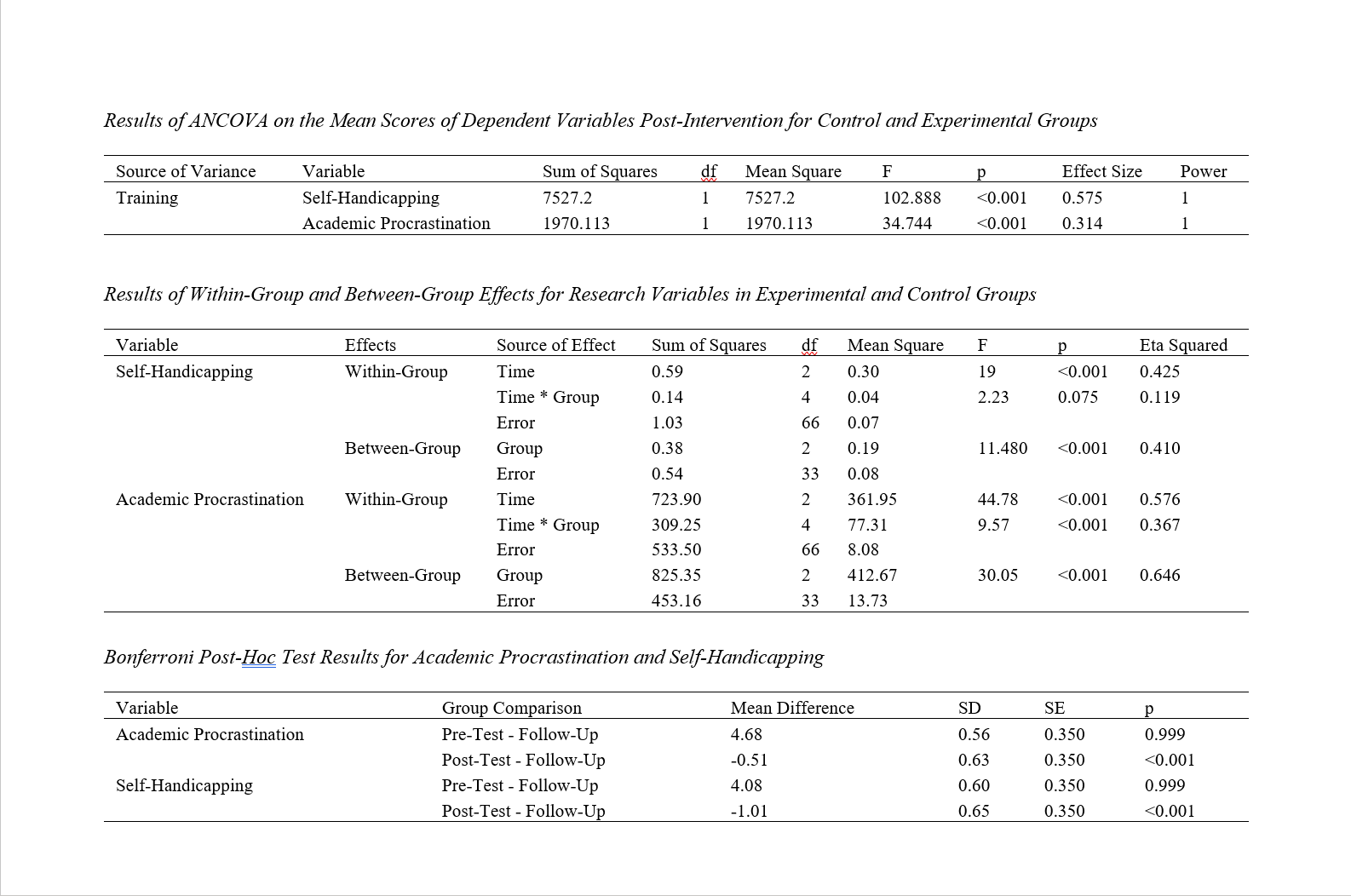
Findings: The results of multivariate covariance analysis indicated that self-determination skills training had a significant effect on reducing student self-handicapping (F=104.88) and academic procrastination (F=34.74) (p<0.001), and these results persisted in the follow-up phase.
Conclusion: Based on the findings, learning and applying self-determination skills by students can reduce self-handicapping and the occurrence of procrastination behaviors during their studies. Therefore, the results of this study have practical implications for psychologists and counselors at university counseling centers to utilize self-determination skills to reduce academic procrastination and self-handicapping among students.
Downloads
Downloads
Additional Files
Publication Timeline
- Submitted
- Revised
- Accepted
Issue
Section
License
Copyright (c) 2024 Farokhro Jalili, Mozhgan Arefi, Amir Ghamarani, Gholamreza Manshei (Author)

This work is licensed under a Creative Commons Attribution-NonCommercial 4.0 International License.