Designing an Academic Failure Model Based on Fear of Failure and Academic Burnout with the Mediating Role of Mindfulness
DOI:
https://doi.org/10.61838/kman.jayps.4345Keywords:
Academic failure, Fear of failure, Academic burnout, MindfulnessAbstract
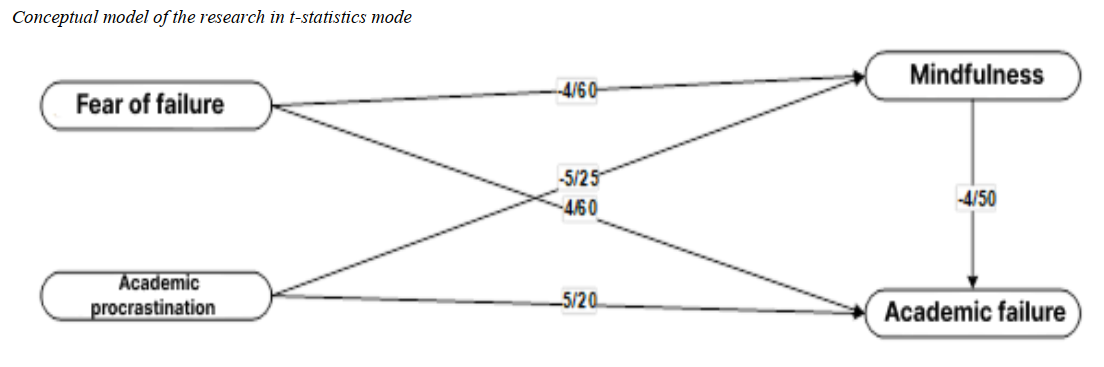
Objective: The present study aimed to develop an academic failure model based on fear of failure and academic burnout, with the mediating role of mindfulness, among second-grade high school students in Ardabil city.
Methods and Materials: This applied research employed a quantitative–analytical design using structural equation modeling. The statistical population comprised 2,890 male and female second-grade high school students who had experienced academic failure or were at risk of it, identified through official data from the Department of Education. A purposive sampling method was used, and 510 students meeting the inclusion criteria participated. Data were collected using the Performance Failure Appraisal Inventory (Conroy, 2001), the Academic Burnout Questionnaire (Breso et al., 1997), and the Mindfulness Questionnaire (Baer et al., 2006), all with acceptable reliability (Cronbach’s α = 0.70–0.72). Data analysis was conducted with SPSS and LISREL, assessing direct and indirect effects through path analysis and bootstrap mediation testing.
Findings: Fear of failure had a significant direct negative effect on mindfulness (β = -0.33, p < 0.001) and a significant direct positive effect on academic failure (β = 0.35, p < 0.001). Academic burnout had a significant direct negative effect on mindfulness (β = -0.40, p < 0.001) and a significant direct positive effect on academic failure (β = 0.40, p < 0.001). Mindfulness had a significant direct negative effect on academic failure (β = -0.32, p < 0.001). Indirect effect analysis indicated that both fear of failure (β = 0.1056, p < 0.001) and academic burnout (β = 0.1280, p < 0.001) influenced academic failure positively and significantly via mindfulness. The final model demonstrated good fit indices (e.g., RMSEA = 0.05, CFI = 0.97).
Conclusion: Fear of failure and academic burnout significantly increase the likelihood of academic failure both directly and indirectly through reduced mindfulness. Enhancing mindfulness in students may serve as a protective mechanism to mitigate the adverse effects of these psychological risk factors on academic performance.
Downloads
References
Adaricheva, K., Brockman, J. T., Elston, G. Z., Hobbie, L., Homan, S., Khalefa, M., Kim, J. V., Nelson, R. K., Samad, S., & Segal, O. (2025). A novel association and ranking approach identifies factors affecting educational outcomes of STEM majors. arXiv preprint. https://arxiv.org/abs/2503.12321
American Psychological, A. (2019). Education and socioeconomic status. https://www.apa.org/pi/ses/resources/publications/education
Camilli, G. (2025). The "Days of Learning" metric for education evaluations. arXiv preprint. https://arxiv.org/abs/2503.22739
Cashman, M. R., Strandh, M., & Högberg, B. (2023). Does fear-of-failure mediate the relationship between educational expectations and stress-related complaints among Swedish adolescents? A structural equation modelling approach. European journal of public health, 34(1), 101-106. https://doi.org/10.1093/eurpub/ckad200
Chirico, F., Magnavita, N., & Yıldırım, M. (2024). Group Psychological Counseling to Contrast Academic Burnout: A Randomized Controlled Trial. Frontiers in psychology, 14, 1400882.
Estrada Araoz, E. G., Paredes Valverde, Y., Quispe Herrera, R., & Paricahua-Peralta, J. N. (2023). Examining the relationship between academic burnout and the university student's engagement: A cross-sectional study on the return to face-to-face classes. Psychology and Education: A Multidisciplinary Journal, 14(6). https://doi.org/10.55908/sdgs.v11i2.424
Foster, C., & Wilkerson, K. (2023). The unrealized promise of high-quality instructional materials. https://www.nasbe.org/the-unrealized-promise-of-high-quality-instructional-materials
Gajderowicz, T., Jakubowski, M., Kennedy, A., Kjeldsen, C. C., Patrinos, H. A., & Strietholt, R. (2025). The learning crisis: Three years after COVID-19. arXiv preprint. https://doi.org/10.2139/ssrn.5059328
Geraghty, M. (2025). The fear of failure: How it shapes careers and how to harness it. https://www.linkedin.com/pulse/fear-failure-how-shapes-careers-harness-executive-recruit-otdne
Gilbert, P., McEwan, K., Catarino, F., & Baião, R. (2023). Fears and resistances to mindfulness: Development of a self-report scale. Mindfulness, 14(4), 1005-1022. https://doi.org/10.1007/s12671-023-02171-y
Hamaideh, S. H., Al-Modallal, H., & Tanash, M. (2020). The impact of academic burnout on academic performance among undergraduate nursing students. BMC Medical Education, 20(1), 452.
Hiratsuka, V. Y., & Heath, K. (2025). "They come here for sanctuary": Educator perspectives on trauma-engaged alternative education. Preventing School Failure: Alternative Education for Children and Youth, 69(2). https://doi.org/10.1080/1045988X.2024.2327292
Ikram, G., Brun, A., & Boyer, A. (2025). A frugal model for accurate early student failure prediction. arXiv preprint. https://doi.org/10.20533/LICE.2024.0015
Leung, C. H., & Lo, T. K. (2024). Teacher effectiveness and academic achievement: A longitudinal study. Frontiers in Education, 9, 1367317.
Lindblom, S., & Fälth, L. (2021). Students' academic stress in higher education: The role of academic demands and social support. Higher Education Research & Development, 40(5), 971-984.
Martin, A. J. (2025). Failure beliefs in school and beyond: From the perspective of social cognitive theory. Journal of Applied Research in Memory and Cognition, 4(1), 15-22.
Metz, S. M., & Dreer, L. E. (2024). Emotion Regulation and Academic Burnout Among Youth: A Meta-Analytic Review. Educational psychology review, 36, 99. https://doi.org/10.1007/s10648-024-09930-w
Morris, K., Hirsch, S. E., Strickland-Cohen, K., & Bruhn, A. (2025). Remote classroom management: A survey study of teachers' online practices. Preventing School Failure: Alternative Education for Children and Youth, 69(2). https://doi.org/10.1080/1045988X.2023.2280982
Nair, P. N., & Sutar, D. (2023). Fear of failure, academic self-efficacy and academic performance among college students. International Journal of Indian Psychology, 11(3), 375-384. https://www.researchgate.net/publication/372418283_Fear_of_Failure_Academic_Self-Efficacy_and_Academic_Performance_among_College_Students
Nakhla, G., & Allan, D. (2025). The role of fear of failure in shaping academic motivation and engagement in higher education. In Motivating Engagement, Belonging, and Success in Higher Education Student Experience. https://doi.org/10.4018/979-8-3693-8089-5.ch002
Pellerone, M., Ramaci, T., & Miccichè, S. (2020). The role of identity development and school climate on academic success and school engagement: A study of high school students. Psychology research and behavior management, 13, 1181-1190.
Sagar, S. S., & Jowett, S. (2023). Fear of failure and student-athlete well-being: The role of perceived coach behaviors. Psychology of Sport and Exercise, 60, 102133.
Satici, S. A., & Can, G. (2023). Academic procrastination and academic stress: The mediating role of self-efficacy. Frontiers in psychology, 14, 1073529.
Serafica, J., & Muria, N. (2023). The relationship between academic burnout and resilience to academic achievement among college students: A mixed methods study. Psychology and Education: A Multidisciplinary Journal, 14(6). https://papers.ssrn.com/sol3/papers.cfm?abstract_id=4615775
Snyder, E., & Witmer, S. E. (2025). Including English learners in multi-tiered systems of support (MTSS) in reading: A CHAT-informed mixed methods investigation. Preventing School Failure: Alternative Education for Children and Youth, 69(2). https://doi.org/10.1080/1045988X.2024.2302145
Szczygieł, M., & Jelińska, M. (2023). The impact of parental involvement on students' social-emotional learning and school engagement. European Journal of Psychology of Education, 39(1), 45-67.
Tanveer, Z., & Kamran, F. (2023). Academic burnout, mindfulness and psychological well-being in young adults. Annals of Human and Social Sciences, 4(1), 286-295. https://doi.org/10.35484/ahss.2023(4-I)26
Timmons, K., Cooper, A., Bozek, E., & Braund, H. (2022). The impacts of COVID-19 on early childhood education: Capturing the unique challenges associated with remote learning and home learning environments. Policy Futures in Education, 20(6), 778-800. https://link.springer.com/article/10.1007/s10643-021-01207-z
Wang, C., & Hall, N. C. (2020). A systematic review of the literature on achievement motivation in education. Sustainability, 12(23), 9798.
Wang, Z., Wu, P., Hou, Y., Guo, J., & Lin, C. (2024). The effects of mindfulness-based interventions on alleviating academic burnout in medical students: A systematic review and meta-analysis. BMC public health, 24, 1414. https://doi.org/10.1186/s12889-024-18938-4
Ward, B., Bhati, D., Neha, F., & Guercio, A. (2024). Analyzing the impact of AI tools on student study habits and academic performance. arXiv preprint. https://doi.org/10.1109/CCWC62904.2025.10903692
Wulandari, F., & Rinaldi. (2024). The relationship between mindfulness and fear of failure in students who are working on a thesis at Padang State University. https://doi.org/10.62260/intrend.v1i2.108 10.62260/intrend.v2i1.108
Downloads
Additional Files
Publication Timeline
- Submitted
- Revised
- Accepted
Issue
Section
License
Copyright (c) 2025 Nima Sabalani Taleshmekaeil (Author); Alinaghi Aghdasi (Corresponding Author); Rahim Badri Gargari, Seyyed Davoud Hoseini Nasab (Author)

This work is licensed under a Creative Commons Attribution-NonCommercial 4.0 International License.