Effectiveness of a Competence- and Worthiness-Based Educational Program for Self-Esteem, Assertiveness, and Psychological Well-Being in Male Adolescents with Low Self-Esteem
Keywords:
adolescence, assertiveness, competence, psychological well-being, self-esteem, worthinessAbstract
Objective: This study aimed to determine the effectiveness of a competence- and worthiness-based educational program in improving self-esteem, assertiveness, and psychological well-being among male adolescents with low self-esteem.
Methods and Materials: This quasi-experimental study employed a pretest-posttest-follow-up design with a control group. The statistical population consisted of male upper-secondary school students in Qazvin, Iran. Thirty adolescents who obtained scores below 25 on the Coopersmith Self-Esteem Inventory and met the eligibility criteria were selected and randomly assigned to an intervention group (n = 15) and a control group (n = 15). The intervention group participated in six weekly 90-minute sessions based on the competence and worthiness framework, whereas the control group received no intervention during the study period. Data were collected using the Coopersmith Self-Esteem Inventory, the Adolescent Assertiveness Scale, and the 18-item Ryff Psychological Well-Being Scales at pretest, posttest, and four-week follow-up. Data were analyzed using mixed repeated-measures analysis of variance and Bonferroni post-hoc comparisons.
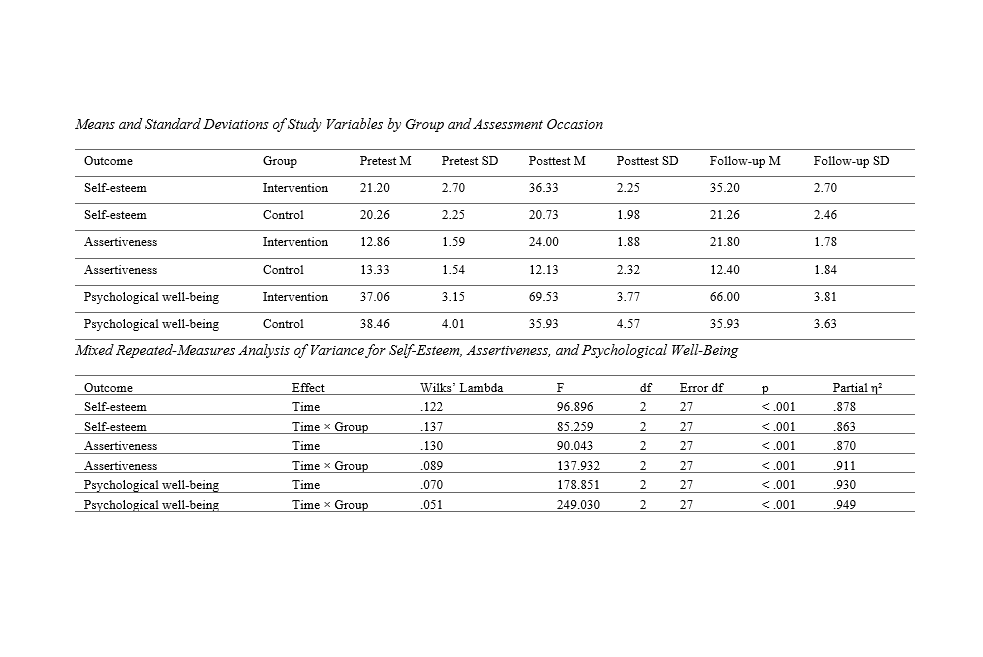
Findings: Significant time-by-group interaction effects were observed for self-esteem, Wilks’ Lambda = .137, F(2, 27) = 85.26, p < .001, partial η² = .863; assertiveness, Wilks’ Lambda = .089, F(2, 27) = 137.93, p < .001, partial η² = .911; and psychological well-being, Wilks’ Lambda = .051, F(2, 27) = 249.03, p < .001, partial η² = .949. Bonferroni comparisons indicated significant improvements from pretest to posttest and from pretest to follow-up for all three outcomes, whereas differences between posttest and follow-up were not statistically significant, indicating maintenance of treatment effects.
Conclusion: The competence- and worthiness-based educational program was effective in enhancing self-esteem, assertiveness, and psychological well-being in male adolescents with low self-esteem, and the observed improvements remained stable at follow-up. The program may therefore provide a useful framework for school-based psychological and educational interventions targeting adolescents with diminished self-worth.
Downloads
References
Abu Omar, D., Kirkman, A., Scott, C., Babicova, I., & Irons, Y. (2024). Positive psychology interventions to increase self-esteem, self-efficacy, and confidence and decrease anxiety among students with dyslexia: A narrative review. Youth, 4(2), 835-853. https://doi.org/10.3390/youth4020055
Alberti, R. E., & Emmons, M. L. (2017). Your Perfect Right: Assertiveness and Equality in Your Life and Relationships (10th ed.). Impact Publishers. https://books.google.com/books?id=iPAhDgAAQBAJ
Avedissian, T., & Alayan, N. (2021). Adolescent well-being: A concept analysis. International journal of mental health nursing, 30(2), 357-367. https://doi.org/10.1111/inm.12833
Bahri, N. (2010). The effect of group counseling-based assertiveness training on female students' self-esteem. Peyk Noor Journal, 8(1), 124-137.
Baumeister, R. F., Campbell, J. D., Krueger, J. I., & Vohs, K. D. (2003). Does high self-esteem cause better performance, interpersonal success, happiness, or healthier lifestyles? Psychological Science in the Public Interest, 4(1), 1-44. https://doi.org/10.1111/1529-1006.01431
Branje, S., de Moor, E. L., Spitzer, J., & Becht, A. I. (2021). Dynamics of identity development in adolescence: A decade in review. Journal of Research on Adolescence, 31(4), 908-927. https://doi.org/10.1111/jora.12678
Cecen, A. R., & Zengel, M. (2009). The effectiveness of an assertiveness training programme on adolescents' assertiveness level. Elementary Education Online, 8(2), 485-492.
Cui, Z., Lin, Z., Ren, J., Cao, Y., & Tian, X. (2024). Exploring self-esteem and personality traits as predictors of mental wellbeing among Chinese university students: The mediating and moderating role of resilience. Frontiers in psychology, 15, 1308863. https://doi.org/10.3389/fpsyg.2024.1308863
Jangi Zahi, S., Raeisi, M., Jangi Zahi, F., & Heybat Zahi, E. (2023). Effectiveness of self-expression and assertiveness skills for self-esteem, occupational success, and social desirability among education employees Proceedings of the Second National Conference on Social and Psychological Harms with Emphasis on Behavioral Sciences, https://civilica.com/doc/1988558
Lin, Y. R., Shiah, I. S., Chang, Y. C., Lai, T. J., Wang, K. Y., & Chou, K. R. (2004). Evaluation of an assertiveness training program on nursing and medical students' assertiveness, self-esteem, and interpersonal communication satisfaction. Nurse Education Today, 24(8), 656-665. https://doi.org/10.1016/j.nedt.2004.09.004
Liu, X., Cao, X., & Gao, W. (2022). Does low self-esteem predict anxiety among Chinese college students? Psychology research and behavior management, 15, 1481-1487. https://doi.org/10.2147/PRBM.S361807
Mruk, C. J. (2006). Self-Esteem: Research, Theory, and Practice (3rd ed.). Springer.
Mruk, C. J. (2013). Self-Esteem and Positive Psychology: Research, Theory, and Practice (4th ed.). Springer Publishing Company.
Muarifah, A., Mashar, R., Hashim, I. H. M., Rofiah, N. H., & Oktaviani, F. (2022). Aggression in adolescents: The role of mother-child attachment and self-esteem. Behavioral Sciences, 12(5), 147. https://doi.org/10.3390/bs12050147
Muris, P., & Otgaar, H. (2023). Self-esteem and self-compassion: A narrative review and meta-analysis on their links to psychological problems and well-being. Psychology research and behavior management, 16, 2961-2975. https://doi.org/10.2147/PRBM.S402455
Rat, L. A., Ghitea, T. C., & Maghiar, A. M. (2025). Effectiveness of a self-esteem enhancement intervention integrated into standard CBT protocol for improving quality of life in patients with colorectal cancer. European Journal of Investigation in Health Psychology and Education, 15(4), 42. https://doi.org/10.3390/ejihpe15040042
Santrock, J. W. (2019). Adolescence (17th ed.). McGraw-Hill Education.
Seyed Alitabar, S. H. (2026). Adolescent mental health in contemporary Iran: A body-mind-culture perspective. International Journal of Body Mind and Culture, 13(1), 1-3. https://doi.org/10.61838/ijbmc.v13i1.6512
Speed, B. C., Goldstein, B. L., & Goldfried, M. R. (2018). Assertiveness training: A forgotten evidence-based treatment. Clinical Psychology: Science and Practice, 25(1), e12216. https://doi.org/10.1111/cpsp.12216
Steinberg, L. (2017). Adolescence (11th ed.). McGraw-Hill Education.
Yang, J., & Seyed Alitabar, S. H. (2022). The effects of school size on student participation and sense of community. Iranian Journal of Educational Sociology, 7(1), 205-211. https://doi.org/10.61838/kman.ijes.7.1.20
Yosep, I., Suryani, S., Mediani, H. S., Mardhiyah, A., Maulana, I., Hernawaty, T., & Hazmi, H. (2024). A scoping review of assertiveness therapy for reducing bullying behavior and its impacts among adolescents. Journal of Multidisciplinary Healthcare, 17, 1777-1790. https://doi.org/10.2147/JMDH.S460343
Yoshinaga, N., & Cooper, S. (2025). The four pathways of assertiveness: A multidimensional framework for enhancing individual well-being. Frontiers in psychology, 16, 1610807. https://doi.org/10.3389/fpsyg.2025.1610807
Downloads
Additional Files
Publication Timeline
- Submitted
- Revised
- Accepted