Serial Mediation of Rumination and Emotion Dysregulation in the Relationship Between Peer Victimization and Adolescent Depression
Keywords:
Peer Victimization, Rumination, Emotion Dysregulation, Depression, Adolescents, Serial MediationAbstract
Objective: This study aimed to examine the serial mediating roles of rumination and emotion dysregulation in the relationship between peer victimization and depressive symptoms among adolescents in Mexico.
Methods and Materials: This cross-sectional correlational study was conducted among 657 adolescents aged 13–18 years enrolled in public and private secondary and upper-secondary schools in Mexico City during the 2025–2026 academic year. Participants were selected through multistage cluster sampling. Peer victimization was assessed using the Multidimensional Peer Victimization Scale, rumination using the rumination subscale of the Children’s Response Styles Questionnaire, emotion dysregulation using the Difficulties in Emotion Regulation Scale, and depressive symptoms using the Patient Health Questionnaire-9. Data were analyzed using IBM SPSS Statistics version 29 and PROCESS macro Model 6. Pearson correlations, multiple regression analyses, and serial mediation analysis with 5,000 bootstrap resamples were performed. Age and sex were entered as covariates, and indirect effects were considered significant when 95% bootstrap confidence intervals excluded zero.
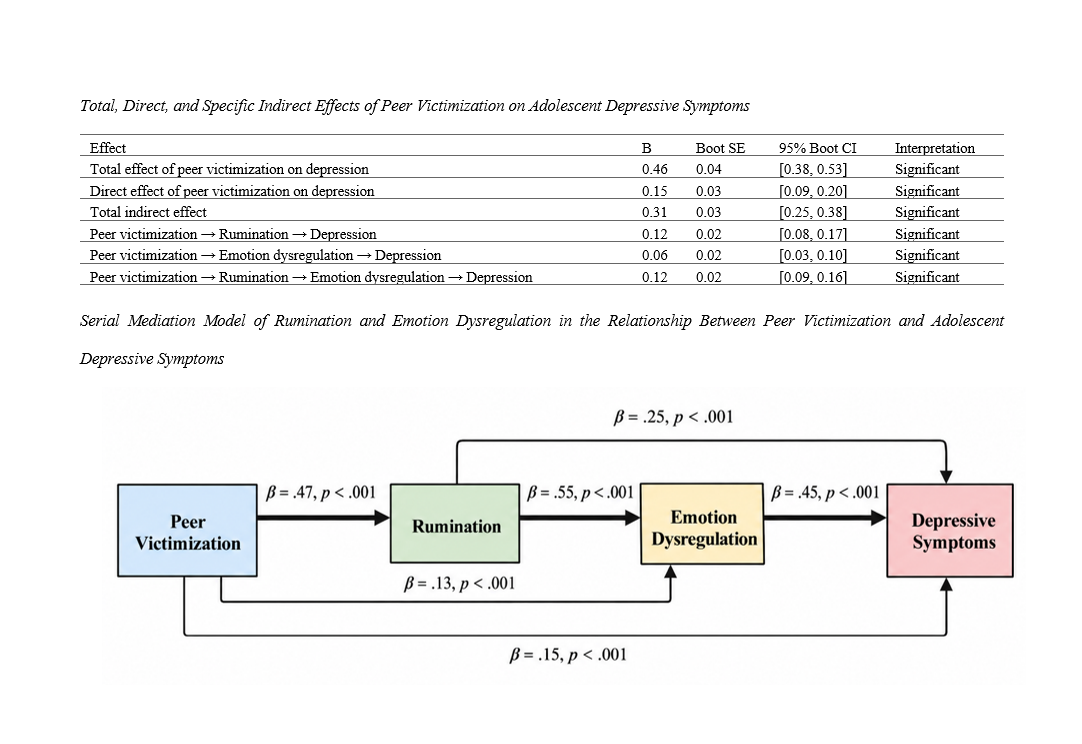
Findings: Peer victimization significantly predicted rumination (β = .47, p < .001), emotion dysregulation (β = .13, p < .001), and depressive symptoms (β = .15, p < .001). Rumination significantly predicted emotion dysregulation (β = .55, p < .001) and depressive symptoms (β = .25, p < .001), while emotion dysregulation significantly predicted depressive symptoms (β = .45, p < .001). The final model explained 51% of the variance in depressive symptoms, F(5, 651) = 133.74, p < .001. The total indirect effect of peer victimization on depression was significant (B = 0.31, 95% Boot CI [0.25, 0.38]). The serial indirect pathway through rumination and emotion dysregulation was also significant (B = 0.12, 95% Boot CI [0.09, 0.16]).
Conclusion: Peer victimization was associated with adolescent depressive symptoms both directly and indirectly through a sequential cognitive-emotional pathway involving increased rumination followed by greater emotion dysregulation.
Downloads
References
Conley, C. S., Hilt, L. M., & Gonzales, C. H. (2023). Internalizing in Adolescents and Young Adults. 505-523. https://doi.org/10.1037/0000298-031
Dell’Osso, L., Nardi, B., Pini, S., Castellani, L., Parri, F., Bonelli, C., Concerto, C., Vincenzo, M. D., Rocca, B. D., Signorelli, M. S., Fusar‐Poli, L., Figini, C., Politi, P., Aguglia, E., & Luciano, M. (2025). Relationships Among Bullying Experiences, Mood Symptoms and Suicidality in Subjects With and Without Autism Spectrum Conditions. Brain Sciences, 15(10), 1114. https://doi.org/10.3390/brainsci15101114
Dianovinina, K., & Surjaningrum, E. R. (2023). Psychosocial Factors Related to Adolescent Depressive Symptom: Systematic Literature Review. International Journal of Public Health Science (Ijphs), 12(1), 417. https://doi.org/10.11591/ijphs.v12i1.22413
Geng, S., Wang, J., Xia, Y., Niu, B., Deng, X., & Wu, X. (2025). Predicting Generalized Anxiety Disorder Among Chinese Depressed Adolescents: An Explainable Machine Learning Approach. BMC Medical Informatics and Decision Making, 25(1). https://doi.org/10.1186/s12911-025-03225-y
Gibb, B. E., Israel, E., & Shankar, P. (2026). Depression in Childhood. 167-182. https://doi.org/10.1037/0000438-010
Giletta, M. (2026). Peer Relationships and Depression. 601-619. https://doi.org/10.1037/0000437-033
Griffith, J. M., & Hankin, B. L. (2025). Early Adolescent Social Anxiety and (Mal)Adaptive Responses to Interpersonal Stress: Exploring Associations in Daily Life. The Journal of Early Adolescence, 46(7), 971-1001. https://doi.org/10.1177/02724316251370618
Hui, y., Huang, J., Xie, Z., & Wang, Y.-X. (2026). The Longitudinal Association Between Peer Victimization and Adolescent Depression: A Moderated Mediation Model. https://doi.org/10.21203/rs.3.rs-8615948/v1
King, E. K., Halbreich, E. D., Callina, K. S., & Mueller, M. K. (2023). Companion Animals and the Relationship Between Peer Victimization and Emotion Regulation in Youth. Journal of Research on Adolescence, 34(1), 85-95. https://doi.org/10.1111/jora.12901
Labella, M. H., Klein, N. D., Yeboah, G., Bailey, C., Doane, A. N., Kaminer, D., & Bravo, A. J. (2023). Childhood Bullying Victimization, Emotion Regulation, Rumination, Distress Tolerance, and Depressive Symptoms: A Cross‐national Examination Among Young Adults in Seven Countries. Aggressive Behavior, 50(1). https://doi.org/10.1002/ab.22111
LeMoult, J., Battaglini, A. M., Grocott, B., Jopling, E., Rnic, K., & Yang, L. (2022). Advances in Stress and Depression Research. Current Opinion in Psychiatry, 36(1), 8-13. https://doi.org/10.1097/yco.0000000000000831
Lim, Y. (2026). From Peer Victimization to Depressive Symptoms Through Acculturative Stress in South Korean Multicultural Adolescents: The Complex Moderating Roles of Family Support. Children, 13(8), 1052. https://doi.org/10.3390/children13081052
Lin, J., & Guo, W. (2024). The Research on Risk Factors for Adolescents’ Mental Health. Behavioral Sciences, 14(4), 263. https://doi.org/10.3390/bs14040263
Lv, G., Ma, B., Qi, S., & An, H. (2025). Sex Differences in the Prevalence and Risk Factors of Non-Suicidal Self-Injury Behaviors Among Adolescent Outpatients With Major Depressive Disorder. Frontiers in Psychiatry, 16. https://doi.org/10.3389/fpsyt.2025.1599627
Malamut, S. T., & Salmivalli, C. (2021). Rumination as a Mediator of the Prospective Association Between Victimization and Bullying. Research on Child and Adolescent Psychopathology, 49(3), 339-350. https://doi.org/10.1007/s10802-020-00755-z
Malamut, S. T., & Salmivalli, C. (2023). Adolescent Victimization Predicts Adult Depression and Aggression: The Role of Rumination. Developmental Psychology, 59(8), 1464-1469. https://doi.org/10.1037/dev0001544
Peets, K., Turunen, T., & Salmivalli, C. (2021). Rumination Mediates the Longitudinal Associations Between Elementary-School Victimization and Adolescents’ Internalizing Problems. Journal of interpersonal violence, 37(17-18), NP16885-NP16906. https://doi.org/10.1177/08862605211025020
Qin, X., Laninga‐Wijnen, L., Steglich, C., Zhang, Y., Ren, P., & Veenstra, R. (2023). Does Having Vulnerable Friends Help Vulnerable Youth? The Co-Evolution of Friendships, Victimization, and Depressive Symptoms in Chinese Adolescents' Social Networks. Child development, 94(6), 1531-1549. https://doi.org/10.1111/cdev.13945
Schunk, F., Zeh, F., & Trommsdorff, G. (2022). Cybervictimization and Well-Being Among Adolescents During the COVID-19 Pandemic: The Mediating Roles of Emotional Self-Efficacy and Emotion Regulation. Computers in human Behavior, 126, 107035. https://doi.org/10.1016/j.chb.2021.107035
Spyropoulou, E., & Giovazolias, T. (2022). Exploring the Longitudinal Relationship Between Anger Rumination and Peer Victimization When Controlling for Sadness Rumination. Current Psychology, 42(32), 28263-28275. https://doi.org/10.1007/s12144-022-03906-1
Steffie van der Mey‐, B., Vuijk, P., Bul, K., Lier, P. A. C. v., Sijbrandij, M., Maras, A., & Buil, J. M. (2025). Co‐Rumination as a Moderator Between Best‐Friend Support and Adolescent Psychological Distress. Journal of adolescence, 97(5), 1161-1172. https://doi.org/10.1002/jad.12483
Tilton‐Weaver, L., Latina, D., & Marshall, S. K. (2022). Trajectories of Nonsuicidal Self‐injury During Adolescence. Journal of adolescence, 95(3), 437-453. https://doi.org/10.1002/jad.12126
Tilton‐Weaver, L., & Rose, A. J. (2023). The Trade‐offs of Co‐ruminating With Friends: A Profile Analysis. Journal of Research on Adolescence, 33(3), 957-972. https://doi.org/10.1111/jora.12850
Vacca, M., Cerolini, S., Zegretti, A., Zagaria, A., & Lombardo, C. (2023). Bullying Victimization and Adolescent Depression, Anxiety and Stress: The Mediation of Cognitive Emotion Regulation. Children, 10(12), 1897. https://doi.org/10.3390/children10121897
Valdes, V., Marshall, H. E., & Nelson, C. A. (2025). Biopsychosocial Pathways From Early Adversity to Depression: Potential Mechanisms and Implications for Intervention. International Journal of Behavioral Development, 50(4), 459-470. https://doi.org/10.1177/01650254251377759
Vaughn, R., & Weisz, J. R. (2021). Leveraging the Developmental Science of Psychosocial Risk to Strengthen Youth Psychotherapy. Development and Psychopathology, 33(2), 670-683. https://doi.org/10.1017/s0954579420002035
Voulgaridou, I. (2025). Trapped in Thought: How Sadness Rumination Links Depression to Relational Victimization in Adolescents. School Psychology International, 46(6), 565-581. https://doi.org/10.1177/01430343251386905
Wang, C., Xu, P., Liang, J., Zhang, F., & Li, B. (2025). More Friends or Good Friends? The Moderation Effect of Friendship on the Relations Between Victimization, Emotional Resilience, and Depression in Early Adolescence. Journal of Social and Personal Relationships, 42(9), 2312-2334. https://doi.org/10.1177/02654075251340267
Wang, J., Li, M., Sun, W., Peng, M., & Gong, H. (2023). The Relationship Between Harsh Parenting and Depression in Adolescents: The Chain Mediation Effect of Rumination and Bullying. https://doi.org/10.21203/rs.3.rs-2767320/v1
Wang, Z., Chen, X., Liu, J., Bullock, A., Li, D., Chen, X., & French, D. C. (2020). Moderating Role of Conflict Resolution Strategies in the Links Between Peer Victimization and Psychological Adjustment Among Youth. Journal of adolescence, 79(1), 184-192. https://doi.org/10.1016/j.adolescence.2020.01.002
Zamfir, M. B. (2020). The Suppression Mediate the Relations Between Cyberbullying and Depression, Anxiety and Self-Esteem. 12, 50-58. https://doi.org/10.18662/lumproc/sec-iasr2019/06
Zhang, X., Hong, H., Hou, W., & Liu, X. (2022). A Prospective Study of Peer Victimization and Depressive Symptoms Among Left-Behind Children in Rural China: The Mediating Effect of Stressful Life Events. Child and adolescent psychiatry and mental health, 16(1). https://doi.org/10.1186/s13034-022-00485-8
Zhou, Y., Zhang, X., Wang, T., Gong, L.-L., Li, K., & Wang, Y. (2024). Identifying the Risk of Depression in a Large Sample of Adolescents: An Artificial Neural Network Based on Random Forest. Journal of adolescence, 96(7), 1485-1497. https://doi.org/10.1002/jad.12357
Zimmer‐Gembeck, M. J., Hawes, T., Scott, R. A., Skinner, E. A., & Kindermann, T. A. (2026). Seeking Support or Concealing? A Longitudinal Study of Adolescents’ Friendships, Peer Victimization, Depression, and Coping With Peer Relationship Stressors. Developmental Psychology, 62(2), 350-364. https://doi.org/10.1037/dev0002096
Downloads
Additional Files
Publication Timeline
- Submitted
- Revised
- Accepted